BBQ Calculator
Tell the goose who is coming and what you are cooking, and get the raw weight to buy for each meat, with cooking loss already taken off.
Last updated
Where are you?
AWG, NEC, 120/240 V, miles and gallons mm², IEC/BS 7671, 230/400 V, km and litres . We remember this on every calculator.
Your result
Total raw meat for 14 adult portions
7.88 lb
- Pulled pork (pork butt), 0.75 lb raw per adult
- 7.88 lb
🪿 The goose says: Buy 7.88 lb of raw meat in total for 12 adults and 4 kids, 7.88 lb of pulled pork (pork butt), 0.75 lb raw per adult.
- These are raw weights to buy. Brisket and pork butt lose about a third of their weight to rendered fat and moisture, which is already accounted for, a pound of raw brisket feeds one adult, not two.
- Start large cuts far earlier than you think. Brisket and pork butt both stall for hours around 160 °F, and a cook that "should" take twelve hours can take sixteen. Finish early and hold in a cooler. They keep at temperature for four hours or more.
- Leftovers are a feature, not a mistake. Pulled pork freezes exceptionally well, and most people would rather have too much than run out an hour into the afternoon.
Shopping list and cook times
Raw weights to buy, with the rough cook time for each.
- Pulled pork (pork butt), 0.75 lb raw per adult
- 7.88 lb 10–14 h at 250 °F, to ~203 °F internal
- Total raw weight
- 7.88 lb
Cook times assume a steady pit temperature and are guides only. Every large cut is done by internal temperature and feel, never by the clock.
How this BBQ calculator works
Catering barbecue works backwards from what ends up on the plate. Roughly half a pound of cooked meat per adult is the planning figure caterers use, and everything else is working out how much raw meat produces that.
The loss is bigger than people expect. Brisket renders out about a third of its weight in fat and moisture, and pork butt is similar, so a pound of raw brisket yields around ten ounces cooked, one adult portion. Ribs lose less by weight but carry a lot of bone. Burgers barely lose anything.
Two adjustments then move the number. Children eat about half an adult portion, which is the standard catering assumption. And a proper spread of sides cuts meat consumption by roughly a quarter, because people fill their plates with slaw and beans rather than a third helping of pork.
-
Step 1 Adult equivalents
adults + children × 0.5 -
Step 2 Raw weight per adult, per meat
brisket 1 lb, pulled pork 0.75, ribs 1.25, chicken 0.75, burgers 0.5, hot dogs 0.375In metric that is 450 g of brisket per adult, 340 g of pork butt or chicken, 570 g of ribs, 230 g of burgers and 170 g of hot dogs, against a target of about 230 g of cooked meat on the plate. -
Step 3 Adjust for appetite and sides
factor = appetite × (sides ? 0.75 , 1)Appetite, light 0.8, normal 1.0, hearty 1.25. -
Step 4 Split across the meats you chose
per_meat = adult_equivalents × raw_per_adult × factor ÷ number_of_meatsTotal protein per head stays constant however many meats you serve.
For example, 12 adults and 4 children is 14 adult portions. Serving pulled pork alone with a full spread of sides, that is 14 × 0.75 × 0.75 = 7.9 lb of raw pork butt, which yields about 5 lb pulled.
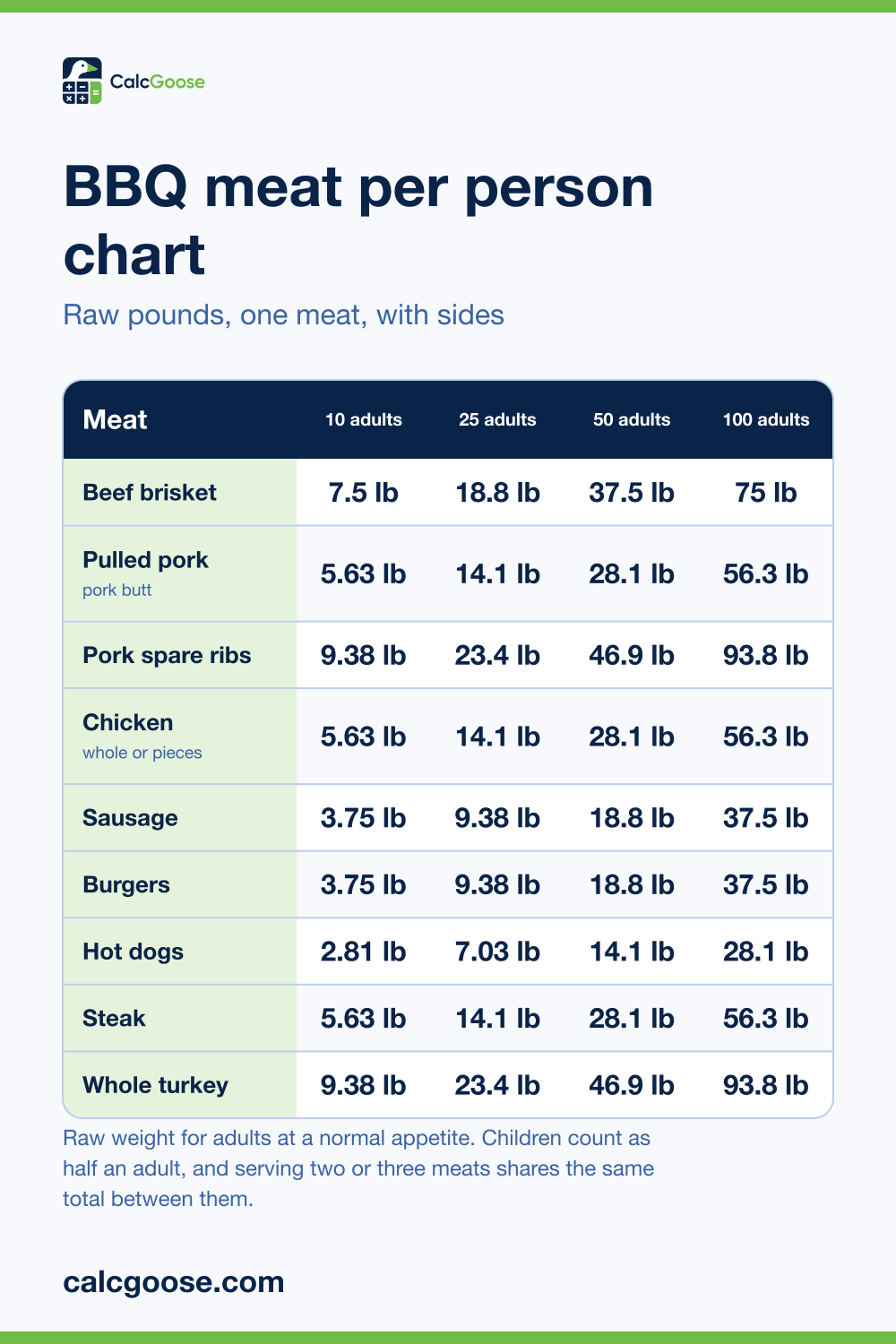
BBQ meat per person chart
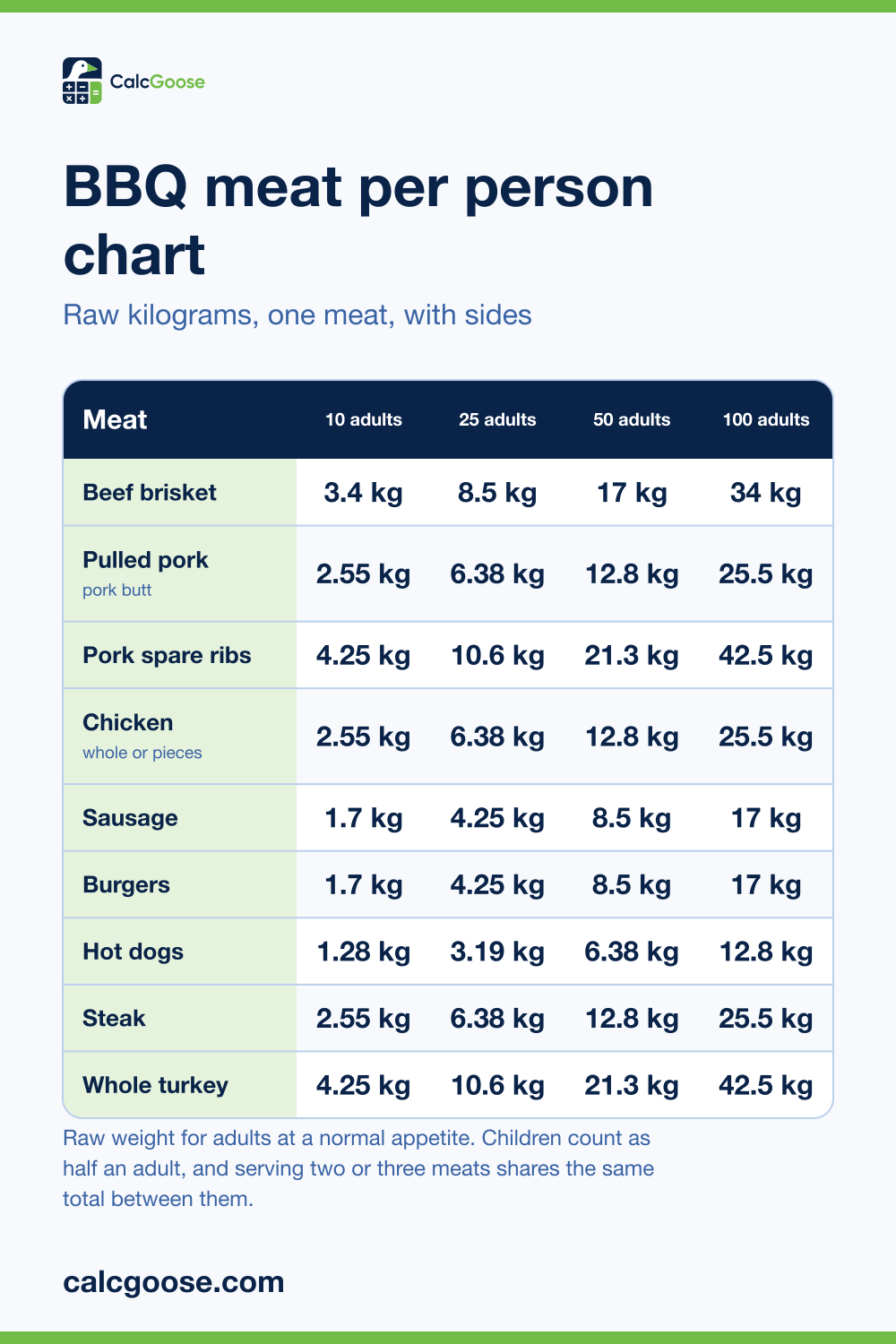
Raw meat to buy for each cut by guest count, served as the only meat with a full spread of sides. Every figure comes from the same formula as the calculator above, which already allows for cooking loss and bone.
| Meat | 10 adults | 25 adults | 50 adults | 100 adults |
|---|---|---|---|---|
| Beef brisket | 7.5 lb | 18.8 lb | 37.5 lb | 75 lb |
| Pulled porkpork butt | 5.63 lb | 14.1 lb | 28.1 lb | 56.3 lb |
| Pork spare ribs | 9.38 lb | 23.4 lb | 46.9 lb | 93.8 lb |
| Chickenwhole or pieces | 5.63 lb | 14.1 lb | 28.1 lb | 56.3 lb |
| Sausage | 3.75 lb | 9.38 lb | 18.8 lb | 37.5 lb |
| Burgers | 3.75 lb | 9.38 lb | 18.8 lb | 37.5 lb |
| Hot dogs | 2.81 lb | 7.03 lb | 14.1 lb | 28.1 lb |
| Steak | 5.63 lb | 14.1 lb | 28.1 lb | 56.3 lb |
| Whole turkey | 9.38 lb | 23.4 lb | 46.9 lb | 93.8 lb |
Raw weight for adults at a normal appetite. Children count as half an adult, and serving two or three meats shares the same total between them.
Raw meat to buy for each cut by guest count, served as the only meat with a full spread of sides. Every figure comes from the same formula as the calculator above, which already allows for cooking loss and bone.
| Meat | 10 adults | 25 adults | 50 adults | 100 adults |
|---|---|---|---|---|
| Beef brisket | 3.4 kg | 8.5 kg | 17 kg | 34 kg |
| Pulled porkpork butt | 2.55 kg | 6.38 kg | 12.8 kg | 25.5 kg |
| Pork spare ribs | 4.25 kg | 10.6 kg | 21.3 kg | 42.5 kg |
| Chickenwhole or pieces | 2.55 kg | 6.38 kg | 12.8 kg | 25.5 kg |
| Sausage | 1.7 kg | 4.25 kg | 8.5 kg | 17 kg |
| Burgers | 1.7 kg | 4.25 kg | 8.5 kg | 17 kg |
| Hot dogs | 1.28 kg | 3.19 kg | 6.38 kg | 12.8 kg |
| Steak | 2.55 kg | 6.38 kg | 12.8 kg | 25.5 kg |
| Whole turkey | 4.25 kg | 10.6 kg | 21.3 kg | 42.5 kg |
Raw weight for adults at a normal appetite. Children count as half an adult, and serving two or three meats shares the same total between them.
Assumptions and limits
Everything this calculator quietly assumes on your behalf. If one of these does not match your situation, the answer will be off.
- Raw weights per adult already account for cooking loss and bone. Brisket and pork butt lose roughly a third of their raw weight; ribs lose less by weight but a large share of what remains is bone.
- Children are counted as half an adult portion, which is the standard catering convention. Teenagers eat like adults and then some. Count them as full adults, or more.
- A full spread of sides reduces meat consumption by about 25%. That assumes real sides in quantity (slaw, beans, cornbread, potato salad), not a bowl of chips.
- Serving several meats does not increase the total protein per head; it splits the same amount between them. People take a bit of each rather than a full portion of every one.
- Cook times are rough guides at a steady pit temperature. Large cuts are finished by internal temperature and probe feel, never by the clock, and both brisket and pork butt stall unpredictably for several hours around 160 °F.
- No allowance is made for a drinking crowd, which typically eats less, or for a long event, which increases consumption. Adjust with the appetite setting.
- Buffet service uses more than plated service, because people take generous first helpings. If you are plating, you can trim about 10%.
- Leftovers are not modelled as waste. Pulled pork and brisket both keep and freeze well, which is why erring high is usually the right call.
Frequently asked questions
How much brisket do I need for 20 people?
About 20 pounds of raw brisket, or 15 if you are serving a full spread of sides. Brisket loses roughly a third of its weight during a long cook, so a pound raw yields around ten ounces on the plate, one adult portion. Buy a whole packer rather than several flats; it cooks more evenly and stays moister.
How much pulled pork per person?
Three-quarters of a pound of raw pork butt per adult, which yields about half a pound pulled. For twenty adults that is 15 pounds raw, usually two 8-pound butts. With plenty of sides you can drop to around 11 pounds, and pulled pork freezes so well that over-buying costs you very little.
How do I work out quantities for several meats?
Keep the total protein per head the same and split it between them. Three meats for twenty people is not three times the meat. It is the same overall quantity divided three ways, because people take a portion of each rather than a full serving of every one. Serving variety costs effort, not weight.
How much meat per person for a barbecue?
About half a pound of cooked meat per adult, which means anywhere from half a pound to a pound and a quarter raw depending on the cut. Children count as half. Sides bring it down by roughly a quarter, and a crowd that has been drinking all afternoon eats noticeably less than one that arrives hungry.
How long does a brisket take to cook?
Twelve to sixteen hours at 250 °F for a full packer, but the honest answer is that it is done when it is done. Every brisket stalls for two to four hours around 160 °F as moisture evaporates, and the length of that stall is unpredictable. Start early, and hold it wrapped in a cooler if it finishes ahead of time.
How much turkey per person?
A pound and a quarter of raw whole turkey per adult, so a 12 pound bird feeds about ten. That allowance covers the carcass, which is roughly half the weight of a whole bird, and still leaves enough for sandwiches the next day. Smoking one runs 30 to 40 minutes a pound at 275 °F, finishing at 165 °F in the breast.
How many ribs per person?
Half a rack of spare ribs per adult, or about a third of a rack of the meatier baby backs. That is roughly 1.25 pounds raw, most of which is bone. Rib eaters tend to be enthusiastic, so if ribs are the only meat, plan closer to two-thirds of a rack each.
Should I cook more than I need?
For anything that keeps, yes. Pulled pork and brisket both reheat and freeze well, and running out an hour into an afternoon is a far worse outcome than having a tray left over. Burgers and chicken are the exception. Cook to the number, since reheated versions of both are disappointing.
Related calculators
- Pool Chemical Calculator Everyday Life How much chlorine and acid your pool needs, worked out from its actual volume.
- Sourdough Calculator Everyday Life Scale any sourdough recipe by baker's percentages, with true hydration worked out properly.
- Coffee Ratio Calculator Everyday Life How many grams of coffee for any brew method, cup count and strength.
- Party Drink Calculator Everyday Life Beer, wine, spirits, mixers and ice for any guest count and party length.
- Tip & Bill Split Calculator Everyday Life Split a bill evenly or by what each person ordered, with tax and tip shared fairly.
- Freelance Rate Calculator Everyday Life Work backwards from the money you want to keep to the hourly rate you have to charge.
- Pizza Dough Calculator Everyday Life Dough ball weight from the pizza size, then flour, water, salt and yeast by baker's percentage.
Share this calculator
Found the number you needed? Send it to whoever asked you for it.