Chicken Coop Calculator
Tell the goose how many hens you have, or how many eggs you want, and get coop size, run size, nest boxes, roost space, feed and monthly cost.
Last updated
Where are you?
AWG, NEC, 120/240 V, miles and gallons mm², IEC/BS 7671, 230/400 V, km and litres . We remember this on every calculator.
Your result
From 6 hens
24 eggs/week
- Coop floor space
- 18 sq ft
- Run space
- 60 sq ft
- Nest boxes
- 2
- Roost bar
- 4.50 ft
- Feed per month
- 45.7 lb
- Feed cost per month
- $22.83
🪿 The goose says: 6 hens need 18 sq ft of coop and 60 sq ft of run, 2 nest boxes, and about 45.7 lb of feed a month, giving you roughly 24 eggs a week in season.
- 18 sq ft of coop floor is a minimum, not a target. Crowded birds pick feathers, bully each other and spread disease faster than any other single management failure, go bigger if you can.
- Laying drops off sharply in winter and stops entirely during the annual moult, which lasts six to eight weeks. The yearly figure assumes about 44 productive weeks, so expect a glut in spring and very little in December.
- You need about 60 sq ft of run and 4.50 ft of roost bar, 8 to 10 inches per bird, all of it higher than the nest boxes or they will sleep in the boxes and foul the eggs.
- Use half-inch hardware cloth, not chicken wire, anywhere a predator could reach. Chicken wire keeps chickens in; raccoons and dogs go straight through it.
How this chicken coop calculator works
Keeping chickens is mostly a space and feed calculation, and both run on simple per-bird figures that have been standard for decades.
Space is the one that matters most. Four square feet of coop floor per bird is the accepted minimum for confined birds, dropping to three if they have a run to spend the day in, plus ten square feet of run each. These are not arbitrary, below them, birds start feather-picking, bullying escalates, and respiratory disease spreads through the flock.
Everything else follows the same pattern. Nest boxes at one per four hens, because hens queue for the same favourite box regardless of how many you provide. Roost bar at eight to ten inches per bird. Feed at a quarter pound per bird per day, which is remarkably consistent across breeds.
-
Step 1 Flock size, either direction
eggs_per_week = hens × rate
hens = ceil(eggs_wanted ÷ rate)
Rate is 5 eggs/week for production hybrids, 4 for dual-purpose, 3 for heritage. -
Step 2 Coop floor area
coop_sqft = hens × 4 (confined) or × 3 (with a run) -
Step 3 Run area
run_sqft = hens × 10 -
Step 4 Nest boxes and roost
boxes = ceil(hens ÷ 4) roost = hens × 9 inches -
Step 5 Feed
lb_per_month = hens × 0.25 × 30.44 -
Step 6 Yearly eggs
eggs_per_year = eggs_per_week × 4444 rather than 52, because hens stop laying for 6–8 weeks during the annual moult.
For example, six dual-purpose hens with a run. That is 24 eggs a week, 18 sq ft of coop, 60 sq ft of run, 2 nest boxes, 4.5 ft of roost bar and about 46 lb of feed a month.
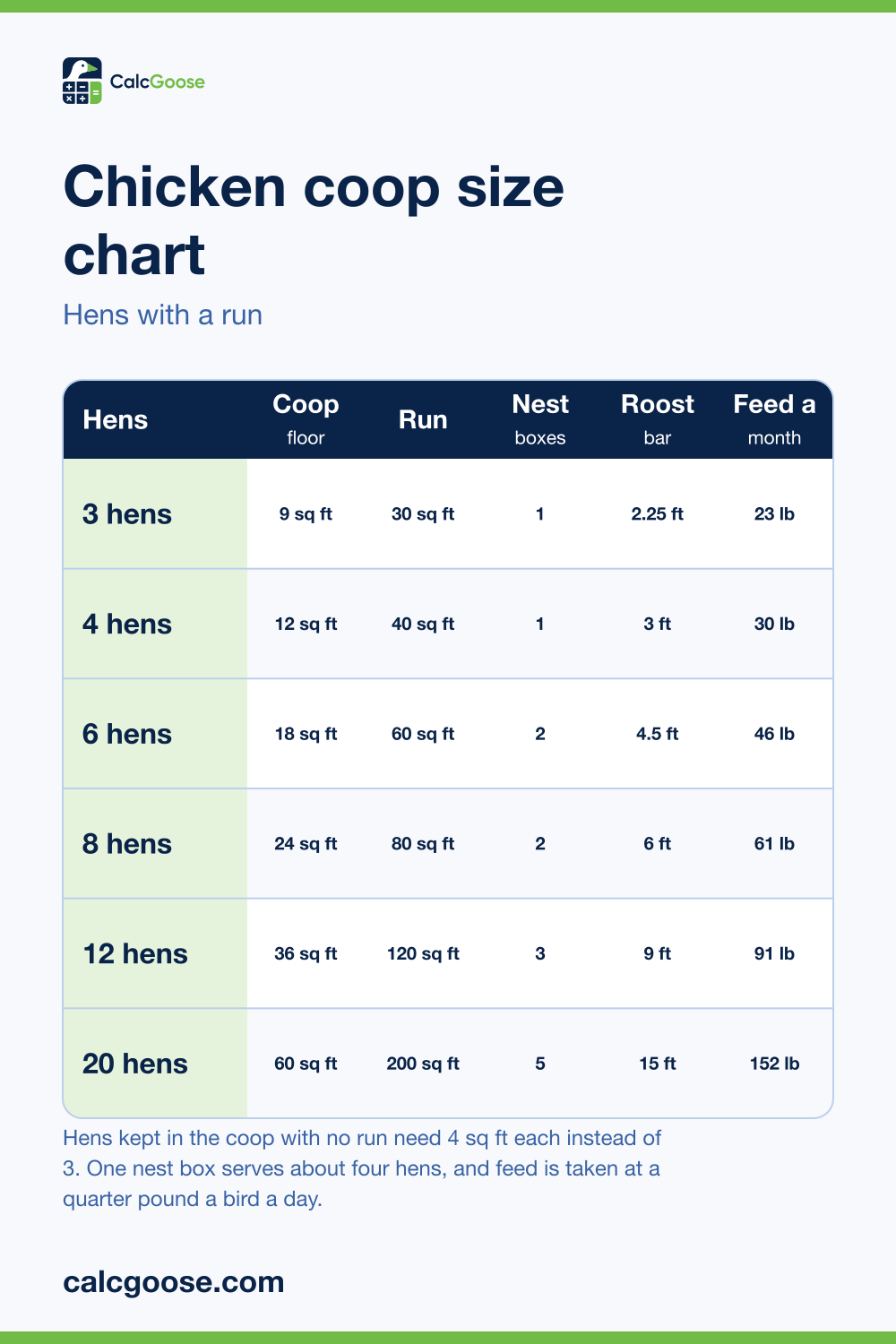
Chicken coop size chart
The coop floor, run, nest boxes, roost bar and feed a flock needs, by number of hens, for birds that also have a run. Every figure comes from the same formula as the calculator above.
| Hens | Coop floor | Run | Nest boxes | Roost bar | Feed a month |
|---|---|---|---|---|---|
| 3 hens | 9 sq ft | 30 sq ft | 1 | 2.25 ft | 23 lb |
| 4 hens | 12 sq ft | 40 sq ft | 1 | 3 ft | 30 lb |
| 6 hens | 18 sq ft | 60 sq ft | 2 | 4.5 ft | 46 lb |
| 8 hens | 24 sq ft | 80 sq ft | 2 | 6 ft | 61 lb |
| 12 hens | 36 sq ft | 120 sq ft | 3 | 9 ft | 91 lb |
| 20 hens | 60 sq ft | 200 sq ft | 5 | 15 ft | 152 lb |
Hens kept in the coop with no run need 4 sq ft each instead of 3. One nest box serves about four hens, and feed is taken at a quarter pound a bird a day.
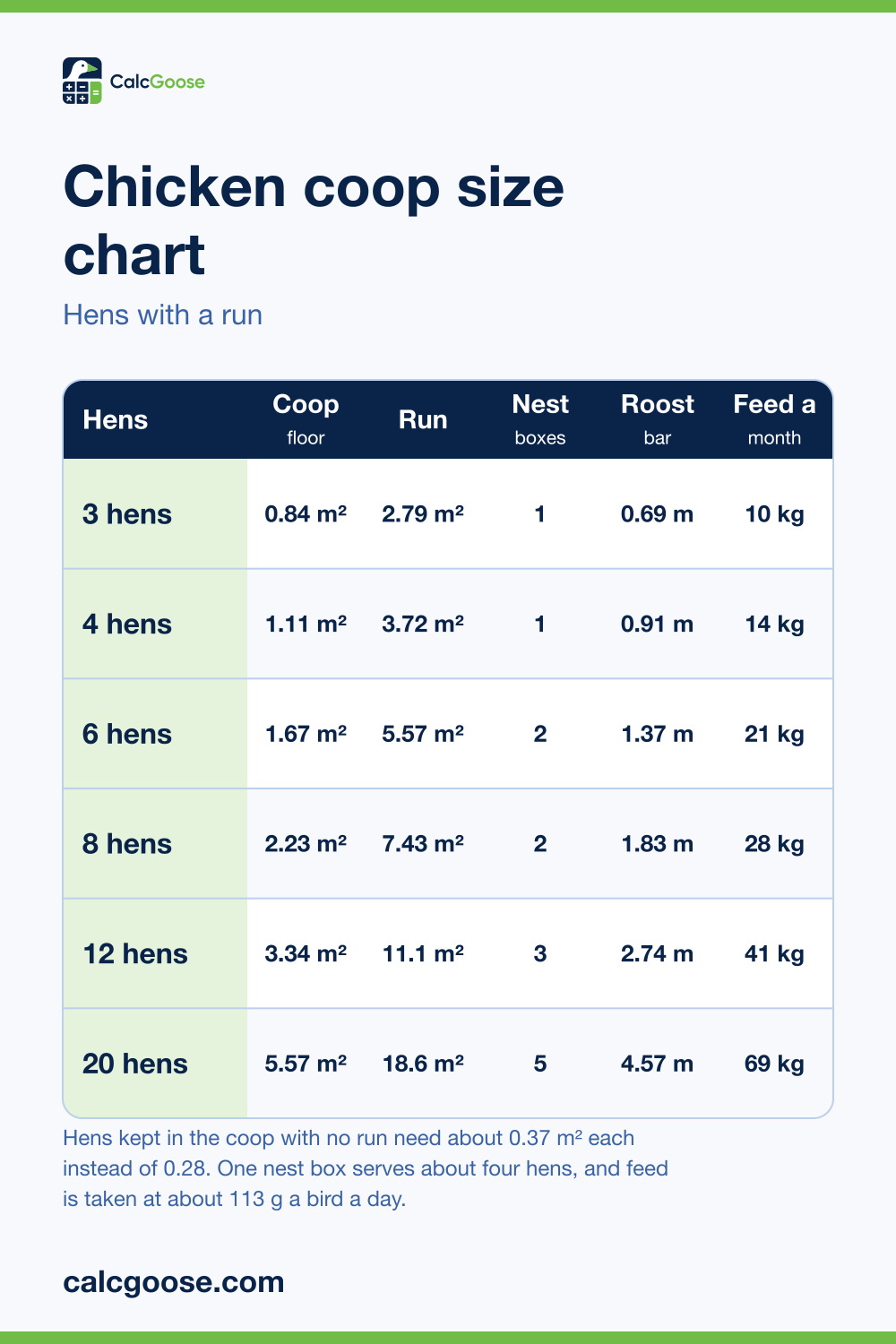
The coop floor, run, nest boxes, roost bar and feed a flock needs, by number of hens, for birds that also have a run. Every figure comes from the same formula as the calculator above.
| Hens | Coop floor | Run | Nest boxes | Roost bar | Feed a month |
|---|---|---|---|---|---|
| 3 hens | 0.84 m² | 2.79 m² | 1 | 0.69 m | 10 kg |
| 4 hens | 1.11 m² | 3.72 m² | 1 | 0.91 m | 14 kg |
| 6 hens | 1.67 m² | 5.57 m² | 2 | 1.37 m | 21 kg |
| 8 hens | 2.23 m² | 7.43 m² | 2 | 1.83 m | 28 kg |
| 12 hens | 3.34 m² | 11.1 m² | 3 | 2.74 m | 41 kg |
| 20 hens | 5.57 m² | 18.6 m² | 5 | 4.57 m | 69 kg |
Hens kept in the coop with no run need about 0.37 m² each instead of 0.28. One nest box serves about four hens, and feed is taken at about 113 g a bird a day.
Assumptions and limits
Everything this calculator quietly assumes on your behalf. If one of these does not match your situation, the answer will be off.
- Laying rates are peak-season figures for healthy hens in their first two laying years, 5 eggs per week for production hybrids, 4 for dual-purpose breeds, 3 for heritage and ornamental. Production drops sharply after year two, and heritage breeds lay longer but never as heavily.
- The annual figure assumes 44 productive weeks. Hens moult once a year and stop laying entirely for six to eight weeks, and most breeds slow dramatically in short winter days without supplementary light.
- Space figures are widely-accepted minimums, not recommendations. Four square feet of coop per confined bird and ten square feet of run are floors, more space consistently produces healthier, calmer birds and fewer behavioural problems.
- Feed is estimated at a quarter pound per bird per day of layer ration. Free-ranging birds eat less purchased feed in summer and more in winter, and treats or scratch grain displace balanced feed rather than adding to it.
- Nest boxes at one per four hens reflects the fact that hens strongly prefer to share a favourite box. Providing more does not increase usage proportionally.
- Grit and oyster shell are additional to the feed figure and should be offered free-choice and separately.
- Nothing here covers predator-proofing, ventilation, bedding volume, or local ordinances on flock size and roosters, all of which matter as much as the numbers.
- Roosters are not required for eggs and are not included in these figures. They do not lay, they eat the same amount, and many municipalities prohibit them.
- The space and feed figures are US units. In metric they come to 0.37 m² of coop per confined bird, 0.28 m² with a run, 0.93 m² of run each, about 23 cm of roost bar per bird and roughly 113 g of feed a day.
Frequently asked questions
How many chickens do I need for a family of four?
Four to six hens for a family that uses eggs regularly, which produces about 16 to 24 eggs a week from dual-purpose breeds. Six is the more common choice because it allows for one or two birds not laying at any given time. Start with more rather than fewer, adding birds to an established flock is harder than starting with them.
How big should a coop be for 6 chickens?
At least 18 square feet of coop floor if they have a run, or 24 if they are confined, plus a 60 square foot run. That is roughly a 4 × 5 foot coop with a 6 × 10 run. These are minimums, crowded birds develop feather-picking and bullying that is very difficult to reverse once it starts.
How much feed does a chicken eat per month?
About 7.5 pounds per bird per month, so six hens go through roughly 46 pounds, just under a standard 50 lb sack. Free-ranging birds eat noticeably less in summer when there is forage, and more in winter. Budget a sack a month for a small backyard flock.
Do chickens stop laying in winter?
Most slow dramatically or stop, because laying is triggered by day length rather than temperature. Below about 14 hours of light, production drops off, and the annual moult usually falls in autumn as well. Adding a light on a timer to reach 14 hours restores laying, though many keepers deliberately give hens the winter off.
How many nest boxes do I need?
One per four hens is the standard ratio and it is what the calculator applies, so a flock of four comes out at a single box. Fit two anyway, because a broody hen sitting tight on the only box will have the others laying on the floor. Beyond that there is no benefit in one each, since hens overwhelmingly prefer to share the same favourite box regardless of how many you provide. Mount them lower than the roost bars, or the birds will sleep in them and foul the eggs.
Do I need a rooster for hens to lay eggs?
No. Hens lay whether or not a rooster is present, a rooster only makes the eggs fertile. Many municipalities ban roosters entirely because of the noise, and a rooster in a small flock can be hard on the hens. Keep one only if you want to hatch chicks.
How long do chickens lay eggs?
Production hybrids lay heavily for two to three years then drop off sharply, while heritage breeds lay less but keep going for five or six. Most hens live eight to ten years, so a backyard flock will spend much of its life past peak production, which is a decision worth making before you start.
Related calculators
- Raw Dog Food Calculator Pets & Animals Daily raw food portions by body weight or calories, with monthly quantity and cost.
- Aquarium Calculator Pets & Animals Tank volume, heater wattage, filter turnover and an honest stocking check.
- Cat Calorie Calculator Pets & Animals Daily calories for a cat, converted into cups of dry or cans of wet food.
- Grass Seed Calculator Home & Yard Pounds of seed or pallets of sod for a lawn, by grass type and whether you are seeding or overseeding.
Share this calculator
Found the number you needed? Send it to whoever asked you for it.