Wallpaper Calculator
Enter your walls and roll size to get the number of rolls, counted the way decorators actually do it, by full-height strips rather than square feet.
Last updated
Where are you?
AWG, NEC, 120/240 V, miles and gallons mm², IEC/BS 7671, 230/400 V, km and litres . We remember this on every calculator.
Your result
US double roll, 20.5 in × 33 ft rolls to buy
4 rolls
- Strips needed
- 12
- Strips per roll
- 3
- Cut length per strip
- 100 in
- Wall width papered
- 19 ft
- Estimated offcut
- 27.3%
- Pattern repeat
- None
🪿 The goose says: Buy 4 rolls. You need 12 strips and each roll gives you 3, order them all together and check the batch numbers match.
- Buy every roll in one order and check the batch number on each label. Two batches of the same paper are visibly different in colour, and the join will show for as long as the paper is up.
- About 27.3% of the paper you buy will be offcut, because your 0 in repeat forces each drop up to a whole pattern. Large repeats are where wallpaper budgets go wrong.
- Windows are deliberately not deducted. The paper above and below a window still has to be cut from a full-height drop, so treating a window as a saving is how people end up a roll short.
How this wallpaper calculator works
Almost every online wallpaper calculator divides wall area by roll area, and almost every one of them gives you the wrong answer. Wallpaper is not spread over a wall like paint. It is hung in full-height strips, and a strip that is two inches too short is worthless.
The method decorators actually use counts strips. Work out how many drops fit across your wall width at the roll width, work out how many drops you can cut from one roll at your drop length, and divide. Everything else is detail.
The pattern repeat is what makes it expensive. With a straight match every drop must begin at the same point in the pattern, so an 8 foot wall with a 21 inch repeat needs a drop cut at 105 inches rather than 100, and the leftover is usually too short to use.
-
Step 1 Total wall width
width = Σ wall widths − full-height doorwaysWindows are not deducted, the paper above and below still comes off a full drop. -
Step 2 Cut length per strip
strip = wall_height + trim_allowance, rounded up to a whole repeatTrim allowance is 4 in total, two at each end. -
Step 3 How many strips you need
strips = ceil(wall_width ÷ roll_width) -
Step 4 How many strips a roll gives
per_roll = floor(roll_length ÷ strip_length)Floor, not round, a partial drop is not a drop. -
Step 5 Rolls to buy
rolls = ceil(strips ÷ per_roll) -
Step 6 What ends up in the bin
waste% = 1 − (strips × wall_height) ÷ (rolls × roll_length)Around a third of a normal order, which is exactly why dividing wall area by roll area comes out short.
For example, two walls totalling 22 ft, 8 ft high, plain paper, US double rolls at 20.5 in × 33 ft. That is 264 inches of wall, needing 13 strips of 100 inches. Each 396-inch roll gives 3 strips, so you need 5 rolls.
Wallpaper roll chart
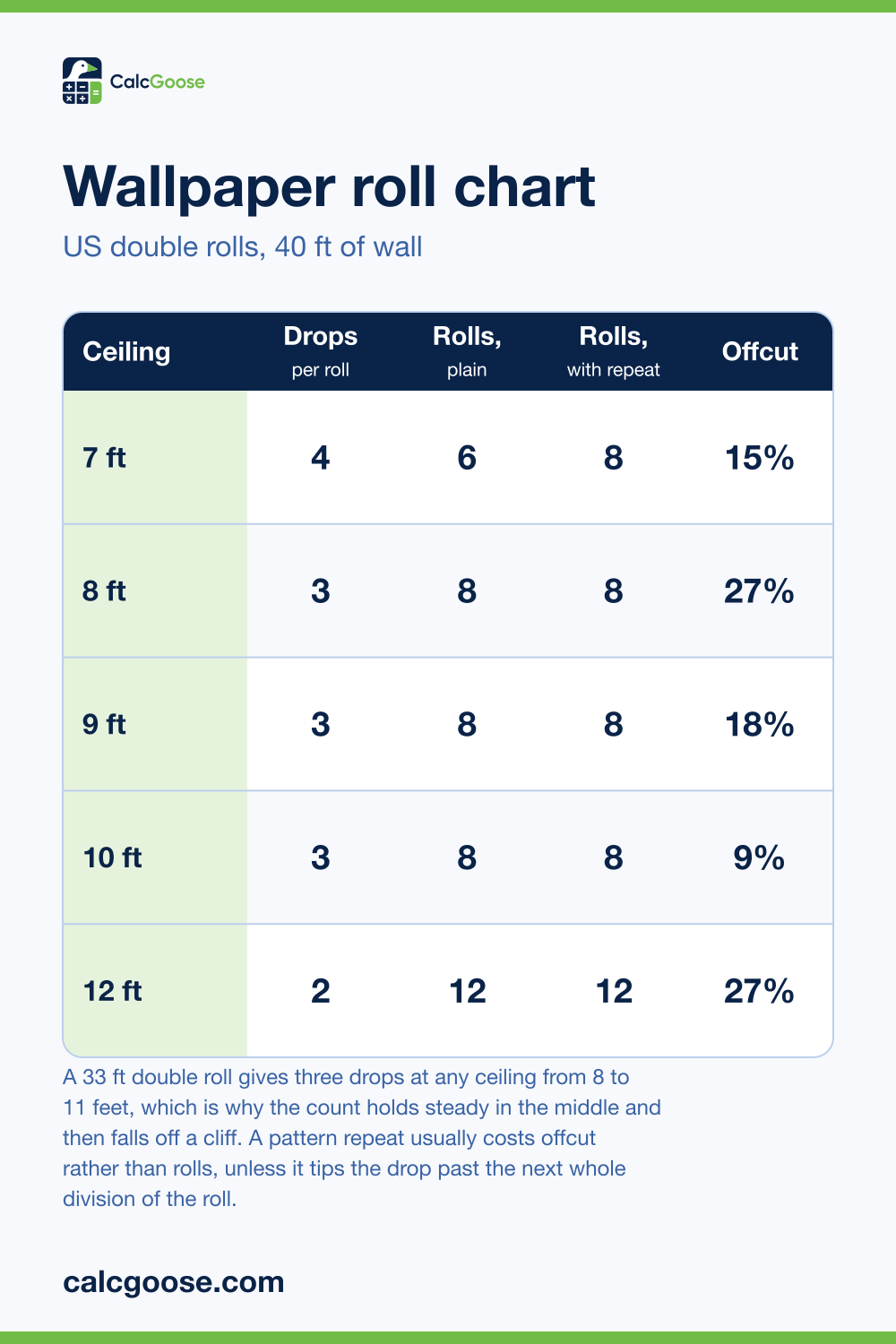
What a US double roll yields at each ceiling height, for 40 feet of wall with the doorways already taken off. The repeat column uses 21 inches, a common straight match. Every figure comes from the same formula as the calculator above.
| Ceiling | Drops per roll | Rolls, plain | Rolls, with repeat | Offcut |
|---|---|---|---|---|
| 7 ft | 4 | 6 | 8 | 15% |
| 8 ft | 3 | 8 | 8 | 27% |
| 9 ft | 3 | 8 | 8 | 18% |
| 10 ft | 3 | 8 | 8 | 9% |
| 12 ft | 2 | 12 | 12 | 27% |
A 33 ft double roll gives three drops at any ceiling from 8 to 11 feet, which is why the count holds steady in the middle and then falls off a cliff. A pattern repeat usually costs offcut rather than rolls, unless it tips the drop past the next whole division of the roll.
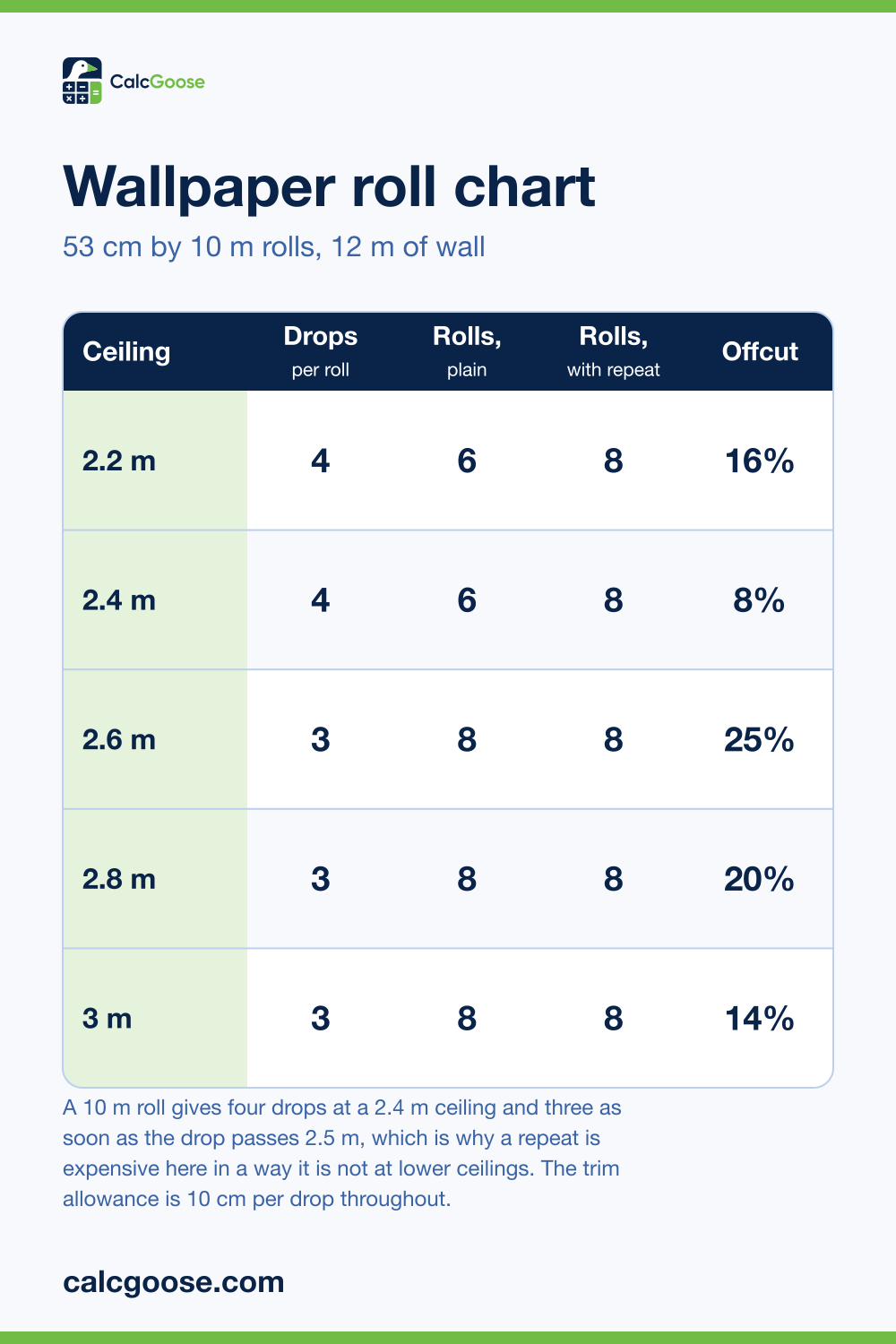
What a 53 cm by 10 m roll yields at each ceiling height, for 12 metres of wall with the doorways already taken off. The repeat column uses 53 cm, a common straight match. Every figure comes from the same formula as the calculator above.
| Ceiling | Drops per roll | Rolls, plain | Rolls, with repeat | Offcut |
|---|---|---|---|---|
| 2.2 m | 4 | 6 | 8 | 16% |
| 2.4 m | 4 | 6 | 8 | 8% |
| 2.6 m | 3 | 8 | 8 | 25% |
| 2.8 m | 3 | 8 | 8 | 20% |
| 3 m | 3 | 8 | 8 | 14% |
A 10 m roll gives four drops at a 2.4 m ceiling and three as soon as the drop passes 2.5 m, which is why a repeat is expensive here in a way it is not at lower ceilings. The trim allowance is 10 cm per drop throughout.
Assumptions and limits
Everything this calculator quietly assumes on your behalf. If one of these does not match your situation, the answer will be off.
- The strip method is used rather than area division, because wallpaper is hung in full-height drops and offcuts shorter than the wall are almost never usable. Area-based estimates typically come out one to two rolls short.
- Full-height doorways are deducted from wall width; windows are not. Paper above and below a window still has to be cut from a whole drop, so counting a window as saved area is the single most common mistake.
- A straight pattern match is assumed. Offset or drop-match patterns alternate the starting point between strips, which nests better and wastes slightly less. This calculator will slightly over-order for those.
- Trim allowance defaults to 4 inches per strip, two at the top and two at the bottom. Rooms with badly out-of-level ceilings need more.
- Roll dimensions are the common nominal sizes. US rolls are priced as singles but almost always sold in double-roll bolts; European rolls are 53 cm by 10 m. Check your specific paper, since designer rolls vary.
- No allowance is made for feature walls with tricky cut-ins, alcoves, chimney breasts or staircases. Anything with an angled cut needs extra.
- Peel-and-stick papers are calculated the same way, but they are more forgiving of a short drop because panels can be overlapped slightly at the seam.
Frequently asked questions
How many rolls of wallpaper do I need for a room?
For a typical 12 × 10 ft room with 8 ft ceilings and one door, plain paper needs about 8 to 9 US double rolls to cover all four walls. A single feature wall of 12 ft needs 3. Pattern repeat can push either figure up by 20 to 40 percent.
How many rolls of wallpaper for a 4 × 3 metre room?
Seven European rolls for a 2.4 metre ceiling with one door, using the standard 53 cm by 10 m size. That is 14 metres of wall perimeter less the doorway, which comes to 25 drops, and a 10 metre roll yields four drops of 2.5 metres at that ceiling height. A pattern repeat changes that, because any repeat at all pushes the drop past 2.5 metres and a roll then yields three, taking the room to nine rolls.
What does pattern repeat mean on wallpaper?
It is the vertical distance before the design starts again, printed on the roll label. Every strip has to begin at the same point in the pattern for the seams to match, so each drop is cut up to a whole repeat longer than the wall, which is where the offcut waste comes from. A 21-inch repeat on an 8-foot wall wastes about five inches per strip.
Do I subtract windows when calculating wallpaper?
No, and this is the mistake that leaves people a roll short. The paper above and below a window still has to be cut from a full-height drop, and the offcut from the middle is rarely long enough to use elsewhere. Only full-height openings like doors and arches reduce the count.
What is the difference between a single and double roll?
In the US, wallpaper is priced by the single roll of about 27 square feet but manufactured and sold as a double-roll bolt of roughly 56 square feet. You order double rolls; the price you see is often for a single. European rolls are a single standard size, 53 cm wide by 10 m long.
How much extra wallpaper should I buy?
Buy one extra roll beyond the calculation, and buy it at the same time. The extra covers a mis-cut and any future repair, and buying it later means a different batch number and a visible colour difference. Most suppliers will accept returns of unopened rolls.
Why do batch numbers matter?
Wallpaper is printed in production runs and the ink shifts slightly between them. Two rolls from different batches look identical in the shop and obviously different once hung side by side in daylight. Check the batch or dye-lot number on every roll label before you start.
Is peel-and-stick wallpaper measured the same way?
Yes, by strips, but the roll dimensions are different, usually 24 inches wide by about 16 feet. Peel-and-stick is more forgiving because you can reposition it and overlap seams slightly, and most brands are random or straight match with modest repeats.
Related calculators
- Mulch Calculator Home & Yard Cubic yards, bags or tons of mulch, soil or gravel for any number of beds.
- Paver Calculator Home & Yard Paver count, gravel base, bedding sand and edging for a patio or path.
- Paint Calculator Home & Yard Gallons of paint for a room, with coats, doors, windows and ceiling accounted for.
- Deck Board Calculator Home & Yard Board count, linear feet, screws and joists for a deck of any size.
- Fence Calculator Home & Yard Posts, panels, pickets, rails and concrete for a fence run of any length.
- Grass Seed Calculator Home & Yard Pounds of seed or pallets of sod for a lawn, by grass type and whether you are seeding or overseeding.
- Concrete Calculator Home & Yard Concrete for slabs, footings, post holes and columns, in yards or metres and in bags.
Share this calculator
Found the number you needed? Send it to whoever asked you for it.