Home Wattage Calculator
Tick what runs in your home and how long it runs for. You get the average draw in watts, the peak if everything came on at once, and what it all costs each month.
Last updated
Where are you?
AWG, NEC, 120/240 V, miles and gallons mm², IEC/BS 7671, 230/400 V, km and litres . We remember this on every calculator.
Your result
Average draw, around the clock
1,160 W
- Everything at once
- 14,995 W
- Energy per day
- 27.9 kWh
- Energy per month
- 848 kWh
- Energy per year
- 10,165 kWh
- Cost per month
- $152.60
- Biggest consumer
- Water heater (electric tank)
🪿 The goose says: Your home averages 1,160 W around the clock, 27.9 kWh a day, $152.60 a month. If every one of those 14 appliances came on together it would pull 14,995 W, which is the number a generator has to cover.
- That lands within a few percent of the US household average of 10,500 kWh a year.
- Water heater (electric tank) alone is 48% of your electricity. Anything you change there moves the bill more than everything else combined.
- Your peak is 13 times your average, which is normal. Most of a home's big loads run in short bursts. It is also why a generator has to be sized on the peak while a solar array is sized on the average.
Where your electricity goes
Your biggest consumers by energy, not by wattage, a 3,000 W dryer used for 45 minutes costs less than a 150 W fridge running all day.
- Water heater (electric tank)
- 13.5 kWh/day 48% · $73.97/mo
- Furnace fan / air handler
- 3 kWh/day 11% · $16.44/mo
- Clothes dryer (electric)
- 2.25 kWh/day 8% · $12.33/mo
- Electric range and oven
- 1.88 kWh/day 7% · $10.27/mo
- Standby and phantom loads
- 1.44 kWh/day 5% · $7.89/mo
- Computers and home office
- 1.20 kWh/day 4% · $6.58/mo
14 appliances checked, totalling 27.9 kWh a day.
What it would take to back this up
The two numbers below answer different questions, and mixing them up is the most common sizing mistake there is.
- Generator, if everything ran at once
- 18,000 W peak × 1.2
- Battery to cover a full day
- 27.9 kWh usable, not nameplate
- Battery to cover the essentials only
- 9.75 kWh about 35% of normal use
- Solar array to break even over a year
- 8,600 W 4.2 sun-hours a day
A generator is sized on the worst instant. A battery and a solar array are sized on the day. Sizing either one from the other number is how people end up with a generator twice the size they need, or a battery that dies before breakfast.
Your bill, three ways
- Per day
- $5.01 27.9 kWh
- Per month
- $152.60 848 kWh
- Per year
- $1,829.75 10,165 kWh
- US household average
- 10,500 kWh/year $1,890.00
At $0.18 per kWh, flat rate. Months are 30.44 days.
How this home wattage calculator works
There are two honest answers to "how many watts does a house use", and they are about ten times apart. The first is the average, total energy over a day, spread evenly across 24 hours. A typical US home lands near 1,200 W by that measure. The second is the peak, everything switched on at the same moment, which for the same house is 12,000 to 15,000 W.
The average is what you pay for and what a solar array or battery has to replace. The peak is what your service panel, your wiring and any generator have to survive. Neither number is wrong; using one where the other belongs is what produces a generator twice the size it needs to be, or a battery that runs flat before breakfast.
Getting either right means multiplying watts by hours, and hours is where the estimates go astray. A refrigerator is plugged in for 24 hours but its compressor only runs for about 8 of them. A dryer pulls 3,000 W but only for 45 minutes. Neither of those is well described by its wattage alone.
-
Step 1 Energy for one appliance
kWh_per_day = watts ÷ 1000 × hours_running_per_dayHours the motor or element is actually working, not hours plugged in. -
Step 2 Add them all up
daily_kWh = sum of every appliance -
Step 3 Average draw
average_watts = daily_kWh × 1000 ÷ 24This is the number that answers "how many watts does my house use" for billing and for solar. -
Step 4 Peak draw
peak_watts = sum of running watts for everything checkedThe worst case if every load came on together. Real homes rarely reach it, but a generator has to. -
Step 5 Monthly and yearly
monthly_kWh = daily × 30.44; yearly_kWh = daily × 365 -
Step 6 The bill
cost = kWh × price_per_kWh
For example, the default selection above comes to about 27.9 kWh a day, or 1,160 W averaged around the clock, just under 15,000 W if it all ran at once, and roughly $153 a month at 18 cents per kWh. The US household average is 10,500 kWh a year, or 28.8 kWh a day.
There are two honest answers to "how many watts does a house use", and they are about twenty times apart. The first is the average, total energy over a day, spread evenly across 24 hours. A typical European home lands near 400 W by that measure. The second is the peak, everything switched on at once, which for the same home is 10,000 W or more, because European kitchens are full of 2–3 kW resistive loads.
The average is what you pay for and what a solar array or battery has to replace. The peak is what your consumer unit, your cable and any generator have to survive. Neither number is wrong; using one where the other belongs is what produces a generator twice the size it needs to be, or a battery that runs flat before breakfast.
European consumption is roughly a third of the US figure, and the reason is heating. Most homes here burn gas or oil for space heating and hot water, so the boiler only draws 100–200 W for its pump and controls. Electrify that with a heat pump or an immersion heater and the total climbs sharply.
-
Step 1 Energy for one appliance
kWh_per_day = watts ÷ 1000 × hours_running_per_dayHours the motor or element is actually working, not hours plugged in. -
Step 2 Add them all up
daily_kWh = sum of every appliance -
Step 3 Average draw
average_watts = daily_kWh × 1000 ÷ 24This is the number that answers "how many watts does my home use" for billing and for solar. -
Step 4 Peak draw
peak_watts = sum of running watts for everything tickedThe worst case if every load came on together. A kettle, an oven and a hob alone are 7 kW of it. -
Step 5 Monthly and yearly
monthly_kWh = daily × 30.44; yearly_kWh = daily × 365 -
Step 6 The bill
cost = kWh × price_per_kWh
For example, the default selection above comes to about 10 kWh a day, or 418 W averaged around the clock, roughly 12,700 W if it all ran at once, and about €89 a month at 29 cents per kWh. The European household average is near 3,500 kWh a year, or 9.6 kWh a day.
Appliance energy use chart
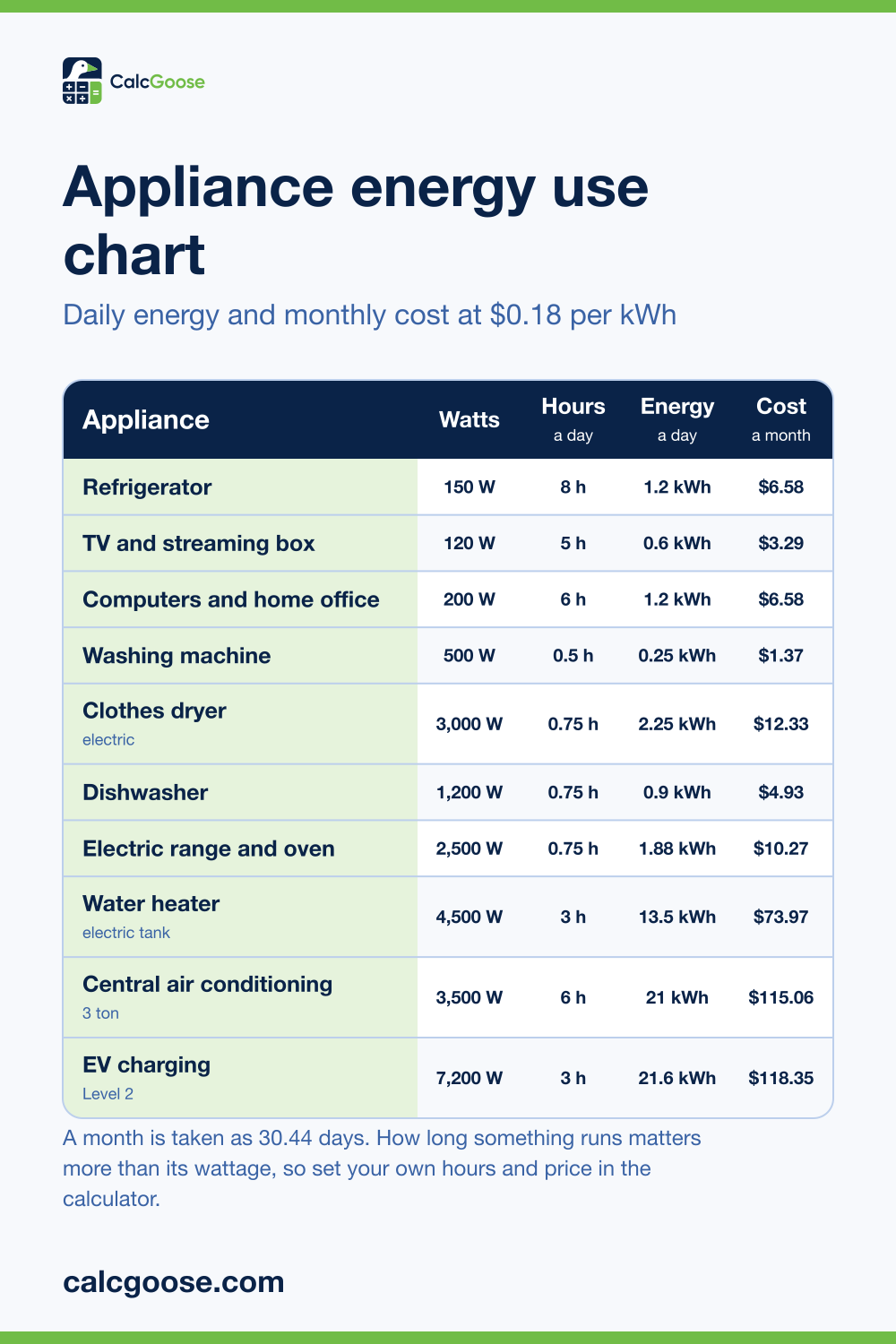
How much electricity common appliances use in a day, and what that costs a month at $0.18 per kWh, about the US average. Hours are typical running time, not time plugged in. Every figure comes from the same formula as the calculator above.
| Appliance | Watts | Hours a day | Energy a day | Cost a month |
|---|---|---|---|---|
| Refrigerator | 150 W | 8 h | 1.2 kWh | $6.58 |
| TV and streaming box | 120 W | 5 h | 0.6 kWh | $3.29 |
| Computers and home office | 200 W | 6 h | 1.2 kWh | $6.58 |
| Washing machine | 500 W | 0.5 h | 0.25 kWh | $1.37 |
| Clothes dryerelectric | 3,000 W | 0.75 h | 2.25 kWh | $12.33 |
| Dishwasher | 1,200 W | 0.75 h | 0.9 kWh | $4.93 |
| Electric range and oven | 2,500 W | 0.75 h | 1.88 kWh | $10.27 |
| Water heaterelectric tank | 4,500 W | 3 h | 13.5 kWh | $73.97 |
| Central air conditioning3 ton | 3,500 W | 6 h | 21 kWh | $115.06 |
| EV chargingLevel 2 | 7,200 W | 3 h | 21.6 kWh | $118.35 |
A month is taken as 30.44 days. How long something runs matters more than its wattage, so set your own hours and price in the calculator.
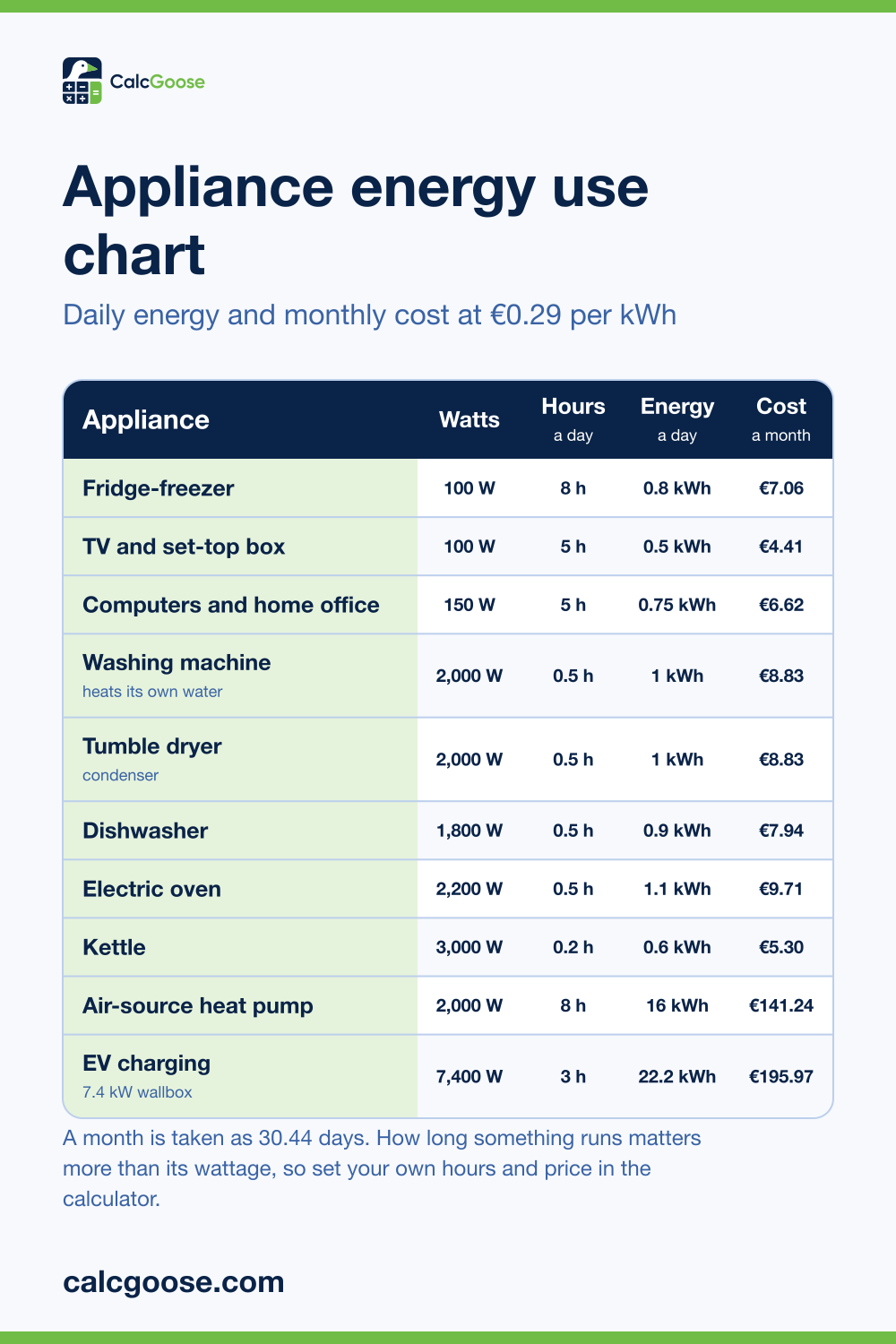
How much electricity common appliances use in a day, and what that costs a month at €0.29 per kWh, about the EU average. Hours are typical running time, not time plugged in. Every figure comes from the same formula as the calculator above.
| Appliance | Watts | Hours a day | Energy a day | Cost a month |
|---|---|---|---|---|
| Fridge-freezer | 100 W | 8 h | 0.8 kWh | €7.06 |
| TV and set-top box | 100 W | 5 h | 0.5 kWh | €4.41 |
| Computers and home office | 150 W | 5 h | 0.75 kWh | €6.62 |
| Washing machineheats its own water | 2,000 W | 0.5 h | 1 kWh | €8.83 |
| Tumble dryercondenser | 2,000 W | 0.5 h | 1 kWh | €8.83 |
| Dishwasher | 1,800 W | 0.5 h | 0.9 kWh | €7.94 |
| Electric oven | 2,200 W | 0.5 h | 1.1 kWh | €9.71 |
| Kettle | 3,000 W | 0.2 h | 0.6 kWh | €5.30 |
| Air-source heat pump | 2,000 W | 8 h | 16 kWh | €141.24 |
| EV charging7.4 kW wallbox | 7,400 W | 3 h | 22.2 kWh | €195.97 |
A month is taken as 30.44 days. How long something runs matters more than its wattage, so set your own hours and price in the calculator.
Assumptions and limits
Everything this calculator quietly assumes on your behalf. If one of these does not match your situation, the answer will be off.
- Wattages are typical figures for common appliances. Yours can differ by 30% or more, the rating plate on the appliance is always a better source, and an inexpensive plug-in energy monitor is better still.
- Hours means running time, not connected time. A refrigerator is powered continuously but its compressor duty-cycles at roughly a third, which is why 8 hours a day is the right entry rather than 24.
- Every day is treated as identical. Real consumption swings hard with the seasons, air conditioning and electric heat can double a summer or winter bill against the shoulder months.
- The peak figure assumes every checked appliance runs simultaneously. That almost never happens in practice, which is why a whole-house load calculation applies demand factors under NEC Article 220 rather than adding nameplates.
- Starting surges are ignored here. They matter enormously for generator sizing and not at all for energy, because a surge lasts under a second.
- The bill uses a flat rate per kWh. Tiered rates, time-of-use pricing, demand charges and fixed monthly service fees all change the total.
- Household averages quoted for comparison are national residential figures, around 10,500 kWh a year in the United States. State-level averages vary by more than a factor of two.
- Wattages are typical European figures. Yours can differ by 30% or more, the rating plate is always a better source, and a plug-in energy monitor better still.
- Hours means running time, not connected time. A fridge-freezer is powered continuously but its compressor duty-cycles at roughly a third, which is why 8 hours a day is the right entry rather than 24.
- Every day is treated as identical. Real consumption swings hard with the seasons, particularly in homes with heat pumps or electric heating.
- The peak figure assumes every ticked appliance runs simultaneously. That almost never happens, which is why installations are designed with the diversity factors in BS 7671 Appendix and equivalent national guidance rather than by adding nameplates.
- Starting surges are ignored here. They matter enormously for generator sizing and not at all for energy, because a surge lasts under a second.
- Gas and oil used for heating, hot water and cooking are not counted. This is an electricity calculation only, which is exactly why European electricity figures look low next to American ones.
- The bill uses a flat rate per kWh including standing charges. Economy 7, time-of-use tariffs and separate day and night meters all change the total.
Frequently asked questions
How many watts does a house use?
A typical US home averages about 1,200 watts around the clock, which works out to roughly 29 kWh a day or 10,500 kWh a year. The peak is a very different number, if every appliance came on at once you would see 12,000 to 15,000 watts. Use the average for solar and battery sizing, and the peak for generator and panel sizing.
How many watts does it take to run a house?
To run everything simultaneously, 12,000 to 15,000 watts for a typical home with electric water heating and a dryer. To run the essentials during an outage (refrigerator, lights, furnace fan, internet and outlets), 5,000 to 7,500 watts is enough. Air conditioning and electric heat are what push the figure into standby-generator territory.
How many watts does a 2,000 sq ft house use?
Around 1,000 to 1,400 watts on average, or 24 to 34 kWh a day, though floor area is a poor predictor on its own. What actually decides it is whether heating, water heating and cooking are electric or gas, an all-electric 1,500 sq ft home easily beats a gas-heated 3,000 sq ft one. Check the appliances above rather than the square footage.
What uses the most electricity in a house?
On the electricity bill specifically, cooling leads at around 19% nationally, and space heating plus cooling together come to roughly 31%. Water heating is about 12%, lighting 9% and refrigeration 7%. Those shares move enormously with your fuel mix, because a house that heats, cooks and makes hot water on gas shifts most of its energy off the electricity bill entirely. It is also why swapping every bulb for LEDs saves real but modest money, while changing how you heat the house changes the bill outright.
How do I work out my kWh from watts?
Multiply watts by the hours it runs, then divide by 1,000. A 1,500 W space heater running 4 hours a day is 1,500 × 4 ÷ 1,000 = 6 kWh a day. At 18 cents that is about $33 a month, which is usually more than people expect from a single appliance.
Is average wattage the same as what my generator needs?
No, and the gap is roughly ten to one. Average wattage is energy spread over 24 hours; a generator has to supply the instantaneous load, plus the starting surge of whatever motor kicks in. Sizing a generator from your average draw is the single most common way people end up with one that stalls.
How much does it cost to run my house for a day?
At 29 kWh a day, roughly the US household average, electricity costs about $5.20 a day and $158 a month at the current national average near 18 cents per kWh. Rates run from about 12 cents in Idaho to over 30 in California and New England, and past 50 in Hawaii, so the national figure is a weak guide to your own bill. Enter your rate above and every number on the page follows it.
How many watts does a house use?
A typical European home averages about 400 watts around the clock, which is roughly 9.6 kWh a day or 3,500 kWh a year. The peak is a very different number, with the oven, hob and kettle going you can pass 10,000 watts. Use the average for solar and battery sizing, and the peak for generator and consumer-unit sizing.
Why is European electricity use so much lower than American?
Mostly heating. Around 70% of European homes heat with gas, oil or district heating, so the boiler only draws 100 to 200 watts for its pump and controls rather than kilowatts for a furnace or heat pump. Add smaller homes, no central air conditioning and stricter appliance efficiency rules, and you land at roughly a third of the US figure.
How many watts does it take to run a home?
To run everything at once, 10,000 to 13,000 watts for a typical home, most of it from the oven, hob and kettle. To keep the essentials going during a power cut (fridge-freezer, boiler, lights and internet), 500 to 1,000 watts is genuinely enough. That gap is why a small inverter generator covers far more than people expect in Europe.
What uses the most electricity in a home?
In a gas-heated home the leaders are wet appliances at around 14% and cold appliances at around 13%, followed by cooking and consumer electronics. Heating and hot water barely register, because they are burning gas rather than electricity. In a home with a heat pump or electric heating, that load dominates everything else at 50 to 60% of the total. Lighting is now typically around 5% since LEDs became standard.
How do I work out my kWh from watts?
Multiply watts by the hours it runs, then divide by 1,000. A 3,000 W kettle boiled for 12 minutes a day is 3,000 × 0.2 ÷ 1,000 = 0.6 kWh a day. At 29 cents that is about €5.30 a month, which surprises most people for something used for a few minutes.
Is average wattage the same as what my generator needs?
No, and the gap is roughly twenty to one. Average wattage is energy spread over 24 hours; a generator has to supply the instantaneous load, plus the starting surge of whatever motor kicks in. Sizing a generator from your average draw is the single most common way people end up with one that stalls.
How much does it cost to run my home for a day?
At the European average of 9.6 kWh a day and 29 cents per kWh, about €2.80 a day or €85 a month for electricity alone. Rates vary widely, from about 11 cents in Hungary to over 40 cents in Germany and Ireland. Enter your own rate above for a figure you can check against your bill.
Guides on this
The reasoning behind the number, and the decisions it does not make for you.
- The biggest appliance is rarely the biggest bill Wattage is only half the story. Hours do the rest, which is how a 20 W device outspends a 1,500 W one and why audits by nameplate find the wrong culprit.
- Choosing which circuits are worth backing up A backup list is a budget decision disguised as an electrical one. Four circuits cover most of the misery, and the fifth is where the costs climb.
- What a device costs to run, once duty cycle is in it A 2 kW heater does not cost 2 kW an hour to run. Thermostats cycle, and the share of the hour the element is actually on changes the bill by half.
- Square footage does not size a generator Most sizing guides map floor area to kilowatts. A 3,000 sq ft house on gas heat needs less backup than a small all-electric one. Size it by what starts.
Related calculators
- Generator Size Calculator Generators Size it from your appliances, or from your floor area and panel, with the surge load included.
- Watts Calculator Generators Convert between watts, amps, volts and kilowatt-hours, on DC, single-phase or three-phase.
- kVA Calculator Generators Convert kVA to kW, amps and horsepower, single or three-phase, with power factor handled properly.
- Whole House Generator Cost Calculator Generators The full installed cost of a generator (unit, transfer switch, gas line, pad, labour and permit).
- Generator Fuel Calculator Generators How much fuel a generator burns, how long a tank lasts, and what an outage costs per day.
- Off-Grid Solar & Battery Calculator Power & Off-Grid How many solar panels and batteries you need, from what you actually run in a day.
- EV Charging Calculator Power & Off-Grid How long a charge takes, what it costs at home, and how much you save against filling a fuel tank.
Share this calculator
Found the number you needed? Send it to whoever asked you for it.