EV Charging Calculator
Pick your car, your charger and your electricity rate to see how long a charge takes, what it costs at home, how fast range comes back, and how much you save against a tank of fuel.
Last updated
Where are you?
AWG, NEC, 120/240 V, miles and gallons mm², IEC/BS 7671, 230/400 V, km and litres . We remember this on every calculator.
Your result
20% → 80% on Level 2, 32A
6 h 45 min
- Cost of this charge
- $9.00
- Charging speed
- 23 mi/h
- Range added
- 158 mi
- Energy from the grid
- 50 kWh
- Cost per mile
- $0.06
- Same on gas
- $0.14/mi
🪿 The goose says: 20→80% on Level 2, 32A, about 6 h 45 min and $9.00, roughly half of what the same distance would cost in gas.
- Per 100 mi you are spending $5.71 on electricity versus $13.67 on gas, a saving of $7.95.
Charging versus gas
What the same driving costs on electricity and on gasoline, at the prices you entered.
- Cost per mile
- $0.06 vs $0.14
- Cost per 100 mi
- $5.71 vs $13.67
- 12,000 mi a year
- $685.71 vs $1,640.00
- You save each year
- $954.29
Assumes 30 MPG at $4.10 per gallon, and 3.5 mi/kWh for the EV. Change any of these under "Compare against a gas car" above. Fuel and electricity only, no maintenance, insurance, tax or depreciation.
Home versus public charging
The same 50 kWh at a public fast charger, where most EV owners occasionally have to charge.
- At your rate ($0.18/kWh)
- $9.00
- At a fast charger ($0.48/kWh)
- $24.00
- Difference
- $15.00
Public charging prices vary widely by network and country; $0.48/kWh is a mid-range US DC fast rate. Session and idle fees are not included.
How this EV charging calculator works
Charging is two questions that share one number. How much energy has to move, and how fast can it move?
The energy is the easy part, your usable battery capacity multiplied by the percentage gap you are closing. A 75 kWh car going from 20% to 80% needs 45 kWh in the battery.
But you always pay for more than the battery receives. Converting AC from your wall into DC in the battery loses about 10%, so 45 kWh in the pack means 50 kWh off your meter, and it is the meter that bills you. DC fast chargers do the conversion in the station and lose less, about 5%.
Time depends on where the charger's rating is measured. Level 1 and Level 2 chargers are rated by what they pull from the wall, so charge time uses the grid figure. DC chargers are rated by what they push into the battery, so time uses the battery figure.
-
Step 1 Energy into the battery
battery_kWh = capacity × (target% − current%) ÷ 100 -
Step 2 Energy off your meter
grid_kWh = battery_kWh ÷ efficiencyEfficiency is 0.90 for AC charging, 0.95 for DC fast charging. -
Step 3 Charging time
hours = grid_kWh ÷ charger_kW (AC) or battery_kWh ÷ charger_kW (DC) -
Step 4 What it costs
cost = grid_kWh × your price per kWh -
Step 5 Cost per 100 miles
(100 ÷ miles_per_kWh ÷ efficiency) × price_per_kWhThe gas comparison is (100 ÷ MPG) × price per gallon. -
Step 6 Charging speed
miles_per_hour = range_added ÷ hoursThis is what really separates a wall outlet from a Level 2 charger, about 4 miles an hour against 23. -
Step 7 What a year costs
annual_cost = cost_per_100_miles × miles_per_year ÷ 100Run the same sum on the gas figures and the gap between them is your yearly saving.
For example, a 75 kWh car from 20% to 80% needs 45 kWh in the battery and 50 kWh from the grid. On a 7.4 kW Level 2 charger that is 6 hours 45 minutes, and at $0.18/kWh it costs $9.00 for about 158 miles of range, or roughly 23 miles back per hour on the charger.
Charging is two questions that share one number. How much energy has to move, and how fast can it move?
The energy is the easy part, your usable battery capacity multiplied by the percentage gap you are closing. A 58 kWh car going from 20% to 80% needs 34.8 kWh in the battery.
But you always pay for more than the battery receives. Converting AC from your wallbox into DC in the battery loses about 10%, so 34.8 kWh in the pack means 38.7 kWh off your meter, and it is the meter that bills you. DC rapid chargers do the conversion in the station and lose less, about 5%.
Time depends on where the charger's rating is measured. A wallbox is rated by what it draws from the supply, so charge time uses the grid figure. DC rapid chargers are rated by what they push into the battery, so time uses the battery figure.
-
Step 1 Energy into the battery
battery_kWh = capacity × (target% − current%) ÷ 100 -
Step 2 Energy off your meter
grid_kWh = battery_kWh ÷ efficiencyEfficiency is 0.90 for AC charging, 0.95 for DC rapid charging. -
Step 3 Charging time
hours = grid_kWh ÷ charger_kW (AC wallbox) or battery_kWh ÷ charger_kW (DC) -
Step 4 What it costs
cost = grid_kWh × your price per kWh -
Step 5 Cost per 100 km
(kWh_per_100km ÷ efficiency) × price_per_kWhThe petrol comparison is litres_per_100km × price per litre. Divide by 100 for cost per kilometre. -
Step 6 Charging speed
km_per_hour = range_added ÷ hoursThis is the number that actually separates a household socket from a wallbox, about 12 km/h against 40. -
Step 7 What a year costs
annual_cost = cost_per_100km × km_per_year ÷ 100Run the same sum with the petrol figures and the difference is your yearly saving.
For example, a 58 kWh ID.3 from 20% to 80% needs 34.8 kWh in the battery and 38.7 kWh from the grid. On a 7.4 kW wallbox that is 5 hours 14 minutes, and at €0.29/kWh it costs €11.21 for about 193 km of range, or roughly 37 km of range back per hour on the charger, at 5.8 cents a kilometre.
EV charging time chart
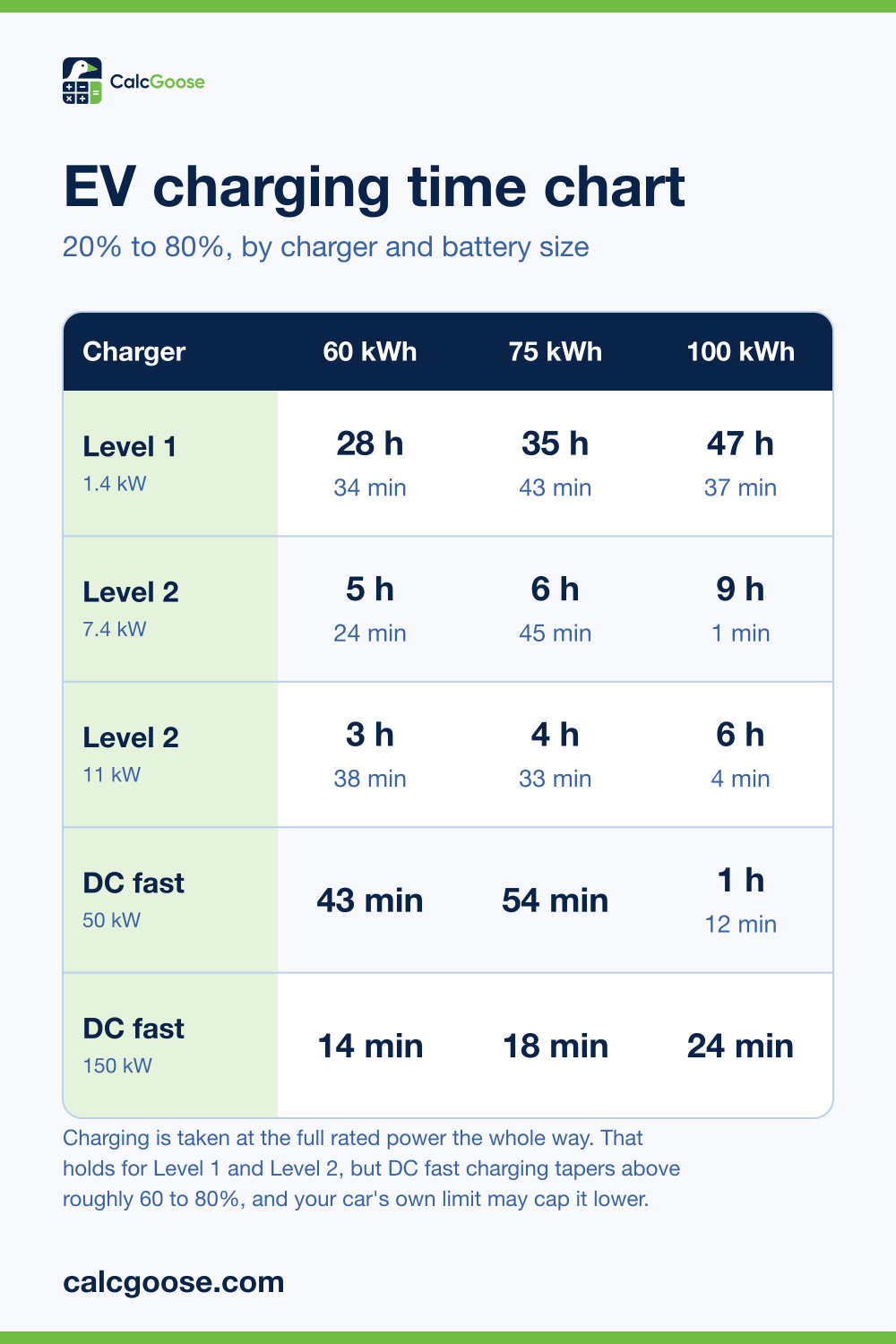
How long a charge from 20% to 80% takes on each kind of charger, by usable battery size. Every figure comes from the same formula as the calculator above, including 90% efficiency on AC and 95% on DC.
| Charger | 60 kWh | 75 kWh | 100 kWh |
|---|---|---|---|
| Level 11.4 kW | 28 h34 min | 35 h43 min | 47 h37 min |
| Level 27.4 kW | 5 h24 min | 6 h45 min | 9 h1 min |
| Level 211 kW | 3 h38 min | 4 h33 min | 6 h4 min |
| DC fast50 kW | 43 min | 54 min | 1 h12 min |
| DC fast150 kW | 14 min | 18 min | 24 min |
Charging is taken at the full rated power the whole way. That holds for Level 1 and Level 2, but DC fast charging tapers above roughly 60 to 80%, and your car's own limit may cap it lower.
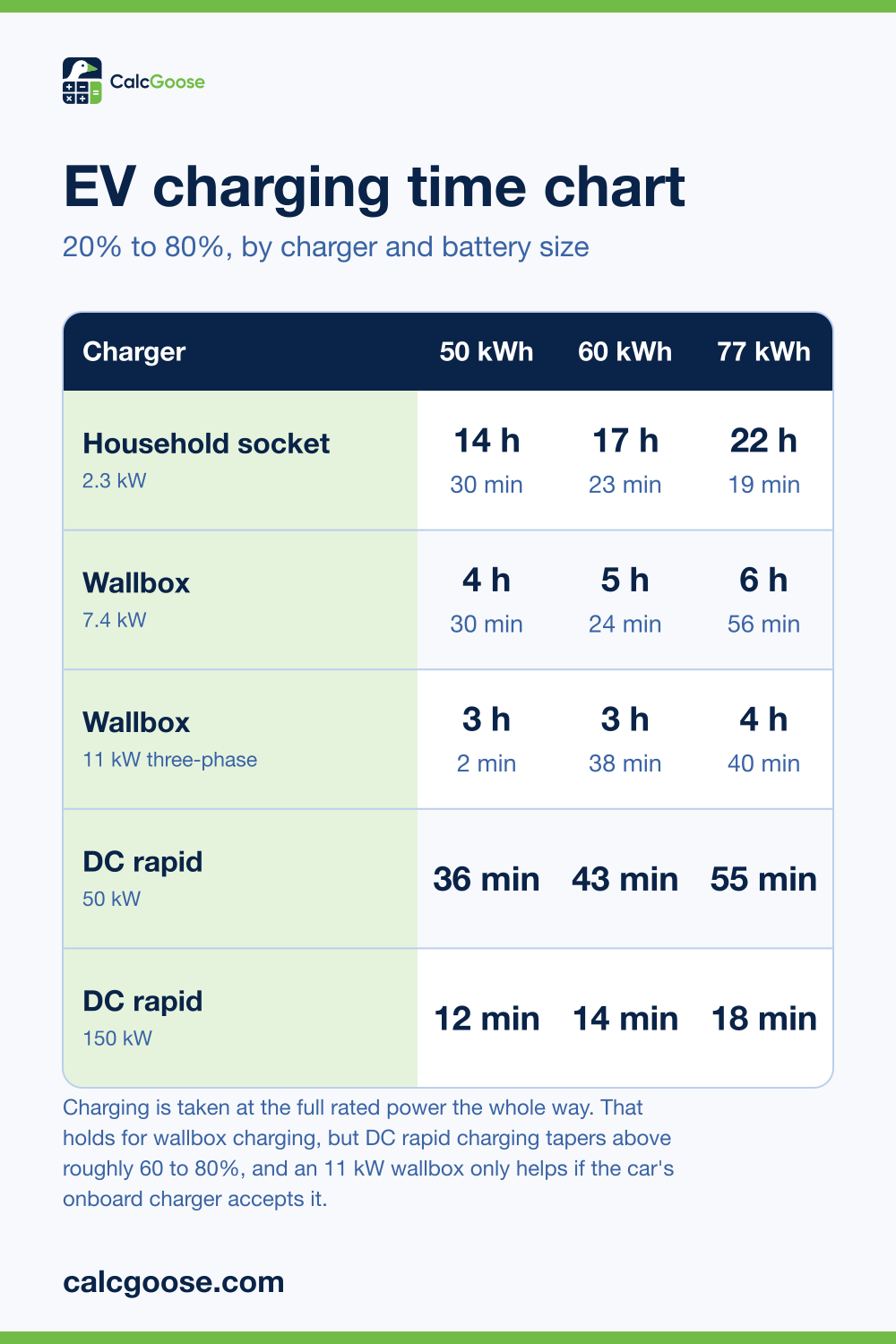
How long a charge from 20% to 80% takes on each kind of charger, by usable battery size. Every figure comes from the same formula as the calculator above, including 90% efficiency on AC and 95% on DC.
| Charger | 50 kWh | 60 kWh | 77 kWh |
|---|---|---|---|
| Household socket2.3 kW | 14 h30 min | 17 h23 min | 22 h19 min |
| Wallbox7.4 kW | 4 h30 min | 5 h24 min | 6 h56 min |
| Wallbox11 kW three-phase | 3 h2 min | 3 h38 min | 4 h40 min |
| DC rapid50 kW | 36 min | 43 min | 55 min |
| DC rapid150 kW | 12 min | 14 min | 18 min |
Charging is taken at the full rated power the whole way. That holds for wallbox charging, but DC rapid charging tapers above roughly 60 to 80%, and an 11 kW wallbox only helps if the car's onboard charger accepts it.
Assumptions and limits
Everything this calculator quietly assumes on your behalf. If one of these does not match your situation, the answer will be off.
- Charging is modeled at a constant rate. This is accurate for Level 1 and Level 2 charging, where the onboard charger is the bottleneck the whole way. It is optimistic for DC fast charging, which tapers steeply above roughly 60–80% state of charge.
- Charging efficiency is 90% for AC and 95% for DC. Cold batteries do worse, sometimes much worse, because the car spends energy heating the pack before it can accept a charge.
- Battery capacities are usable capacity, not gross pack size. Manufacturers reserve a buffer at both ends that you never see.
- AC charger power is the rate drawn from the grid; DC charger power is the rate delivered to the battery. This is why the time formula differs between the two.
- The station rating is treated as the actual delivered rate. In practice your car's own maximum, the number of cars sharing the station and the battery temperature all cap it lower.
- No idle, connection or session fees are included, and no time-of-use rate changes mid-session. Public networks often add both.
- The gas comparison uses fuel and electricity only. It ignores maintenance, which usually favors the EV, and depreciation, insurance and taxes, which vary far too much to model.
- Miles per kWh is taken from your trip computer, which already accounts for your driving. Highway speeds and cold weather can knock 30% off it.
- The default rates are national averages and both of them move. US residential electricity runs from about 12 cents a kWh in Idaho to over 50 in Hawaii, and gasoline swings by more than a dollar a gallon between states, so this comparison is only as good as the two prices you type in.
- Charging is modelled at a constant rate. This is accurate for AC wallbox charging, where the onboard charger is the bottleneck the whole way. It is optimistic for DC rapid charging, which tapers steeply above roughly 60–80% state of charge.
- Charging efficiency is 90% for AC and 95% for DC. Cold batteries do worse, sometimes much worse, because the car spends energy heating the pack before it can accept a charge.
- Battery capacities are usable capacity, not gross pack size. Manufacturers reserve a buffer at both ends that you never see.
- Wallbox power is the rate drawn from the supply; DC charger power is the rate delivered to the battery. This is why the time formula differs between the two.
- A three-phase 11 kW or 22 kW wallbox only helps if your car's onboard charger accepts it. Most European EVs cap at 11 kW, and several are single-phase 7.4 kW only.
- The station rating is treated as the actual delivered rate. In practice your car's own maximum, the number of cars sharing the station and the battery temperature all cap it lower.
- No idle fees, connection fees or subscription costs are included, and no time-of-use tariff changes mid-session. European rapid networks frequently add all three.
- Electricity prices vary enormously across Europe, from roughly €0.10/kWh in Hungary to over €0.40 in Germany and Ireland. The €0.29 default is a rough EU household average including taxes; use your own bill.
- The petrol comparison uses fuel and electricity only. It ignores maintenance, which usually favours the EV, and depreciation, insurance, road tax and any congestion or emissions-zone charges.
- Consumption in kWh/100 km comes from your trip computer, which already reflects your driving. Motorway speeds and winter can add 30% or more.
- Charging speed is the average across the whole session, not the peak. On DC rapid charging the real rate is much higher at the start and much lower at the end.
- The yearly comparison assumes every kilometre is charged at the rate you entered. In practice most drivers do 80–90% of their charging at home and the rest at public prices, so the true figure sits a little above the home-only number.
- The public charging rate used in the home-versus-public comparison is a mid-range European rapid rate. Networks charge anywhere from €0.35 to €0.89 per kWh depending on country and subscription.
Frequently asked questions
How long does it take to charge an EV at home?
On a 7.4 kW Level 2 charger, a typical 20% to 80% charge takes six to eight hours, an overnight job. On a standard household outlet at 1.4 kW, the same charge takes about a day and a half. This is why almost everyone with a driveway ends up installing Level 2.
How much does it cost to charge a Tesla?
At about $0.18/kWh, roughly the current US residential average, a 20% to 80% charge on a 75 kWh Model 3 costs around $9 and adds about 160 miles. On an overnight off-peak rate near $0.10 it is closer to $5. At a Supercharger paying $0.45/kWh the same charge runs about $21.
What is the difference between Level 1 and Level 2 charging?
Level 1 is a normal 120V household outlet delivering about 1.4 kW, which is four or five miles of range per hour. Level 2 uses a 240V circuit like a dryer outlet and delivers 7 to 11 kW, working out to 23 to 35 miles per hour. Level 1 is fine if you drive under 40 miles a day; anything more and you will fall behind.
Is charging an EV cheaper than gas?
At home, comfortably. Electricity at $0.18/kWh works out to about $5.70 per 100 miles for a typical EV, against $13.70 for a 30 MPG gas car at a $4.10 national average. Public DC fast charging is a different story, because $0.45 to $0.60 a kWh puts you between $13.50 and $18 per 100 miles, level with gasoline at best and worse at the top end.
Why should I only charge to 80%?
Lithium-ion cells age faster when held at a high state of charge, so routinely stopping at 80% measurably extends pack life. On DC fast chargers there is a second reason, charging slows dramatically above 80%, so the last fifth can take as long as the first three. Charge to 100% only when you actually need the range, and drive soon after.
Does cold weather affect EV charging?
Yes, in two ways. A cold battery physically cannot accept a fast charge, so the car spends the first stretch heating the pack, DC fast charging in freezing weather can take twice as long. Range also falls 20–40% in winter, mostly from cabin heating, which means more charging sessions overall.
How much does it cost to charge an EV per mile?
About 6 cents a mile at $0.18/kWh, for a car doing 3.5 miles per kWh. A 30 MPG gas car at $4.10 a gallon costs about 14 cents a mile, so you are running at well under half the fuel bill. On an overnight rate near $0.10/kWh it drops to about 3 cents a mile.
Is it cheaper to charge at home or at a public station?
Home is dramatically cheaper, typically around $0.18/kWh against $0.40 to $0.60 at a public DC fast charger, so the same charge can cost three times as much on the road. Public fast charging is priced for convenience and speed, not value. If you cannot charge at home, run the numbers at public rates before assuming an EV will save you money.
How many miles of range do I get per hour of charging?
Around 4 miles per hour on a standard household outlet, 23 to 35 on a Level 2 home charger, and 300 or more on a DC fast charger. That is the figure that matters day to day, because on a 40-mile commute Level 1 barely keeps up overnight while Level 2 replaces the lot in under two hours.
How many kWh does it take to charge an EV?
A 20% to 80% charge on a mid-size EV moves about 40–50 kWh, which is roughly what a typical US home uses in a day and a half. A full charge from near empty on a big truck battery like the F-150 Lightning is 130 kWh or more. Your meter reads about 10% higher than the battery gains, because of conversion losses.
How long does it take to charge an EV at home?
On a 7.4 kW single-phase wallbox, a typical 20% to 80% charge takes four to six hours, an overnight job. On an 11 kW three-phase wallbox it is three to four. On a household socket at 2.3 kW the same charge takes most of a day, which is why almost everyone with off-street parking fits a wallbox.
How much does it cost to charge an electric car?
At the EU average of about €0.29/kWh, a 20% to 80% charge on a 58 kWh hatchback costs roughly €11.20 and adds about 190 km. On a night tariff near €0.15 it is under €6. At a public rapid charger at €0.59/kWh the same charge is about €22.
Do I need a 22 kW wallbox or is 7.4 kW enough?
For almost everyone, 7.4 kW is enough. It adds around 40 km of range per hour, which covers a normal day's driving overnight. A 22 kW wallbox only helps if your car has a three-phase onboard charger that accepts it, and most European EVs cap at 11 kW. Check your car's AC charging spec before paying for the bigger unit.
Is charging an EV cheaper than petrol?
At home, comfortably. Electricity at €0.29/kWh works out to about €5.80 per 100 km for a typical EV, against €13.70 for a 7.5 L/100 km petrol car at €1.83 a litre. Public rapid charging at €0.60 to €0.79/kWh narrows that sharply and in some countries can cost more than petrol.
Why should I only charge to 80%?
Lithium-ion cells age faster when held at a high state of charge, so routinely stopping at 80% measurably extends pack life. On rapid chargers there is a second reason, charging slows dramatically above 80%, so the last fifth can take as long as the first three. LFP batteries, as used in the base Model 3 and MG4, are the exception and prefer a regular full charge.
Does cold weather affect EV charging?
Yes, in two ways. A cold battery physically cannot accept a fast charge, so the car spends the first stretch heating the pack, rapid charging on a freezing morning in Scandinavia can take twice as long. Range also falls 20–40% in winter, mostly from cabin heating, which means more charging sessions overall.
How much does it cost to charge an EV per kilometre?
About 6 cents a kilometre at the EU average of €0.29/kWh, for a car using 18 kWh/100 km. A petrol car at 7.5 L/100 km and €1.83 a litre costs about 14 cents a kilometre, so you are cutting your fuel bill by well over half. On a night tariff near €0.15/kWh it falls to about 3 cents.
Is it cheaper to charge at home or at a public rapid charger?
Home is far cheaper, typically €0.29/kWh against €0.50 to €0.79 at a public rapid charger, so the same charge can cost more than twice as much on the road. Rapid charging is priced for speed and convenience. If you have no off-street parking, work out your running costs at public rates before assuming an EV will save you money.
How many kilometres of range do I get per hour of charging?
Around 10 to 14 km/h on a household socket, 40 on a 7.4 kW wallbox, 60 on an 11 kW three-phase wallbox, and 400 or more on a DC rapid charger. This is the number that matters day to day, at 40 km/h a wallbox refills an average daily commute in under an hour.
What is the difference between kW and kWh?
kW is a rate, kWh is an amount. A 7.4 kW wallbox delivers 7.4 kWh of energy every hour it runs, so a 37 kWh charge takes five hours. Your electricity bill is in kWh; your charger is rated in kW.
Related calculators
- Off-Grid Solar & Battery Calculator Power & Off-Grid How many solar panels and batteries you need, from what you actually run in a day.
- Wire Gauge Calculator Power & Off-Grid Cable size from amps, distance and voltage, in AWG or mm², with voltage drop, resistance and parallel runs.
- UPS Runtime Calculator Power & Off-Grid How many minutes your UPS really holds your gear up, by battery rather than by guesswork.
- Home Wattage Calculator Generators How many watts your house actually uses, from average draw to everything-at-once peak and the monthly bill.
- Watts Calculator Generators Convert between watts, amps, volts and kilowatt-hours, on DC, single-phase or three-phase.
Share this calculator
Found the number you needed? Send it to whoever asked you for it.