Fabric Calculator
Pick your project and fabric width to get the yardage you need, with hem allowances, seams and pattern repeat already accounted for.
Last updated
Where are you?
AWG, NEC, 120/240 V, miles and gallons mm², IEC/BS 7671, 230/400 V, km and litres . We remember this on every calculator.
Your result
Fabric needed at 44 in wide
10.8 yd
- In metres
- 9.80 m
- Fabric widths
- 4
- Total length
- 384 in
- Cutting plan
- 4 fabric widths at 96 in each
- Pattern repeat
- None
- Rounded to
- Next ¼ yard
🪿 The goose says: Buy 10.8 yards (9.80 m) of 44 in fabric, 4 fabric widths at 96 in each. Pre-wash it before you cut.
- This needs 4 widths of fabric joined together. Place the seams symmetrically, for curtains, put the join at the outer edge of each panel where it falls into the folds.
- Pre-wash natural fibres before cutting. Cotton and linen shrink 3–5% on the first wash, which turns a perfectly-measured curtain into a short one.
How this fabric calculator works
Fabric is sold by length off a roll of fixed width, so the question is never "how many square yards". It is "how many times does my piece fit across the width, and how long does each of those runs need to be".
That is why fabric width matters so much. A 60-inch-wide curtain panel fits in one width of 60-inch home-decor fabric but needs two widths of 44-inch quilting cotton, which doubles the yardage even though the finished curtain is identical.
Every project then adds its own allowances. Curtains need eight inches at the bottom for a doubled hem and four at the top for the header. Pillow covers need a seam allowance plus two overlapping back panels. Quilt backing needs four inches of overage on every side so it can be loaded on a frame. Those allowances are built in rather than left for you to remember.
-
Step 1 Usable width
usable = fabric_width − 1 inHalf an inch of selvedge each side is unusable. -
Step 2 How many widths across
widths = ceil(piece_width ÷ usable)Curtains, piece_width = window × fullness ÷ panels. -
Step 3 Cut length per width
cut = finished_length + allowancesCurtains +12 in, skirts +4 in, quilt backing +8 in, tablecloths +2 in. -
Step 4 Round up to the pattern repeat
cut = ceil(cut ÷ repeat) × repeatOnly if the fabric has a repeat. This is where patterned fabric gets expensive. -
Step 5 Total, in yards
yards = widths × cut ÷ 36, rounded up to the next ¼ yard
For example, a pair of curtains for a 48-inch window at 2× fullness needs 48 in of gathered width per panel. On 44-inch fabric that is two widths per panel, four widths total, each cut at 96 in. That is 384 inches, or 10.75 yards.
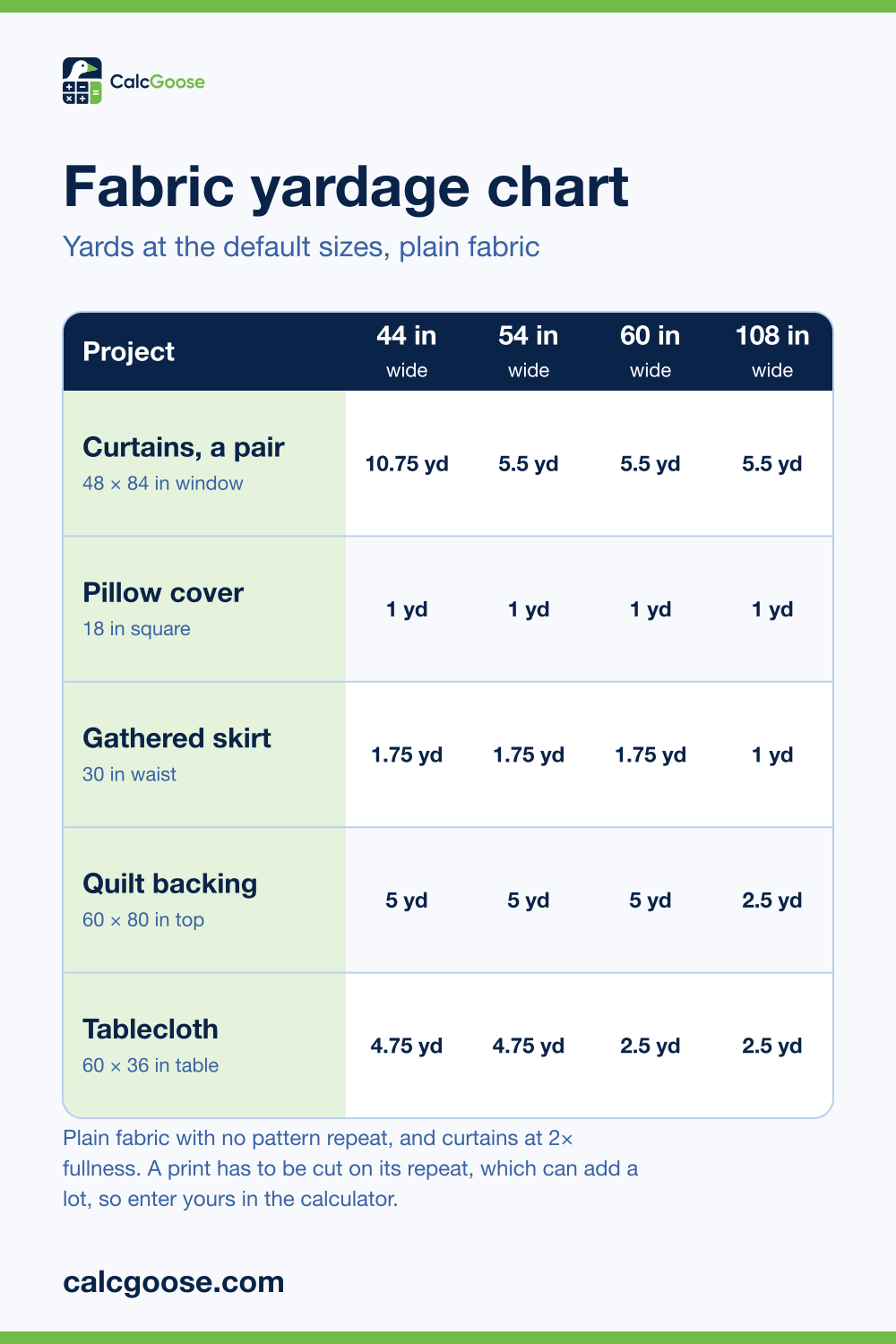
Fabric yardage chart
How much fabric common home sewing projects take on each standard fabric width, at the calculator's default sizes. Every figure comes from the same formula as the calculator above, including hems and rounding up to the next quarter yard.
| Project | 44 in wide | 54 in wide | 60 in wide | 108 in wide |
|---|---|---|---|---|
| Curtains, a pair48 × 84 in window | 10.75 yd | 5.5 yd | 5.5 yd | 5.5 yd |
| Pillow cover18 in square | 1 yd | 1 yd | 1 yd | 1 yd |
| Gathered skirt30 in waist | 1.75 yd | 1.75 yd | 1.75 yd | 1 yd |
| Quilt backing60 × 80 in top | 5 yd | 5 yd | 5 yd | 2.5 yd |
| Tablecloth60 × 36 in table | 4.75 yd | 4.75 yd | 2.5 yd | 2.5 yd |
Plain fabric with no pattern repeat, and curtains at 2× fullness. A print has to be cut on its repeat, which can add a lot, so enter yours in the calculator.
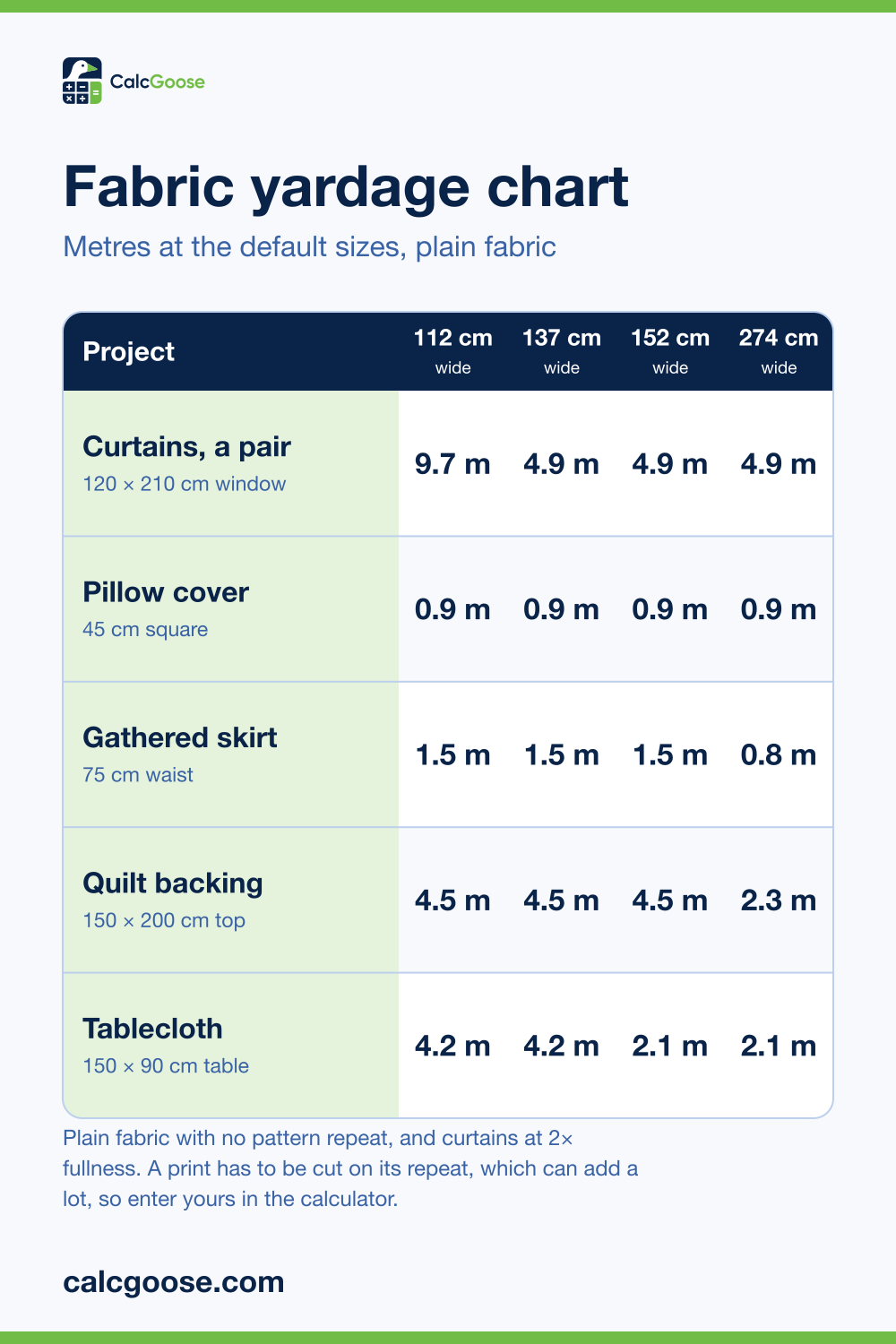
How much fabric common home sewing projects take on each standard fabric width, at the calculator's default sizes. Every figure comes from the same formula as the calculator above, including hems and rounding up to the next 10 cm.
| Project | 112 cm wide | 137 cm wide | 152 cm wide | 274 cm wide |
|---|---|---|---|---|
| Curtains, a pair120 × 210 cm window | 9.7 m | 4.9 m | 4.9 m | 4.9 m |
| Pillow cover45 cm square | 0.9 m | 0.9 m | 0.9 m | 0.9 m |
| Gathered skirt75 cm waist | 1.5 m | 1.5 m | 1.5 m | 0.8 m |
| Quilt backing150 × 200 cm top | 4.5 m | 4.5 m | 4.5 m | 2.3 m |
| Tablecloth150 × 90 cm table | 4.2 m | 4.2 m | 2.1 m | 2.1 m |
Plain fabric with no pattern repeat, and curtains at 2× fullness. A print has to be cut on its repeat, which can add a lot, so enter yours in the calculator.
Assumptions and limits
Everything this calculator quietly assumes on your behalf. If one of these does not match your situation, the answer will be off.
- One inch is deducted from the stated fabric width for selvedges. Some fabrics have wider unusable edges, particularly printed home-decor cottons.
- Curtain allowances are 8 inches for a doubled bottom hem and 4 inches for a rod-pocket or tape header, plus 2 inches total for side hems. Pinch-pleat or interlined curtains need more.
- Curtain fullness defaults to 2×, which is the standard for a gathered heading. Wave and eyelet headings often specify 2.2–2.5×; flat panels use 1.5×.
- Pillow covers assume an envelope back with two panels overlapping by about 40% of the pillow height, and a 0.5 inch seam allowance. The two back panels are laid side by side wherever the fabric is wide enough to take them, which is the case for most cushions on most fabric, and end to end when it is not. Zipped covers need slightly less fabric but more hardware.
- Quilt backing includes 4 inches of overage on every side, which is what most longarm quilters ask for. If you are quilting it yourself on a domestic machine, 2 inches is usually enough.
- Pattern repeat is applied by rounding every cut length up to a whole repeat. This is what makes patterns match across seams, and on a large repeat it can add 20% or more to the total.
- Nothing here accounts for shrinkage. Cotton and linen lose 3–5% on the first wash, so pre-wash before cutting or buy extra.
- Directional prints and napped fabrics such as velvet must all be cut the same way up, which can prevent efficient nesting of pieces. The estimates here assume a non-directional fabric.
Frequently asked questions
How much fabric do I need for curtains?
For a 48-inch window with a 84-inch drop, a pair of curtains at 2× fullness needs about 10.75 yards of 44-inch fabric, or roughly 5.5 yards of 54-inch. The width of the fabric matters as much as the size of the window, going from 44 to 54 inch fabric can halve the yardage by removing a seam.
How much fabric for a pillow cover?
About one yard of 44-inch fabric for a standard 18-inch envelope-back cover, counting the front panel and two overlapping back panels. The pieces are only 19 inches wide against 43 inches of usable fabric, so the two back panels sit side by side and cost one band of length between them rather than two. A 20-inch cover is about 1.25 yards. Cut straight down the roll without nesting them and the same cover takes half a yard more.
How much fabric do I need for a tablecloth?
Add twice your drop to both the length and the width of the table, then check whether that finished width fits inside one fabric width. A 72 × 36 inch table with a 10 inch drop finishes at 56 × 92 inches, which takes 2.75 yards of 60-inch fabric but 5.25 yards of 54-inch, because 56 inches plus seam allowance will not quite cross a 54-inch roll. Tablecloths are the project where a few inches of roll width doubles the bill, so check the width before you check the price.
What does fabric width mean?
It is how wide the roll is, measured selvedge to selvedge, and it is fixed. You buy length off it. Quilting cotton is typically 44 inches, home-decor fabric 54, and sheeting or knits 60 or more. Wider fabric often means fewer seams and less total yardage for the same project.
How much extra fabric do I need for a pattern repeat?
Enough to round every cut piece up to a whole repeat, which typically adds 10 to 25 percent. A fabric with a 24-inch repeat and an 86-inch curtain cut becomes a 96-inch cut, wasting ten inches per width. Large repeats on multi-width projects are where fabric budgets go wrong.
Should I pre-wash fabric before sewing?
Yes for anything washable, especially cotton and linen, which shrink 3 to 5 percent on the first wash. Wash and dry exactly as you intend to launder the finished item, then press before cutting. Skipping this is the most common reason a well-made curtain ends up two inches short.
How much fabric for a quilt backing?
The quilt top plus four inches on every side, which usually means two lengths of standard 44-inch fabric seamed down the middle. A 60 × 80 inch quilt needs about 5 yards of 44-inch backing, or 2.5 yards if you use 108-inch extra-wide backing fabric. Wide backing costs more per yard but often less overall.
How do I convert yards to metres for fabric?
One yard is 0.914 metres, so metres are roughly 10 percent fewer than yards, 5 yards is 4.6 metres. Fabric sold in metric is also usually 112, 137 or 150 cm wide rather than 44, 54 or 60 inches, and those are direct equivalents.
Related calculators
- Epoxy Resin Calculator Maker & Craft Work out how much resin a mould, river table or tumbler actually takes, split by part A and B.
- Candle Making Calculator Maker & Craft How much wax and fragrance oil a batch of candles needs, plus a wick size for your jar.
- Soap Lye Calculator Maker & Craft Work out exactly how much lye and water your oils need, with superfat and a full safety brief.
- 3D Print Cost Calculator Maker & Craft The real cost of a print (filament, power, wear and failures) and what to charge for it.
- Yarn Calculator Maker & Craft How much yarn a blanket, scarf or hat takes, by craft, stitch density and yarn weight.
- Vinyl & Sticker Pricing Calculator Maker & Craft What to charge for decals, shirts and signs once materials, labour and marketplace fees are in.
Share this calculator
Found the number you needed? Send it to whoever asked you for it.