Paver Calculator
Enter your patio size and paver dimensions to get the number of pavers, the gravel base, the bedding sand and the polymeric sand for the joints.
Last updated
Where are you?
AWG, NEC, 120/240 V, miles and gallons mm², IEC/BS 7671, 230/400 V, km and litres . We remember this on every calculator.
Your result
4 × 8 brick paver pavers to buy
568
- Without waste
- 516
- Patio area
- 120 sq ft
- Gravel base
- 1.48 cu yd
- Bedding sand
- 0.37 cu yd
- Polymeric sand
- 2 bags
- Edging needed
- 44 ft
🪿 The goose says: Buy 568 pavers. That is 516 to fill the area plus 10% for cuts. You also need 1.48 cu yd of gravel and 0.37 cu yd of bedding sand.
- Compact the gravel base in layers of no more than 3–4 inches. A base dumped in one lift and tamped on top looks fine and sinks within a year.
- Order the full 568 at once. Paver colour varies between production batches, and a top-up pallet ordered a week later will not match.
- You also need about 44 ft of restrained edging around the perimeter. Without it the outer pavers creep and the whole field loosens.
How this paver calculator works
Paver counting is deceptively simple, patio area divided by the area one paver occupies. The trap is that a paver occupies more than its own footprint. It also takes half a joint on each side, so a 4 × 8 inch paver with an eighth-inch joint really covers 4.125 × 8.125.
On a small patio that difference is a handful of pavers. On a large one with wide joints it is a pallet.
The base is a separate calculation and uses the same 324 constant that governs every bulk landscape material, square feet times depth in inches, divided by 324, gives cubic yards. Base depth is the thing most DIY patios get wrong, and it is the only part you cannot fix later.
-
Step 1 Patio area
area = length × width -
Step 2 Area one paver occupies
paver_area = (paver_L + gap) × (paver_W + gap) ÷ 144Divide by 144 to convert square inches to square feet. -
Step 3 Paver count with cutting waste
pavers = ceil(area ÷ paver_area × (1 + waste%))10% is standard; 15% for herringbone, diagonal layouts or curved edges. -
Step 4 Or in metric
paver_area_m² = (L_cm + gap) × (W_cm + gap) ÷ 10,000The same sum without the 144, because metric units already nest in powers of ten. -
Step 5 Gravel base and bedding sand
cubic_yards = area × depth_inches ÷ 324, or cubic_metres = area_m² × depth_cm ÷ 100 -
Step 6 Joint sand and edging
poly_sand_bags = ceil(area ÷ 100)
edging = perimeter of the patio
For example, a 12 × 10 ft patio is 120 square feet. A 4 × 8 in paver with 1/8 in joints occupies 0.233 sq ft, so you need 516 pavers, or 568 with 10% waste. The base at 4 inches is 1.48 cubic yards of gravel plus 0.37 of sand.
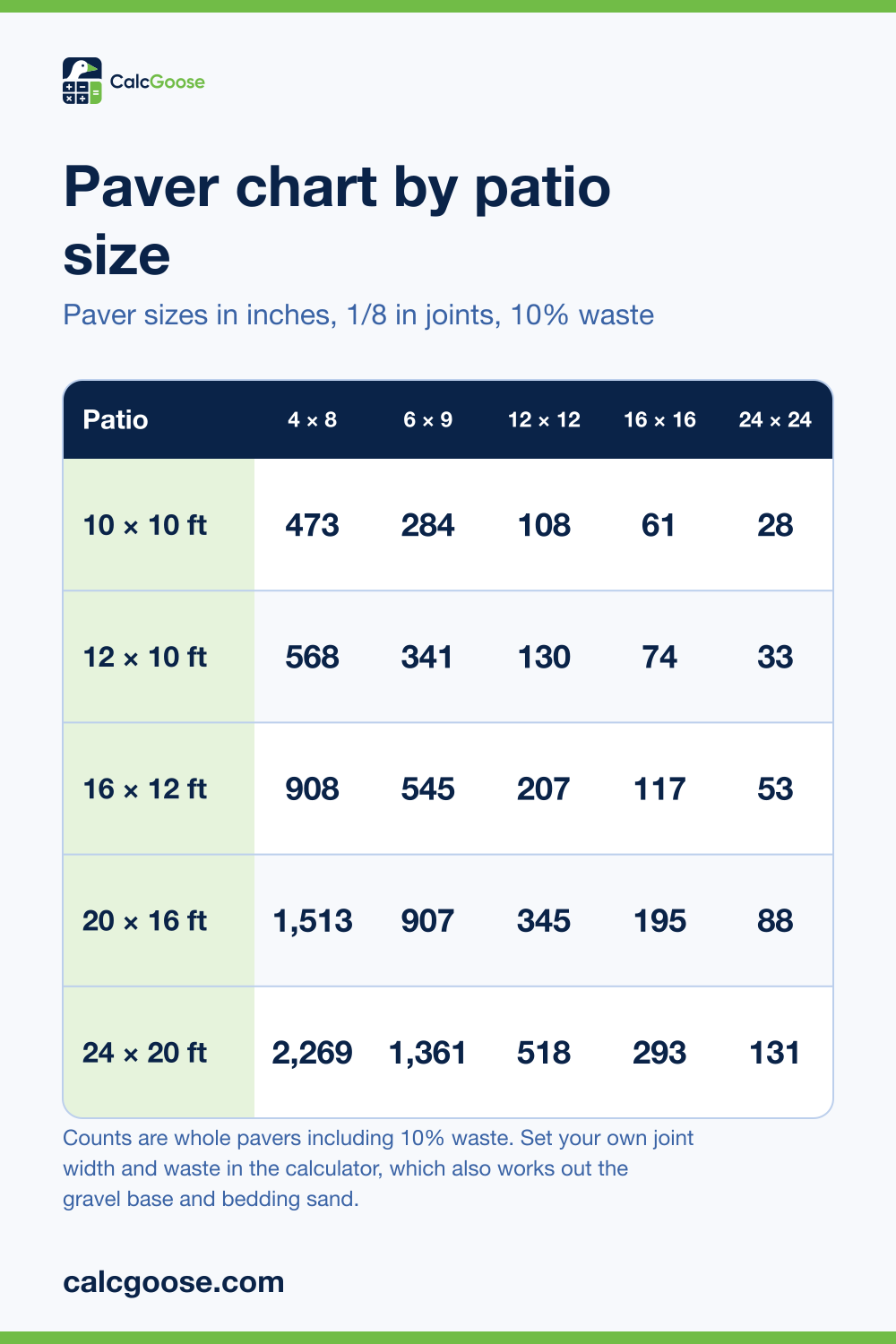
Paver chart by patio size
How many pavers common patio sizes take, for each paver size the calculator offers, measured in inches, with 1/8 in joints and 10% cutting waste. Every figure comes from the same formula as the calculator above.
| Patio | 4 × 8 | 6 × 9 | 12 × 12 | 16 × 16 | 24 × 24 |
|---|---|---|---|---|---|
| 10 × 10 ft | 473 | 284 | 108 | 61 | 28 |
| 12 × 10 ft | 568 | 341 | 130 | 74 | 33 |
| 16 × 12 ft | 908 | 545 | 207 | 117 | 53 |
| 20 × 16 ft | 1,513 | 907 | 345 | 195 | 88 |
| 24 × 20 ft | 2,269 | 1,361 | 518 | 293 | 131 |
Counts are whole pavers including 10% waste. Set your own joint width and waste in the calculator, which also works out the gravel base and bedding sand.
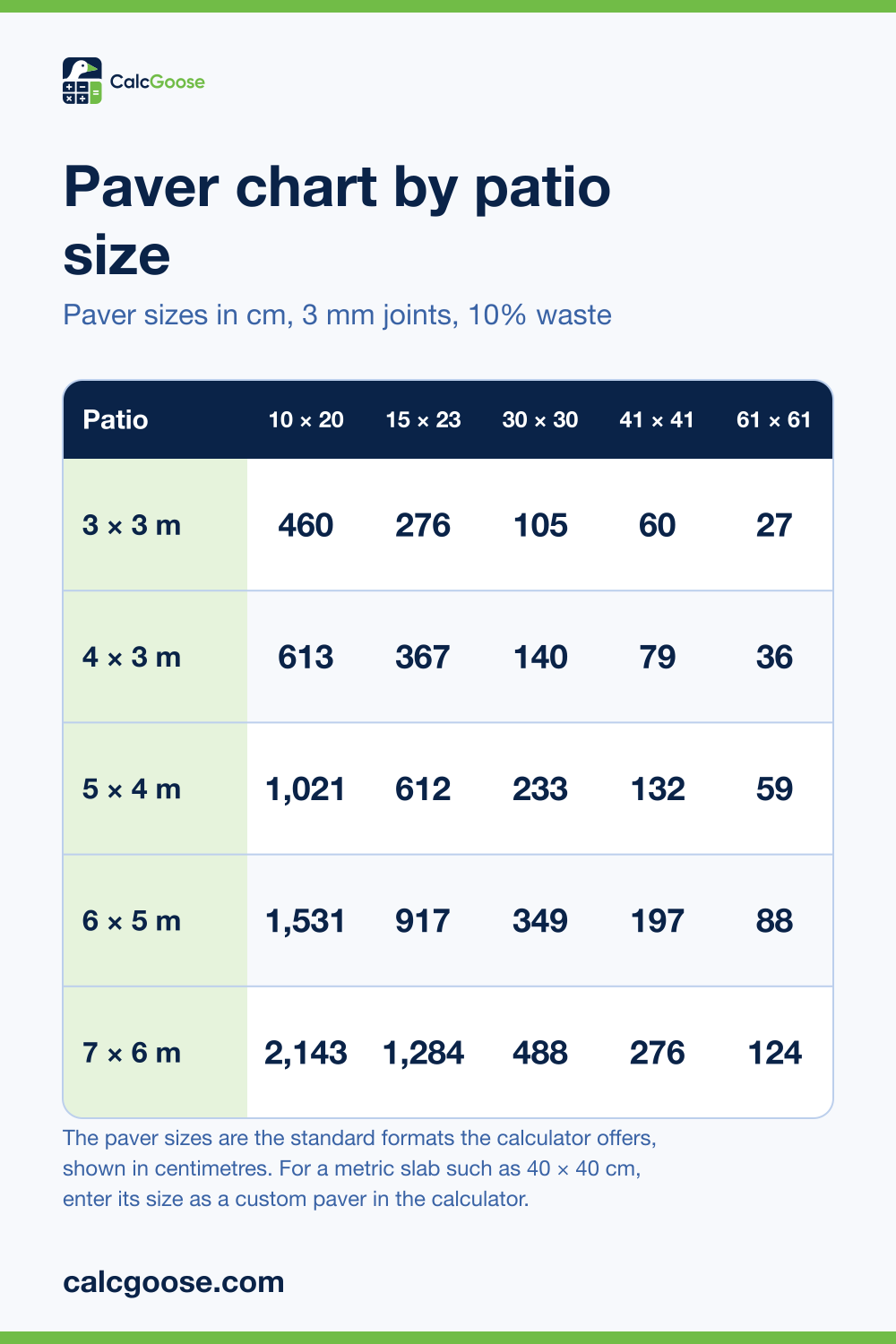
How many pavers common patio sizes take, for each paver size the calculator offers, measured in centimetres, with 3 mm joints and 10% cutting waste. Every figure comes from the same formula as the calculator above.
| Patio | 10 × 20 | 15 × 23 | 30 × 30 | 41 × 41 | 61 × 61 |
|---|---|---|---|---|---|
| 3 × 3 m | 460 | 276 | 105 | 60 | 27 |
| 4 × 3 m | 613 | 367 | 140 | 79 | 36 |
| 5 × 4 m | 1,021 | 612 | 233 | 132 | 59 |
| 6 × 5 m | 1,531 | 917 | 349 | 197 | 88 |
| 7 × 6 m | 2,143 | 1,284 | 488 | 276 | 124 |
The paver sizes are the standard formats the calculator offers, shown in centimetres. For a metric slab such as 40 × 40 cm, enter its size as a custom paver in the calculator.
Assumptions and limits
Everything this calculator quietly assumes on your behalf. If one of these does not match your situation, the answer will be off.
- Pavers are assumed to be laid in a running bond or stack pattern. Herringbone at 45 degrees needs closer to 15% waste because every perimeter paver is a diagonal cut.
- The nominal paver size is used. Manufacturers usually make pavers a fraction under nominal so that with a standard joint they lay out on a clean module, using the nominal figure with a joint added is the conventional way to count.
- Polymeric sand is estimated at one 50 lb bag per 100 square feet, which suits joints of about an eighth of an inch on standard pavers. Wide joints, large-format slabs or permeable pavers use considerably more.
- Gravel base depth defaults to 4 inches, which suits a patio or walkway on stable, well-drained soil. Clay soils, driveways and hard-freeze climates need 6 to 12 inches, and that judgement is site-specific.
- The base volume is the compacted depth. Crushed stone compacts by roughly 20%, so order about 20% more loose material than the figure shown, or specify compacted yardage with your supplier.
- Bedding sand is 1 inch screeded flat. This is a levelling layer only; using sand to correct base depth is the most common cause of settling.
- Edging is the patio perimeter. Curved edges and steps need more, and any edge against a house wall or existing hard surface needs none.
- Excavation depth is not calculated. Total dig is base depth plus sand depth plus paver thickness, which for a typical patio is around 9 inches.
- The paver size presets are US formats. In metric mode the standard European block paver of 200 × 100 mm is the Custom option with 20 and 10 entered, and the joint drops to about 3 mm for a sand-set laying course.
Frequently asked questions
How many pavers do I need for a 10 × 12 patio?
About 568 standard 4 × 8 inch pavers, which is 516 to fill the 120 square feet plus 10% for cuts. With 12 × 12 inch slabs the same patio needs about 130. Always order the full amount in one go so the colour batch matches.
How deep should a paver base be?
Four inches of compacted gravel for a patio or walkway on stable soil, six inches for clay or poor drainage, and eight to twelve for a driveway or a hard-freeze climate. Compact it in lifts of three to four inches, a base dumped in one go and tamped on top will sink no matter how deep it is.
Do I need polymeric sand or regular sand?
Polymeric for the joints, regular concrete sand for the bedding layer. Polymeric sand contains a binder that sets when wetted, locking the joints and blocking weeds and ants. Follow the wetting instructions precisely, under-wetting leaves it loose and over-wetting hazes the paver surface permanently.
Can I lay pavers directly on dirt?
You can, and it will look fine for one season. Without a compacted gravel base the pavers sink unevenly as the soil settles and shifts with moisture, and frost heave will lift them out of level in any climate that freezes. The base is what the patio actually stands on.
How much does a paver patio cost per square foot?
Materials typically run 6 to 15 per square foot for pavers, base, sand and edging, depending on paver style. Professional installation usually adds another 8 to 20 per square foot. Large-format slabs and permeable systems sit at the top of both ranges.
How much waste should I allow for cutting?
Ten percent for a straightforward rectangular patio in running bond. Fifteen for herringbone or any 45-degree pattern, because every perimeter piece is a diagonal cut and the offcuts are rarely reusable. Curved edges and circular features can need twenty.
How much does a pallet of pavers cover?
It varies by paver, but a typical pallet of 4 × 8 inch pavers holds around 480 to 500 units, covering roughly 105 to 115 square feet. Suppliers quote coverage per pallet on the product page. Check it, because pallet counts differ significantly between manufacturers.
Guides on this
The reasoning behind the number, and the decisions it does not make for you.
Related calculators
- Mulch Calculator Home & Yard Cubic yards, bags or tons of mulch, soil or gravel for any number of beds.
- Wallpaper Calculator Home & Yard How many rolls a room needs, counted by strips rather than square footage.
- Paint Calculator Home & Yard Gallons of paint for a room, with coats, doors, windows and ceiling accounted for.
- Deck Board Calculator Home & Yard Board count, linear feet, screws and joists for a deck of any size.
- Fence Calculator Home & Yard Posts, panels, pickets, rails and concrete for a fence run of any length.
- Grass Seed Calculator Home & Yard Pounds of seed or pallets of sod for a lawn, by grass type and whether you are seeding or overseeding.
- Concrete Calculator Home & Yard Concrete for slabs, footings, post holes and columns, in yards or metres and in bags.
Share this calculator
Found the number you needed? Send it to whoever asked you for it.