Generator Fuel Calculator
Set your generator size and how hard it is working to see the burn rate, how long a tank lasts, how much fuel a day of outage takes, and what a kilowatt-hour costs you.
Last updated
Where are you?
AWG, NEC, 120/240 V, miles and gallons mm², IEC/BS 7671, 230/400 V, km and litres . We remember this on every calculator.
Your result
Run time on a full tank
8 h 53 min
- Burn rate
- 0.67 gal/h
- Output
- 3.75 kW
- Fuel per day
- 8.10 gal
- Cost per hour
- $2.77
- Cost per day
- $33.21
- Cost per kWh
- $0.74
🪿 The goose says: At 50% load it burns 0.67 gal an hour, so a 6 gal tank lasts 8 h 53 min. Running 12 hours a day costs $33.21 and takes 8.10 gal of fuel.
- At 50% load this set empties its 6 gal tank in 8 h 53 min. Running 12 hours a day means 1.35 refuels a day and 8.10 gal of fuel.
- Gasoline goes stale in three to six months, and ethanol-blended fuel absorbs water and gums carburettors faster than that. Treat storage fuel with stabilizer, rotate it through the car twice a year, and never store more than you will use in a season.
Estimate for planning only. Have any electrical work verified by a qualified electrician and installed to code. See the full disclaimer at the bottom of this page.
Fuel burn by load
What a 7.50 kW set on gasoline costs at each point on the dial.
- 25% load, 1.88 kW
- 0.45 gal/h 13 h 20 min on a tank · $1.84/h
- 50% load, 3.75 kW
- 0.67 gal/h 8 h 53 min on a tank · $2.77/h
- 75% load, 5.63 kW
- 0.90 gal/h 6 h 40 min on a tank · $3.69/h
- 100% load, 7.50 kW
- 1.13 gal/h 5 h 20 min on a tank · $4.61/h
Consumption is modelled as an idle term plus a marginal term per kilowatt, fitted to published manufacturer consumption tables. It is not a straight proportion of load, which is why quarter load never costs a quarter as much.
What a kilowatt-hour costs on each fuel
Same 7.50 kW set at 50% load, delivering 3.75 kW.
- Gasoline
- $0.74 / kWh 0.67 gal/h · $2.77/h
- Propane
- $0.49 / kWh 0.75 gal/h · $1.83/h
- Diesel
- $0.55 / kWh 0.38 gal/h · $2.04/h
- Natural gas
- $0.26 / kWh 64.8 ft³/h · $0.97/h
At $4.10/gal gasoline, $2.45/gal propane, $5.45/gal diesel and $1.45/therm gas. For comparison, grid electricity is typically $0.18 per kWh. A generator is emergency power, never cheap power.
How this generator fuel calculator works
Almost every fuel figure you will find quoted is consumption at full load, and almost nobody runs a generator at full load. That single mismatch is why people budget half the fuel they end up needing.
An engine has two separate fuel costs. One is fixed. It burns fuel simply to keep turning at 3,600 rpm, whether or not anything is plugged in. The other is proportional, rising with every kilowatt it actually delivers. Add them and consumption is a straight line, not a proportion, which is why a generator at quarter load uses closer to a third of its full-load fuel rather than a quarter.
Fitting that line to published manufacturer consumption tables gives a per-kilowatt idle term and a per-kilowatt marginal term for each fuel. Those two coefficients reproduce the 25%, 50% and 100% columns in the manuals to within a few percent, across sizes from a 2 kW inverter to a 48 kW standby set.
The fuels themselves then differ in energy density. Diesel carries 138,700 BTU per gallon and burns in a more efficient cycle; gasoline carries 120,000; propane only 91,500, which is why a propane generator empties a tank faster than a gasoline one of the same size even though propane is cheaper per gallon.
-
Step 1 Fuel burn per hour
burn = rated_kW × (idle_term + marginal_term × load_fraction)Gasoline 0.030 + 0.120; propane 0.036 + 0.127; diesel 0.010 + 0.080 gallons per rated kW. Natural gas 2.96 + 11.36 cubic feet. -
Step 2 Run time on a tank
hours = usable_tank_capacity ÷ burn_per_hour -
Step 3 Fuel for a day of outage
per_day = burn_per_hour × hours_you_run_it -
Step 4 What it costs to run
cost_per_hour = burn_per_hour × fuel_price -
Step 5 Cost per kilowatt-hour
cost_per_kWh = cost_per_hour ÷ (rated_kW × load_fraction)The number worth comparing against your electricity rate, and against a bigger battery. -
Step 6 Natural gas pricing
therms = cubic_feet ÷ 97; cost = therms × price_per_thermOne therm is 100,000 BTU, and natural gas runs about 1,030 BTU per cubic foot.
For example, a 7.5 kW gasoline portable at 50% load burns 7.5 × (0.030 + 0.120 × 0.5) = 0.68 gallons an hour. A 6-gallon tank lasts 8 hours 53 minutes. Running it 12 hours a day takes 8.1 gallons, about $33 a day at $4.10, or $0.74 per kilowatt-hour delivered, roughly four times what the grid charges.
Almost every fuel figure you will find quoted is consumption at full load, and almost nobody runs a generator at full load. That single mismatch is why people budget half the fuel they end up needing.
An engine has two separate fuel costs. One is fixed. It burns fuel simply to keep turning at 3,000 rpm, whether or not anything is plugged in. The other is proportional, rising with every kilowatt it actually delivers. Add them and consumption is a straight line, not a proportion, which is why a generator at quarter load uses closer to a third of its full-load fuel rather than a quarter.
Fitting that line to published manufacturer consumption tables gives a per-kilowatt idle term and a per-kilowatt marginal term for each fuel. Those two coefficients reproduce the 25%, 50% and 100% columns in the manuals to within a few percent, across sizes from a 2 kW inverter to a 40 kW standby set.
The fuels themselves then differ in energy density. Diesel carries about 36.6 MJ per litre and burns in a more efficient cycle, which is why it dominates European standby generation; petrol carries 33.5; LPG only 25.5, so an LPG set empties a bottle faster than a petrol one of the same size even though the gas is cheaper per litre.
-
Step 1 Fuel burn per hour
burn = rated_kW × (idle_term + marginal_term × load_fraction)Per rated kW and converted to litres, petrol 0.114 + 0.454; LPG 0.136 + 0.481; diesel 0.038 + 0.303 litres. Natural gas 0.084 + 0.322 cubic metres. -
Step 2 Run time on a tank
hours = usable_tank_capacity ÷ burn_per_hour -
Step 3 Fuel for a day of outage
per_day = burn_per_hour × hours_you_run_it -
Step 4 What it costs to run
cost_per_hour = burn_per_hour × fuel_price -
Step 5 Cost per kilowatt-hour
cost_per_kWh = cost_per_hour ÷ (rated_kW × load_fraction)The number worth comparing against your electricity tariff, and against a bigger battery. -
Step 6 Natural gas pricing
cost = cubic_metres × price_per_m³If your bill is in kWh, one cubic metre of natural gas is about 10.55 kWh.
For example, a 6 kW diesel set at 50% load burns 6 × (0.038 + 0.303 × 0.5) = 1.14 litres an hour. A 25-litre tank lasts 22 hours. Running it 12 hours a day takes 13.6 litres, about €27 a day at €1.98, or €0.75 per kilowatt-hour delivered, more than two and a half times the grid tariff.
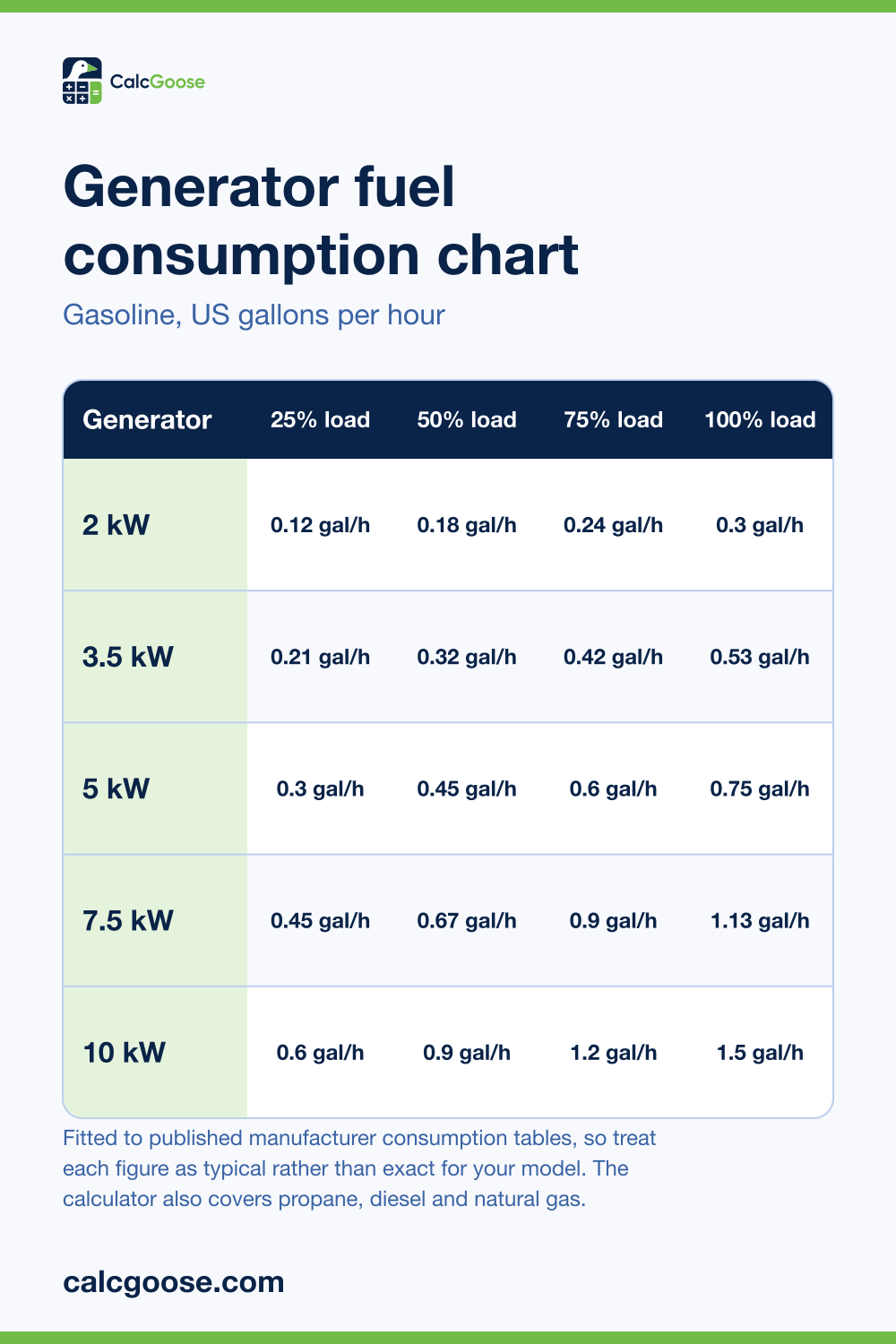
Generator fuel consumption chart
Gasoline burned per hour by portable generators at different loads, from the same consumption model as the calculator above. Part load is where headline fuel figures mislead most.
| Generator | 25% load | 50% load | 75% load | 100% load |
|---|---|---|---|---|
| 2 kW | 0.12 gal/h | 0.18 gal/h | 0.24 gal/h | 0.3 gal/h |
| 3.5 kW | 0.21 gal/h | 0.32 gal/h | 0.42 gal/h | 0.53 gal/h |
| 5 kW | 0.3 gal/h | 0.45 gal/h | 0.6 gal/h | 0.75 gal/h |
| 7.5 kW | 0.45 gal/h | 0.67 gal/h | 0.9 gal/h | 1.13 gal/h |
| 10 kW | 0.6 gal/h | 0.9 gal/h | 1.2 gal/h | 1.5 gal/h |
Fitted to published manufacturer consumption tables, so treat each figure as typical rather than exact for your model. The calculator also covers propane, diesel and natural gas.
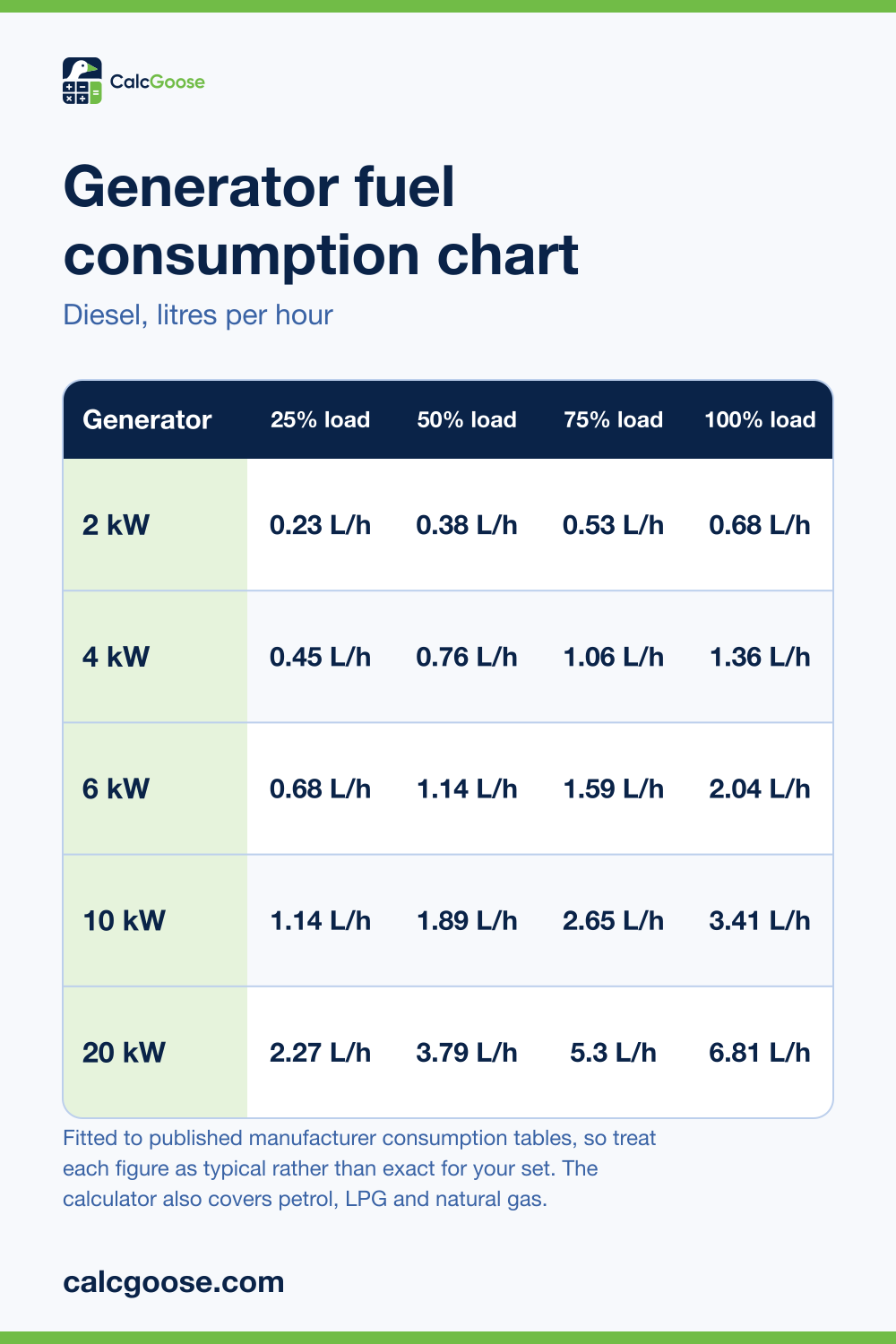
Diesel burned per hour by generators at different loads, from the same consumption model as the calculator above. Part load is where headline fuel figures mislead most.
| Generator | 25% load | 50% load | 75% load | 100% load |
|---|---|---|---|---|
| 2 kW | 0.23 L/h | 0.38 L/h | 0.53 L/h | 0.68 L/h |
| 4 kW | 0.45 L/h | 0.76 L/h | 1.06 L/h | 1.36 L/h |
| 6 kW | 0.68 L/h | 1.14 L/h | 1.59 L/h | 2.04 L/h |
| 10 kW | 1.14 L/h | 1.89 L/h | 2.65 L/h | 3.41 L/h |
| 20 kW | 2.27 L/h | 3.79 L/h | 5.3 L/h | 6.81 L/h |
Fitted to published manufacturer consumption tables, so treat each figure as typical rather than exact for your set. The calculator also covers petrol, LPG and natural gas.
Assumptions and limits
Everything this calculator quietly assumes on your behalf. If one of these does not match your situation, the answer will be off.
- Consumption uses a two-term linear model fitted to published manufacturer data. Real engines vary by 15% either way depending on age, tune, altitude and how well the governor holds speed.
- The load percentage is of rated output, not of the surge rating. If your generator is advertised at 9,000 starting watts and 7,500 running watts, the running figure is the one to enter.
- Tank capacity means usable capacity. Portables cannot run a tank completely dry without picking up sediment, and bulk propane tanks are filled to 80% by law to leave room for expansion.
- Propane figures assume the tank can vaporise fast enough to keep up. In freezing weather a small cylinder cannot, and the generator will starve regardless of how much gas is left in it.
- Natural gas is assumed to be at normal supply pressure with a correctly sized line. An undersized gas line is the most common cause of a standby set failing to reach its rated output.
- Energy content is taken as 120,000 BTU per gallon for gasoline, 91,500 for propane, 138,700 for diesel and 1,030 BTU per cubic foot for natural gas. These are higher heating values and vary a little by season and region.
- Gasoline coefficients are fitted to portable engines and propane coefficients to standby sets, because that is where each fuel is normally used. Comparing the two at the same rated kilowatts therefore understates the gap you would see on one dual-fuel machine, where switching to propane typically lifts consumption by 25 to 30% rather than the 10% these figures imply.
- No allowance is made for the fuel used during weekly exercise cycles, which for a standby set add up to a few gallons a year on top of anything an outage costs.
- Consumption uses a two-term linear model fitted to published manufacturer data. Real engines vary by 15% either way depending on age, tune, altitude and how well the governor holds speed.
- The load percentage is of rated output, not of the surge rating. If your set is advertised in kVA, multiply by 0.8 first, a 5 kVA generator is a 4 kW one for these purposes.
- Tank capacity means usable capacity. Portables cannot run a tank completely dry without picking up sediment, and bulk LPG tanks are filled to 80% to leave room for expansion.
- LPG figures assume the bottle can vaporise fast enough to keep up. In freezing weather a single small bottle cannot, and the generator will starve regardless of how much gas is left in it.
- European LPG is usually propane rather than the propane-butane mix sold for heating; butane will not vaporise below about 0°C at all.
- Energy content is taken as 33.5 MJ per litre for petrol, 25.5 for LPG, 36.6 for diesel and 10.55 kWh per cubic metre for natural gas. These vary a little by season and supplier.
- No allowance is made for the fuel used during weekly exercise cycles, which for a standby set add up to several litres a year on top of anything an outage costs.
Frequently asked questions
How much fuel does a generator use per hour?
A 7.5 kW gasoline portable at half load burns about 0.68 gallons an hour, and about 1.13 gallons at full load. Diesel sets of the same size use roughly half that, and propane about 10% more by volume. The load matters as much as the size, because an engine burns fuel just to spin.
How long will a generator run on a tank of gas?
A typical 6-gallon portable at half load runs 8 to 9 hours, which is why manufacturers quote "8 hours at 50% load" on the box. At full load the same tank gives about 5 hours. Larger standby sets on natural gas never run out at all, since they are piped.
How long will a generator run on a 20 lb propane tank?
A 20 lb barbecue cylinder holds about 4.6 usable gallons, which runs a 7.5 kW generator for roughly 6 hours at half load or 3 hours 45 minutes at full load. On a small 2 kW inverter it stretches to about 24 hours. In freezing weather expect less, because a small cylinder cannot vaporise gas fast enough to keep up.
How much natural gas does a whole house generator use?
A 22 kW standby set draws about 190 cubic feet an hour at half load and 315 at full, which is roughly 1.9 and 3.2 therms. At $1.45 a therm that works out to about $2.85 an hour, or $34 for a twelve-hour day, and it never needs refuelling. The catch is supply rather than cost, because plenty of residential meters cannot deliver 300 cubic feet an hour alongside a furnace and a water heater without the utility upsizing them first.
How much propane does a whole house generator use?
A 22 kW standby set burns about 2.2 gallons an hour at half load and 3.6 at full load. A 500-gallon tank holds 400 usable gallons, so it will carry that generator for roughly 7 days of continuous running at half load, or two to three weeks if you cycle it 12 hours a day. Sizing the tank is really a question of how long an outage you want to survive without a delivery.
Is propane or gasoline cheaper to run a generator?
Propane, at current prices. Gasoline near $4.10 a gallon works out to about 74 cents per kilowatt-hour on a 7.5 kW set at half load, while propane near $2.45 comes to about 49 cents, even though you burn slightly more of it by volume. That ranking follows the pump prices rather than the chemistry and it has flipped before, so check both before you commit. Propane also stores indefinitely, burns cleaner and does not gum up a carburettor, which suits a generator that sits unused most years.
How much does it cost to run a generator for a day?
A 7.5 kW gasoline portable at half load, run 12 hours a day, uses about 8 gallons, which is roughly $33 at $4.10 a gallon. A 22 kW standby on piped natural gas is about $34 for the same twelve hours and never needs refuelling, though it is delivering three times the power. Per kilowatt-hour the portable costs around four times the grid rate while the natural gas set costs about half as much again, which is why piped gas is the cheapest way to ride out a long outage.
Why does my generator use so much fuel at low load?
Because most of the fuel goes into keeping the engine turning rather than into the electricity. A conventional generator runs at a fixed 3,600 rpm whatever the load, so idle consumption is nearly constant. Inverter generators solve exactly this problem by varying engine speed with demand, and they can cut light-load consumption by half.
How much fuel does a generator use per hour?
A 6 kW diesel set at half load burns about 1.14 litres an hour, and 2.05 litres at full load. Petrol sets of the same size use nearly twice as much, and LPG a shade over twice, by volume. The load matters as much as the size, because an engine burns fuel just to spin.
How long will a generator run on a tank?
A typical 25-litre diesel tank at half load runs about 22 hours; a 13-litre petrol portable runs 5 to 6 hours. Manufacturers quote run time at 50% or 75% load, so always check which figure is on the box. Sets fed from piped natural gas never run out.
How long will a generator run on a 13kg LPG bottle?
A 13 kg bottle holds about 25 litres of liquid propane, which runs a 6 kW generator for roughly 12 hours at half load. On a 2 kW inverter it stretches past 30 hours. In freezing weather expect less, because a single bottle cannot vaporise gas fast enough and the regulator ices up.
Is diesel or petrol cheaper for a generator?
Diesel, by a wide margin, usually 40 to 50% less per kilowatt-hour. Diesel engines are more efficient, the fuel carries more energy per litre, and the price gap at the pump is small in most of Europe. It is why almost every European standby set above about 5 kVA is a diesel.
How much does it cost to run a generator for a day?
A 6 kW diesel set at half load, run 12 hours a day, uses about 13.7 litres, roughly €27 at €1.98 a litre. The same job on petrol costs closer to €45. Either way you are paying between two and a half and four times the grid tariff per kilowatt-hour, which is the price of having power at all.
Why does my generator use so much fuel at low load?
Because most of the fuel goes into keeping the engine turning rather than into the electricity. A conventional generator runs at a fixed 3,000 rpm whatever the load, so idle consumption is nearly constant. Inverter generators solve exactly this problem by varying engine speed with demand, and they can cut light-load consumption by half.
What is wet stacking and should I worry about it?
Wet stacking is unburnt fuel and soot glazing the cylinders of a diesel engine that has been run too lightly for too long, and it is the main reason not to buy a diesel set far larger than your load. Keep a diesel above about 30% of its rating in normal use, and give it an hour a month at 50% or more. Petrol and LPG engines are not affected.
Guides on this
The reasoning behind the number, and the decisions it does not make for you.
- Which generator fuel keeps, and for how long Petrol goes off in months, diesel in about a year, propane effectively never. That difference matters more than efficiency for a machine used twice a decade.
- How long a tank lasts, and why load decides it Run time figures on a spec sheet assume a quarter or half load. Put the house on it and the same tank empties in a fraction of the advertised hours.
Related calculators
- Generator Size Calculator Generators Size it from your appliances, or from your floor area and panel, with the surge load included.
- Watts Calculator Generators Convert between watts, amps, volts and kilowatt-hours, on DC, single-phase or three-phase.
- Home Wattage Calculator Generators How many watts your house actually uses, from average draw to everything-at-once peak and the monthly bill.
- kVA Calculator Generators Convert kVA to kW, amps and horsepower, single or three-phase, with power factor handled properly.
- Whole House Generator Cost Calculator Generators The full installed cost of a generator (unit, transfer switch, gas line, pad, labour and permit).
- UPS Runtime Calculator Power & Off-Grid How many minutes your UPS really holds your gear up, by battery rather than by guesswork.
- Off-Grid Solar & Battery Calculator Power & Off-Grid How many solar panels and batteries you need, from what you actually run in a day.
Share this calculator
Found the number you needed? Send it to whoever asked you for it.
Safety disclaimer
Never run a generator indoors, in a garage, in a crawlspace or within 20 feet of a window or door. Carbon monoxide from a portable generator is odorless and kills in minutes; it is the leading cause of death after a storm. Let the engine cool before refuelling (petrol spilled on a hot muffler ignites) and store fuel in approved containers away from the house.
Never run a generator indoors, in a garage, in an outbuilding or within 6 metres of a window or door. Carbon monoxide from a portable generator is odourless and kills in minutes. Let the engine cool before refuelling (petrol spilled on a hot exhaust ignites) and store fuel in approved containers away from the house. LPG bottles must stand upright, outdoors, and never below ground level, because propane is heavier than air and pools.