Cat Calorie Calculator
Work out how many calories your cat needs a day using the standard veterinary equation, then how much dry or wet food that actually is.
Last updated
Where are you?
AWG, NEC, 120/240 V, miles and gallons mm², IEC/BS 7671, 230/400 V, km and litres . We remember this on every calculator.
Your result
Calories per day
280 kcal
- Dry food
- 0.80 cups
- Wet food
- 3.12 cans
- Half and half
- 0.40 cup + 1.56 cans
- Resting requirement
- 234 kcal
- Treat allowance
- 28 kcal
- Based on
- 11 lb
🪿 The goose says: Feed about 280 kcal a day. That is 0.80 cups of dry food, or 3.12 cans of wet, or a mix of the two.
- Weigh the food rather than scooping it. A "cup" is a measured 8 fl oz, and the scoop in the bag usually is not. That difference alone accounts for a lot of feline obesity.
- Treats count. They should be under 10% of daily calories, which for this cat is about 28 kcal, roughly two or three small commercial treats, not a handful.
Estimate for planning only. Have any electrical work verified by a qualified electrician and installed to code. See the full disclaimer at the bottom of this page.
How this cat calorie calculator works
Cat feeding runs on the same equation vets use for every species, resting energy requirement equals 70 times body weight in kilograms raised to the power of 0.75. That exponent is the important part, metabolism does not scale linearly with size, so a 6 kg cat does not need half again what a 4 kg cat does.
Resting requirement is what the cat burns doing nothing. Multiply by a factor for its situation and you get the daily requirement, 1.2 for a neutered adult, 1.4 for an intact one, 2.5 for a kitten. Neutering takes the multiplier from 1.4 down to 1.2, about 15% less food, which is exactly why so many cats gain weight in the year after the operation.
Weight loss works differently, and getting it wrong is dangerous. The calculation is based on the target weight rather than the current one, then multiplied by 0.8, because feeding a fraction of what an overweight cat currently needs still feeds it for being overweight.
-
Step 1 Resting energy requirement
RER = 70 × weight_kg^0.75For weight loss, use the target weight here rather than the current one. -
Step 2 Daily requirement
DER = RER × factorNeutered adult 1.2, intact 1.4, senior 1.1, kitten 2.5, weight loss 0.8. -
Step 3 Convert to dry food
cups = DER ÷ kcal_per_cupTypical dry cat food is 350–450 kcal per measured cup. -
Step 4 Convert to wet food
cans = DER ÷ kcal_per_canA 3 oz / 85 g can is usually 70–100 kcal. -
Step 5 Check the pace of weight loss
weekly% = (current − target) ÷ current ÷ weeks × 100Must stay under 2% per week. Above that, the risk of hepatic lipidosis rises sharply.
For example, a 5 kg neutered adult cat. RER is 70 × 5^0.75 = 234 kcal, times 1.2 gives 281 kcal a day, which is about 0.8 cups of a 350 kcal/cup dry food, or roughly 3 cans of a 90 kcal wet food.
Cat calorie chart
Daily calories to keep a healthy adult cat at its current weight, by life stage. Every figure comes from the same veterinary energy equation as the calculator above.
| Cat weight | Neutered adult | Intact adult | Senior 11+ years |
|---|---|---|---|
| 6 lb | 178 kcal | 208 kcal | 163 kcal |
| 8 lb | 221 kcal | 258 kcal | 202 kcal |
| 10 lb | 261 kcal | 305 kcal | 239 kcal |
| 12 lb | 299 kcal | 349 kcal | 274 kcal |
| 14 lb | 336 kcal | 392 kcal | 308 kcal |
| 16 lb | 371 kcal | 433 kcal | 340 kcal |
For maintaining weight only. Cats vary by up to 20% around this, so adjust by watching body condition. Weight loss has to be planned from the target weight with your vet, because losing weight too fast can cause fatal liver disease.
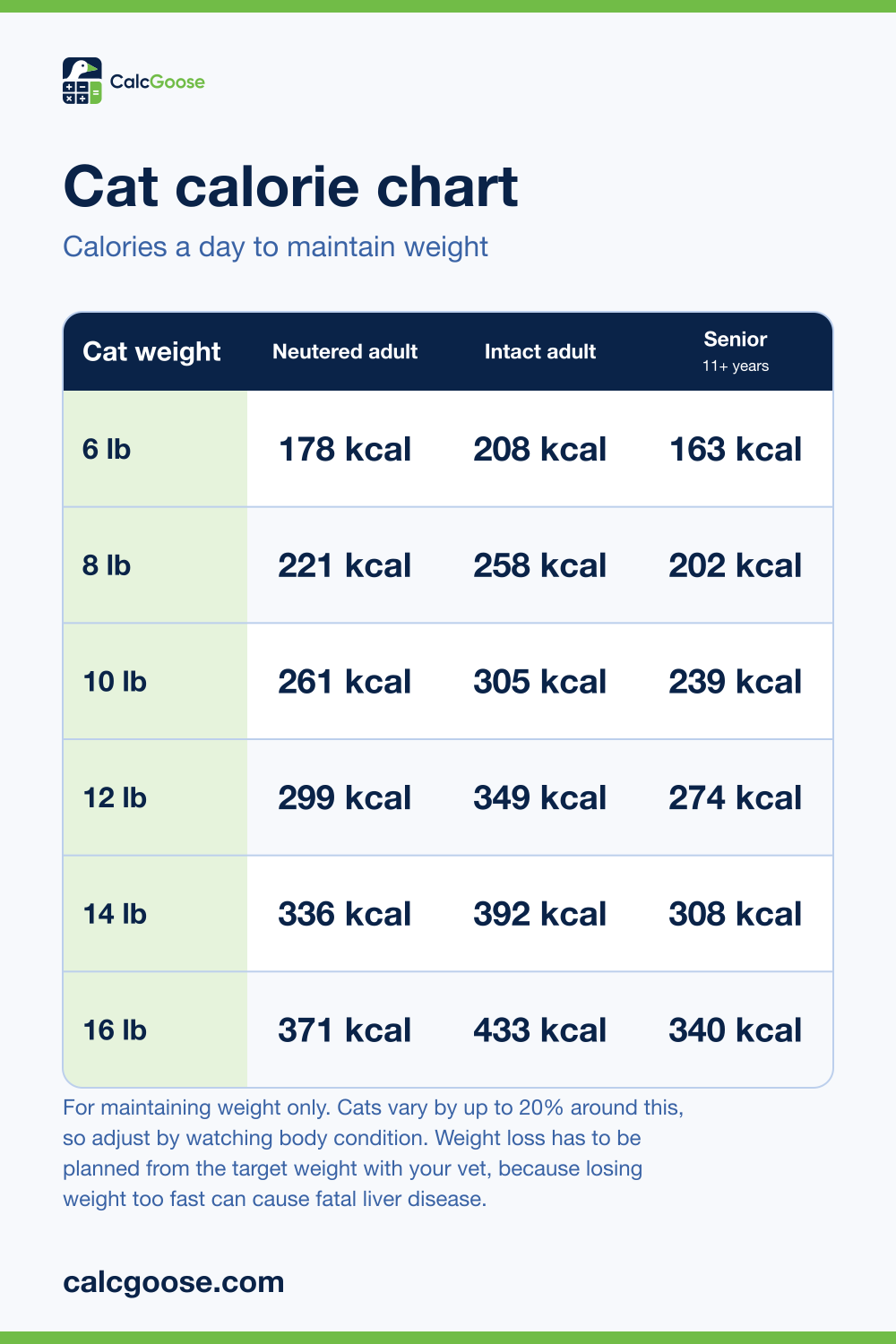
Daily calories to keep a healthy adult cat at its current weight, by life stage. Every figure comes from the same veterinary energy equation as the calculator above.
| Cat weight | Neutered adult | Intact adult | Senior 11+ years |
|---|---|---|---|
| 3 kg | 191 kcal | 223 kcal | 176 kcal |
| 3.5 kg | 215 kcal | 251 kcal | 197 kcal |
| 4 kg | 238 kcal | 277 kcal | 218 kcal |
| 5 kg | 281 kcal | 328 kcal | 257 kcal |
| 6 kg | 322 kcal | 376 kcal | 295 kcal |
| 7 kg | 361 kcal | 422 kcal | 331 kcal |
For maintaining weight only. Cats vary by up to 20% around this, so adjust by watching body condition. Weight loss has to be planned from the target weight with your vet, because losing weight too fast can cause fatal liver disease.
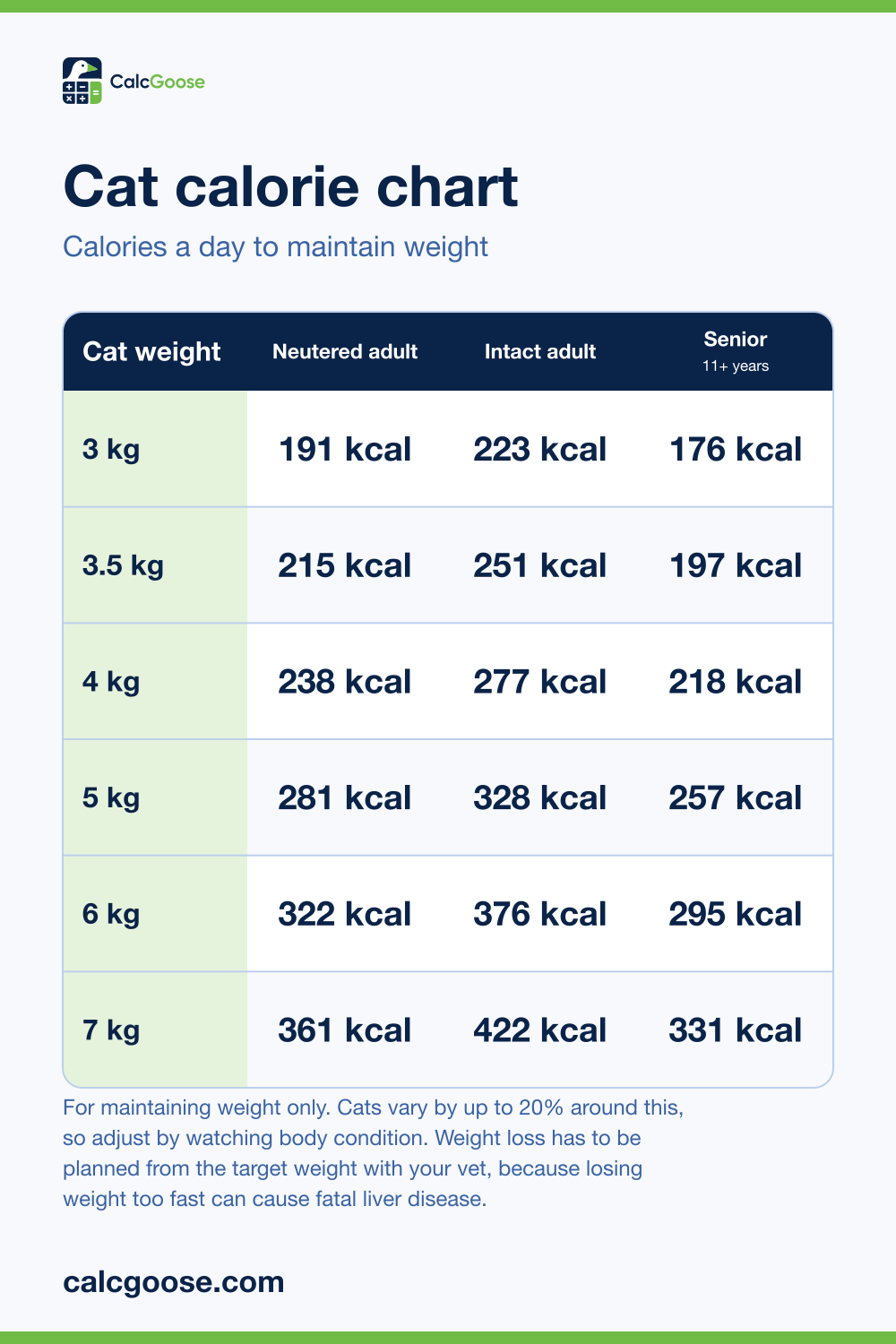
Assumptions and limits
Everything this calculator quietly assumes on your behalf. If one of these does not match your situation, the answer will be off.
- The resting energy equation RER = 70 × kg^0.75 is the standard veterinary formula. Individual cats vary by up to 20% around it, so the output is a starting point to be adjusted by watching body condition.
- Activity multipliers are the widely-used clinical values, 1.2 for a neutered adult, 1.4 intact, 1.1 senior, 2.5 for a kitten under twelve months. Very active or outdoor cats need more; strictly indoor sedentary cats often need less than 1.2.
- Weight-loss calculations use the target weight as the basis, multiplied by 0.8. This is the standard clinical approach, using current weight would keep feeding the cat for the weight it is trying to lose.
- Safe weight loss for cats is 0.5 to 2% of body weight per week. Faster loss risks hepatic lipidosis, a serious and often fatal liver condition that cats are uniquely prone to. Any weight-loss plan should be supervised by a vet.
- Food energy values default to 350 kcal per cup of dry and 90 kcal per can of wet. Real products range from 300 to over 500 per cup, so read your own label, using the default when your food is denser is a common way to overfeed.
- A "cup" means a measured 8 fluid ounce cup. The scoop supplied in a bag of food frequently holds more than that.
- Pregnancy, lactation, hyperthyroidism, diabetes, chronic kidney disease and recovery from illness all change energy requirements substantially and are outside what this models.
- Treats and table food are not included in the daily figure. They should stay under 10% of total calories.
Frequently asked questions
How many calories does a cat need per day?
A typical 5 kg neutered indoor cat needs about 280 calories a day. The equation is 70 times body weight in kilograms to the power 0.75, multiplied by 1.2 for a neutered adult. Kittens need roughly double that per kilo, and intact or very active cats need about 15% more than neutered ones.
How much dry food should I feed my cat?
Around three-quarters to one measured cup a day for an average 5 kg neutered cat, depending on the calorie density of your food. Check the kcal-per-cup figure on the bag rather than the feeding chart, which is usually generous. And use an actual measuring cup, the scoop in the bag is rarely 8 fluid ounces.
Wet food or dry food for cats?
Wet food has a large advantage in water content, which matters because cats have a weak thirst drive and are prone to urinary problems. Dry food is cheaper, easier to portion and better for free-feeding. Many vets suggest a mix, wet as the base for hydration, dry for convenience and dental texture.
How do I help my cat lose weight safely?
Slowly, at half a percent to two percent of body weight per week, with your vet involved. Feed to the target weight rather than a fraction of current intake, weigh every two weeks, and add activity through puzzle feeders and play. Never crash-diet a cat, rapid weight loss can trigger hepatic lipidosis, which is frequently fatal.
Why did my cat gain weight after being neutered?
Because neutering reduces energy requirements and most people carry on feeding the same amount. The multiplier here drops from 1.4 to 1.2 the day it happens, which is about 15% less food, while the cat's appetite does not move at all. Studies following cats after the operation often find a larger real-world drop, 20 to 30%, once reduced activity is counted in as well. Recalculating the portion on the day prevents almost all of it.
Is free feeding bad for cats?
For most indoor cats, yes. Free access to dry food is one of the strongest predictors of feline obesity, because cats will eat well past their needs when food is always available. Measured meals, or a timed feeder splitting a measured ration into several small portions, suits their natural pattern better and keeps intake controlled.
How much should I feed a kitten?
Roughly 2.5 times the resting requirement, which for a 2 kg kitten is about 300 calories a day, more than many adult cats. Kittens should be fed three to four small meals daily on food formulated for growth, and portions need recalculating every few weeks as they grow.
Guides on this
The reasoning behind the number, and the decisions it does not make for you.
- Why the feeding guide on the bag overfeeds most cats Label portions are built around an average cat that barely exists. A neutered indoor cat burns far less, and the gap is around a fifth of the bowl.
- Why a cat has to lose weight slowly Cats are not small dogs on this. Drop their intake sharply and the liver can fail, so the safe pace is half a percent to one percent of body weight a week.
Related calculators
- Raw Dog Food Calculator Pets & Animals Daily raw food portions by body weight or calories, with monthly quantity and cost.
- Chicken Coop Calculator Pets & Animals Coop size, run size, nest boxes, feed and eggs for a backyard flock, in either direction.
- Aquarium Calculator Pets & Animals Tank volume, heater wattage, filter turnover and an honest stocking check.
Share this calculator
Found the number you needed? Send it to whoever asked you for it.
Safety disclaimer
This is a planning estimate, not veterinary advice. Talk to your vet before changing your cat's diet, and especially before starting any weight-loss plan. Cats are uniquely vulnerable to hepatic lipidosis (fatty liver disease) when they lose weight too quickly or stop eating, and it is frequently fatal. Safe loss is 0.5 to 2% of body weight per week under supervision. A cat that refuses food for more than 48 hours, or loses weight without a diet change, needs to be seen by a vet promptly.