Freelance Rate Calculator
Start from the take-home pay you actually want, add business costs and tax, and divide by the hours you genuinely bill, to get the rate that gets you there.
Last updated
Where are you?
AWG, NEC, 120/240 V, miles and gallons mm², IEC/BS 7671, 230/400 V, km and litres . We remember this on every calculator.
Your result
Hourly rate
$94.29
- Day rate (8 h)
- $754.29
- Week rate
- $2,357.14
- Gross to invoice
- $94,285.71
- Billable hours a year
- 1,150
- Working weeks
- 46
- Salary equivalent
- $85,714.29
🪿 The goose says: Charge at least $94.29 an hour, or $754.29 a day. That is what it takes to bank $60,000.00 after 30% tax and $6,000.00 of costs, billing 25 hours a week.
- You need to invoice $94,285.71 a year gross to take home $60,000.00. Of every hour you bill, roughly $24.60 goes to tax and $5.22 to business costs.
- An employee earning $85,714.29 would take home the same amount, and they would also get paid holiday, sick leave, pension contributions and equipment. That gap is why freelance rates look high next to salaries and usually are not.
- This is a floor, not a price. What you can actually charge depends on the value of the work to the client, your market and your positioning, and for project work, pricing by value rather than by the hour is almost always better for both sides.
Estimate for planning only. Have any electrical work verified by a qualified electrician and installed to code. See the full disclaimer at the bottom of this page.
Where every billed hour goes
Based on 1,150 billable hours a year.
- Tax and contributions
- $24.60
- Business costs
- $5.22
- Profit margin
- $12.30
- Reaches your pocket
- $52.17
- Total hourly rate
- $94.29
A project floor is a useful sanity check, a one-week project should not come in below your week rate, however keen you are to win it.
How this freelance rate calculator works
Most freelancers set a rate by looking at what other people charge, then wonder why the year does not add up. The reliable method runs the other way, start from the money you want to keep and work backwards through everything that takes a share of it.
Two things are consistently underestimated. The first is that tax comes out of gross, so you have to gross up rather than mark up, at a 30% rate, keeping 60,000 means invoicing 85,700, not 78,000. The second is billable hours. Nobody bills forty hours a week. Pitching, invoicing, admin, email, bookkeeping and the hours between contracts are all real and none of them are chargeable, which is why 25 billable hours is a realistic full-time week.
Together those two things explain almost the entire gap between a freelance rate and a salary. A 60 an hour rate sounds like 124,000 a year at forty hours. Billed at 25 hours over 46 working weeks it is 69,000 gross, which after tax and costs is not a large income at all.
-
Step 1 Working weeks
weeks = 52 − weeks_offHoliday, illness and the gaps between contracts all count. -
Step 2 Billable hours a year
hours = billable_hours_per_week × working_weeks -
Step 3 Gross you need to invoice
gross = (take_home + business_costs) ÷ (1 − tax_rate)Divide, not multiply, tax comes out of the top. -
Step 4 Base rate
base = gross ÷ billable_hours -
Step 5 Add margin
rate = base × (1 + margin%)Headroom for slow quarters, reinvestment and the risk you carry. -
Step 6 Where the rate actually goes
costs_per_hour = business_costs ÷ billable_hours
tax_per_hour = gross × tax_rate ÷ billable_hours
On the example that is about 5 an hour of costs and 25 of tax, which is why a 94 rate leaves roughly 52 an hour in your account. -
Step 7 Day and week rates
day = rate × 8
week = rate × billable_hours_per_week
For example, 60,000 take-home, 6,000 of costs, 30% tax, 25 billable hours over 46 weeks, 15% margin. Gross needed is 94,286 over 1,150 hours, which is 82 an hour before margin and 94 after, a day rate of 754.
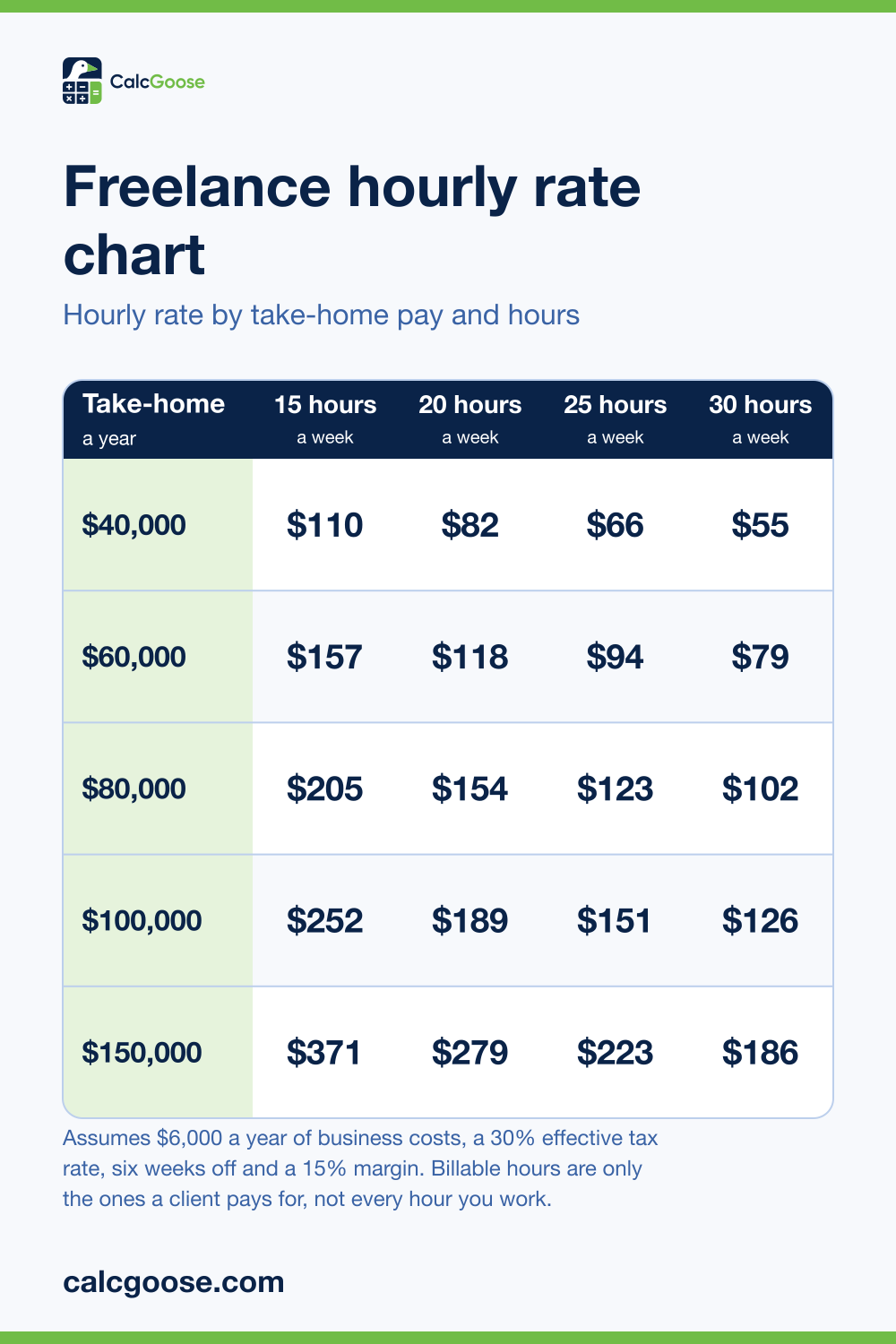
Freelance hourly rate chart
The hourly rate a freelancer has to charge to take home a given amount, by billable hours a week. Every figure comes from the same formula as the calculator above.
| Take-home a year | 15 hours a week | 20 hours a week | 25 hours a week | 30 hours a week |
|---|---|---|---|---|
| $40,000 | $110 | $82 | $66 | $55 |
| $60,000 | $157 | $118 | $94 | $79 |
| $80,000 | $205 | $154 | $123 | $102 |
| $100,000 | $252 | $189 | $151 | $126 |
| $150,000 | $371 | $279 | $223 | $186 |
Assumes $6,000 a year of business costs, a 30% effective tax rate, six weeks off and a 15% margin. Billable hours are only the ones a client pays for, not every hour you work.
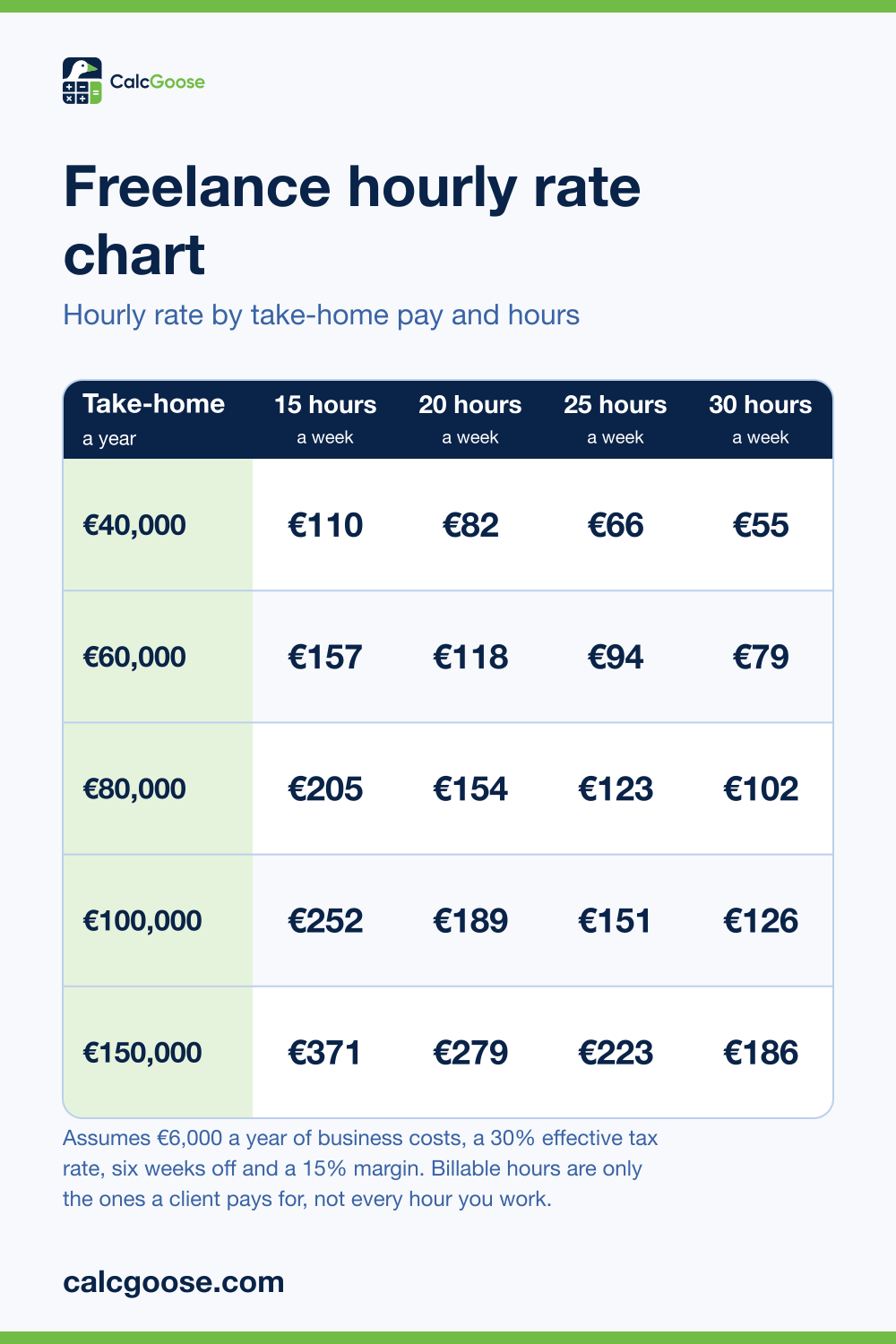
The hourly rate a freelancer has to charge to take home a given amount, by billable hours a week. Every figure comes from the same formula as the calculator above.
| Take-home a year | 15 hours a week | 20 hours a week | 25 hours a week | 30 hours a week |
|---|---|---|---|---|
| €40,000 | €110 | €82 | €66 | €55 |
| €60,000 | €157 | €118 | €94 | €79 |
| €80,000 | €205 | €154 | €123 | €102 |
| €100,000 | €252 | €189 | €151 | €126 |
| €150,000 | €371 | €279 | €223 | €186 |
Assumes €6,000 a year of business costs, a 30% effective tax rate, six weeks off and a 15% margin. Billable hours are only the ones a client pays for, not every hour you work.
Assumptions and limits
Everything this calculator quietly assumes on your behalf. If one of these does not match your situation, the answer will be off.
- The tax rate you enter is an effective rate across all of your income and contributions, not a marginal bracket. Real tax depends on your country, your business structure, deductible expenses and any other income, an accountant will give you a number that is worth far more than this estimate.
- Business costs are annual and should include everything, software subscriptions, hardware amortisation, insurance, accountancy, workspace, phone and internet, training, professional memberships and travel. Most people underestimate this by half.
- Billable hours are hours a client pays for. The default of 25 per week reflects that admin, sales, proposals, invoicing and email consume a large share of any freelance week. Very few people sustain more than 30.
- Weeks off should include holiday, sickness and the gaps between contracts. Six is optimistic, employees receive that in paid holiday alone before any sick leave.
- Margin is applied on top of the covered costs. It is not profit in an accounting sense; it is headroom for slow quarters, equipment replacement and the risk that a client does not pay.
- Nothing here accounts for pension or retirement saving, health insurance where an employer would normally provide it, or paid parental leave. If those matter to you, add them to business costs or to the take-home target.
- The salary equivalent shown compares gross figures only. It does not price in employer pension contributions, paid leave, sick pay, equipment or job security, all of which make an employed role worth more than the same headline number.
- The result is a floor for pricing, not a market price. What you can charge depends on the value of the work, your specialism and your positioning.
Frequently asked questions
How do I convert a salary into a freelance rate?
Take the salary, add 25 to 40 percent for the benefits and paid leave you are giving up, then divide by realistic billable hours, around 1,100 to 1,300 a year, not 2,080. A 70,000 salary therefore maps to roughly 75 to 90 an hour rather than the 34 a straight division suggests. This calculator does the same thing from the other direction.
How many hours a week can a freelancer actually bill?
Twenty to thirty for most people working full time. The remaining hours go on finding work, writing proposals, invoicing, bookkeeping, email and admin, none of which anyone pays for. If you are billing more than 32 consistently, either you have unusually stable retained work or you are working far more than 40 hours.
Why do freelancers charge more than employees earn?
Because the rate has to cover everything an employer normally provides, tax and social contributions paid on the whole amount, holiday, sick pay, pension, equipment, software, insurance, and the unbillable half of the week. A freelance rate that looks like double an equivalent hourly salary usually produces a similar or lower net income.
What profit margin should a freelancer aim for?
Ten to twenty percent above simply covering costs and take-home. That headroom absorbs a quiet quarter, replaces a laptop, and compensates for carrying all the risk of the business. Pricing at exactly break-even means any disruption comes straight out of your own income.
Should I charge hourly or by the project?
Use the hourly rate to work out the floor, then quote projects wherever you can. Hourly billing penalises you for getting faster and puts you in an argument about time rather than results. Estimate the hours, apply this rate, add a buffer for scope, and quote a fixed number, but never quote below your week rate for a week of work.
How do I raise my rates with existing clients?
Give notice, be specific, and do not apologise. Tell them the new rate and the date it applies from, ideally six to eight weeks ahead and at a natural break like a new project or a new year. Raise new-client rates first so you have evidence the market accepts it, and accept that some clients will leave. That is usually a sign the rate was overdue.
What day rate should I charge?
Roughly eight times your hourly rate, though many freelancers discount slightly for a booked full day since it removes the risk of an idle afternoon. If you offer a day rate, define what a day is. Most people mean 7 or 8 hours, and leaving it vague is how days turn into 10 hours.
Related calculators
- Pool Chemical Calculator Everyday Life How much chlorine and acid your pool needs, worked out from its actual volume.
- Sourdough Calculator Everyday Life Scale any sourdough recipe by baker's percentages, with true hydration worked out properly.
- Coffee Ratio Calculator Everyday Life How many grams of coffee for any brew method, cup count and strength.
- BBQ Calculator Everyday Life How much meat to buy for a cookout, adjusted for kids, appetite and sides.
- Party Drink Calculator Everyday Life Beer, wine, spirits, mixers and ice for any guest count and party length.
- Tip & Bill Split Calculator Everyday Life Split a bill evenly or by what each person ordered, with tax and tip shared fairly.
- Pizza Dough Calculator Everyday Life Dough ball weight from the pizza size, then flour, water, salt and yeast by baker's percentage.
- Vinyl & Sticker Pricing Calculator Maker & Craft What to charge for decals, shirts and signs once materials, labour and marketplace fees are in.
Share this calculator
Found the number you needed? Send it to whoever asked you for it.
Safety disclaimer
This is a planning tool, not financial or tax advice. Tax rates, allowable expenses, social contributions and business structures vary enormously between countries and change regularly, and the effective rate you enter here is a rough estimate at best. Talk to a qualified accountant in your own jurisdiction before setting rates, registering a business or making decisions about how much to set aside for tax.