Mulch Calculator
Measure your beds and get the cubic yards, bag count and, for gravel and soil, the delivery weight in tons.
Last updated
Where are you?
AWG, NEC, 120/240 V, miles and gallons mm², IEC/BS 7671, 230/400 V, km and litres . We remember this on every calculator.
Your result
Wood or bark mulch needed
0.74 cu yd
- In cubic metres
- 0.57 m³
- In cubic feet
- 20 cu ft
- Bags (2 cu ft)
- 10
- Area covered
- 80 sq ft
- Depth
- 3 in
- Delivery weight
- Sold by volume
🪿 The goose says: You need about 0.74 cubic yards of wood or bark mulch. That is 10 bags, or an easy load of bags.
- Under about 2 cubic yards, bags usually win once you count the delivery fee. 10 bags fits in most cars in two trips.
- Keep mulch a couple of inches clear of trunks and stems. Piling it against bark (the "mulch volcano") rots the trunk and is one of the most common ways homeowners kill young trees.
How this mulch calculator works
Bulk landscape materials are sold by the cubic yard, and a cubic yard is bigger than almost everyone pictures, 27 cubic feet, enough to cover 108 square feet at three inches deep. Getting from a bed measurement to that unit is the whole calculation.
The shortcut every landscaper uses is the number 324. Multiply your square footage by the depth in inches, divide by 324, and you have cubic yards. That 324 is just 12 inches per foot multiplied by 27 cubic feet per yard, folded into one constant so you never have to convert twice.
Bags are then a straight division, but bag sizes differ by material, mulch comes in 2 cubic foot bags, topsoil in 0.75, gravel in 0.5. That is why forty bags of gravel is far less material than forty bags of mulch.
-
Step 1 Total the area
area = Σ (length × width), or π × (diameter ÷ 2)² for a round bed -
Step 2 Convert to cubic yards
cubic_yards = area_sqft × depth_inches ÷ 324324 = 12 × 27, folding both conversions into one step. -
Step 3 Or in metric
cubic_metres = area_m² × depth_cm ÷ 100No constant needed here, because a centimetre is already a hundredth of a metre. One cubic metre is 1.31 cubic yards. -
Step 4 Convert to bags
bags = ceil(cubic_yards × 27 ÷ bag_size_cuft)Mulch bags are 2 cu ft, topsoil 0.75, gravel 0.5. -
Step 5 Convert to delivery weight
tons = cubic_yards × densityGravel ≈ 1.4 tons/yd³, topsoil ≈ 1.1, sand ≈ 1.35. Mulch is sold by volume only.
For example, a 20 × 4 ft bed is 80 square feet. At 3 inches deep that is 80 × 3 ÷ 324 = 0.74 cubic yards, which is 20 cubic feet, or 10 bags of mulch.
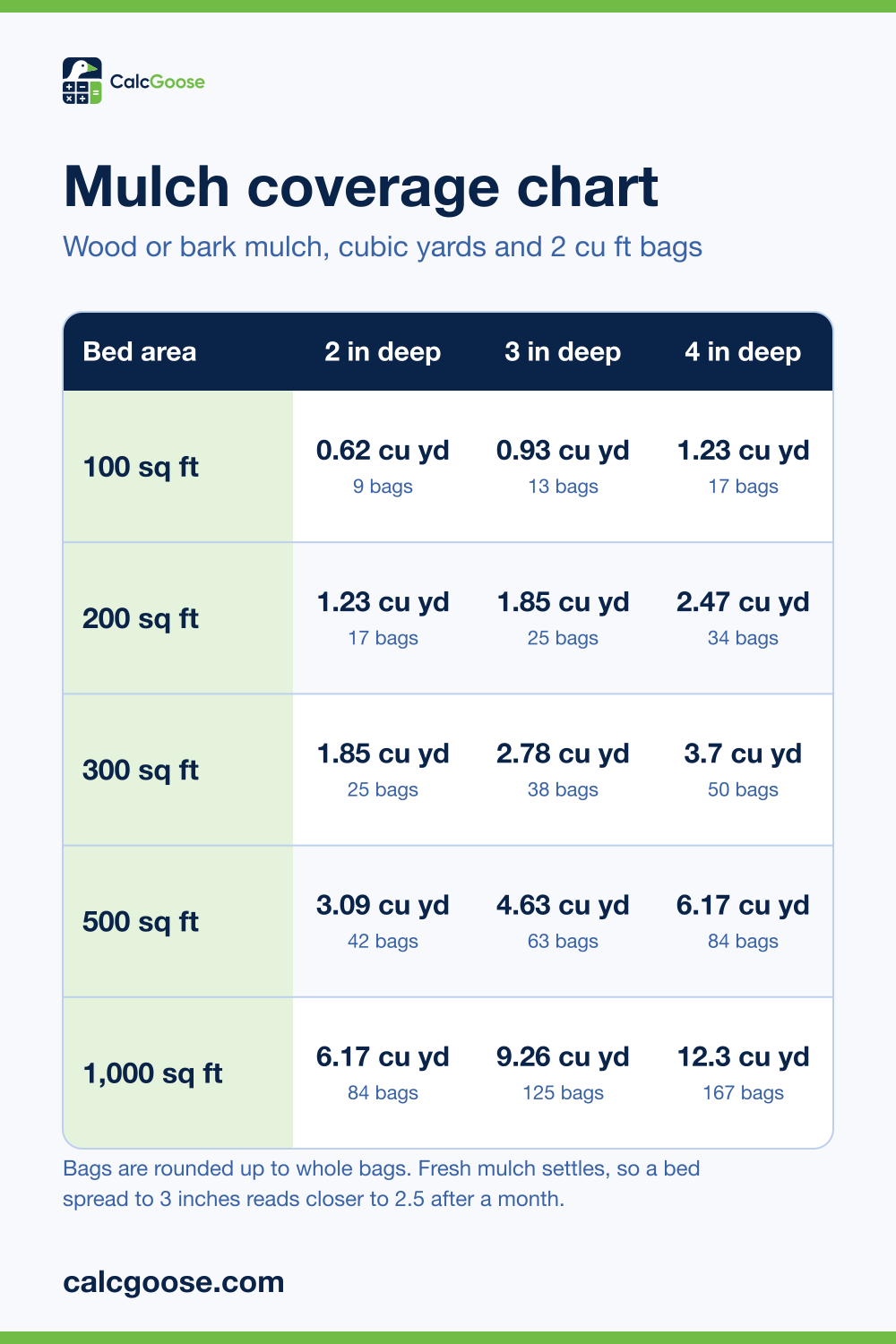
Mulch coverage chart
How much wood or bark mulch common bed sizes need at 2, 3 and 4 inches deep. Every figure comes from the same formula as the calculator above, and bag counts assume the standard 2 cubic foot bag.
| Bed area | 2 in deep | 3 in deep | 4 in deep |
|---|---|---|---|
| 100 sq ft | 0.62 cu yd9 bags | 0.93 cu yd13 bags | 1.23 cu yd17 bags |
| 200 sq ft | 1.23 cu yd17 bags | 1.85 cu yd25 bags | 2.47 cu yd34 bags |
| 300 sq ft | 1.85 cu yd25 bags | 2.78 cu yd38 bags | 3.7 cu yd50 bags |
| 500 sq ft | 3.09 cu yd42 bags | 4.63 cu yd63 bags | 6.17 cu yd84 bags |
| 1,000 sq ft | 6.17 cu yd84 bags | 9.26 cu yd125 bags | 12.3 cu yd167 bags |
Bags are rounded up to whole bags. Fresh mulch settles, so a bed spread to 3 inches reads closer to 2.5 after a month.
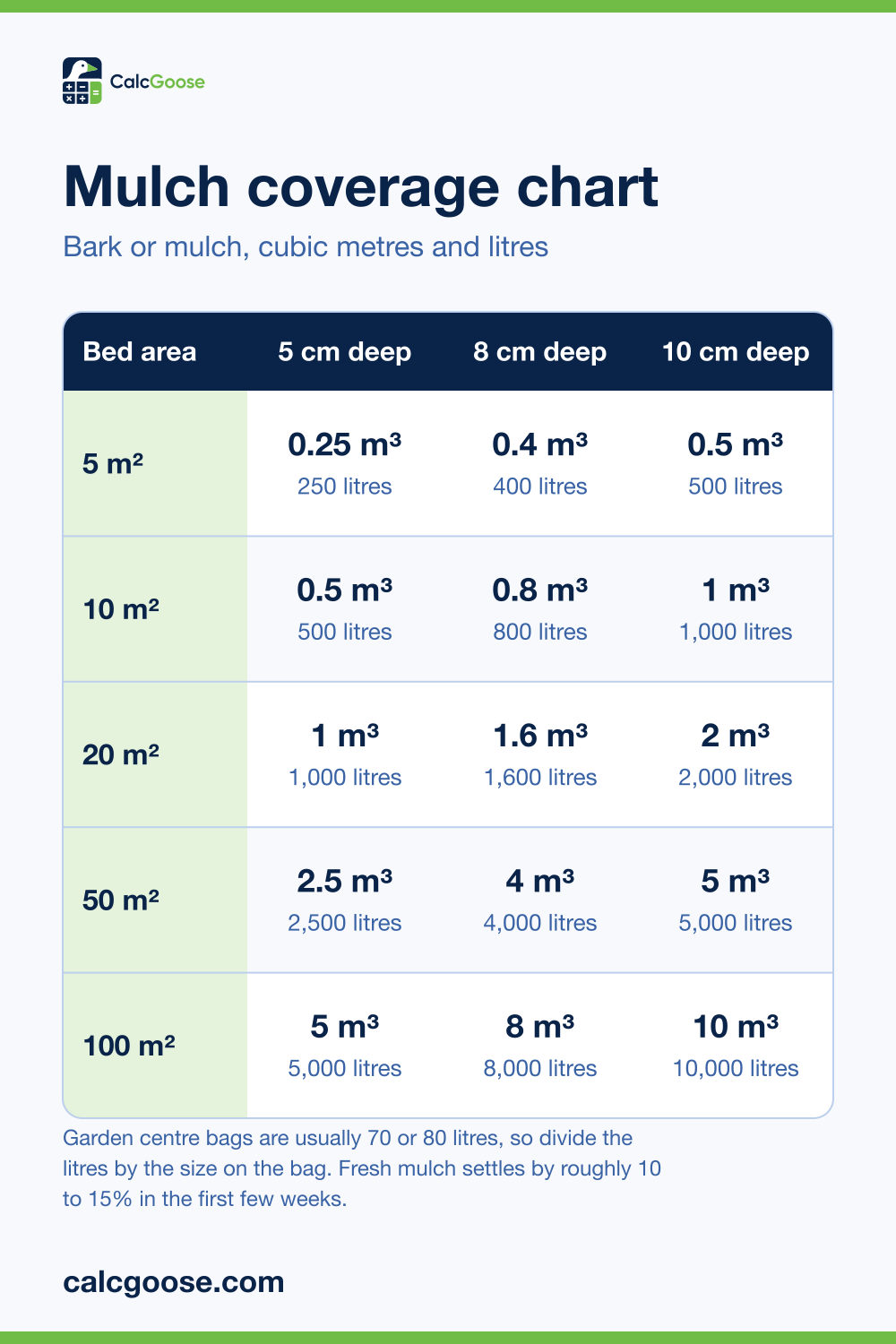
How much bark or mulch common bed sizes need at 5, 8 and 10 cm deep, in cubic metres and litres. Every figure comes from the same formula as the calculator above.
| Bed area | 5 cm deep | 8 cm deep | 10 cm deep |
|---|---|---|---|
| 5 m² | 0.25 m³250 litres | 0.4 m³400 litres | 0.5 m³500 litres |
| 10 m² | 0.5 m³500 litres | 0.8 m³800 litres | 1 m³1,000 litres |
| 20 m² | 1 m³1,000 litres | 1.6 m³1,600 litres | 2 m³2,000 litres |
| 50 m² | 2.5 m³2,500 litres | 4 m³4,000 litres | 5 m³5,000 litres |
| 100 m² | 5 m³5,000 litres | 8 m³8,000 litres | 10 m³10,000 litres |
Garden centre bags are usually 70 or 80 litres, so divide the litres by the size on the bag. Fresh mulch settles by roughly 10 to 15% in the first few weeks.
Assumptions and limits
Everything this calculator quietly assumes on your behalf. If one of these does not match your situation, the answer will be off.
- Volumes assume an even depth across a flat bed. Sloped or uneven ground needs more material at the low end, and mounded beds need noticeably more.
- Bag sizes are the common US retail figures, 2 cubic feet for mulch, 1 for compost, 0.75 for topsoil, 0.5 for gravel and sand. Check your supplier, bag sizes do vary.
- The bag count keeps those US sizes in metric mode too, so treat it as a volume rather than a shopping list if you are buying in Europe. Garden centre bark and compost bags here are usually 70 or 80 litres, and a bulk or dumpy bag runs from 0.5 to 1.0 cubic metres, so divide your cubic metres by whatever the label actually says.
- Bulk weights are approximate and change with moisture, gravel around 1.4 tons per cubic yard, topsoil 1.1, sand 1.35. Wet material can be 15% heavier, which matters if your delivery is priced by weight.
- Mulch and compost settle. Fresh wood mulch compresses roughly 10–15% in the first few weeks, so a bed spread to exactly 3 inches will read closer to 2.5 after a month.
- No allowance is made for the space plants occupy. A densely planted bed needs perhaps 10% less than the bare area suggests.
- Rubber mulch and stone do not decompose and do not need annual topping up. Organic mulch does. Budget for about a third of this volume each following year.
- Delivery minimums are common. Many suppliers will not deliver under 3 cubic yards, or charge the same fee regardless, which changes the bags-versus-bulk maths.
Frequently asked questions
How much mulch do I need?
Multiply your bed area in square feet by the depth in inches, then divide by 324 for cubic yards. A 20 × 4 foot bed at 3 inches deep needs 0.74 cubic yards, which is 10 standard bags. Most home beds land between half a yard and three yards.
How many bags of mulch are in a cubic yard?
Thirteen and a half bags at the standard 2 cubic foot size, because a cubic yard is 27 cubic feet. Suppliers usually round this to 14. For topsoil in 0.75 cubic foot bags it is 36 bags per yard, which is when bulk delivery starts to look obvious.
How much bark or mulch do I need in cubic metres?
Multiply the bed area in square metres by the depth in centimetres and divide by 100. A 6 × 1.2 metre bed at 7.5 cm deep works out to 0.54 cubic metres, which is just over one 500 litre bulk bag or about seven 80 litre bags from a garden centre. One cubic metre covers roughly 13 square metres at that depth.
How deep should mulch be?
Three inches for established beds. Two inches lets light through and weeds come up; more than four holds moisture against stems and cuts oxygen to the roots. Around trees, keep the same three inches but pull it back a few inches from the trunk itself.
How much area does a cubic yard of mulch cover?
About 108 square feet at 3 inches deep, 162 square feet at 2 inches, or 81 square feet at 4 inches. The quick version most landscapers use is "a yard does about 100 square feet", which is close enough for ordering.
Is bulk mulch cheaper than bags?
Per cubic yard, yes, usually less than half the price, sometimes a third. The break-even is around two to three cubic yards once you add the delivery fee, and bulk also saves you dozens of plastic bags and several car trips. Below two yards, bags generally win.
How much does a cubic yard of gravel weigh?
About 1.4 tons, or 2,800 pounds, for typical crushed stone, enough to overload a half-ton pickup on its own. Topsoil is around 1.1 tons per yard and sand about 1.35. This is why gravel is delivered by weight rather than volume.
Do I need landscape fabric under mulch?
Under gravel, yes. It stops stone working down into the soil. Under organic mulch, generally no, mulch is supposed to break down into the soil, and fabric prevents that while eventually filling with soil on top and growing weeds anyway. Save it for stone.
Guides on this
The reasoning behind the number, and the decisions it does not make for you.
- Why a mulch order comes up short Most short orders come from measuring the bed and forgetting the depth, or from buying bags by the look of the pile. The arithmetic is two numbers wide.
- How deep mulch should be, and the depth that kills trees Two to three inches does everything mulch is for. Past four it starts working against you, and piled against a trunk it quietly kills the tree.
Related calculators
- Paver Calculator Home & Yard Paver count, gravel base, bedding sand and edging for a patio or path.
- Wallpaper Calculator Home & Yard How many rolls a room needs, counted by strips rather than square footage.
- Paint Calculator Home & Yard Gallons of paint for a room, with coats, doors, windows and ceiling accounted for.
- Deck Board Calculator Home & Yard Board count, linear feet, screws and joists for a deck of any size.
- Fence Calculator Home & Yard Posts, panels, pickets, rails and concrete for a fence run of any length.
- Grass Seed Calculator Home & Yard Pounds of seed or pallets of sod for a lawn, by grass type and whether you are seeding or overseeding.
- Concrete Calculator Home & Yard Concrete for slabs, footings, post holes and columns, in yards or metres and in bags.
Share this calculator
Found the number you needed? Send it to whoever asked you for it.