Soap Lye Calculator
Enter your oils and get the sodium or potassium hydroxide, water and total batch weight, with superfat applied and the saponification values shown.
Last updated
Where are you?
AWG, NEC, 120/240 V, miles and gallons mm², IEC/BS 7671, 230/400 V, km and litres . We remember this on every calculator.
Your result
NaOH needed
143 g
- Water
- 330 g
- Total oils
- 1,000 g
- Lye solution strength
- 30.3%
- Superfat
- 5%
- Batch weight (wet)
- 1,473 g
- Oils in recipe
- 3
🪿 The goose says: Use 143 g of NaOH and 330 g of water for 1,000 g of oils at 5% superfat. Weigh everything. Do not measure lye by volume.
- Always add lye to water, never water to lye. Reversing it can make the mixture erupt. Mix outdoors or under extraction, the fumes in the first minute are harsh.
- The finished batch weighs about 1,473 g before cure. Soap loses roughly 5–10% of that to water evaporation over four to six weeks.
Estimate for planning only. Have any electrical work verified by a qualified electrician and installed to code. See the full disclaimer at the bottom of this page.
How this soap lye calculator works
Soap making is one of the few crafts with a genuinely exact calculation at its centre. Every fat has a saponification value, the grams of sodium hydroxide it takes to convert one gram of that fat into soap. Those values are published and reliable, which is why a lye calculator can be trusted in a way that most craft rules of thumb cannot.
Add up the lye each oil demands, then deliberately use slightly less than the full amount. That shortfall is the superfat, the percentage of oils left unsaponified, which is what makes a bar feel conditioning rather than stripping. Five percent is the standard, and it also covers the small variations between batches of natural oil.
Water does not appear in the chemistry at all. It is only there to dissolve the lye so it can meet the oils evenly. That is why you can discount it. Less water means a faster trace and a shorter cure; more water means a longer working time.
-
Step 1 Lye each oil needs
for each oil, grams × its SAP valueOlive is 0.135, coconut 0.183, castor 0.129. Swapping oils changes this figure. -
Step 2 Apply the superfat
lye = Σ(grams × SAP) × (1 − superfat%)A 5% superfat means you use 95% of the theoretically required lye. -
Step 3 Convert if you are using KOH
KOH = NaOH_amount × 1.403 ÷ purityPotassium hydroxide is heavier per molecule and usually only 90% pure. -
Step 4 Work out the water
water = oils × water% or, by strength, water = lye ÷ concentration% − lye -
Step 5 Total batch weight
batch = oils + lye + waterExpect to lose 5–10% of this to evaporation during cure.
For example, 500 g olive, 300 g coconut and 200 g palm. That is 500 × 0.135 + 300 × 0.183 + 200 × 0.142 = 150.8 g of NaOH at full saponification. At 5% superfat you use 143.3 g, with 330 g of water at the 33% default.
Lye chart for common soap oils
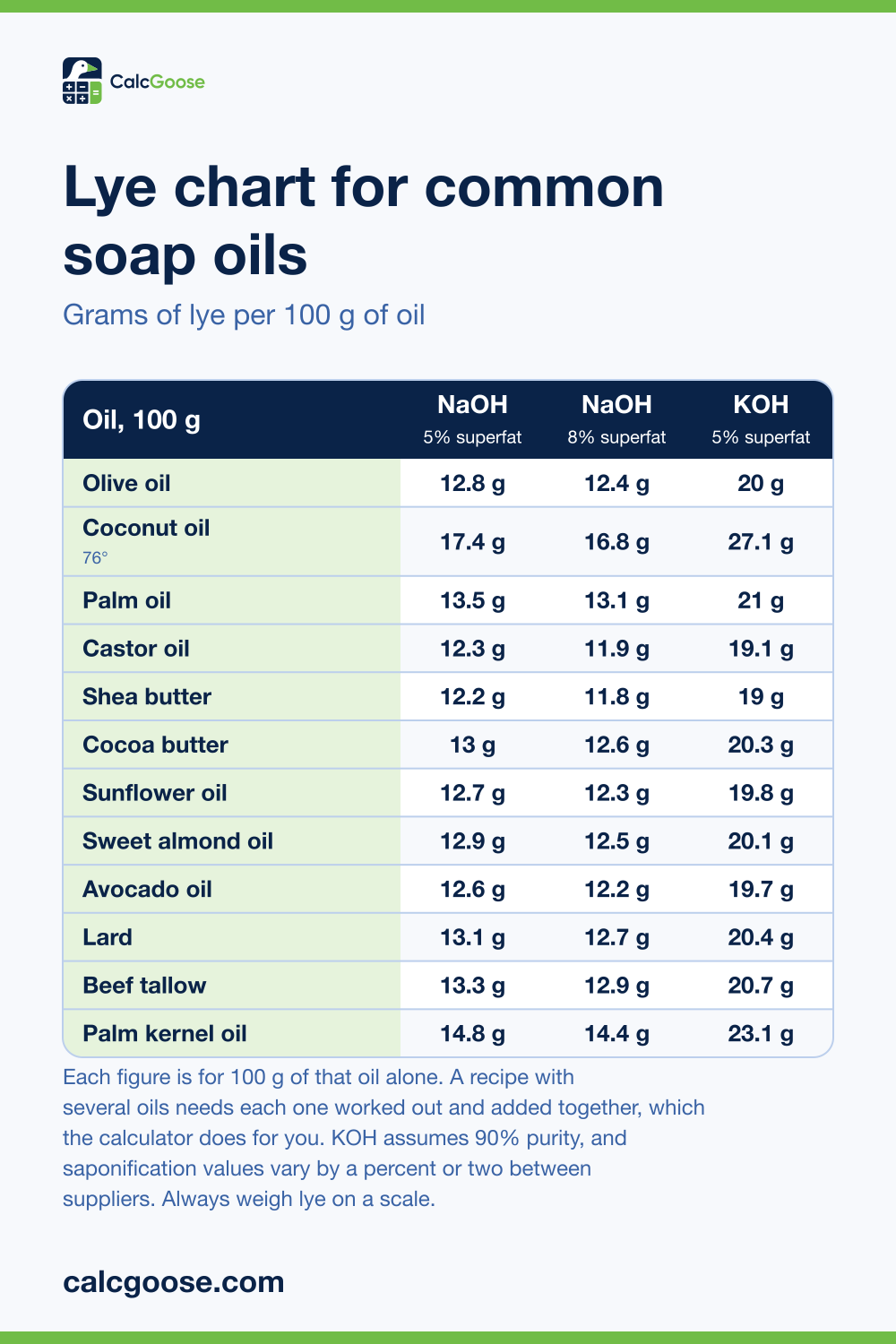
How much lye each common soap oil needs per 100 grams of oil, at the standard 5% superfat and at 8% for a gentler facial bar. Every figure comes from the same saponification values as the calculator above.
| Oil, 100 g | NaOH 5% superfat | NaOH 8% superfat | KOH 5% superfat |
|---|---|---|---|
| Olive oil | 12.8 g | 12.4 g | 20 g |
| Coconut oil76° | 17.4 g | 16.8 g | 27.1 g |
| Palm oil | 13.5 g | 13.1 g | 21 g |
| Castor oil | 12.3 g | 11.9 g | 19.1 g |
| Shea butter | 12.2 g | 11.8 g | 19 g |
| Cocoa butter | 13 g | 12.6 g | 20.3 g |
| Sunflower oil | 12.7 g | 12.3 g | 19.8 g |
| Sweet almond oil | 12.9 g | 12.5 g | 20.1 g |
| Avocado oil | 12.6 g | 12.2 g | 19.7 g |
| Lard | 13.1 g | 12.7 g | 20.4 g |
| Beef tallow | 13.3 g | 12.9 g | 20.7 g |
| Palm kernel oil | 14.8 g | 14.4 g | 23.1 g |
Each figure is for 100 g of that oil alone. A recipe with several oils needs each one worked out and added together, which the calculator does for you. KOH assumes 90% purity, and saponification values vary by a percent or two between suppliers. Always weigh lye on a scale.
Assumptions and limits
Everything this calculator quietly assumes on your behalf. If one of these does not match your situation, the answer will be off.
- Saponification values are mid-range published figures. Natural oils genuinely vary by one to two percent between harvests and suppliers, which is one of the reasons a superfat above zero is standard practice.
- Superfat is applied as a straight reduction in lye. It does not control which oils remain unsaponified, saponification is not selective, so you cannot "superfat with shea" by adding it at trace.
- KOH conversion uses the standard 1.403 factor and divides by your stated purity. Most potassium hydroxide sold to soap makers is 90%; using 100% by mistake produces a lye-heavy batch.
- Water is not part of the chemistry and its amount is a working choice, not a correctness one. Anything from a 25% to a 40% lye concentration makes soap; it changes trace speed, cure time and how prone the batch is to gel.
- Fatty-acid quality figures (hardness, cleansing, conditioning), are deliberately not shown. They require a full fatty-acid profile per oil, and an approximated version would be worse than none.
- Batch weight is the wet weight at pour. Cold-process soap loses roughly 5–10% to evaporation over a four to six week cure.
- Additives at trace (fragrance, clays, oats, colourants), are not included in the totals. Fragrance is typically 3–5% of oil weight and does not affect the lye calculation.
- All weights are grams, in both regions. Saponification values are defined per gram of oil, and working in grams is universal practice among soap makers regardless of country.
- This calculator assumes accurate scales and pure lye. Drain cleaner is not a substitute for soap-grade sodium hydroxide. It contains additives that will ruin a batch and can react unpredictably.
Frequently asked questions
How much lye do I need for 1000 g of oils?
It depends entirely on which oils, because each has its own saponification value. A common 50/30/20 olive-coconut-palm blend at 1000 g needs about 143 g of sodium hydroxide at 5% superfat. Pure coconut oil at the same weight would need 174 g, and pure olive 128 g, which is exactly why recipes cannot be substituted freely.
How many bars of soap will this recipe make?
Divide the total batch weight by your bar size, then take off the cure loss. A 1,000 g oil recipe pours at about 1,473 g wet, sheds 5 to 10% of that to evaporation over four to six weeks, and settles near 1,350 g, which is a dozen 110 g bars. Moulds are usually sold by the oil weight they hold rather than by batch weight, so check which figure yours quotes before scaling a recipe.
What does superfat mean in soap making?
Superfat is the percentage of oils deliberately left unsaponified by using slightly less lye than the recipe strictly needs. Those free oils stay in the bar and make it feel gentler and more moisturising. Five percent is standard, eight is common for facial bars, and going below one leaves no safety margin for oil variation or scale error.
What is a water discount?
Using less water than the traditional 33% of oil weight, usually expressed as a lye concentration of 33–40% instead. Less water means the batch traces faster, unmoulds sooner and cures in less time, but it also gives you a much shorter window to work in. Beginners should stay at full water until pouring feels comfortable.
What is the difference between NaOH and KOH?
Sodium hydroxide makes hard bar soap; potassium hydroxide makes soft paste and liquid soap. They are not interchangeable, and KOH needs about 1.4 times the weight for the same oils because it is a heavier molecule. KOH is also usually sold at 90% purity, which has to be divided out or your soap will be lye-heavy.
Can I substitute one oil for another?
Only if you recalculate the lye. Swapping 200 g of olive oil for 200 g of coconut oil raises the lye requirement by about 9 grams, and a batch that is 10 grams short of lye is not a problem while a batch 10 grams over is caustic. Change the recipe here first, then make it.
Is there such a thing as lye-free soap?
No. Every true soap is made by reacting a fat with a strong alkali, so lye is always involved, in finished soap it has all been consumed by the reaction, which is why the bar is safe. Melt-and-pour bases are lye-free only in the sense that someone else already did that step for you.
What safety gear do I actually need?
Sealed splash goggles, nitrile gloves, long sleeves and good ventilation, as a minimum. Keep vinegar away from your work area despite the common advice, the recommended first aid for a lye splash is flushing with large amounts of cool running water, not neutralising with acid. Never leave lye solution unattended around children or pets.
Guides on this
The reasoning behind the number, and the decisions it does not make for you.
- Swapping an oil means recalculating the lye Every oil takes a different amount of lye to saponify. Substituting gram for gram without rerunning the numbers is how a mild recipe turns caustic.
- What superfat actually buys you in a bar Superfat is deliberate leftover oil, and it is also your safety margin against a weighing error. Five percent is the default for reasons worth knowing.
Related calculators
- Epoxy Resin Calculator Maker & Craft Work out how much resin a mould, river table or tumbler actually takes, split by part A and B.
- Candle Making Calculator Maker & Craft How much wax and fragrance oil a batch of candles needs, plus a wick size for your jar.
- 3D Print Cost Calculator Maker & Craft The real cost of a print (filament, power, wear and failures) and what to charge for it.
- Yarn Calculator Maker & Craft How much yarn a blanket, scarf or hat takes, by craft, stitch density and yarn weight.
- Fabric Calculator Maker & Craft How much fabric a project needs, with hems, seams and pattern repeat already added.
- Vinyl & Sticker Pricing Calculator Maker & Craft What to charge for decals, shirts and signs once materials, labour and marketplace fees are in.
Share this calculator
Found the number you needed? Send it to whoever asked you for it.
Safety disclaimer
Sodium and potassium hydroxide are strongly caustic and cause severe chemical burns on contact with skin and permanent damage to eyes. Always wear sealed splash goggles and nitrile gloves, work in a well-ventilated space or outdoors, and always add lye to water rather than water to lye. The reverse can boil violently and erupt. Never use aluminium containers or utensils, which react with lye. Keep lye and raw soap batter away from children and animals, and flush any skin contact with large amounts of cool running water. This calculator produces the correct amounts for a recipe; it cannot make the process safe on your behalf.