3D Print Cost Calculator
Work out what a print actually costs in filament, electricity, machine wear and failed attempts, then what to sell it for at the margin you want.
Last updated
Where are you?
AWG, NEC, 120/240 V, miles and gallons mm², IEC/BS 7671, 230/400 V, km and litres . We remember this on every calculator.
Your result
Suggested selling price
$11.18
- Cost to make
- $6.71
- Filament
- $0.90
- Electricity
- $0.14
- Machine wear
- $0.50
- Your labour
- $5.00
- Profit per unit
- $4.47
🪿 The goose says: This print costs you $6.71 all in, filament, power, wear, failures and 15 minutes of your time. Sell it at $11.18 to keep a 40% margin.
- A 10% failure rate adds $0.17 to every successful print. That is not pessimism. It is what the failures actually cost you.
- This price is before marketplace fees. Etsy takes roughly 9.5% plus payment processing, so add that on top or your margin is not the margin you set.
Where the money goes
The full cost of one shipped print, before marketplace fees.
- Filament
- $0.90 13.4%
- Electricity
- $0.14 2.01%
- Printer depreciation
- $0.50 7.46%
- Failed prints (10%)
- $0.17 2.54%
- Your labour
- $5.00 74.6%
- Total cost to make
- $6.71
Add marketplace fees and shipping on top of the suggested price. They come out of the selling price, not out of the cost.
How this 3D print cost calculator works
Most people cost a print by weighing it and multiplying by the filament price. That gets you maybe half the real number.
The full cost has four parts. Filament is the obvious one. Electricity is the one people overestimate, since a printer drawing 150 watts for five hours uses 0.75 kWh, which is about fourteen cents. Machine wear is the one people forget, a printer that cost four hundred and lasts four thousand hours costs ten cents an hour to own. And failures are the one people refuse to count, even though a print that fails at hour nine consumed real filament and real time.
The failure adjustment is the part worth understanding. If one print in ten fails, only nine of every ten you start actually ship, so each shipped print has to carry the cost of the tenth. That means dividing by 0.9, not adding 10%.
-
Step 1 Filament
material = weight_g ÷ 1000 × price_per_kg -
Step 2 Electricity
energy = watts ÷ 1000 × hours × price_per_kWhUse measured draw, not the power supply rating, printers idle far below it. -
Step 3 Machine wear
depreciation = printer_price ÷ lifetime_hours × hours -
Step 4 Spread the failures
cost = (material + energy + depreciation) ÷ (1 − failure_rate)Divide, do not add. A 10% failure rate raises cost by 11.1%, not 10%. -
Step 5 Add your time
total = cost + (hands_on_minutes ÷ 60 × your_rate) -
Step 6 Work back from the margin
price = total ÷ (1 − margin%)Margin is a share of the selling price, which is why you divide rather than multiply.
For example, a 45 g print over 5 hours on 20 per kg filament is 0.90 in material, 0.14 in electricity and 0.50 in machine wear. That is 1.54, or 1.71 after a 10% failure rate. Add 15 minutes at 20 an hour and the true cost is 6.71, so you sell at 11.18 for a 40% margin.
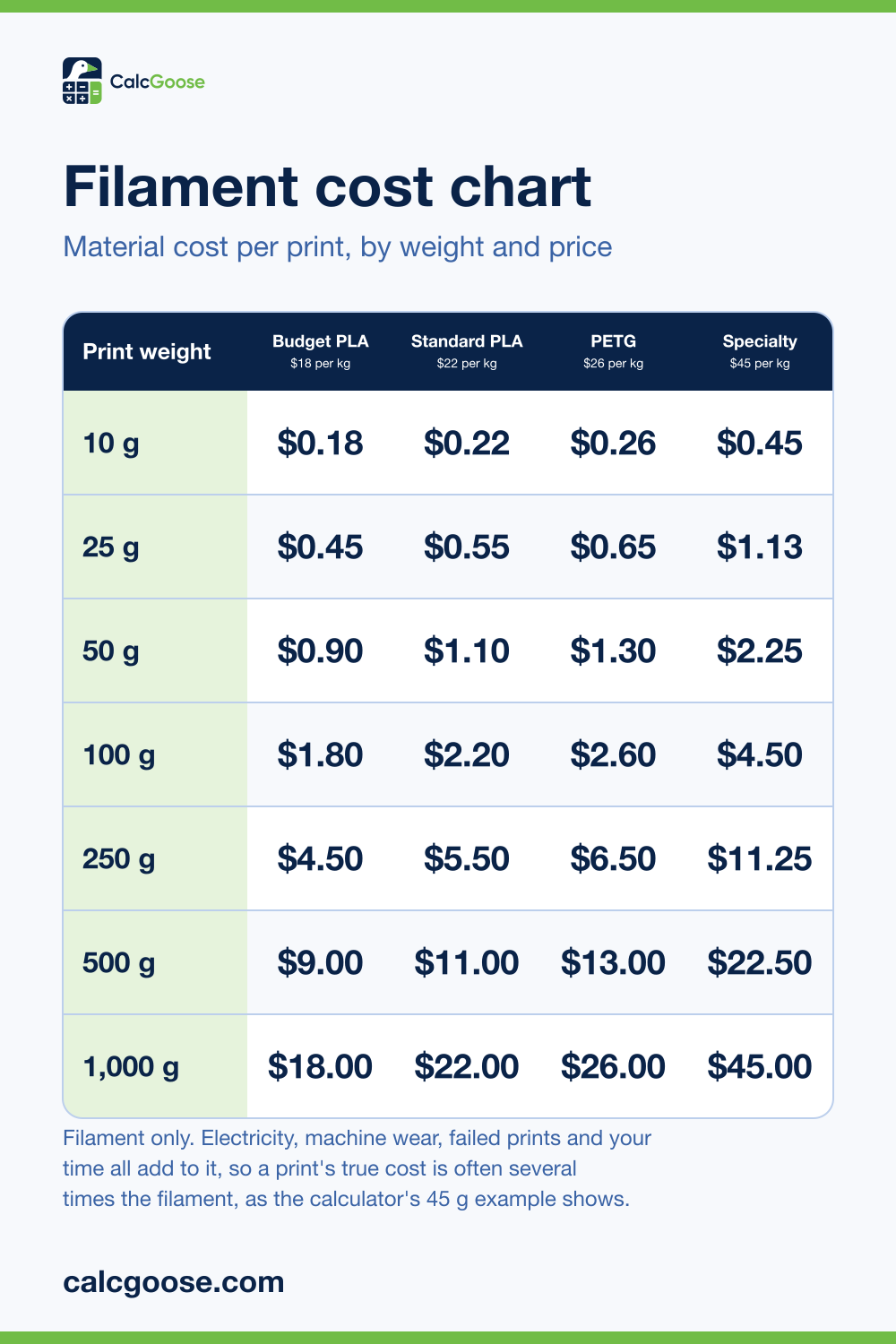
Filament cost chart
What the filament in a print costs at common print weights, for each filament price the calculator offers as a preset. Every figure comes from the same formula as the calculator above.
| Print weight | Budget PLA $18 per kg | Standard PLA $22 per kg | PETG $26 per kg | Specialty $45 per kg |
|---|---|---|---|---|
| 10 g | $0.18 | $0.22 | $0.26 | $0.45 |
| 25 g | $0.45 | $0.55 | $0.65 | $1.13 |
| 50 g | $0.90 | $1.10 | $1.30 | $2.25 |
| 100 g | $1.80 | $2.20 | $2.60 | $4.50 |
| 250 g | $4.50 | $5.50 | $6.50 | $11.25 |
| 500 g | $9.00 | $11.00 | $13.00 | $22.50 |
| 1,000 g | $18.00 | $22.00 | $26.00 | $45.00 |
Filament only. Electricity, machine wear, failed prints and your time all add to it, so a print's true cost is often several times the filament, as the calculator's 45 g example shows.
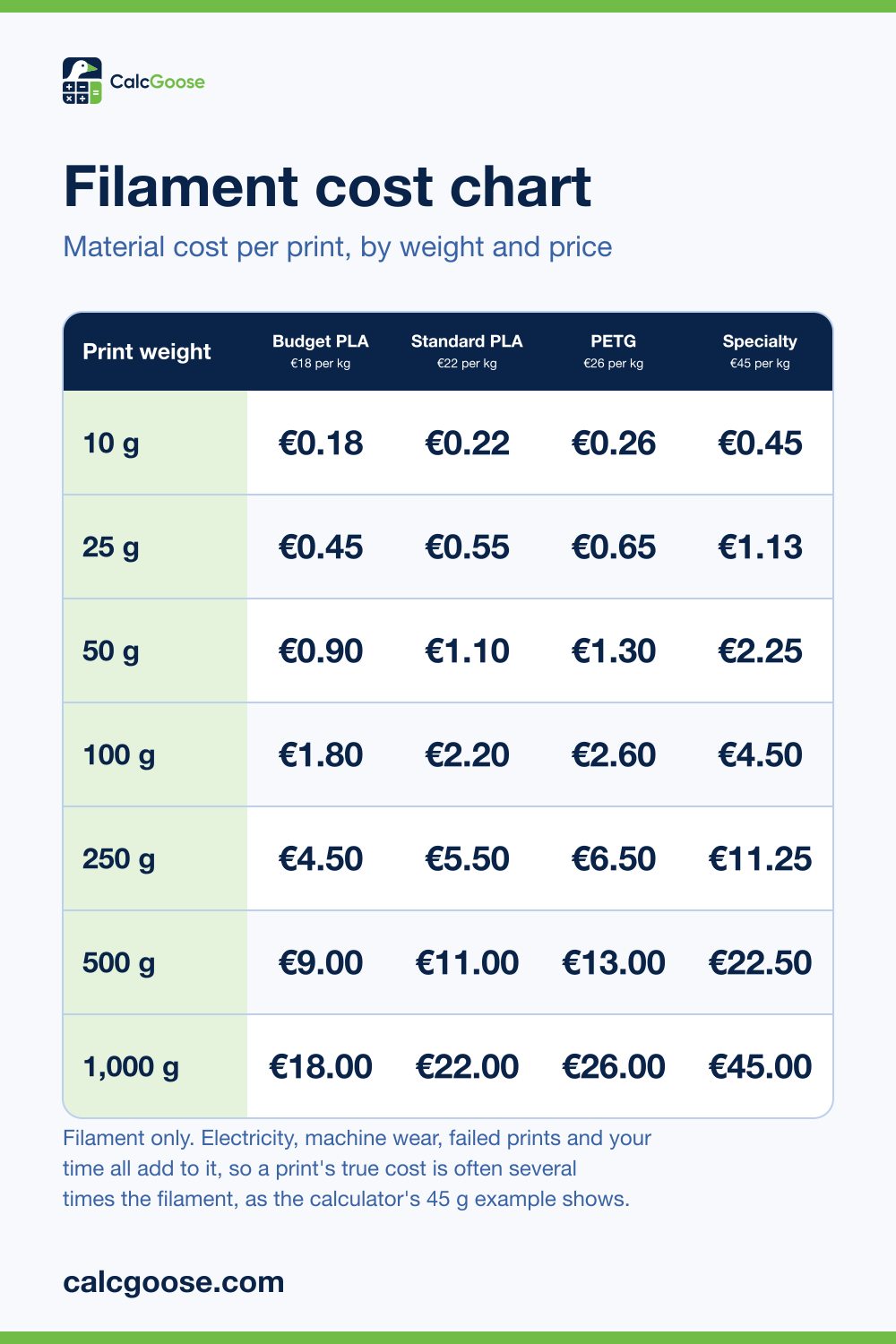
What the filament in a print costs at common print weights, for each filament price the calculator offers as a preset. Every figure comes from the same formula as the calculator above.
| Print weight | Budget PLA €18 per kg | Standard PLA €22 per kg | PETG €26 per kg | Specialty €45 per kg |
|---|---|---|---|---|
| 10 g | €0.18 | €0.22 | €0.26 | €0.45 |
| 25 g | €0.45 | €0.55 | €0.65 | €1.13 |
| 50 g | €0.90 | €1.10 | €1.30 | €2.25 |
| 100 g | €1.80 | €2.20 | €2.60 | €4.50 |
| 250 g | €4.50 | €5.50 | €6.50 | €11.25 |
| 500 g | €9.00 | €11.00 | €13.00 | €22.50 |
| 1,000 g | €18.00 | €22.00 | €26.00 | €45.00 |
Filament only. Electricity, machine wear, failed prints and your time all add to it, so a print's true cost is often several times the filament, as the calculator's 45 g example shows.
Assumptions and limits
Everything this calculator quietly assumes on your behalf. If one of these does not match your situation, the answer will be off.
- Electricity is calculated from average draw across the whole print. Real consumption is higher during bed heat-up and lower during long travel-free stretches, but the average over a multi-hour print is close.
- Printer depreciation is straight-line across the stated lifetime hours. It does not account for the resale value of a working machine, which makes this figure slightly conservative.
- The failure rate is applied by dividing rather than adding, because failures reduce the number of prints that actually ship. It assumes failures happen at an average point in the print, so a machine that mostly fails in the first layer is being over-charged here.
- Consumables beyond filament (nozzles, build plates, adhesion sticks, isopropyl) are not itemised. They typically add 3–8% to material cost.
- Marketplace fees are not included in the suggested price. Etsy takes about 9.5% including payment processing, eBay 13.6% for most categories or 12.7% with a store subscription, and a personal website takes payment processing of around 3%.
- Labour is your hands-on time only. Print time is machine time and should not be billed at your hourly rate. That is what depreciation covers.
- Margin is expressed as a share of the selling price, which is the standard retail convention. A 40% margin means 40 cents of every dollar taken is profit, not that you marked cost up by 40%.
- Filament price assumes you use the whole spool. Partial spools and colour changes waste more than most people account for.
Frequently asked questions
How much does a 3D print actually cost?
For a typical 45-gram, five-hour print on 20-per-kilo filament, the direct cost is around 1.50 in material, power and machine wear. Once you add a realistic failure rate and even fifteen minutes of your own time, the true cost is closer to 6 or 7. Material is rarely the biggest line.
How should I price 3D prints on Etsy?
Work out the full cost including failures and labour, divide by one minus your target margin, then add the marketplace fee on top. At a 40% margin, a print costing 6.71 to make needs to sell at about 11.18 before fees, or roughly 12.35 once Etsy takes its 9.5%. Pricing on filament weight alone is the single most common mistake in the hobby.
How much electricity does a 3D printer use?
A typical consumer FDM printer with a heated bed averages 100–180 watts, so a five-hour print uses under a kilowatt-hour, about 14 cents at the US average rate. Nameplate ratings of 350 W or more are peak figures during bed heat-up and are not what the machine draws for most of the print.
How many prints do I get from a 1 kg spool?
A kilogram of filament gives about 22 prints of 45 grams, or roughly 330 metres of 1.75 mm filament. Small articulated toys typically run 20–40 g, functional brackets 50–120 g, and large vases or helmets can eat half a spool on their own.
Should I include failed prints in my pricing?
Yes, and by dividing rather than adding. If one in ten prints fails, only 90% of what you start ships, so each successful print must carry 1/0.9 of the cost, an 11.1% uplift. Ignoring failures is why so many print sellers find their margin evaporating.
How long does a 3D printer last?
A consumer FDM machine with routine maintenance typically gives 3,000–5,000 printing hours before major parts need replacing, and many last far longer with rebuilds. Spread over that lifetime, a 400 printer costs about 10 cents an hour to run, which is usually less than the filament in the same print.
What am I really earning per hour on a 3D print?
Take the selling price, subtract everything the print cost to make apart from your own labour, and divide by your hands-on minutes. At the defaults above that is about 38 an hour for fifteen minutes of work, comfortably ahead of the 20 an hour the labour line charges. Long unattended prints are where the figure gets flattering, because the machine works and you do not. Short fiddly ones with heavy support removal are where a print business quietly loses money.
Should I charge for print time or just labour?
Charge for your hands-on labour and let machine time be covered by depreciation. Billing print time at an hourly rate produces absurd prices for long prints, because you are not actually working during them. If your printer is the bottleneck on volume, raise the margin instead.
Related calculators
- Epoxy Resin Calculator Maker & Craft Work out how much resin a mould, river table or tumbler actually takes, split by part A and B.
- Candle Making Calculator Maker & Craft How much wax and fragrance oil a batch of candles needs, plus a wick size for your jar.
- Soap Lye Calculator Maker & Craft Work out exactly how much lye and water your oils need, with superfat and a full safety brief.
- Yarn Calculator Maker & Craft How much yarn a blanket, scarf or hat takes, by craft, stitch density and yarn weight.
- Fabric Calculator Maker & Craft How much fabric a project needs, with hems, seams and pattern repeat already added.
- Vinyl & Sticker Pricing Calculator Maker & Craft What to charge for decals, shirts and signs once materials, labour and marketplace fees are in.
Share this calculator
Found the number you needed? Send it to whoever asked you for it.