Epoxy Resin Calculator
Enter your mould or project dimensions and get the total resin volume, split into part A and part B, in millilitres, fluid ounces and grams.
Last updated
Where are you?
AWG, NEC, 120/240 V, miles and gallons mm², IEC/BS 7671, 230/400 V, km and litres . We remember this on every calculator.
Your result
Total resin needed (mixed)
111 ml
- In fluid ounces
- 3.72 fl oz
- Part A (resin)
- 56 ml
- Part B (hardener)
- 56 ml
- By weight
- 122 g
- Per piece
- 111 ml
- Resin type
- Tabletop / craft
🪿 The goose says: You need about 111 ml of mixed resin. That is 56 ml of part A and 56 ml of part B.
- Mix by volume at 1:1 unless your bottles say otherwise. Some brands specify a different ratio by weight than by volume, and getting that backwards is the most common cause of a soft cure.
- Mix for a full three minutes, scraping the sides and bottom of the cup. Unmixed resin at the edges is what produces sticky patches days later.
How this epoxy resin calculator works
Resin is a volume problem wearing a chemistry costume. Work out how much space the resin has to fill, convert that into millilitres, then split it by the mix ratio printed on your bottles.
The only genuinely awkward shape is the tumbler wrap, because you are not filling a space. You are coating a surface. That is the circumference of the cup multiplied by the height you are covering multiplied by how thick the coat is, which gives a thin shell rather than a solid volume.
-
Step 1 Volume of the shape
rectangle = L × W × D cylinder = π × (d/2)² × h sphere = 4/3 × π × (d/2)³ tumbler wrap = π × d × h × coat_thickness -
Step 2 Multiply by quantity and add waste
total = volume × pieces × (1 + waste%)Waste is resin left in the cup and on the stick. It is real and it is always more than you expect. -
Step 3 Convert to millilitres
ml = cubic_inches × 16.387In metric mode the dimensions are centimetres, and 1 cm³ is exactly 1 ml. -
Step 4 Split by the mix ratio
part_A = total × A ÷ (A + B) part_B = total × B ÷ (A + B) -
Step 5 Convert to weight if you mix on scales
grams = ml × 1.1Most epoxies sit close to 1.1 g/ml. Check your data sheet if you need precision.
For example, a 4 × 4 in coaster mould poured 0.4 in deep is 6.4 cubic inches, which is 105 ml. Add 5% waste and you need 110 ml of mixed resin, 55 ml of each part at 1:1.
Epoxy resin chart
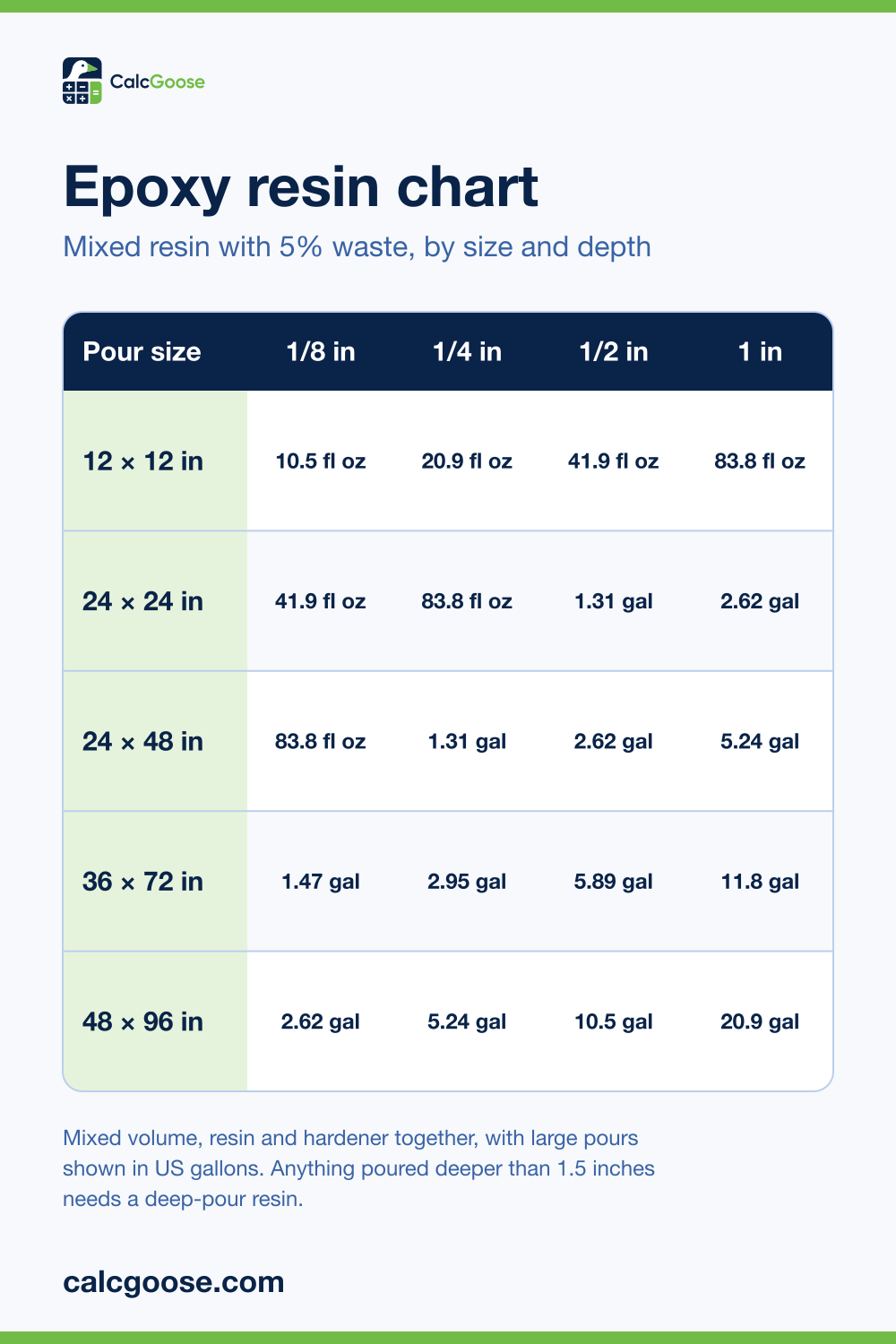
How much mixed resin a rectangular pour takes at common depths, from a coaster to a full tabletop, with a 5% waste margin for resin left in the mixing cup. Every figure comes from the same formula as the calculator above.
| Pour size | 1/8 in | 1/4 in | 1/2 in | 1 in |
|---|---|---|---|---|
| 12 × 12 in | 10.5 fl oz | 20.9 fl oz | 41.9 fl oz | 83.8 fl oz |
| 24 × 24 in | 41.9 fl oz | 83.8 fl oz | 1.31 gal | 2.62 gal |
| 24 × 48 in | 83.8 fl oz | 1.31 gal | 2.62 gal | 5.24 gal |
| 36 × 72 in | 1.47 gal | 2.95 gal | 5.89 gal | 11.8 gal |
| 48 × 96 in | 2.62 gal | 5.24 gal | 10.5 gal | 20.9 gal |
Mixed volume, resin and hardener together, with large pours shown in US gallons. Anything poured deeper than 1.5 inches needs a deep-pour resin.
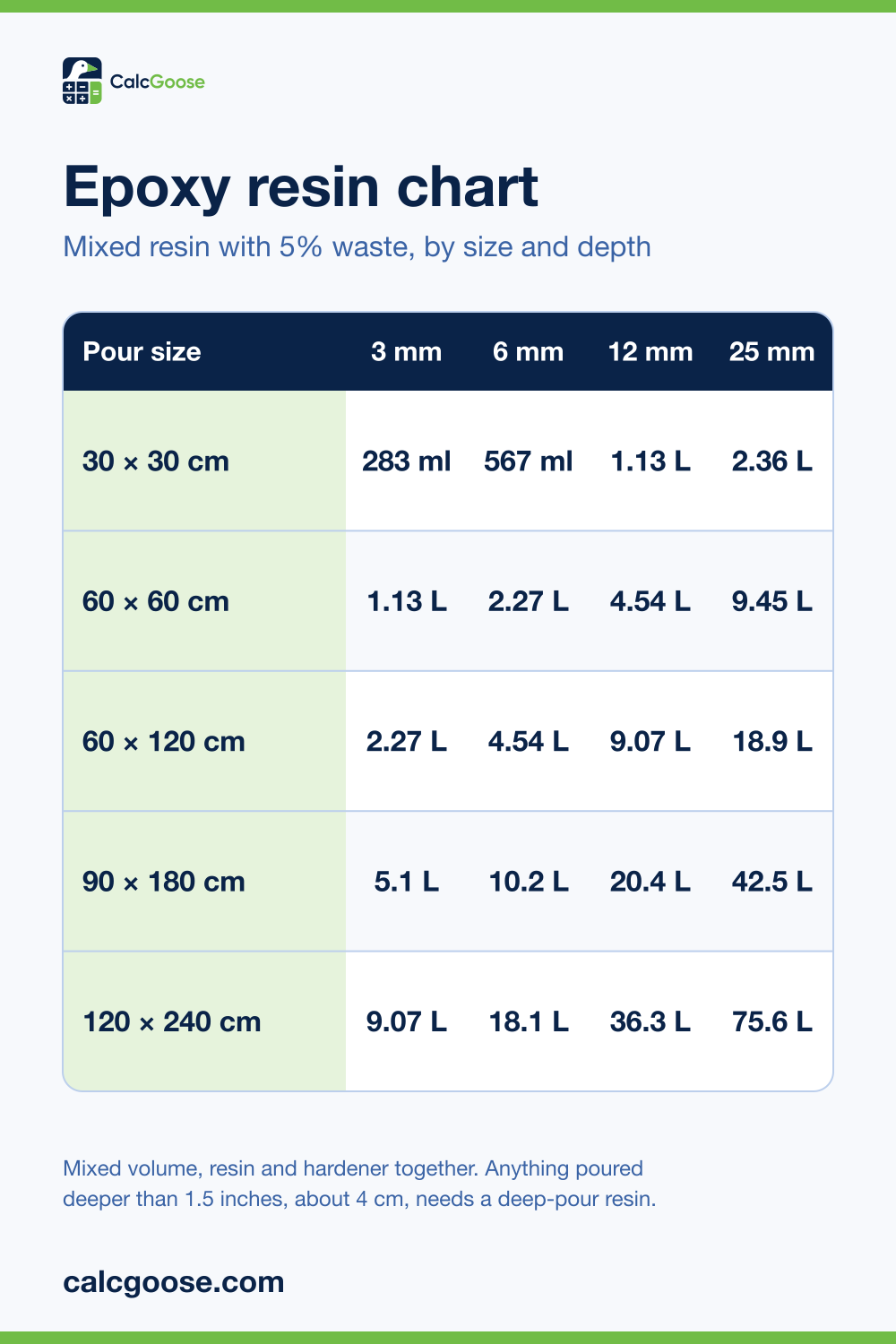
How much mixed resin a rectangular pour takes at common depths, from a coaster to a full tabletop, with a 5% waste margin for resin left in the mixing cup. Every figure comes from the same formula as the calculator above.
| Pour size | 3 mm | 6 mm | 12 mm | 25 mm |
|---|---|---|---|---|
| 30 × 30 cm | 283 ml | 567 ml | 1.13 L | 2.36 L |
| 60 × 60 cm | 1.13 L | 2.27 L | 4.54 L | 9.45 L |
| 60 × 120 cm | 2.27 L | 4.54 L | 9.07 L | 18.9 L |
| 90 × 180 cm | 5.1 L | 10.2 L | 20.4 L | 42.5 L |
| 120 × 240 cm | 9.07 L | 18.1 L | 36.3 L | 75.6 L |
Mixed volume, resin and hardener together. Anything poured deeper than 1.5 inches, about 4 cm, needs a deep-pour resin.
Assumptions and limits
Everything this calculator quietly assumes on your behalf. If one of these does not match your situation, the answer will be off.
- Mixed resin density is taken as 1.1 g/ml, which is typical across craft and casting epoxies. Check your product data sheet if you are mixing by weight and need better than about 3% accuracy.
- The mix ratio is applied by volume. Several brands specify a different ratio by weight than by volume, for example 100:45 by weight but 2:1 by volume. Always use the figure that matches how you are measuring.
- The waste margin covers resin clinging to the mixing cup and stirring stick. It does not cover a spilled pour, a leaking mould, or a second coat.
- A tumbler wrap is modelled as a thin shell of even thickness. Real coats are thicker at the bottom where resin flows down, so treat the figure as a minimum.
- River table channels are modelled as a plain rectangular prism using the average width. Live-edge slabs curve, so measure the width at several points and use the middle value, and expect the true volume to be slightly lower.
- Deep-pour warnings trigger above 1.5 inches (about 4 cm) of pour depth, which is the common limit for tabletop resins. Deep-pour formulas on sale now are generally rated for 2 to 4 inches in a single layer, though a few are only good for 1 to 2. Follow the figure printed on your own product rather than the class.
- No allowance is made for objects embedded in the pour. Anything you place in the mould displaces resin, so the true requirement will be lower.
Frequently asked questions
How much resin do I need for a coaster?
A standard 4-inch round or square coaster mould poured about 0.4 in (1 cm) deep takes roughly 80–110 ml of mixed resin. A set of four therefore needs about 400 ml, or 440 once you allow for what stays in the cup. A 1-quart kit is roughly 950 ml, so it covers two sets of four with a little to spare.
How much resin do I need for a tumbler?
Far less than most people mix. A 20 oz skinny tumbler is roughly 2.9 inches across with about 6.5 inches of coated height, and at a normal 0.03 inch coat that comes to only 30 ml of mixed resin. Pick the tumbler wrap option above and put your own numbers in, because the answer is driven by coat thickness rather than by how big the cup is. Mixing 100 ml for one tumbler is how most of a bottle ends up in the bin.
How much resin does a river table take?
Multiply the channel length by its average width by the pour depth, then convert. A 48 × 4 × 1.5 inch channel is 288 cubic inches, which is about 4.7 litres of mixed resin. River tables are almost always the point where people move from quarts to gallons.
What is the difference between deep-pour and tabletop resin?
Tabletop resin cures fast and hot, which limits it to layers of about 1.5 inches or less; pour deeper and the exotherm can crack the piece or yellow it. Deep-pour resin cures slowly over 24–72 hours so the heat dissipates, and most current formulas are rated for 2 to 4 inches in one layer. They are not interchangeable.
Should I mix epoxy by weight or by volume?
Use whichever method your manufacturer specifies, and never mix the two. Many resins have a 1:1 volume ratio but a different weight ratio because the resin and hardener have different densities, so measuring by weight to a volume ratio gives a soft, tacky cure that never fixes itself.
How do I stop bubbles in resin?
Warm the bottles in a water bath before mixing, stir slowly rather than whipping, and pass a butane torch quickly over the surface a few minutes after pouring. Most bubbles come from air folded in during mixing, so the fix is technique rather than product.
How long does epoxy take to cure?
Most craft resins are touch-dry in 12–24 hours and fully cured in 72. Deep-pour formulas take longer, often 5–7 days to reach full hardness. Cold rooms slow everything down, below about 70 °F (21 °C) cure times stretch significantly and some resins never fully harden.
Can I pour resin in layers?
Yes, and it is the standard workaround for depth. Pour up to your resin's maximum layer thickness, wait until it is firm but still slightly tacky, then pour the next layer, bonding to a tacky surface avoids visible lines. If it has fully cured, sand the surface before the next pour.
Guides on this
The reasoning behind the number, and the decisions it does not make for you.
- How deep you can pour resin in one go Pour past a resin's depth limit and the batch heats itself. That is what cracks a river table, yellows a cast and sometimes smokes in the cup.
- Why a resin pour stays sticky Sticky resin is almost always a ratio problem, and the usual culprit is mixing by volume a resin that is specified by weight. The two are not the same.
Related calculators
- Candle Making Calculator Maker & Craft How much wax and fragrance oil a batch of candles needs, plus a wick size for your jar.
- Soap Lye Calculator Maker & Craft Work out exactly how much lye and water your oils need, with superfat and a full safety brief.
- 3D Print Cost Calculator Maker & Craft The real cost of a print (filament, power, wear and failures) and what to charge for it.
- Yarn Calculator Maker & Craft How much yarn a blanket, scarf or hat takes, by craft, stitch density and yarn weight.
- Fabric Calculator Maker & Craft How much fabric a project needs, with hems, seams and pattern repeat already added.
- Vinyl & Sticker Pricing Calculator Maker & Craft What to charge for decals, shirts and signs once materials, labour and marketplace fees are in.
Share this calculator
Found the number you needed? Send it to whoever asked you for it.