Pool Chemical Calculator
Enter your pool size and current readings to get the exact chlorine dose and pH adjustment, derived from published dosing chemistry, not a generic chart.
Last updated
Where are you?
AWG, NEC, 120/240 V, miles and gallons mm², IEC/BS 7671, 230/400 V, km and litres . We remember this on every calculator.
Your result
Cal-hypo granules, 65% to add
6.16 oz
- Pool volume
- 15,000 gal
- Chlorine increase
- 2 ppm
- In pounds
- 0.38 lb
- pH change needed
- -0.30
- Muriatic acid
- 27 fl oz
- Alkalinity assumed
- 100 ppm
🪿 The goose says: Add 6.16 oz of cal-hypo granules, 65% to raise free chlorine by 2 ppm, and 27 fl oz of muriatic acid (31.45%) for the pH. Run the pump, then retest before adding anything else.
- Never mix pool chemicals. Chlorine products and acid together produce chlorine gas. Add one chemical, run the pump for a few hours, retest, then add the next.
- Pre-dissolve cal-hypo in a bucket of water and pour it in slowly with the pump running. Adding granules straight to the pool bleaches vinyl liners, and putting it in the skimmer can react violently with trichlor residue.
Estimate for planning only. Have any electrical work verified by a qualified electrician and installed to code. See the full disclaimer at the bottom of this page.
How this pool chemical calculator works
Pool chlorine dosing is real chemistry, and it can be derived rather than looked up in a chart. Parts per million is milligrams per litre, so to raise a volume of water by one ppm you need the weight of that water multiplied by one millionth.
Ten thousand US gallons weighs 83,400 pounds, so one ppm needs 0.0834 pounds of pure available chlorine. Divide that by the strength of your product and you have the dose, 65% cal-hypo needs 0.128 lb, which is 2.05 ounces. That is exactly the figure printed on the bag, and now you know where it comes from.
pH is messier and genuinely is a chart, because how far the pH moves depends on total alkalinity, the water's buffering capacity. The doses here are scaled from the standard reference of 10,000 gallons at 100 ppm alkalinity, which is why the alkalinity input changes the answer.
-
Step 1 Pool volume
gallons = length × width × avg_depth × 7.48 round, π × radius² × avg_depth × 7.48 -
Step 2 Pure chlorine needed
lb = gallons × 8.34 × ppm_increase ÷ 1,000,000Water weighs 8.34 lb per US gallon. -
Step 3 Convert to product
product_lb = pure_lb ÷ product_strengthCal-hypo 65% or 73%, dichlor 56%, trichlor 90%, liquid 10% or 12.5%. -
Step 4 Or in metric
grams_of_product = litres × ppm_increase ÷ 1000 ÷ product_strengthA part per million is a milligram per litre, so a cubic metre of water needs exactly one gram of pure chlorine. No 8.34 required. -
Step 5 Liquid products by volume
fl_oz = product_lb ÷ density × 12812.5% liquid chlorine weighs about 9.74 lb per gallon. -
Step 6 pH adjustment
dose = (gallons ÷ 10,000) × (|pH_change| ÷ 0.2) × base_dose × (alkalinity ÷ 100)Base dose is 12 fl oz of 31.45% muriatic acid, or 6 oz of soda ash, per 0.2 pH per 10,000 gal at 100 ppm alkalinity.
For example, 15,000 gallons going from 1 to 3 ppm free chlorine with 65% cal-hypo. That is 2 ppm × 15,000 ÷ 10,000 × 0.0834 = 0.25 lb of pure chlorine, divided by 0.65 = 0.385 lb of product, which is 6.2 ounces.
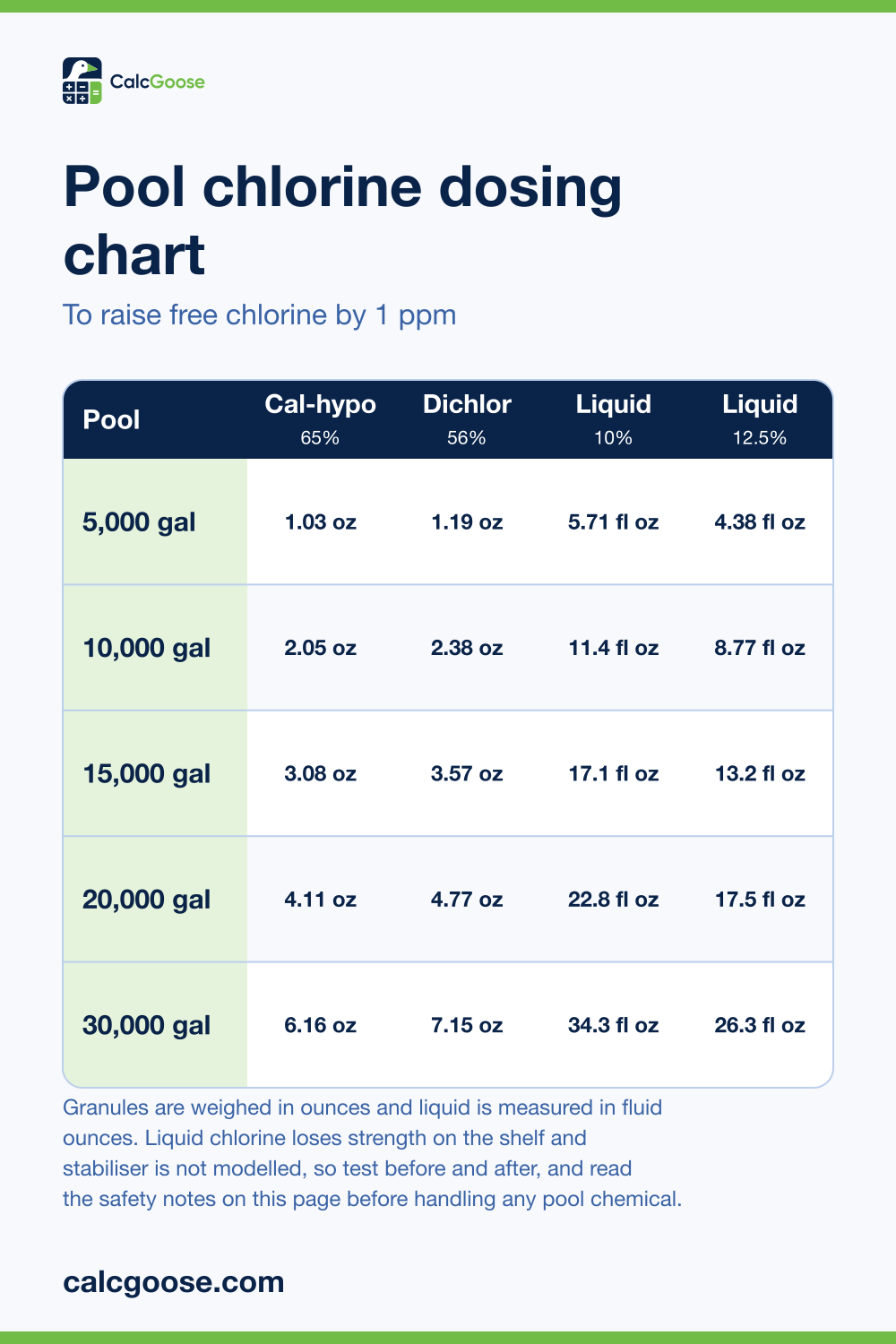
Pool chlorine dosing chart
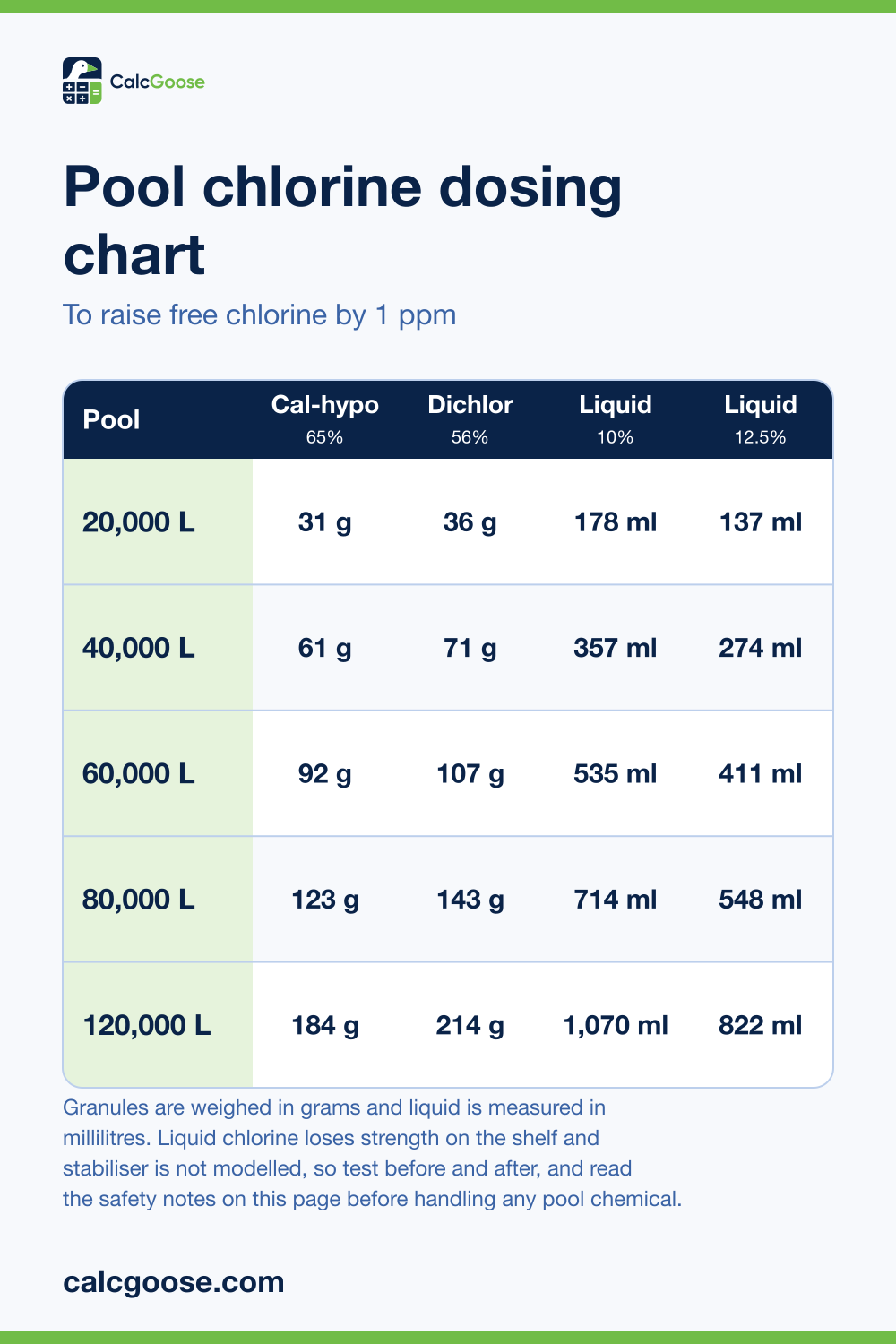
How much of each common chlorine product raises free chlorine by 1 ppm, by pool volume, so multiply by the rise you need. Every figure comes from the same formula as the calculator above.
| Pool | Cal-hypo 65% | Dichlor 56% | Liquid 10% | Liquid 12.5% |
|---|---|---|---|---|
| 5,000 gal | 1.03 oz | 1.19 oz | 5.71 fl oz | 4.38 fl oz |
| 10,000 gal | 2.05 oz | 2.38 oz | 11.4 fl oz | 8.77 fl oz |
| 15,000 gal | 3.08 oz | 3.57 oz | 17.1 fl oz | 13.2 fl oz |
| 20,000 gal | 4.11 oz | 4.77 oz | 22.8 fl oz | 17.5 fl oz |
| 30,000 gal | 6.16 oz | 7.15 oz | 34.3 fl oz | 26.3 fl oz |
Granules are weighed in ounces and liquid is measured in fluid ounces. Liquid chlorine loses strength on the shelf and stabiliser is not modelled, so test before and after, and read the safety notes on this page before handling any pool chemical.
How much of each common chlorine product raises free chlorine by 1 ppm, by pool volume, so multiply by the rise you need. Every figure comes from the same formula as the calculator above.
| Pool | Cal-hypo 65% | Dichlor 56% | Liquid 10% | Liquid 12.5% |
|---|---|---|---|---|
| 20,000 L | 31 g | 36 g | 178 ml | 137 ml |
| 40,000 L | 61 g | 71 g | 357 ml | 274 ml |
| 60,000 L | 92 g | 107 g | 535 ml | 411 ml |
| 80,000 L | 123 g | 143 g | 714 ml | 548 ml |
| 120,000 L | 184 g | 214 g | 1,070 ml | 822 ml |
Granules are weighed in grams and liquid is measured in millilitres. Liquid chlorine loses strength on the shelf and stabiliser is not modelled, so test before and after, and read the safety notes on this page before handling any pool chemical.
Assumptions and limits
Everything this calculator quietly assumes on your behalf. If one of these does not match your situation, the answer will be off.
- Chlorine doses are derived from first principles using the weight of water (8.34 lb per US gallon) and the stated available-chlorine strength of each product. They match published dosing charts closely.
- Liquid chlorine loses strength on the shelf, roughly 1% of its available chlorine per week at room temperature and faster in heat. A jug that has been in the garage all summer is materially weaker than its label.
- pH doses are scaled from a reference of 10,000 gallons and 100 ppm total alkalinity. Alkalinity is what buffers pH, so the dose scales with it. This is an approximation of a non-linear relationship and should be treated as a starting point.
- Adjust pH in stages. Add about half the calculated amount, circulate for four hours, and retest. Overshooting downwards is much harder to correct than creeping up.
- Cyanuric acid, the stabiliser, is not modelled. It has a large effect on how much free chlorine you actually need, at 30 ppm CYA the target is around 2–4 ppm, but at 80 ppm you need 6–8 ppm to achieve the same sanitising power. Dichlor and trichlor both add CYA with every dose.
- Calcium hardness is not modelled. Repeated cal-hypo use raises it, and above about 400 ppm you get scaling on surfaces and equipment.
- Salt-water pools generate chlorine in the cell rather than from added product. Use these figures only for a manual top-up or shock, not for routine chlorination.
- Water temperature, sunlight, bather load and rainfall all consume chlorine. Test frequently in summer, a pool can drop from 3 ppm to zero in a single hot day with heavy use.
Frequently asked questions
How much shock do I need for a 10,000 gallon pool?
To take free chlorine from 1 ppm to a shock level of 10 ppm in 10,000 gallons, you need about 1.16 pounds of 65% cal-hypo, or roughly 2.5 quarts of 12.5% liquid chlorine. Add it after sunset so ultraviolet does not destroy it before it works, and run the pump overnight.
How much chlorine per 1,000 litres?
One gram of pure available chlorine per 1,000 litres raises free chlorine by 1 ppm, because a part per million is simply a milligram per litre. Through 65% cal-hypo that is about 1.5 grams of product, and through 12.5% liquid chlorine about 7 millilitres. The metric version of this sum is much easier than the imperial one, which has to start from the weight of a gallon of water.
How much muriatic acid do I need to lower pH?
About 12 fluid ounces of 31.45% muriatic acid per 10,000 gallons lowers pH by 0.2 at a total alkalinity of 100 ppm. Higher alkalinity needs proportionally more. Always add half, circulate for four hours and retest, overshooting into acidic water is much harder to correct.
What is the difference between chlorine and shock?
They are the same chemical at different doses. Routine chlorination keeps free chlorine at 2 to 4 ppm; shocking raises it to around 10 ppm briefly to break down chloramines and kill algae. "Shock" sold as a product is usually cal-hypo or dichlor, the same thing in a single-dose bag.
How often should I shock my pool?
Whenever combined chlorine exceeds 0.5 ppm, after heavy use or a storm, and typically every one to two weeks in peak season. Shocking on a fixed schedule regardless of test results is wasteful; shocking based on a proper test is not. A strong chlorine smell means chloramines, which is a sign you need to shock, not that you have too much chlorine.
How long after adding chemicals can I swim?
After a normal chlorine addition, once free chlorine is back under 5 ppm, usually a few hours with the pump running. After acid, wait about four hours and confirm pH is in the 7.2 to 7.8 range. After a full shock, that can mean waiting overnight or longer. Always test rather than relying on time.
Why does my chlorine disappear so fast?
Usually sunlight without enough stabiliser, or a high chlorine demand from algae or organic load. Cyanuric acid protects chlorine from UV, and an unstabilised outdoor pool can lose most of its free chlorine in a single sunny day. If chlorine vanishes overnight with adequate stabiliser, you likely have an algae bloom consuming it.
Can I mix pool chemicals to save time?
No, and this is the most dangerous thing you can do at a pool. Chlorine products and acid react to produce chlorine gas, which has killed people in domestic settings. Different chlorine types can also react with each other. Add one chemical, run the pump for several hours, retest, then add the next.
Guides on this
The reasoning behind the number, and the decisions it does not make for you.
- Why a pool can hold chlorine and algae at the same time Stabiliser protects chlorine from sunlight and slows it down at the same time. Once it climbs, the chlorine reading you trust stops meaning what it did.
- Shock is a level to reach, not a bag to tip in One bag per 10,000 gallons is a guess at a number that depends on your stabiliser. Fall short of breakpoint and you make the smell worse, not better.
Related calculators
- Sourdough Calculator Everyday Life Scale any sourdough recipe by baker's percentages, with true hydration worked out properly.
- Coffee Ratio Calculator Everyday Life How many grams of coffee for any brew method, cup count and strength.
- BBQ Calculator Everyday Life How much meat to buy for a cookout, adjusted for kids, appetite and sides.
- Party Drink Calculator Everyday Life Beer, wine, spirits, mixers and ice for any guest count and party length.
- Tip & Bill Split Calculator Everyday Life Split a bill evenly or by what each person ordered, with tax and tip shared fairly.
- Freelance Rate Calculator Everyday Life Work backwards from the money you want to keep to the hourly rate you have to charge.
- Pizza Dough Calculator Everyday Life Dough ball weight from the pizza size, then flour, water, salt and yeast by baker's percentage.
Share this calculator
Found the number you needed? Send it to whoever asked you for it.
Safety disclaimer
Pool chemicals are hazardous. Never mix chemicals with each other, combining chlorine products with acid produces chlorine gas, which can be fatal. Always add chemicals to water, never water to chemicals, and always add acid to water. Pre-dissolve calcium hypochlorite in a bucket of water before adding it, and never add it directly to the skimmer. Wear chemical-resistant gloves and eye protection, work upwind, and store products separately in a cool dry place. These figures are estimates for planning. Always test the water before and after dosing, add chemicals in stages rather than all at once, and follow the instructions on your specific product.