Watts Calculator
Enter any two of watts, amps and volts and get the third, with power factor and three-phase handled properly, then see what the load costs to run for a day, a month and a year.
Last updated
Where are you?
AWG, NEC, 120/240 V, miles and gallons mm², IEC/BS 7671, 230/400 V, km and litres . We remember this on every calculator.
Your result
Watts
1,200 W
- Watts
- 1,200 W
- Kilowatts
- 1.20 kW
- Amps
- 10 A
- Volts
- 120 V
- Apparent power
- 1,200 VA
- Energy per day
- 4.80 kWh
🪿 The goose says: 120 V × 10 A is 1,200 W, 1.20 kW. Left on for 4 hours a day that is $26.30 a month.
- NEC sizes a continuous load at 125% of its current, so 10 A wants a 15 A breaker and conductors rated for it. A 15 A household circuit is limited to 12 A continuous, which is 1,440 W at 120 V.
The same load on a different supply
How many amps 1,200 W draws at each common voltage, at the power factor you set.
- 12 V DC
- 100 A
- 120 V
- 10 A your supply
- 240 V
- 5 A
- 480 V three-phase
- 1.44 A
Doubling the voltage halves the current, which is why the same appliance needs half the copper on 240 V that it needs on 120 V.
What this costs to run
- Energy per day
- 4.80 kWh 4 h a day
- Energy per month
- 146 kWh
- Energy per year
- 1,752 kWh
- Cost per day
- $0.86
- Cost per month
- $26.30
- Cost per year
- $315.36
At $0.18 per kWh. A month is 30.44 days, the average across a year.
How this watts calculator works
Watts, volts and amps are three views of the same thing. Volts is the pressure pushing electrons, amps is how many are moving, and watts is the work they do, pressure times flow. That gives one equation, W = V × A, which you rearrange depending on which of the three you are missing.
On direct current that is the whole story. On alternating current it is not, because voltage and current do not necessarily peak at the same instant. Anything with a coil in it (a motor, a transformer, a fluorescent ballast), pulls current slightly out of step with the voltage, and the portion that is out of step does no useful work. Power factor is the fraction that does.
Three-phase adds one more term. Three-phase equipment is rated by its line-to-line voltage, and each of the three lines carries current, so the total works out to √3 (about 1.732) times line volts times line amps times power factor.
-
Step 1 DC, or resistive AC
watts = volts × amps -
Step 2 Single-phase AC
watts = volts × amps × power_factorPower factor is 1.0 for anything that only makes heat, and 0.7–0.9 for anything with a motor. -
Step 3 Three-phase AC
watts = √3 × line_volts × line_amps × power_factorLine volts means the 208 V, 240 V or 480 V between two phases, not the 120 V to neutral. -
Step 4 Rearranged for current
amps = watts ÷ (volts × factor) -
Step 5 Rearranged for voltage
volts = watts ÷ (amps × factor) -
Step 6 Apparent power
VA = volts × amps (× √3 on three-phase)Watts is the work done, VA is what the cable and the breaker actually carry. On a resistive load the two are identical. -
Step 7 The breaker it belongs on
breaker_A = next standard size at or above amps × 1.25NEC sizes a continuous load at 125% of its current, which is why a 15 A circuit is good for only 12 A all day. -
Step 8 Energy and money
kWh = watts ÷ 1000 × hours; cost = kWh × price_per_kWhWatts is a rate. Kilowatt-hours is the quantity you actually buy.
For example, a 1,500 W space heater on a 120 V outlet draws 1,500 ÷ 120 = 12.5 A. That is already above the 12 A continuous limit of a 15 A circuit, which is why heaters trip breakers when anything else shares the outlet. Run it four hours a day and it uses 6 kWh, about $33 a month at 18 cents.
Watts, volts and amps are three views of the same thing. Volts is the pressure pushing electrons, amps is how many are moving, and watts is the work they do, pressure times flow. That gives one equation, W = V × A, which you rearrange depending on which of the three you are missing.
On direct current that is the whole story. On alternating current it is not, because voltage and current do not necessarily peak at the same instant. Anything with a coil in it (a motor, a transformer, a fluorescent ballast), pulls current slightly out of step with the voltage, and the portion that is out of step does no useful work. Power factor is the fraction that does.
Three-phase adds one more term. A 400 V three-phase supply is 400 V between any two lines and 230 V from any line to neutral, and all three lines carry current, so the power works out to √3 (about 1.732) times line volts times line amps times power factor.
-
Step 1 DC, or resistive AC
watts = volts × amps -
Step 2 Single-phase AC at 230 V
watts = volts × amps × power_factorPower factor is 1.0 for kettles, ovens and immersion heaters, and 0.7–0.9 for anything with a motor. -
Step 3 Three-phase AC at 400 V
watts = √3 × line_volts × line_amps × power_factorLine volts is the 400 V between two phases, not the 230 V from a phase to neutral. -
Step 4 Rearranged for current
amps = watts ÷ (volts × factor) -
Step 5 Rearranged for voltage
volts = watts ÷ (amps × factor) -
Step 6 Apparent power
VA = volts × amps (× √3 on three-phase)Watts is the work done, VA is what the cable and the MCB actually carry. On a kettle or an oven the two are the same number. -
Step 7 The breaker it belongs on
breaker_A = next standard size at or above amps × 1.25A sustained load is sized at 125% of its running current, so 13 A of kettle wants a 20 A MCB rather than a 16 A one. -
Step 8 Energy and money
kWh = watts ÷ 1000 × hours; cost = kWh × price_per_kWhWatts is a rate. Kilowatt-hours is the quantity your meter counts.
For example, a 3,000 W kettle on a 230 V socket draws 3,000 ÷ 230 = 13.0 A, which is exactly why UK plug fuses are rated 13 A and why a kettle is the largest thing most homes plug into a socket. Boil it for six minutes a day and it uses 0.3 kWh, around €2.65 a month at 29 cents.
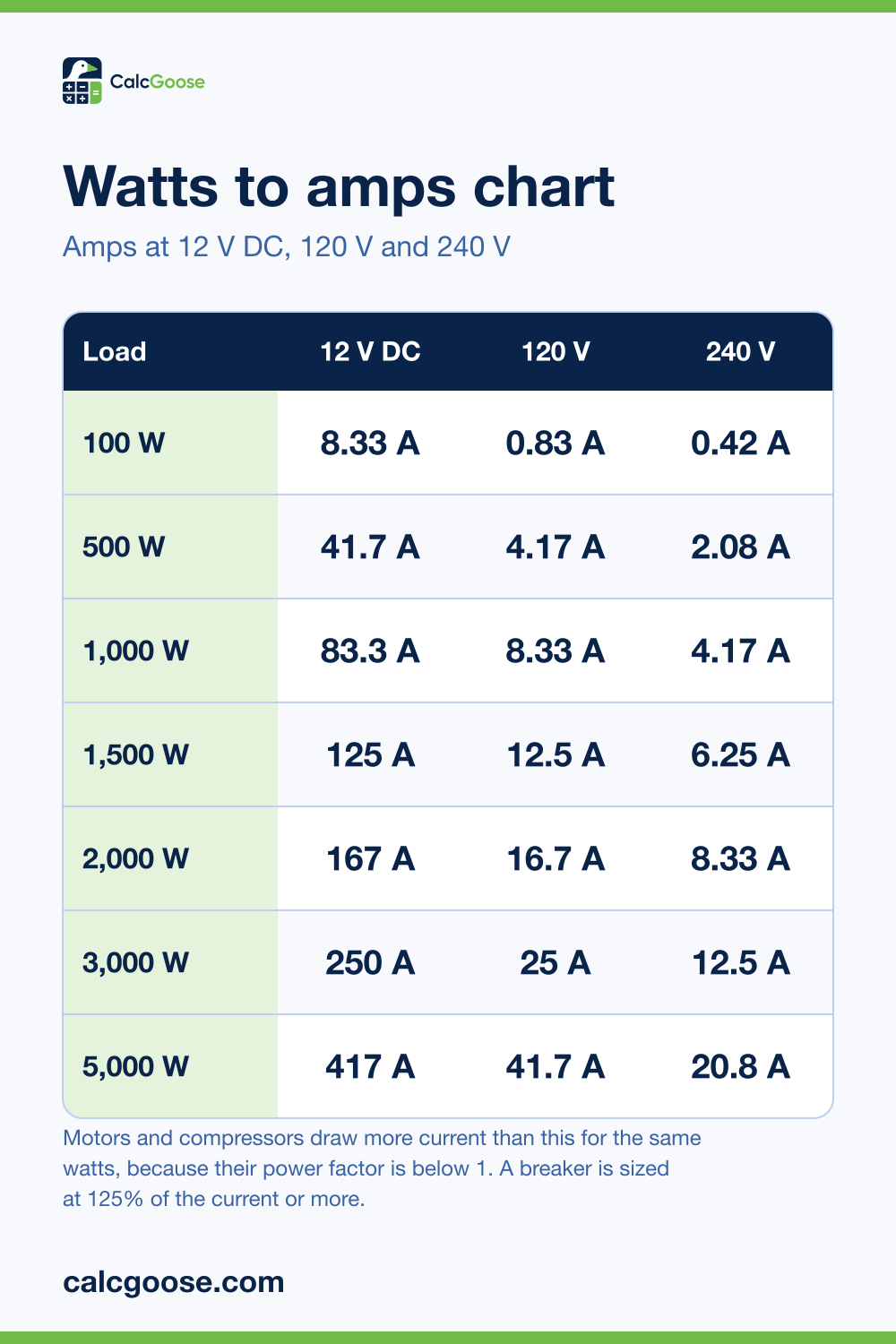
Watts to amps chart
The current common loads draw at the voltages you meet at home, for a resistive load with a power factor of 1. Every figure comes from the same formula as the calculator above.
| Load | 12 V DC | 120 V | 240 V |
|---|---|---|---|
| 100 W | 8.33 A | 0.83 A | 0.42 A |
| 500 W | 41.7 A | 4.17 A | 2.08 A |
| 1,000 W | 83.3 A | 8.33 A | 4.17 A |
| 1,500 W | 125 A | 12.5 A | 6.25 A |
| 2,000 W | 167 A | 16.7 A | 8.33 A |
| 3,000 W | 250 A | 25 A | 12.5 A |
| 5,000 W | 417 A | 41.7 A | 20.8 A |
Motors and compressors draw more current than this for the same watts, because their power factor is below 1. A breaker is sized at 125% of the current or more.
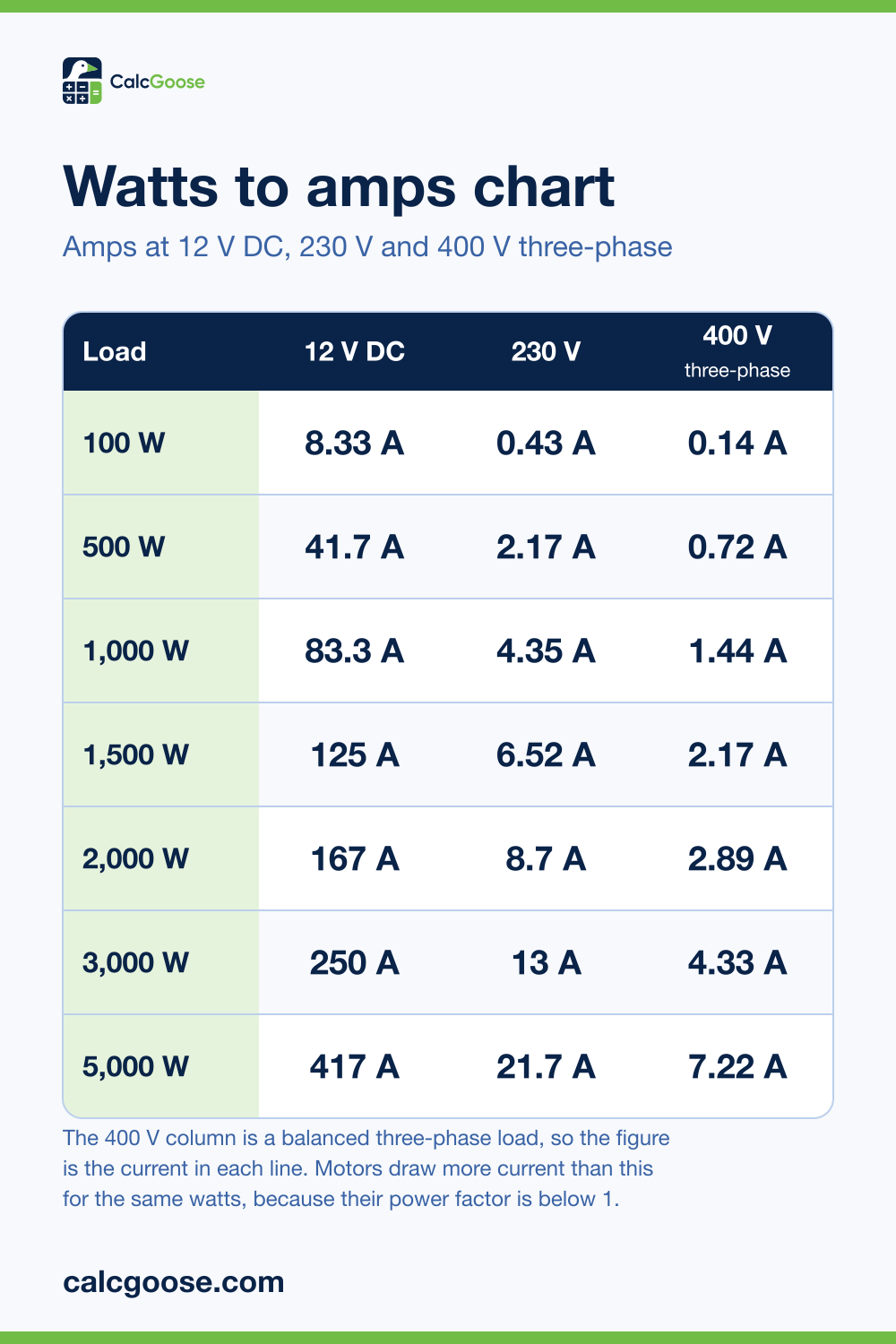
The current common loads draw at the voltages you meet at home, for a resistive load with a power factor of 1. Every figure comes from the same formula as the calculator above.
| Load | 12 V DC | 230 V | 400 V three-phase |
|---|---|---|---|
| 100 W | 8.33 A | 0.43 A | 0.14 A |
| 500 W | 41.7 A | 2.17 A | 0.72 A |
| 1,000 W | 83.3 A | 4.35 A | 1.44 A |
| 1,500 W | 125 A | 6.52 A | 2.17 A |
| 2,000 W | 167 A | 8.7 A | 2.89 A |
| 3,000 W | 250 A | 13 A | 4.33 A |
| 5,000 W | 417 A | 21.7 A | 7.22 A |
The 400 V column is a balanced three-phase load, so the figure is the current in each line. Motors draw more current than this for the same watts, because their power factor is below 1.
Assumptions and limits
Everything this calculator quietly assumes on your behalf. If one of these does not match your situation, the answer will be off.
- Power factor is applied to AC only. On DC, voltage and current are always in step, so watts is simply volts times amps.
- Three-phase is assumed balanced, all three lines carrying the same current. An unbalanced load has to be worked out phase by phase.
- The voltage entered for three-phase is line-to-line. Entering 120 V for a three-phase supply gives a nonsense answer, because no three-phase system is rated on its line-to-neutral voltage.
- Nameplate figures are maximums. A 1,000 W microwave is rated on its cooking output and typically draws around 1,500 W from the outlet; a 3-ton air conditioner draws its full current only in hot weather.
- The VA figure shown alongside the watts is apparent power, and on anything with a poor power factor it is the larger of the two. Cable, breakers and generators are sized on VA, while your meter bills you for the watts.
- Breaker suggestions apply the NEC 125% continuous-load factor to the calculated current. They do not account for conductor derating, ambient temperature, grouping, or what else is already on the circuit.
- Running cost assumes a flat rate per kWh and the same hours every day. Time-of-use tariffs, demand charges and tiered rates all change the answer.
- Standby draw is ignored. Anything with a clock, a remote sensor or a wall wart keeps using a watt or two even when it is off.
- Power factor is applied to AC only. On DC, voltage and current are always in step, so watts is simply volts times amps.
- Three-phase is assumed balanced, all three lines carrying the same current. An unbalanced load has to be worked out phase by phase.
- The voltage entered for three-phase is line-to-line, so 400 V rather than the 230 V measured from a phase to neutral. Entering 230 V for a three-phase supply understates the power by a factor of 1.73.
- Nominal voltage is treated as 230 V single-phase and 400 V three-phase, the harmonised values. Actual supply voltage is permitted to sit anywhere from 216 V to 253 V, so real current can be several percent off the calculation.
- The VA figure shown alongside the watts is apparent power, and on anything with a poor power factor it is the larger of the two. Cable, MCBs and generators are sized on VA, while your meter bills you for the watts.
- Breaker suggestions apply a 125% continuous-load factor. They do not account for cable derating, grouping, ambient temperature, or the diversity allowances used when sizing a whole installation.
- Running cost assumes a flat rate per kWh including standing charges, and the same hours every day. Economy tariffs and time-of-use pricing change the answer substantially.
- Standby draw is ignored. Anything with a clock, a standby light or a charger left plugged in keeps drawing a watt or two.
Frequently asked questions
How do I calculate watts?
Multiply volts by amps, a 120 V outlet supplying 10 A is delivering 1,200 W. On alternating current with a motor involved, multiply by the power factor as well, which is typically 0.85. On a three-phase supply, multiply by √3 (1.732) on top of that.
How many watts is 1 amp?
It depends entirely on the voltage, which is why the question has no single answer. One amp is 120 W at 120 V, 240 W at 240 V, and only 12 W at 12 V. Amps measure flow; watts measure flow multiplied by pressure.
How do I convert watts to amps?
Divide watts by volts. A 1,500 W heater on a 120 V circuit draws 12.5 A, and the same heater on 240 V would draw 6.25 A. If the load has a motor, divide by the power factor as well, which increases the current.
What is the difference between watts and kilowatt-hours?
Watts is a rate, like miles per hour; kilowatt-hours is a quantity, like miles travelled. A 1,000 W appliance running for one hour uses 1 kWh. Your electricity bill charges for kilowatt-hours, which is why running time matters as much as wattage.
What is power factor and do I need to worry about it?
Power factor is the fraction of the current that does useful work, and it matters whenever there is a motor, transformer or compressor in the circuit. A pump drawing 10 A at 120 V with a power factor of 0.8 delivers 960 W, not 1,200 W. For heaters, kettles, ovens and filament bulbs the power factor is 1.0 and you can ignore it entirely.
How many watts can a 15 amp circuit handle?
A 15 A circuit at 120 V can carry 1,800 W momentarily but only 1,440 W continuously, because the NEC limits a continuous load to 80% of the breaker rating. A 20 A circuit gives you 1,920 W continuous. That 1,440 W limit is why a space heater and a hair dryer on the same circuit trip the breaker.
Why does three-phase use the square root of 3?
Because the three phases peak at different moments, 120 degrees apart, so the total power is not simply three times the single-phase figure. Working through the trigonometry gives √3, about 1.732, when the voltage is measured line-to-line. It is the reason a 480 V three-phase supply carries far more power per amp than its voltage alone suggests.
How do I calculate watts?
Multiply volts by amps, a 230 V socket supplying 10 A is delivering 2,300 W. On alternating current with a motor involved, multiply by the power factor as well, typically 0.85. On a 400 V three-phase supply, multiply by √3 (1.732) on top of that.
How many watts is 1 amp at 230V?
One amp at 230 V is 230 W for a resistive load such as a heater or a kettle. With a motor at a power factor of 0.85 the same amp delivers about 196 W. The voltage always has to be part of the answer, because amps alone measure flow rather than power.
How many amps is a 3kW kettle?
A 3,000 W kettle on a 230 V supply draws 13.0 A, which is exactly the rating of a UK plug fuse and the reason kettles are the largest single socket load in most homes. On a 16 A radial circuit it leaves almost nothing spare. Two kettles on the same circuit will trip it.
What is the difference between watts and kilowatt-hours?
Watts is a rate, like kilometres per hour; kilowatt-hours is a quantity, like kilometres travelled. A 1,000 W appliance running for one hour uses 1 kWh. Your meter counts kilowatt-hours, which is why running time matters as much as wattage.
What is power factor and do I need to worry about it?
Power factor is the fraction of the current that does useful work, and it matters whenever there is a motor, transformer or compressor in the circuit. A pump drawing 10 A at 230 V with a power factor of 0.8 delivers 1,840 W, not 2,300 W. For kettles, ovens, immersion heaters and filament bulbs the power factor is 1.0 and you can ignore it.
How many watts can a 16A circuit handle?
A 16 A circuit at 230 V carries 3,680 W momentarily and about 2,944 W continuously once you allow the usual 80% margin for a sustained load. A 32 A ring final circuit gives 7,360 W in total, shared across every socket on the ring. Grouping and ambient temperature can reduce both figures.
Why is a 400V three-phase supply not just 400 volts?
A 400 V three-phase supply measures 400 V between any two of the three lines and 230 V from any line to neutral, because the phases are 120 degrees apart rather than in step. Power is √3 × 400 V × line current × power factor. That is why a 400 V supply moves nearly three times the power of a 230 V one at the same current per conductor.
Guides on this
The reasoning behind the number, and the decisions it does not make for you.
- Amps to watts, and the voltage people assume Watts equals amps times volts, which is easy until you guess the voltage. Half the errors in load planning come from assuming a circuit is 120 V.
- What a device costs to run, once duty cycle is in it A 2 kW heater does not cost 2 kW an hour to run. Thermostats cycle, and the share of the hour the element is actually on changes the bill by half.
- The biggest appliance is rarely the biggest bill Wattage is only half the story. Hours do the rest, which is how a 20 W device outspends a 1,500 W one and why audits by nameplate find the wrong culprit.
- Why 90 C wire is almost never a 90 C circuit The highest column in the ampacity table is usually off limits, because the terminations decide the rating. Then heat and bundling take more off the top.
- Running watts, starting watts, and the arithmetic in between The usual advice is to add the highest starting wattage to your running total. That double-counts, and the correction changes which generator you buy.
Related calculators
- Generator Size Calculator Generators Size it from your appliances, or from your floor area and panel, with the surge load included.
- Home Wattage Calculator Generators How many watts your house actually uses, from average draw to everything-at-once peak and the monthly bill.
- kVA Calculator Generators Convert kVA to kW, amps and horsepower, single or three-phase, with power factor handled properly.
- Whole House Generator Cost Calculator Generators The full installed cost of a generator (unit, transfer switch, gas line, pad, labour and permit).
- Generator Fuel Calculator Generators How much fuel a generator burns, how long a tank lasts, and what an outage costs per day.
- Wire Gauge Calculator Power & Off-Grid Cable size from amps, distance and voltage, in AWG or mm², with voltage drop, resistance and parallel runs.
- EV Charging Calculator Power & Off-Grid How long a charge takes, what it costs at home, and how much you save against filling a fuel tank.
Share this calculator
Found the number you needed? Send it to whoever asked you for it.