Generator Size Calculator
Two ways in, check off what you need to keep running, or size the whole house from its floor area and service. Either way you get the generator wattage to buy, surge load included.
Last updated
Where are you?
AWG, NEC, 120/240 V, miles and gallons mm², IEC/BS 7671, 230/400 V, km and litres . We remember this on every calculator.
Your result
Generator size to buy
3,500 W
- Running watts
- 950 W
- Starting surge
- +1,500 W
- Minimum needed
- 2,450 W
- With 20% headroom
- 2,940 W
- Appliances
- 3
- Class
- Inverter
🪿 The goose says: You need at least 2,450 W to start and run everything, get a 3,500 W generator so it isn't working flat-out. The Refrigerator / freezer is what sets the surge.
- This load fits an inverter generator, quieter, lighter, more fuel-efficient at part load, and safe for laptops and phones.
Estimate for planning only. Have any electrical work verified by a qualified electrician and installed to code. See the full disclaimer at the bottom of this page.
How this generator size calculator works
Two numbers decide your generator size. The first is how many watts your appliances draw while they are simply running. The second is the extra kick a motor needs in the first half-second as it spins up, the starting or surge watts. A fridge that runs at 700 W can demand 2,200 W for a moment when the compressor kicks in.
Here is the part most sizing guides get wrong, motors do not all start at the same instant. Your fridge, your well pump and your furnace fan each surge for a fraction of a second, and the odds of two doing it in the same fraction of a second are low. So you add up every running watt, then add only the single biggest surge on top.
-
Step 1 Add up the running watts
total_running = sum of running watts for everything you checked -
Step 2 Find the biggest single surge
largest_surge = max(starting watts − running watts) across your appliancesOnly the largest one, because motors rarely start simultaneously. -
Step 3 That is your true minimum
required = total_running + largest_surge -
Step 4 Add 20% headroom
recommended = required × 1.2A generator run at 100% is loud, hot and short-lived. 20% spare keeps it in its efficient range and leaves room for the appliance you forgot. -
Step 5 Round up to a size you can buy
Next size in 2,000 / 3,500 / 4,500 / 6,500 / 8,000 / 10,000 / 12,000 / 15,000 / 18,000 / 22,000 / 26,000 / 32,000 / 38,000 / 48,000 W -
Step 6 Or, from the house, NEC 220.82
general = 3 VA/sq ft + 4,500 + fixed appliance nameplates -
Step 7 Apply the demand factor
demand = first 10,000 VA at 100% + remainder at 40%The step that stops a nameplate total from becoming a nonsense answer. -
Step 8 Add heating or cooling
calculated = demand + max(heating, cooling)Never both. They do not run at the same time, and the code says so.
For example, a fridge (700 W running, 2,200 W starting), LED lights (150 W) and device charging (100 W) gives 950 W running. The fridge has the biggest surge delta at 1,500 W. So you need 2,450 W minimum, 2,940 W with headroom, a 3,500 W generator.
Sizing from the whole house instead works differently, because there is a published method for it. NEC 220.82, the optional calculation for a dwelling unit. It allows 3 VA per square foot for lighting and receptacles, adds 4,500 VA for the small-appliance and laundry circuits, adds the nameplate of every fixed appliance, then takes the first 10 kVA at 100% and everything above it at 40%. Heating or air conditioning is added afterwards, whichever is larger, never both, since they never run together.
The result is your calculated load, and NEC 702.4(B)(2) lets an optional standby system be sized to exactly that with no extra margin, because the demand factors already are the margin. That is why a gas-heated 2,000 square foot house comes out at 17,207 VA and an 18 kW generator rather than the 22 kW that adding a safety factor on top would suggest.
It is also why sizing on your service rating is wrong. A 200 A service can theoretically pass 48,000 VA, but the calculated load of the house behind it is typically 70 to 140 A. Quoting a generator against the breaker rather than the load routinely doubles the machine, and the price.
Two numbers decide your generator size. The first is how many watts your appliances draw while they are simply running. The second is the extra kick a motor needs in the first half-second as it spins up, the starting or surge watts. A fridge-freezer that runs at 150 W can demand 900 W for a moment when the compressor kicks in.
Here is the part most sizing guides get wrong, motors do not all start at the same instant. Your fridge, your borehole pump and your boiler pump each surge for a fraction of a second, and the odds of two doing it in the same fraction of a second are low. So you add up every running watt, then add only the single biggest surge on top.
European homes shift the balance towards resistive loads. A kettle, an oven or a washing machine heating its own water pulls 2–3 kW with no surge at all, which lands entirely on the running total. That is usually what decides the size, not the motors.
-
Step 1 Add up the running watts
total_running = sum of running watts for everything you ticked -
Step 2 Find the biggest single surge
largest_surge = max(starting watts − running watts) across your appliancesOnly the largest one, because motors rarely start simultaneously. -
Step 3 That is your true minimum
required = total_running + largest_surge -
Step 4 Add 20% headroom
recommended = required × 1.2A generator run at 100% is loud, hot and short-lived. 20% spare keeps it in its efficient range and leaves room for the appliance you forgot. -
Step 5 Round up to a size you can buy
Next size in 2,000 / 3,000 / 4,000 / 5,500 / 6,500 / 8,000 / 10,000 / 12,000 / 15,000 W
For example, a fridge-freezer (150 W running, 900 W starting), a boiler and its pump (150 W running, 450 W starting), LED lights (100 W) and device charging (100 W) gives 500 W running. The fridge-freezer has the biggest surge delta at 750 W. So you need 1,250 W minimum, 1,500 W with headroom, a 2,000 W generator. Add the kettle and it jumps to 4,000 W.
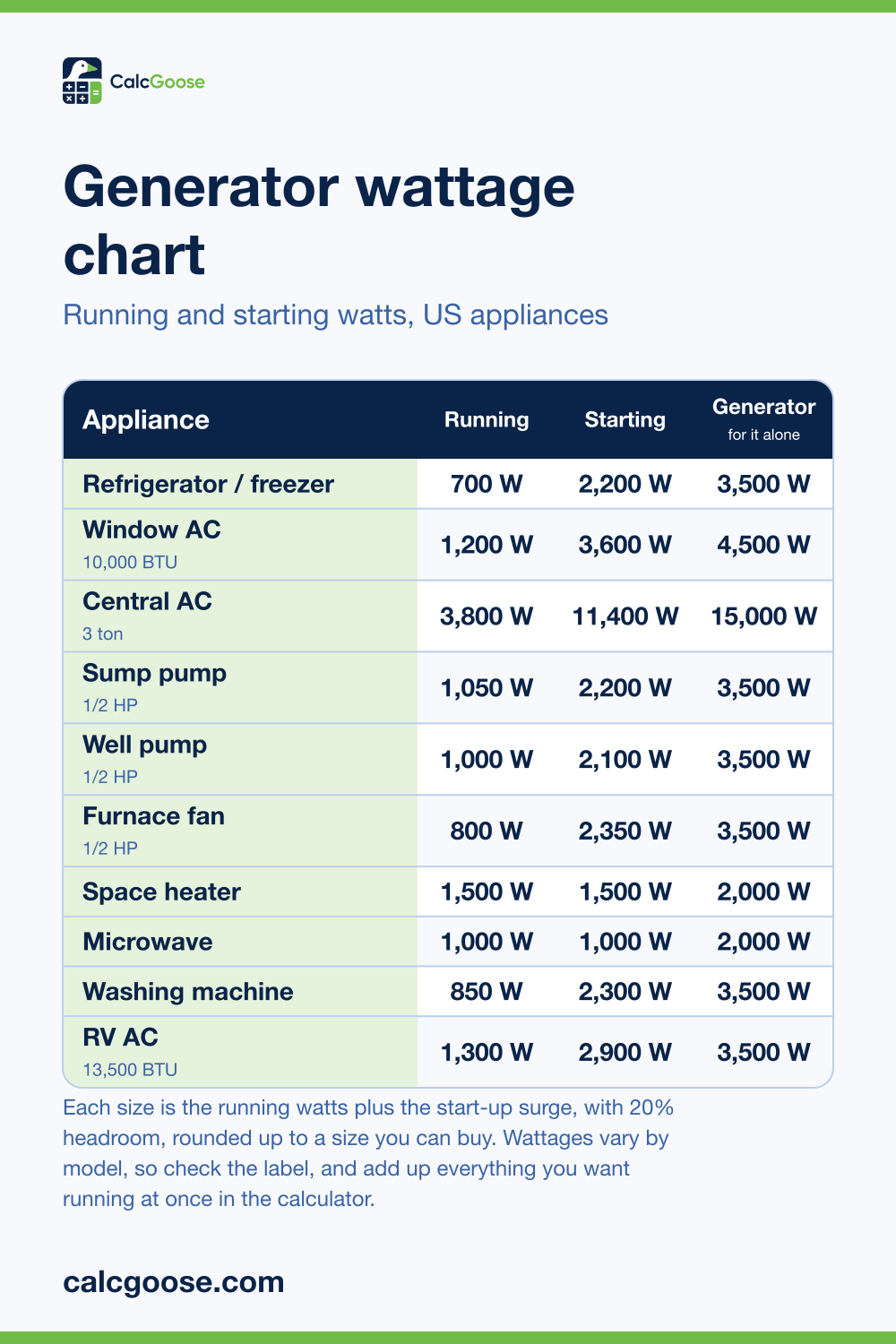
Generator wattage chart
Typical running and starting watts for common household appliances, and the smallest generator that could start each one on its own. The wattages are the calculator's own defaults, and each size comes from the same formula as the calculator above.
| Appliance | Running | Starting | Generator for it alone |
|---|---|---|---|
| Refrigerator / freezer | 700 W | 2,200 W | 3,500 W |
| Window AC10,000 BTU | 1,200 W | 3,600 W | 4,500 W |
| Central AC3 ton | 3,800 W | 11,400 W | 15,000 W |
| Sump pump1/2 HP | 1,050 W | 2,200 W | 3,500 W |
| Well pump1/2 HP | 1,000 W | 2,100 W | 3,500 W |
| Furnace fan1/2 HP | 800 W | 2,350 W | 3,500 W |
| Space heater | 1,500 W | 1,500 W | 2,000 W |
| Microwave | 1,000 W | 1,000 W | 2,000 W |
| Washing machine | 850 W | 2,300 W | 3,500 W |
| RV AC13,500 BTU | 1,300 W | 2,900 W | 3,500 W |
Each size is the running watts plus the start-up surge, with 20% headroom, rounded up to a size you can buy. Wattages vary by model, so check the label, and add up everything you want running at once in the calculator.
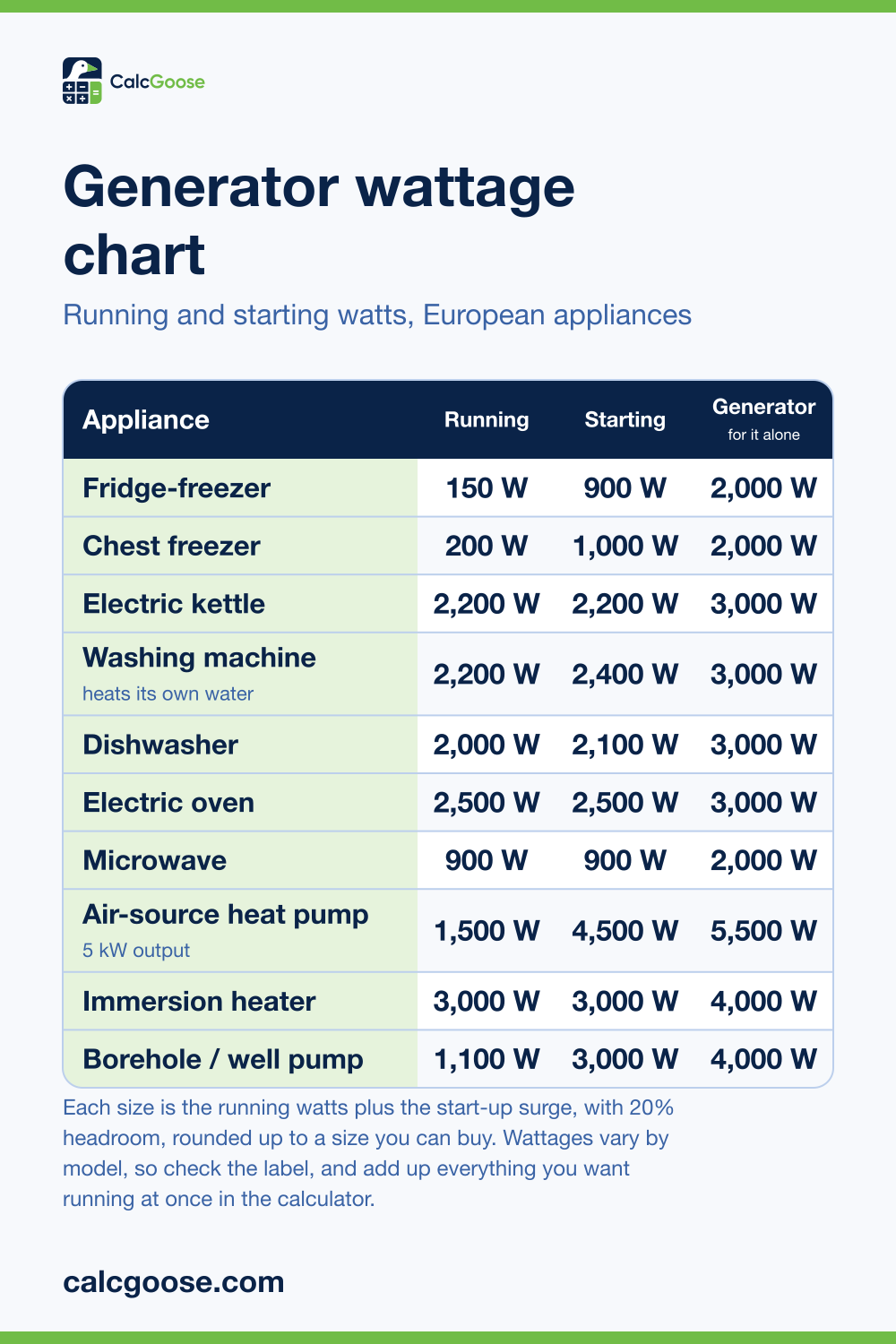
Typical running and starting watts for common appliances in European homes, and the smallest generator that could start each one on its own. The wattages are the calculator's own defaults, and each size comes from the same formula as the calculator above.
| Appliance | Running | Starting | Generator for it alone |
|---|---|---|---|
| Fridge-freezer | 150 W | 900 W | 2,000 W |
| Chest freezer | 200 W | 1,000 W | 2,000 W |
| Electric kettle | 2,200 W | 2,200 W | 3,000 W |
| Washing machineheats its own water | 2,200 W | 2,400 W | 3,000 W |
| Dishwasher | 2,000 W | 2,100 W | 3,000 W |
| Electric oven | 2,500 W | 2,500 W | 3,000 W |
| Microwave | 900 W | 900 W | 2,000 W |
| Air-source heat pump5 kW output | 1,500 W | 4,500 W | 5,500 W |
| Immersion heater | 3,000 W | 3,000 W | 4,000 W |
| Borehole / well pump | 1,100 W | 3,000 W | 4,000 W |
Each size is the running watts plus the start-up surge, with 20% headroom, rounded up to a size you can buy. Wattages vary by model, so check the label, and add up everything you want running at once in the calculator.
Assumptions and limits
Everything this calculator quietly assumes on your behalf. If one of these does not match your situation, the answer will be off.
- Only one motor starts at a time. This is true in practice but not guaranteed, if your well pump and AC habitually cycle together, add the second surge delta manually by editing the wattages.
- A 20% headroom factor is applied. Running a generator continuously at full nameplate output shortens its life and makes it much louder.
- The wattages are typical values for common household appliances. Yours may differ by 20% or more. Check the data plate on the appliance and edit the numbers.
- Generator nameplate ratings are peak/starting watts. Continuous running output is usually 10–20% lower, which the headroom factor partially covers.
- Altitude and temperature derate engines. Above roughly 3,000 ft, expect to lose about 3% of output per 1,000 ft.
- Resistive loads (heaters, kettles, incandescent bulbs) have no surge; their starting and running watts are the same.
- This does not size a transfer switch or check your panel. Anything hardwired needs a licensed electrician.
- The whole-house mode uses NEC 220.82, the optional dwelling-unit calculation. It is a sizing method, not a measurement. It deliberately errs high so a service is never undersized, and your actual peak demand will be lower.
- Floor area drives only the lighting and receptacle allowance. Whether your heat, range, dryer and water heater are gas or electric moves the answer far more than square footage does, which is why two identical-looking houses can need generators twice apart.
- The service rating is used only for comparison. A generator is sized on your calculated load under NEC 702.4(B)(2), never on the rating of your main breaker.
- Only one motor starts at a time. This is true in practice but not guaranteed, if your borehole pump and heat pump habitually cycle together, add the second surge delta manually by editing the wattages.
- A 20% headroom factor is applied. Running a generator continuously at full nameplate output shortens its life and makes it much louder.
- The wattages are typical European figures. Yours may differ by 20% or more. Check the rating plate and edit the numbers.
- Generators sold in Europe are often rated in kVA rather than watts. Multiply kVA by about 0.8 to get usable watts, a 5 kVA set is roughly a 4,000 W generator.
- Everything is assumed to be 230 V single-phase, which covers almost all domestic appliances. Ovens, hobs and large heat pumps are sometimes wired 400 V three-phase, particularly in Germany, Austria and Scandinavia. Those are flagged in the result.
- Altitude and temperature derate engines. Above roughly 1,000 m, expect to lose about 10% of output per 1,000 m.
- Resistive loads (kettles, immersion heaters, ovens, hobs) have no surge; their starting and running watts are the same. They are also the largest single loads in most European homes.
- This does not size a changeover switch or check your consumer unit. Anything hardwired needs a qualified electrician.
- There is no whole-house sizing mode here, and that is deliberate. Square footage, "200 amp service" and the NEC 220.82 calculation on the US version of this page are all American; the European equivalent is a diversity assessment under BS 7671 Appendix A, which works differently. Whole-house standby generation is also rare in Europe, so the appliance list is the tool that fits the job.
Frequently asked questions
What size generator do I need to run my house?
Most homes need 6,500–8,000 watts to cover a fridge, furnace fan, well pump, lights and outlets at once. Add central air conditioning and the compressor surge pushes that to 15,000–18,000 watts, which is permanent standby territory. Check the boxes above for your actual appliances rather than guessing, because the number is usually lower than people expect once you skip the AC.
What size generator do I need for a 2,000 sq ft house?
For a gas-heated 2,000 square foot home the NEC 220.82 calculated load comes to about 17,200 VA, which is an 18 kW standby generator for automatic whole-house cover. Add a load-management module that sheds the air conditioning and 15 kW does the same job. If the house is all-electric (electric heat, range, dryer and water heater), the same floor area needs 38 kW. Square footage on its own is a weak predictor; what your heating and hot water run on decides it.
What size generator do I need for a 200 amp service?
Not 48 kW, which is what 200 A × 240 V suggests and what a lot of sizing advice quotes. A 200 A service is sized for future capacity, and the actual calculated load behind it is usually 70 to 140 A, 17,000 to 34,000 VA. NEC 702.4(B)(2) lets you size an optional standby generator to that calculated load, or smaller still with automatic load management, so most 200 A homes land on an 18 to 26 kW set.
What size generator do I need for a refrigerator?
A 2,000-watt inverter generator runs a typical home refrigerator comfortably. The fridge draws about 700 watts while running but spikes to around 2,200 watts for a moment when the compressor starts. That momentary spike is what sets the minimum size, not the running load.
What size generator do I need for a 30-amp RV?
A 30-amp RV hookup can pull 3,600 watts (30 A × 120 V), and a 3,500 watt inverter generator covers a normal load inside that limit. Run a 13,500 BTU roof air conditioner and a microwave together and peak demand is about 3,900 watts, which this calculator rounds up to a 6,500 watt set once the 20% headroom goes on. A 4,000 to 4,500 watt inverter does the same job in practice if you accept running it near its limit. A 2,000-watt unit will run the air conditioner alone only if it has a soft-start kit fitted.
What size generator do I need to run central air conditioning?
A 3-ton central AC draws about 3,800 watts running and surges to around 11,400 watts on startup, so on its own it already calls for a 15,000 watt generator, and 18,000 once the fridge, furnace fan and lights are running alongside it. A hard-start capacitor or soft-start module cuts that surge by roughly half and brings it down to 10,000. Central AC is also 240V, so a 120V-only generator will not run it at all.
Will a soft start let me use a smaller generator?
Often by a full size class, because the starting surge is what sets your minimum and a soft-start module roughly halves it. A 3-ton central air conditioner surging to 11,400 watts needs a 15,000 watt generator on its own, and cutting the surge to about 7,600 brings that down to 10,000. The same trick is what lets a 2,000 watt inverter generator run a 13,500 BTU RV air conditioner. It does nothing for the running watts, so it only helps where a motor surge rather than the steady load is what is driving your size.
What is the difference between running watts and starting watts?
Running watts is the steady draw once an appliance is up and going. Starting watts is the brief spike, typically two to three times higher and lasting under a second, that an electric motor needs to overcome inertia. Anything with a compressor or motor has both; heaters, kettles and lights have only a running figure.
Can I run a generator in the rain?
Not uncovered. Water in the outlets or alternator is a shock and short-circuit risk. Use a purpose-built generator tent or an open-sided canopy that keeps rain off while allowing full airflow. Never run one in a garage, shed, crawlspace or under an open window, carbon monoxide from a generator can kill in minutes.
How loud are generators?
Inverter generators run around 48–60 dB at 23 feet, roughly the level of a normal conversation. Conventional open-frame generators are 65–76 dB, closer to a lawnmower and loud enough to annoy neighbors overnight. Noise rises with load, which is another reason for the 20% headroom.
Should I buy an inverter or a conventional generator?
Inverter generators produce clean, stable power that is safe for laptops, TVs and modern appliance electronics, and they throttle down at light load so they are much quieter and use less fuel. Conventional generators cost far less per watt and are the practical choice above about 5,000 watts. For whole-home backup, conventional; for camping, RVs and sensitive electronics, inverter.
What size generator do I need for my house?
For the essentials during a power cut (fridge-freezer, boiler, lights and chargers), a 2,000 to 3,000 W generator is enough, because European central heating runs on gas or oil and only needs power for the pump and controls. Add a kettle, an oven or a washing machine and you need 4,000 to 6,500 W. Whole-house cover including an electric shower or immersion heater means 8,000 W or more.
How many kVA is my generator in watts?
Multiply kVA by the power factor, which is 0.8 for most generators sold in Europe. A 3 kVA set delivers about 2,400 W, and a 5.5 kVA set about 4,400 W. Manufacturers advertise the bigger number, so always check the watt figure before comparing against a sizing calculation.
What size generator do I need to run a fridge-freezer?
A 2,000 W inverter generator runs a European fridge-freezer easily. It draws about 150 W while running but spikes to roughly 900 W for a moment when the compressor starts, and that spike is what sets the minimum, not the running load. The same generator will comfortably cover lights and phone charging alongside it.
Will a generator run my gas boiler during a power cut?
Yes, and it is the single best reason to own one in Europe. A gas or oil boiler needs only 100 to 200 W for its pump, fan and controls, so even a small inverter generator keeps the heating and hot water going. Many boilers are fussy about power quality, so use an inverter generator rather than a cheap conventional one.
Do I need a three-phase generator?
Only if you actually have three-phase appliances, which in practice means an oven, a hob, a large heat pump or a workshop machine. Three-phase domestic supplies are common in Germany, Austria and Scandinavia and rare in the UK, Ireland and France. A single-phase 230 V generator cannot run a three-phase appliance at all, so check the connection before buying.
Can I run a generator in the rain?
Not uncovered. Water in the sockets or alternator is a shock and short-circuit risk. Use a purpose-built generator tent or an open-sided canopy that keeps rain off while allowing full airflow. Never run one in a garage, shed or under an open window, carbon monoxide from a generator can kill in minutes.
How loud are generators?
Inverter generators run around 48 to 60 dB at 7 metres, roughly the level of a normal conversation. Conventional open-frame generators are 65 to 76 dB, closer to a lawnmower and loud enough to breach residential noise rules overnight in many countries. Noise rises with load, which is another reason for the 20% headroom.
Guides on this
The reasoning behind the number, and the decisions it does not make for you.
- Square footage does not size a generator Most sizing guides map floor area to kilowatts. A 3,000 sq ft house on gas heat needs less backup than a small all-electric one. Size it by what starts.
- Running watts, starting watts, and the arithmetic in between The usual advice is to add the highest starting wattage to your running total. That double-counts, and the correction changes which generator you buy.
- Choosing which circuits are worth backing up A backup list is a budget decision disguised as an electrical one. Four circuits cover most of the misery, and the fifth is where the costs climb.
- How long a tank lasts, and why load decides it Run time figures on a spec sheet assume a quarter or half load. Put the house on it and the same tank empties in a fraction of the advertised hours.
- Portable, standby, and the option in between A portable wired to an inlet and an interlock covers most of what a standby does, for a fraction of the install, and almost nobody advertises it.
- The generator is about half of what a standby install costs Transfer switch, electrical run, pad, gas connection and permits routinely match the price of the machine. Here is what each line item is doing.
- Why a 10 kVA generator gives you 8 kW Apparent power is what the windings carry, real power is what does the work, and the gap between them is power factor. The convention hides a fifth.
Related calculators
- Watts Calculator Generators Convert between watts, amps, volts and kilowatt-hours, on DC, single-phase or three-phase.
- Home Wattage Calculator Generators How many watts your house actually uses, from average draw to everything-at-once peak and the monthly bill.
- kVA Calculator Generators Convert kVA to kW, amps and horsepower, single or three-phase, with power factor handled properly.
- Whole House Generator Cost Calculator Generators The full installed cost of a generator (unit, transfer switch, gas line, pad, labour and permit).
- Generator Fuel Calculator Generators How much fuel a generator burns, how long a tank lasts, and what an outage costs per day.
- UPS Runtime Calculator Power & Off-Grid How many minutes your UPS really holds your gear up, by battery rather than by guesswork.
- Off-Grid Solar & Battery Calculator Power & Off-Grid How many solar panels and batteries you need, from what you actually run in a day.
Share this calculator
Found the number you needed? Send it to whoever asked you for it.
Safety disclaimer
This is an estimate for planning and shopping. Never backfeed a generator into a wall outlet. It can electrocute utility line workers. Connecting a generator to house circuits requires a transfer switch or interlock installed by a licensed electrician, per NEC 702. Always run generators outdoors, at least 20 feet from windows and doors.
This is an estimate for planning and shopping. Never backfeed a generator into a socket. It can electrocute utility line workers. Connecting a generator to house circuits requires a changeover switch installed and certified by a qualified electrician to IEC 60364 and your national rules. Always run generators outdoors, at least 6 metres from windows and doors.