Paint Calculator
Enter your room size and number of coats to get the gallons and quarts you need, with doors, windows, ceilings and primer handled separately.
Last updated
Where are you?
AWG, NEC, 120/240 V, miles and gallons mm², IEC/BS 7671, 230/400 V, km and litres . We remember this on every calculator.
Your result
Paint for 2 coats
2 gal
- Exact amount
- 1.90 gal
- Paintable area
- 333 sq ft
- Wall area
- 384 sq ft
- Doors & windows removed
- 51 sq ft
- Ceiling
- Not painted
- Primer
- None
🪿 The goose says: Buy 2 gal. That covers 333 square feet at 2 coats, with your doors and windows already taken off.
- Have it all mixed at once from the same batch. Two tins of the same colour mixed weeks apart can differ slightly, and on a large wall that shows.
How this paint calculator works
Paint is the one material where people usually over-buy rather than under-buy, and the reason is that they add up wall area and forget to take anything off.
The calculation is straightforward, perimeter times ceiling height gives wall area, then subtract the doors and windows, then multiply by the number of coats and divide by the coverage rate. The manufacturer's 350 square feet per gallon is genuinely achievable on smooth, previously painted drywall.
The part worth getting right is buying in the correct tin sizes. Needing 2.3 gallons does not mean buying three. It means two gallons and two quarts, which costs less and leaves a sensible touch-up amount instead of most of a full tin going hard in the garage.
-
Step 1 Wall area
walls = 2 × (length + width) × ceiling_height -
Step 2 Subtract the openings
openings = doors × 21 + windows × 15 sq ftStandard door and window sizes. Count a large picture window as two. -
Step 3 Add the ceiling if you are painting it
ceiling = length × width -
Step 4 Multiply by coats and divide by coverage
gallons = paintable_area × coats ÷ coverage_per_gallon350 sq ft/gal on smooth drywall; 300 on texture or bare board. -
Step 5 Split into tins
buy whole gallons plus quarts for the remainderThe same 1.9 gallons is 7.2 litres, which in Europe is a 5 litre tin plus a 2.5.
For example, a 12 × 12 ft room with 8 ft ceilings has 384 sq ft of wall. Take off one door and two windows, 51 sq ft, and you have 333 sq ft. Two coats at 350 sq ft per gallon is 1.9 gallons, so buy 1 gallon plus 4 quarts, or simply 2 gallons.
Paint coverage chart
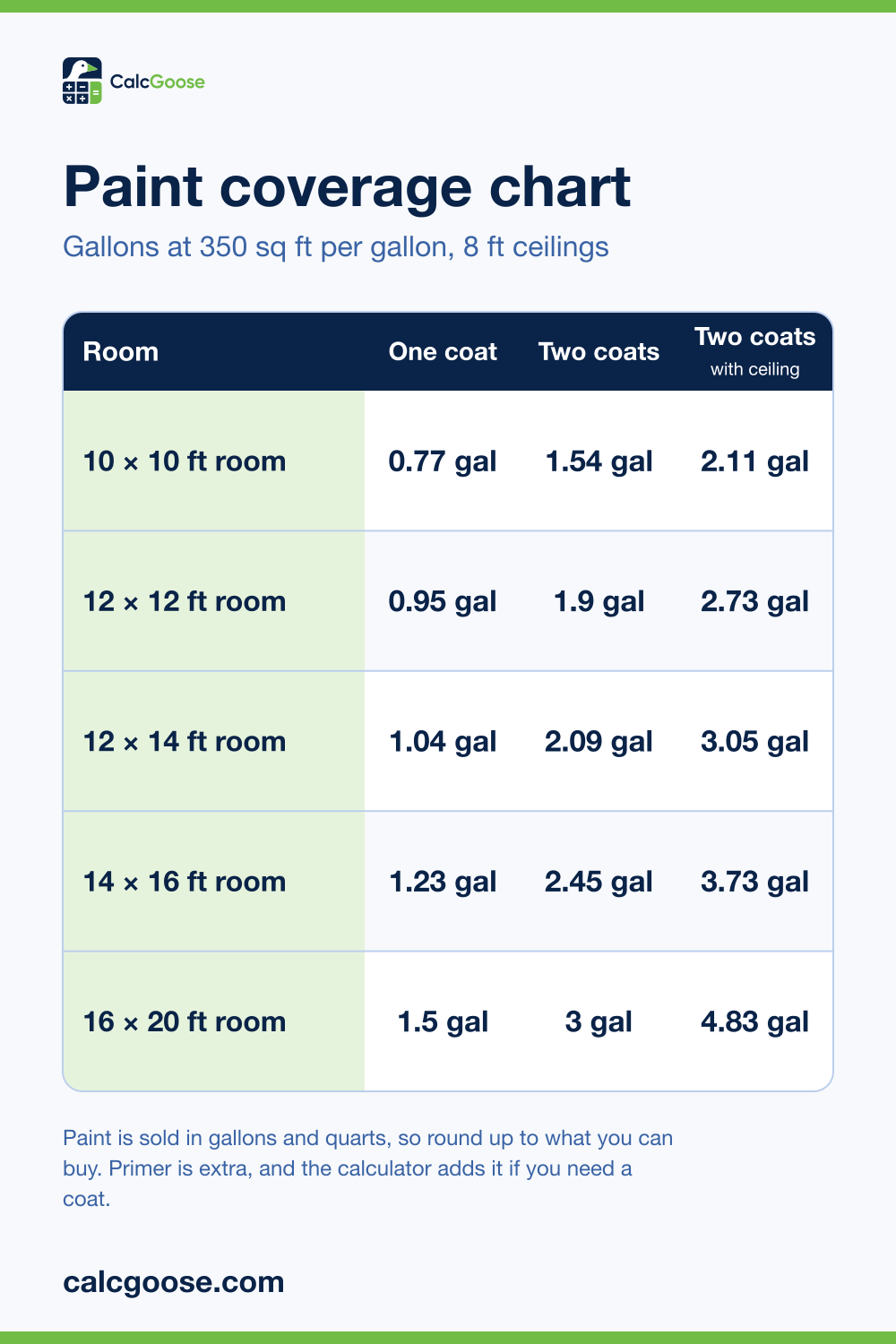
How much paint common rooms take at 350 sq ft per gallon, with 8 ft ceilings and one door and two windows left unpainted. Every figure comes from the same formula as the calculator above.
| Room | One coat | Two coats | Two coats with ceiling |
|---|---|---|---|
| 10 × 10 ft room | 0.77 gal | 1.54 gal | 2.11 gal |
| 12 × 12 ft room | 0.95 gal | 1.9 gal | 2.73 gal |
| 12 × 14 ft room | 1.04 gal | 2.09 gal | 3.05 gal |
| 14 × 16 ft room | 1.23 gal | 2.45 gal | 3.73 gal |
| 16 × 20 ft room | 1.5 gal | 3 gal | 4.83 gal |
Paint is sold in gallons and quarts, so round up to what you can buy. Primer is extra, and the calculator adds it if you need a coat.
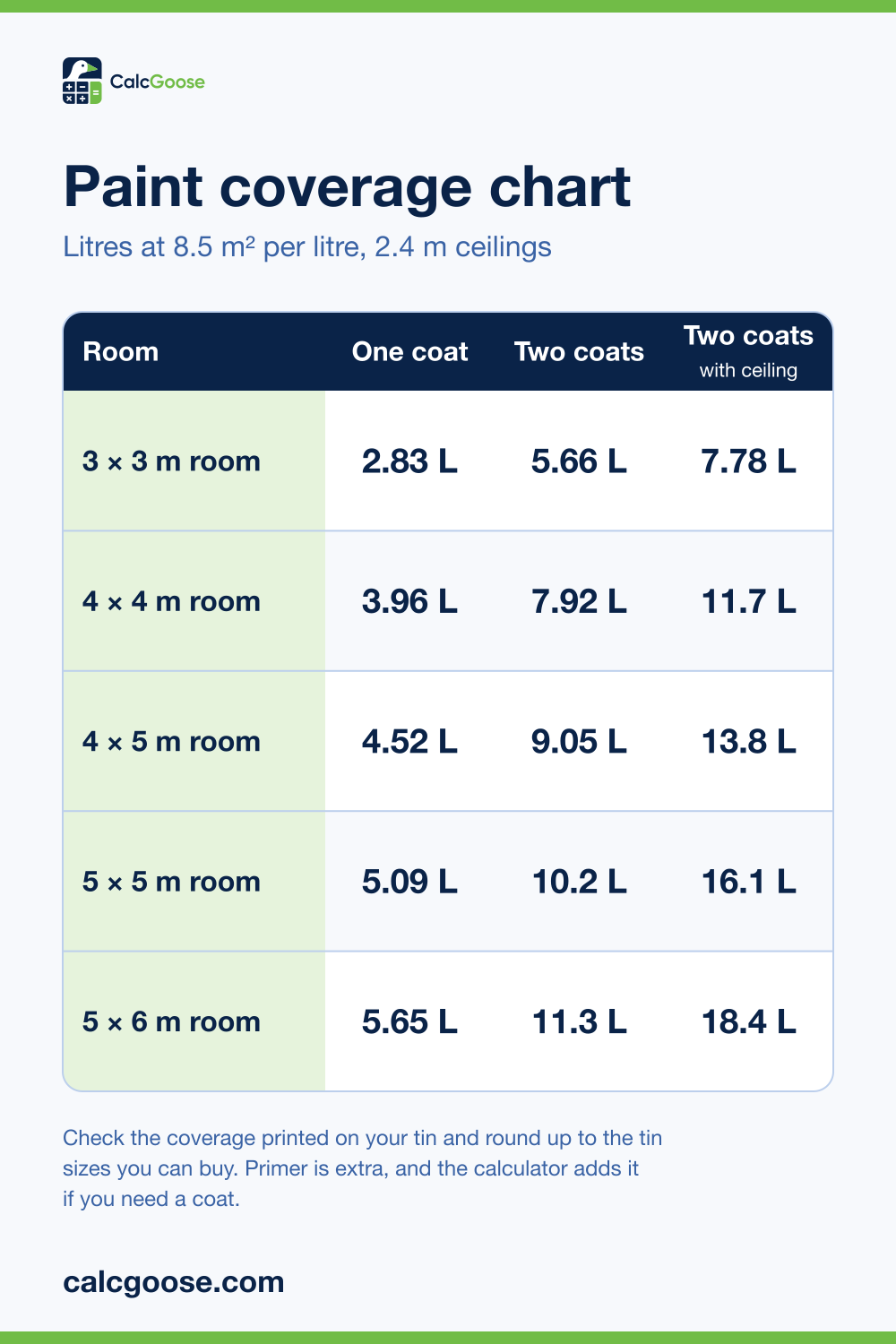
How much paint common rooms take at 8.5 m² per litre, with 2.4 m ceilings and one door and two windows left unpainted. Every figure comes from the same formula as the calculator above.
| Room | One coat | Two coats | Two coats with ceiling |
|---|---|---|---|
| 3 × 3 m room | 2.83 L | 5.66 L | 7.78 L |
| 4 × 4 m room | 3.96 L | 7.92 L | 11.7 L |
| 4 × 5 m room | 4.52 L | 9.05 L | 13.8 L |
| 5 × 5 m room | 5.09 L | 10.2 L | 16.1 L |
| 5 × 6 m room | 5.65 L | 11.3 L | 18.4 L |
Check the coverage printed on your tin and round up to the tin sizes you can buy. Primer is extra, and the calculator adds it if you need a coat.
Assumptions and limits
Everything this calculator quietly assumes on your behalf. If one of these does not match your situation, the answer will be off.
- Coverage defaults to 350 square feet per gallon, which is realistic for a quality paint on smooth, previously painted drywall. Textured walls, bare drywall, and deep or bright colours all reduce it, 300 is a safer figure for those.
- Doors are taken as 21 square feet and windows as 15. These are standard US sizes; measure your own if they are unusual, and count a large picture window as two.
- Trim, doors and window frames are not included. Those are normally a different paint in a different sheen, and a quart usually covers the trim in an average room.
- The first coat on bare or heavily patched drywall soaks in and covers less than the stated rate. Priming solves this and is cheaper than an extra finish coat.
- Closet interiors, alcoves and stairwells are not included in the room dimensions. Add them as a separate calculation.
- Primer is estimated at one coat over the same paintable area at the same coverage rate. Stain-blocking primers often cover less.
- Roller nap affects consumption noticeably, a 1/2 inch nap holds and deposits more paint than a 3/8 inch nap on the same wall.
- The tin split is in US gallons and quarts. European paint is sold in 1, 2.5, 5 and 10 litre tins, so work from the litre figure and round up to that ladder instead.
Frequently asked questions
How much paint do I need for a 12 × 12 room?
About 2 gallons for two coats on the walls, assuming 8 foot ceilings and taking off one door and two windows. Add roughly 0.8 gallons if you are painting the ceiling as well, since ceilings normally want two coats too. One gallon covers a 12 × 12 room in a single coat with a little to spare.
How many square feet does a gallon of paint cover?
About 350 square feet on smooth, previously painted drywall, which is the figure most manufacturers quote. Bare drywall, textured surfaces and deep colours drop it to 250 to 300. A gallon is roughly one coat on an average bedroom.
Do I need two coats of paint?
Almost always. One coat only genuinely covers when you are repainting the same colour in the same sheen with a premium paint. Any colour change, any sheen change, and any patched or previously unpainted surface needs two, and a dramatic colour change over a dark wall may need primer plus two.
When do I need primer?
On bare drywall, over patches and repairs, over glossy surfaces, when covering stains, and on any drastic colour change. Repainting a similar colour over sound, matt paint does not need it. Tinting the primer towards your final colour often saves a whole topcoat.
Should I subtract doors and windows?
Yes, unlike wallpaper, paint genuinely is spread over area, so the openings really do reduce what you need. A door is about 21 square feet and a window 15, which in an average bedroom removes roughly 50 square feet, or about 15 percent of the wall.
How much paint do I need for a ceiling?
The room area divided by coverage, per coat, a 12 × 12 ceiling is 144 square feet, so about 0.4 gallons for one coat or 0.8 for two. Ceilings almost always need two coats because they are usually flat white over a surface that shows every roller line.
How long does leftover paint last?
Two to five years in a well-sealed tin stored somewhere that does not freeze. Store it upside down so the paint itself seals the lid, and keep it indoors, a garage that freezes will ruin latex paint permanently. Label the tin with the room and the date.
Guides on this
The reasoning behind the number, and the decisions it does not make for you.
- How far a gallon of paint really goes The 350 square feet on the tin is a lab figure on smooth primed drywall. Texture, porosity and colour change all eat into it, and here is by how much.
- When a wall needs primer and when it does not Primer is not a rule, it is an answer to four specific wall problems. If your wall has none of them, a self-priming paint is genuinely enough.
Related calculators
- Mulch Calculator Home & Yard Cubic yards, bags or tons of mulch, soil or gravel for any number of beds.
- Paver Calculator Home & Yard Paver count, gravel base, bedding sand and edging for a patio or path.
- Wallpaper Calculator Home & Yard How many rolls a room needs, counted by strips rather than square footage.
- Deck Board Calculator Home & Yard Board count, linear feet, screws and joists for a deck of any size.
- Fence Calculator Home & Yard Posts, panels, pickets, rails and concrete for a fence run of any length.
- Grass Seed Calculator Home & Yard Pounds of seed or pallets of sod for a lawn, by grass type and whether you are seeding or overseeding.
- Concrete Calculator Home & Yard Concrete for slabs, footings, post holes and columns, in yards or metres and in bags.
Share this calculator
Found the number you needed? Send it to whoever asked you for it.