Deck Board Calculator
Enter your deck size and board dimensions to get the number of boards, the linear footage, the fasteners and the joist count.
Last updated
Where are you?
AWG, NEC, 120/240 V, miles and gallons mm², IEC/BS 7671, 230/400 V, km and litres . We remember this on every calculator.
Your result
16 ft boards to buy
29 boards
- Rows across the deck
- 26
- Linear length
- 458 ft
- Before waste
- 416 ft
- Deck area
- 192 sq ft
- Screws
- 672
- Joists
- 13 at 16 in
🪿 The goose says: You need 29 boards at 16 ft, 26 rows across the deck, which is 458 linear feet including 10% waste. Budget about 672 screws.
- Wet-treated lumber shrinks across its width as it dries. Lay it with a gap of about 1/8 in rather than 1/4, or you will end up with 3/8 in gaps by the following summer.
- Framing is a separate structural question. 13 joists at 16 in spacing is the count for this footprint, but joist size and beam spans depend on your load and local code.
How this deck board calculator works
Deck boards are counted by rows, not by area, because a board only ever covers a fixed strip of width. What matters is how many strips fit across the deck and how long each strip has to be.
The width of a strip is the board plus one gap, and the gap matters more than people expect. A 5.5 inch board with a quarter-inch gap covers 5.75 inches of width, so a 12 foot wide deck takes 26 rows. Size it on the 5.5 inches alone and you land on 27, which is a whole row of boards you did not need to buy.
Everything after that is multiplication. Rows times deck length gives linear footage, add waste, divide by the length of board you can buy. Fasteners come from area, because screw count depends on how many joists the boards cross rather than on how the boards are cut.
-
Step 1 How many rows
rows = ceil(deck_width_inches ÷ (board_width + gap)) -
Step 2 Linear footage
linear_ft = rows × deck_length -
Step 3 Add cutting waste
linear_ft × (1 + waste%)10% for a rectangular deck, 15% or more for diagonal or picture-frame layouts. -
Step 4 Convert to boards
boards = ceil(linear_ft_with_waste ÷ board_length) -
Step 5 Fasteners and framing
screws = deck_area ÷ 100 × screws_per_100_sqft
joists = ceil(deck_length_inches ÷ spacing) + 1
For example, a 16 × 12 ft deck with 5.5 in boards and 1/4 in gaps needs 26 rows. That is 416 linear feet, or 458 with 10% waste, 29 boards at 16 ft. Add about 672 screws and 13 joists at 16 in spacing.
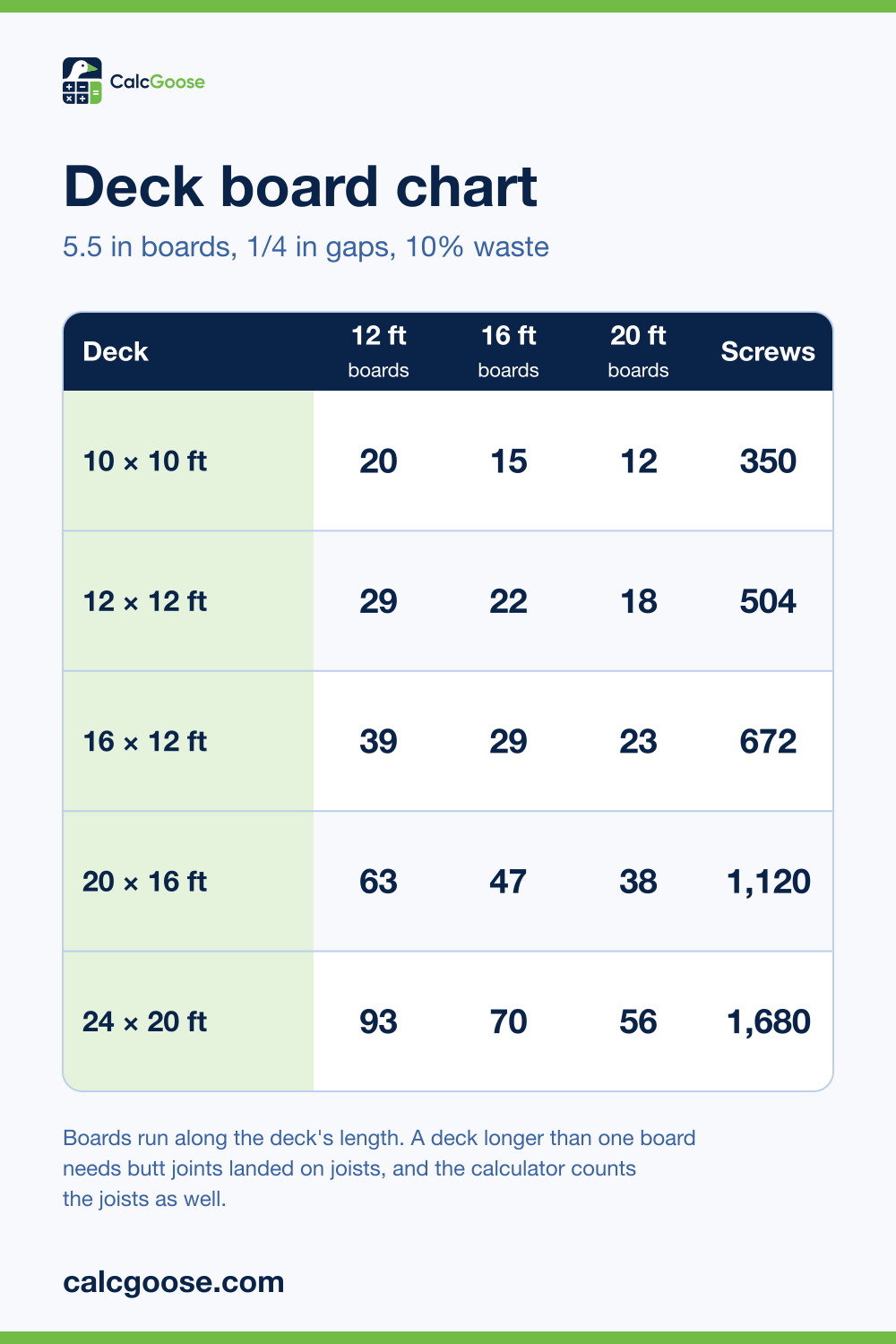
Deck board chart
How many deck boards common deck sizes take, with 5.5 in boards, 1/4 in gaps and 10% waste, for each board length you can buy, plus the screws to fix them. Every figure comes from the same formula as the calculator above.
| Deck | 12 ft boards | 16 ft boards | 20 ft boards | Screws |
|---|---|---|---|---|
| 10 × 10 ft | 20 | 15 | 12 | 350 |
| 12 × 12 ft | 29 | 22 | 18 | 504 |
| 16 × 12 ft | 39 | 29 | 23 | 672 |
| 20 × 16 ft | 63 | 47 | 38 | 1,120 |
| 24 × 20 ft | 93 | 70 | 56 | 1,680 |
Boards run along the deck's length. A deck longer than one board needs butt joints landed on joists, and the calculator counts the joists as well.
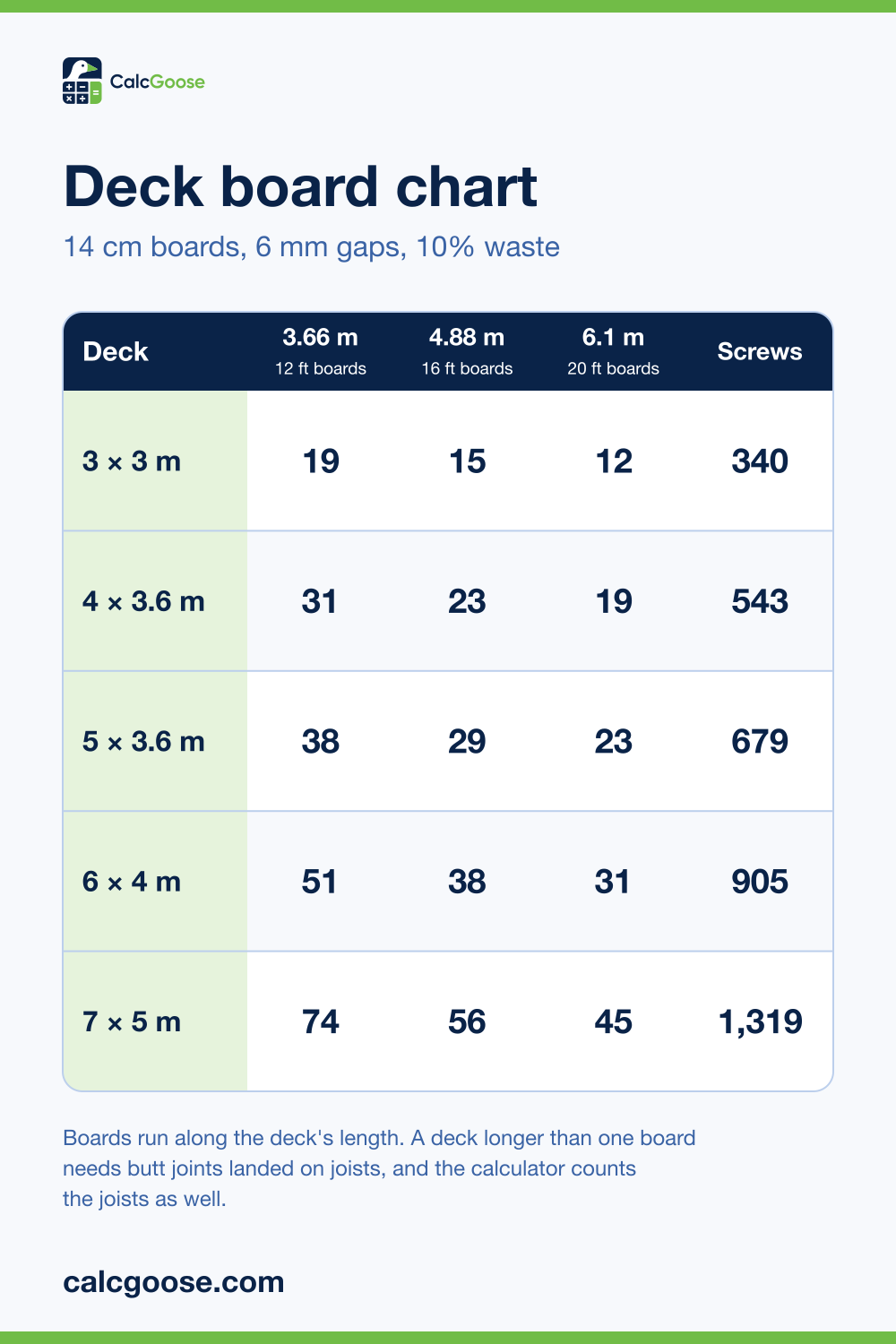
How many deck boards common deck sizes take, with 14 cm boards, 6 mm gaps and 10% waste, for each board length the calculator offers, plus the screws to fix them. Every figure comes from the same formula as the calculator above.
| Deck | 3.66 m 12 ft boards | 4.88 m 16 ft boards | 6.1 m 20 ft boards | Screws |
|---|---|---|---|---|
| 3 × 3 m | 19 | 15 | 12 | 340 |
| 4 × 3.6 m | 31 | 23 | 19 | 543 |
| 5 × 3.6 m | 38 | 29 | 23 | 679 |
| 6 × 4 m | 51 | 38 | 31 | 905 |
| 7 × 5 m | 74 | 56 | 45 | 1,319 |
Boards run along the deck's length. A deck longer than one board needs butt joints landed on joists, and the calculator counts the joists as well.
Assumptions and limits
Everything this calculator quietly assumes on your behalf. If one of these does not match your situation, the answer will be off.
- Boards are assumed to run along the deck length in a straight, parallel layout. Diagonal decking wastes considerably more, raise the waste figure to 15–20%, and picture-frame borders need extra long boards for the perimeter.
- Board widths are actual, not nominal. A 5/4 × 6 deck board and a 2 × 6 are both really 5.5 inches wide.
- The 1/4 inch default gap suits kiln-dried and composite boards. Wet-treated lumber shrinks as it dries and should be laid at about 1/8 inch, otherwise the finished gaps end up too wide.
- Screw estimates assume two fasteners per board per joist at 16 inch spacing. Hidden fastener systems and clip systems use different quantities entirely. Check the manufacturer's coverage figure.
- The joist count is for the deck footprint only. It does not size the joists, beams, posts or footings, all of which depend on span, load and local code and need a proper span table or an engineer.
- No allowance is made for stairs, railings, fascia or skirting. Those are separate material lists.
- Board widths are US actual sizes. European decking is usually 120 to 145 mm wide, so in metric mode enter the width off your own board rather than assuming the default converts to anything standard.
- Butt joints are assumed acceptable where the deck is longer than the boards available. Staggering them across rows and landing every joint on a joist is a structural requirement, not a preference.
Frequently asked questions
How many deck boards do I need for a 12 × 16 deck?
About 29 boards at 16 feet, assuming standard 5.5 inch wide boards with quarter-inch gaps and 10 percent waste. That is 26 rows across the 12 foot width. If you can only get 12 foot boards the linear footage comes to 39, but each 16 foot row wants a 12 and a 4, so unless you use every offcut you will buy closer to 52 and every row will carry a butt joint.
What gap should I leave between deck boards?
A quarter inch for kiln-dried or composite boards, and about an eighth for wet pressure-treated lumber. Treated boards arrive saturated and shrink across the width as they dry, so a quarter-inch gap at installation becomes three-eighths within a year. The gap is for drainage and debris, not appearance.
How many screws do I need for a deck?
Roughly 350 per 100 square feet, which is two screws per board per joist at 16 inch spacing. A 12 × 16 foot deck therefore needs around 670. Buy stainless or properly coated screws, plain ones react with treated lumber and bleed rust stains within a season.
Do composite boards need different joist spacing?
Usually yes. Most composite decking requires 12 inch on-centre spacing rather than the 16 used for wood, and diagonal layouts require 12 regardless of material. Check the manufacturer span table before framing, retrofitting extra joists under a finished deck is not practical.
How much waste should I allow on decking?
Ten percent for a straightforward rectangular deck. Fifteen to twenty for diagonal layouts, herringbone or picture-frame borders, because every board meets an edge at an angle and the offcuts are rarely reusable. Also add extra if your deck length is awkward against available board lengths.
Should deck boards run the long way or the short way?
Running boards across the shorter dimension means fewer, shorter boards and fewer butt joints, but it also fixes your joist direction, since joists must run perpendicular to the boards. Most decks run boards parallel to the house wall. Decide the board direction first, because the framing follows it.
How long do deck boards last?
Pressure-treated pine gives 10 to 15 years with regular sealing, cedar 15 to 20, and quality composite 25 or more with a warranty to match. The frame usually fails before the boards do, which is why joist tape over the tops of the joists is such a cheap upgrade.
Related calculators
- Mulch Calculator Home & Yard Cubic yards, bags or tons of mulch, soil or gravel for any number of beds.
- Paver Calculator Home & Yard Paver count, gravel base, bedding sand and edging for a patio or path.
- Wallpaper Calculator Home & Yard How many rolls a room needs, counted by strips rather than square footage.
- Paint Calculator Home & Yard Gallons of paint for a room, with coats, doors, windows and ceiling accounted for.
- Fence Calculator Home & Yard Posts, panels, pickets, rails and concrete for a fence run of any length.
- Grass Seed Calculator Home & Yard Pounds of seed or pallets of sod for a lawn, by grass type and whether you are seeding or overseeding.
- Concrete Calculator Home & Yard Concrete for slabs, footings, post holes and columns, in yards or metres and in bags.
Share this calculator
Found the number you needed? Send it to whoever asked you for it.