Fence Calculator
Enter your fence length and style to get the post count, panels or pickets, rails and bags of concrete, with gate openings handled properly.
Last updated
Where are you?
AWG, NEC, 120/240 V, miles and gallons mm², IEC/BS 7671, 230/400 V, km and litres . We remember this on every calculator.
Your result
Posts needed
14 posts
- Sections
- 12
- Panels
- 12
- Fence run
- 96 ft
- Gate openings
- 4 ft
- Concrete
- 28 bags
🪿 The goose says: You need 14 posts and 12 panels for 96 ft of fence, plus roughly 28 bags of concrete.
- Set posts at least a third of their above-ground height deep, and below your local frost line. At 30 in you need posts about 8.50 ft long for a 6 ft fence.
- Gate posts carry a swinging load and should be one size larger and set deeper than line posts, 6×6 rather than 4×4, with an extra bag of concrete each. Gates are what fail first on almost every fence.
- Check your property line and call the utility locate service before digging. Both are free, and both are far cheaper than moving a fence or hitting a gas line.
- Pre-built panels only fit if posts are set at exactly the panel width. Measure and set each post from the previous one as you go rather than digging every hole first.
How this fence calculator works
A fence is a row of sections between posts, so the whole calculation hangs on one thing people get wrong. There is always one more post than there are sections. Ten sections need eleven posts, because the run has two ends.
Gates complicate that slightly. A gate opening is not a fence section. It needs its own hanging post and latch post, and the opening itself has to come out of the run before you divide by the post spacing. Otherwise you end up a post short and a panel over.
Everything else follows. Panels equal sections. Pickets are the fence run divided by the picket-plus-gap pitch. Concrete is bags per hole times holes, and the depth of those holes is the one figure that decides whether the fence is still standing in ten years.
-
Step 1 Take out the gates
fence_run = total_length − (gates × gate_width) -
Step 2 Sections
sections = ceil(fence_run ÷ post_spacing) -
Step 3 Posts
posts = sections + 1 + gatesOne more than sections for the closing end, plus one extra per gate opening. -
Step 4 Panels or pickets
panels = sections pickets = ceil(fence_run × 12 ÷ (picket_width + gap)) -
Step 5 Concrete
bags = posts × bags_per_postTwo 50 lb bags per hole is typical for a 4×4 in a 10 in × 30 in hole.
For example, 100 ft of privacy fence with one 4 ft gate. The fence run is 96 ft, which at 8 ft spacing is 12 sections and 12 panels. Posts are 12 + 1 + 1 = 14, needing about 28 bags of concrete.
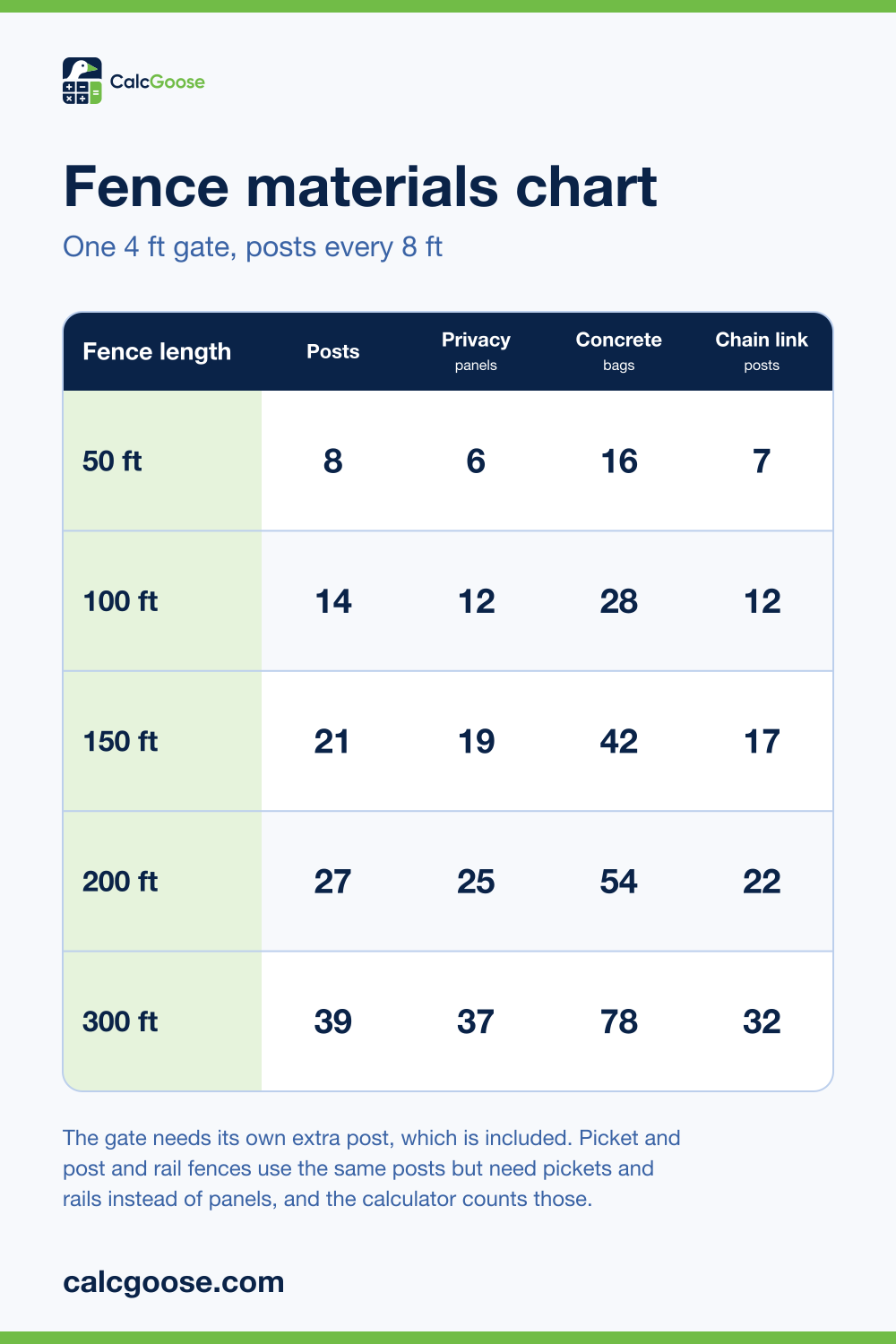
Fence materials chart
The posts, panels and concrete a privacy fence takes with one 4 ft gate, posts every 8 ft and two bags of concrete per post, plus the posts for chain link at 10 ft spacing. Every figure comes from the same formula as the calculator above.
| Fence length | Posts | Privacy panels | Concrete bags | Chain link posts |
|---|---|---|---|---|
| 50 ft | 8 | 6 | 16 | 7 |
| 100 ft | 14 | 12 | 28 | 12 |
| 150 ft | 21 | 19 | 42 | 17 |
| 200 ft | 27 | 25 | 54 | 22 |
| 300 ft | 39 | 37 | 78 | 32 |
The gate needs its own extra post, which is included. Picket and post and rail fences use the same posts but need pickets and rails instead of panels, and the calculator counts those.
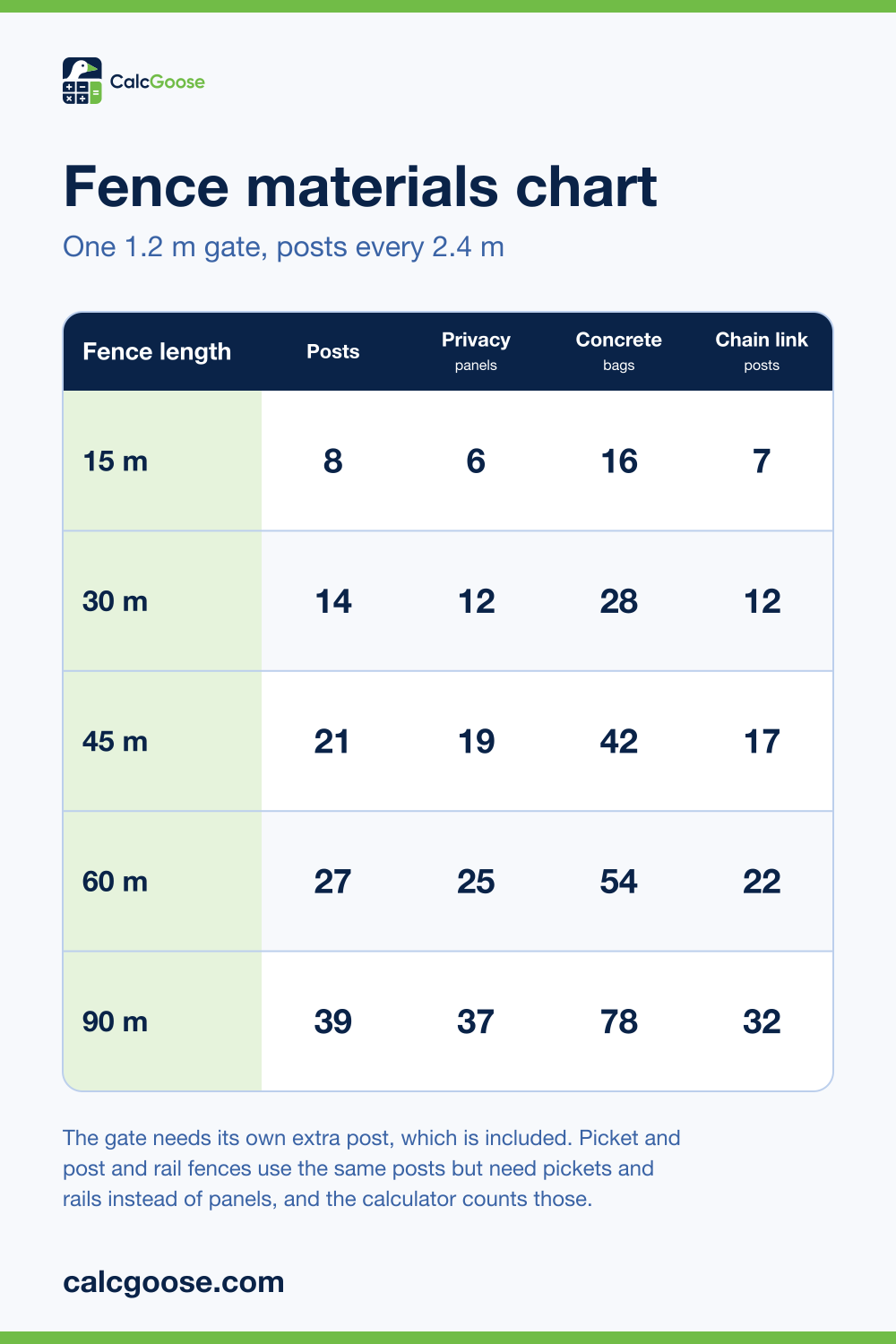
The posts, panels and concrete a privacy fence takes with one 1.2 m gate, posts every 2.4 m and two bags of concrete per post, plus the posts for chain link at about 3 m spacing. Every figure comes from the same formula as the calculator above.
| Fence length | Posts | Privacy panels | Concrete bags | Chain link posts |
|---|---|---|---|---|
| 15 m | 8 | 6 | 16 | 7 |
| 30 m | 14 | 12 | 28 | 12 |
| 45 m | 21 | 19 | 42 | 17 |
| 60 m | 27 | 25 | 54 | 22 |
| 90 m | 39 | 37 | 78 | 32 |
The gate needs its own extra post, which is included. Picket and post and rail fences use the same posts but need pickets and rails instead of panels, and the calculator counts those.
Assumptions and limits
Everything this calculator quietly assumes on your behalf. If one of these does not match your situation, the answer will be off.
- Post spacing is measured on centre. Pre-built panels require posts set at exactly the panel width, so set each post from the last rather than digging every hole in advance.
- One extra post is added per gate, on the basis that a gate opening needs a hanging post and a latch post while sharing one with the adjacent run. Double drive gates and free-standing gates need more.
- Concrete is estimated at two 50 lb bags per post, which fills a hole roughly 10 inches across and 30 inches deep around a 4×4. Corner, end and gate posts should get more, and wider or deeper holes obviously need more again.
- Post depth guidance is a third of the above-ground height or below the local frost line, whichever is deeper. Frost depth varies enormously, from nothing in the far south to over 4 feet in the northern US and Scandinavia, and local code governs.
- Terrain is assumed flat and the run straight. Slopes require either stepped or racked panels, corners need their own posts, and both add material.
- Picket counts do not include the extra pickets a gate needs, and do not account for the pattern needing to end cleanly at a post.
- Rails, caps, gravel boards and fixings beyond the headline items are not included. Neither is the gate itself.
- Property boundaries, setback rules, height limits and neighbour notification requirements are all local and are not modelled. Check before you dig.
Frequently asked questions
How many posts do I need for a 100 ft fence?
Fourteen for a 100 foot run with one 4 foot gate at 8 foot spacing, which is twelve sections, plus one to close the end, plus one extra for the gate. Take the gate out and it is still fourteen, because the run grows into a thirteenth section just as you drop the gate post. The rule that catches people is that posts always outnumber sections by one.
How much concrete do I need per fence post?
About two 50 lb bags for a standard 4×4 post in a 10 inch wide, 30 inch deep hole. Corner, end and gate posts carry more load and should get three. Fast-setting mix can be poured dry into the hole and watered, which avoids mixing entirely.
How deep should fence posts be?
At least a third of the post's above-ground height, and always below your local frost line. A 6 foot fence therefore wants a minimum 2 foot hole, but in a hard-freeze climate the frost line may require 42 inches or more. Posts set above the frost line get pushed out of the ground over a few winters.
How many pickets do I need for a fence?
Divide the fence run in inches by the picket width plus the gap. A 96 foot run with 3.5 inch pickets and 2 inch gaps needs 1,152 divided by 5.5, which is about 210 pickets. Solid privacy fencing with no gap needs roughly 330 for the same run.
Should I use panels or build stick by stick?
Panels are far faster and are the right choice on flat ground with a straight run, but they demand precise post spacing and cannot follow a slope without stepping. Stick-built fencing takes longer but racks smoothly down a hill, handles awkward lengths and lets you replace a single board later.
How far apart should fence posts be?
Eight feet on centre is the standard for wood panels and picket in the US, ten for chain link, and 1.8 metres in the UK and Ireland where panels come in six foot widths. Closer spacing, at six feet, makes a noticeably stiffer fence and is worth it in high wind or for tall privacy fencing, at the cost of more posts and more concrete.
Do I need a permit to build a fence?
Often yes, and almost always if it is over about 6 feet or fronts a street. Rules on height, setback from the boundary, which side faces out and whether you must notify neighbours are all local. Also call the free utility locate service before digging. That part is not optional anywhere.
Guides on this
The reasoning behind the number, and the decisions it does not make for you.
Related calculators
- Mulch Calculator Home & Yard Cubic yards, bags or tons of mulch, soil or gravel for any number of beds.
- Paver Calculator Home & Yard Paver count, gravel base, bedding sand and edging for a patio or path.
- Wallpaper Calculator Home & Yard How many rolls a room needs, counted by strips rather than square footage.
- Paint Calculator Home & Yard Gallons of paint for a room, with coats, doors, windows and ceiling accounted for.
- Deck Board Calculator Home & Yard Board count, linear feet, screws and joists for a deck of any size.
- Grass Seed Calculator Home & Yard Pounds of seed or pallets of sod for a lawn, by grass type and whether you are seeding or overseeding.
- Concrete Calculator Home & Yard Concrete for slabs, footings, post holes and columns, in yards or metres and in bags.
Share this calculator
Found the number you needed? Send it to whoever asked you for it.