Aquarium Calculator
Get your tank's real volume in gallons and litres, then the heater wattage, filter flow rate and stocking guidance that follow from it.
Last updated
Where are you?
AWG, NEC, 120/240 V, miles and gallons mm², IEC/BS 7671, 230/400 V, km and litres . We remember this on every calculator.
Your result
Tank volume
22.4 gal
- Volume (with decor)
- 22.4 gal
- Volume (bare glass)
- 24.9 gal
- Heater
- 100 W
- Filter turnover
- 112 GPH actual
- Filter to buy
- 173 GPH rated
- Rough stocking limit
- 22.4 in of fish
🪿 The goose says: This is a 22.4 gal tank. Fit a 100 W heater and a filter rated around 173 GPH, and cycle it fully before a single fish goes in.
- The one-inch-per-gallon rule is a crude starting point, not a limit. It works reasonably for small slim community fish and fails badly for anything that produces heavy waste, a single common goldfish or a pleco outproduces a dozen tetras and needs far more water than its length suggests.
- Filters are rated with an empty chamber. Once media is in, real flow drops by about a third, so for 112 GPH of actual turnover, buy a filter rated around 173 GPH.
- Cycle the tank before adding fish. Establishing the bacteria that convert ammonia to nitrite to nitrate takes four to eight weeks, and skipping it is the single most common reason new tanks lose their first fish.
Everything this tank needs
- Water volume
- 22.4 gal
- Heater (10° below target)
- 100 W
- Filter at 5× turnover
- 173 GPH rated
- Weekly water change (25%)
- 5.61 gal
- Rough stocking guide
- 22.4 in of small community fish
Stocking by inches is a starting point only. Bioload depends on the species, not on length, research every fish you plan to keep, and stock slowly.
How this aquarium calculator works
Everything about an aquarium starts with its real water volume, and that is not the number on the box. A "20 gallon" tank holds about 20 gallons of glass, but once you subtract the inch below the rim and the gravel, rock and wood inside it, the actual water is closer to 17.
That matters because every other figure is derived from it. Heater wattage, filter flow, dosing, water changes and stocking all scale from water volume, so starting from the marketing number puts everything else out by ten percent or more.
Heater sizing is the part most guides oversimplify. The old "5 watts per gallon" rule ignores the thing that actually decides the load, how far the room drops below your target temperature. A tank in a warm room barely needs a heater; the same tank in a cold garage needs two.
-
Step 1 Water volume
gallons = length × width × water_height ÷ 231231 cubic inches per US gallon. Measure inside the glass and use water height, not tank height. -
Step 2 Deduct for substrate and decor
net = gross × 0.9Ten percent is typical for a normally-decorated tank. -
Step 3 Or in metric
litres = length_cm × width_cm × water_height_cm ÷ 1000No constant needed, since a litre is a thousand cubic centimetres. -
Step 4 Heater wattage
watts = gallons × watts_per_gallon(temperature_gap)2.5 W/gal for a 5 °F gap, 3.5 for 10 °F, 5 for 15 °F, 6.5 above that. In metric that is roughly 0.7 W per litre for a 3 °C gap, 0.9 for 6 °C, 1.3 for 8 °C and 1.7 beyond. -
Step 5 Filter flow
GPH = gallons × turnover, then ÷ 0.65 for the rated figureFilters are rated empty; media cuts real flow by about a third. -
Step 6 Stocking rule of thumb
inches_of_fish ≈ gallonsA crude starting point that fails for heavy-waste species.
For example, a 30 × 12 × 16 in tank holds 24.9 gallons of glass, or 22.4 with decor. In a room that drops to 68 °F with a 78 °F target, that is a 10-degree gap, needing 78 W, so a 100 W heater. At 5× turnover it needs 112 GPH of real flow, meaning a filter rated around 172.
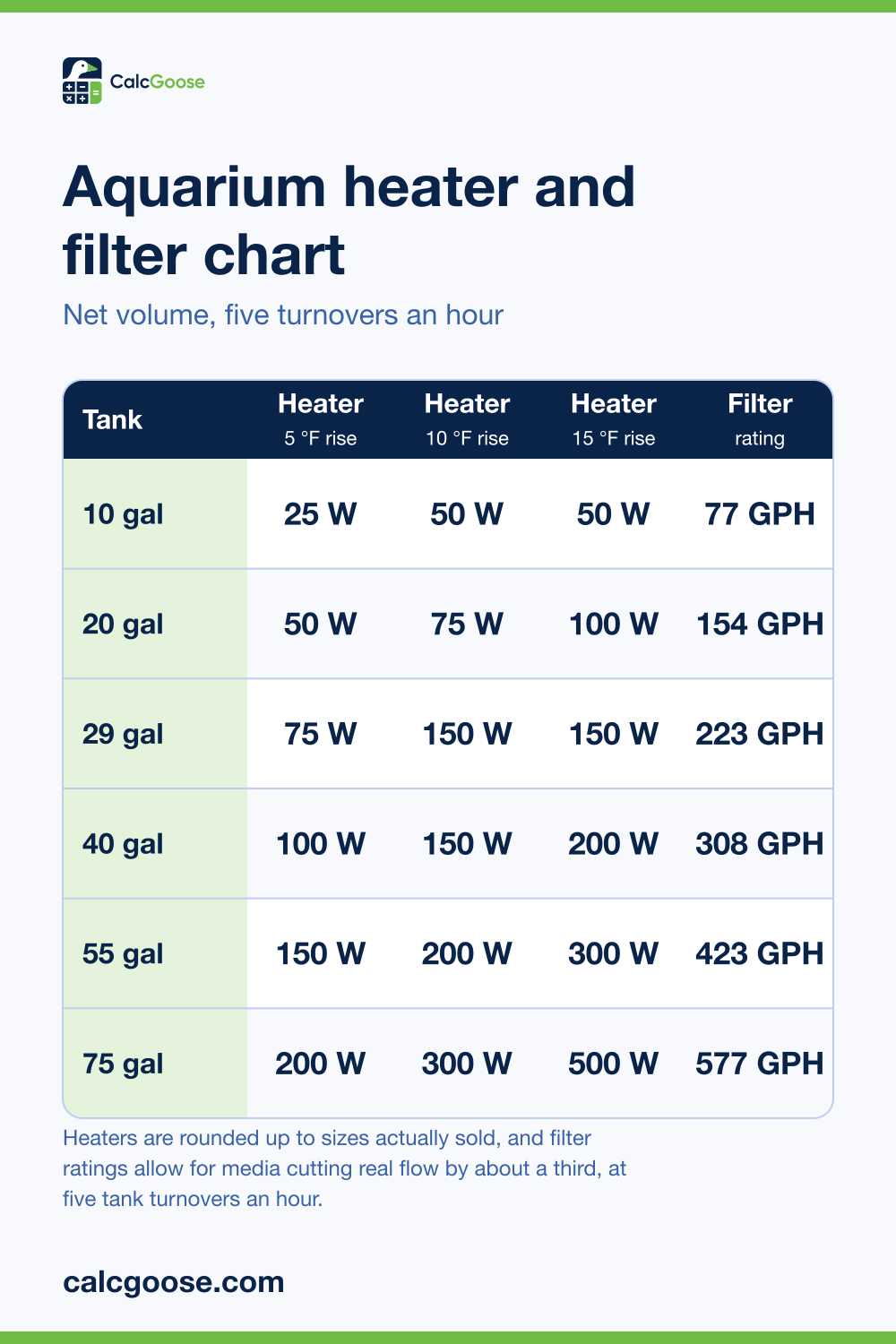
Aquarium heater and filter chart
The heater and filter a tank needs by net water volume, for how far the tank has to sit above the coolest room temperature. Every figure comes from the same formula as the calculator above.
| Tank | Heater 5 °F rise | Heater 10 °F rise | Heater 15 °F rise | Filter rating |
|---|---|---|---|---|
| 10 gal | 25 W | 50 W | 50 W | 77 GPH |
| 20 gal | 50 W | 75 W | 100 W | 154 GPH |
| 29 gal | 75 W | 150 W | 150 W | 223 GPH |
| 40 gal | 100 W | 150 W | 200 W | 308 GPH |
| 55 gal | 150 W | 200 W | 300 W | 423 GPH |
| 75 gal | 200 W | 300 W | 500 W | 577 GPH |
Heaters are rounded up to sizes actually sold, and filter ratings allow for media cutting real flow by about a third, at five tank turnovers an hour.
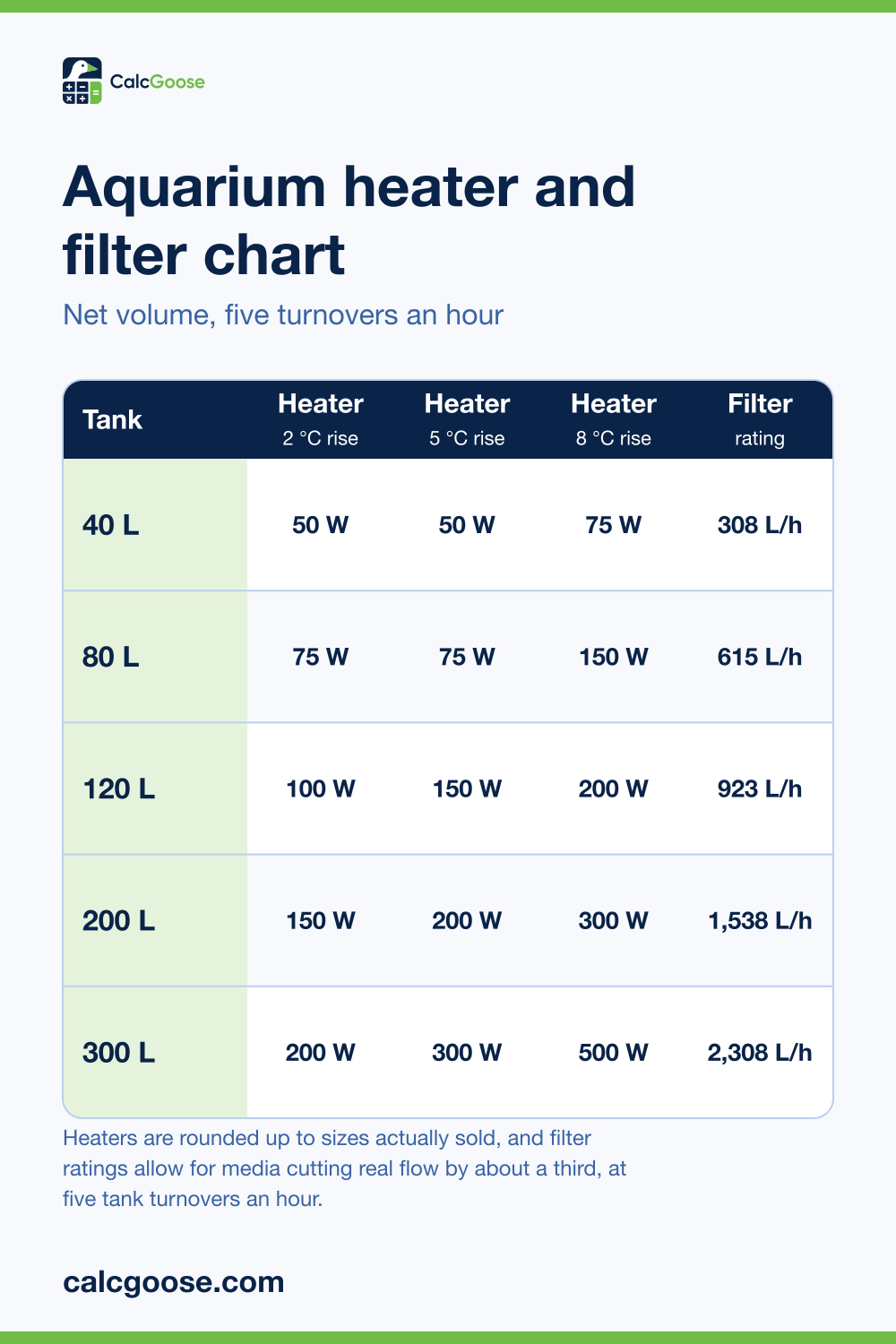
The heater and filter a tank needs by net water volume, for how far the tank has to sit above the coolest room temperature. Every figure comes from the same formula as the calculator above.
| Tank | Heater 2 °C rise | Heater 5 °C rise | Heater 8 °C rise | Filter rating |
|---|---|---|---|---|
| 40 L | 50 W | 50 W | 75 W | 308 L/h |
| 80 L | 75 W | 75 W | 150 W | 615 L/h |
| 120 L | 100 W | 150 W | 200 W | 923 L/h |
| 200 L | 150 W | 200 W | 300 W | 1,538 L/h |
| 300 L | 200 W | 300 W | 500 W | 2,308 L/h |
Heaters are rounded up to sizes actually sold, and filter ratings allow for media cutting real flow by about a third, at five tank turnovers an hour.
Assumptions and limits
Everything this calculator quietly assumes on your behalf. If one of these does not match your situation, the answer will be off.
- Volume uses internal dimensions and water height rather than tank height. Measuring the outside of the trim overstates volume by several percent.
- The 10% displacement allowance covers a normal gravel bed and moderate decor. A heavily aquascaped tank with deep substrate and large hardscape can lose 20% or more.
- Heater wattage is based on the gap between the coldest room temperature and the target, which is what actually determines the load. Tanks in unheated garages, conservatories or basements need substantially more than the old flat watts-per-gallon rules suggest.
- Above a 15 °F gap, two smaller heaters are safer than one large one, a stuck thermostat cannot overheat the tank as fast, and a failure leaves partial heating rather than none.
- Filter ratings are manufacturer figures for an empty chamber. Real flow with media installed is typically 30 to 40 percent lower, which is why the rated figure shown is higher than the target turnover.
- The one-inch-per-gallon stocking rule is a crude heuristic included because people search for it. It is roughly usable for small slim community fish such as tetras and rasboras, and badly wrong for goldfish, plecos, cichlids and anything with a heavy bioload.
- Nothing here models the nitrogen cycle, water chemistry, species compatibility or minimum tank sizes for particular fish, all of which matter more than volume alone.
- Marine and reef tanks have different requirements for turnover, flow and equipment, and this calculator is aimed at freshwater.
Frequently asked questions
How many gallons is my fish tank?
Multiply length by width by water height in inches and divide by 231. A 30 × 12 × 16 inch tank holds about 25 gallons of glass, or roughly 22 once substrate and decor are in. Always use the water height rather than the full tank height. Most tanks are filled an inch or two below the rim.
How many litres is my fish tank?
Multiply length by width by water height in centimetres and divide by 1,000. A 75 × 30 × 40 cm tank holds 90 litres of glass, or about 81 once substrate and decor are in. That lower figure is the one to dose medication and water conditioner against, not the number printed on the box.
What size heater do I need for a 20 gallon tank?
Around 75 watts for a typical room that sits about 10 °F below your target temperature, or 100 watts if the room drops further. Heater sizing depends on the temperature gap rather than tank volume alone, so the same tank in a cold room can need double the wattage of one in a warm living room.
What GPH filter do I need?
Aim for four to six times the tank volume per hour, then buy a filter rated about 50 percent higher than that figure. A 25 gallon community tank wants 125 GPH of real turnover, which means a filter rated around 190, because manufacturers rate flow with an empty chamber and media slows it considerably.
How many fish can I put in my tank?
The one-inch-per-gallon rule gives a rough ceiling for small slim community fish, so a 20 gallon tank might hold 20 inches of tetras. It fails completely for heavy-waste species, a single common goldfish needs 20 gallons on its own and a common pleco needs over 100. Research each species rather than trusting the rule.
Do I need to deduct substrate from tank volume?
Yes, and most people forget. Gravel, sand, rock and wood typically take about ten percent of the tank's stated volume, and a heavily aquascaped tank can lose twenty. It matters because medication and water conditioner doses are calculated per gallon of actual water.
How long does it take to cycle an aquarium?
Four to eight weeks for a fishless cycle, less if you seed it with media from an established tank. The tank needs bacteria colonies that convert ammonia to nitrite and nitrite to nitrate, and you know it is done when both ammonia and nitrite read zero within 24 hours of dosing ammonia. Adding fish before this is the most common beginner mistake.
How often should I change aquarium water?
Twenty to thirty percent weekly for most freshwater community tanks, more for heavily stocked ones. Water changes export nitrate and replace trace elements, and no filter does that job. A python-style changer that connects to a tap turns this from a bucket chore into a ten-minute task.
Related calculators
- Raw Dog Food Calculator Pets & Animals Daily raw food portions by body weight or calories, with monthly quantity and cost.
- Chicken Coop Calculator Pets & Animals Coop size, run size, nest boxes, feed and eggs for a backyard flock, in either direction.
- Cat Calorie Calculator Pets & Animals Daily calories for a cat, converted into cups of dry or cans of wet food.
Share this calculator
Found the number you needed? Send it to whoever asked you for it.