Vinyl & Sticker Pricing Calculator
Add up material, transfer tape, blanks, packaging and your own time, then get a selling price that survives marketplace fees at the margin you want.
Last updated
Where are you?
AWG, NEC, 120/240 V, miles and gallons mm², IEC/BS 7671, 230/400 V, km and litres . We remember this on every calculator.
Your result
Suggested selling price
$19.11
- Cost per item
- $9.65
- Materials
- $4.75
- Your labour
- $4.50
- Marketplace fee
- $1.82
- You receive
- $17.29
- Profit per item
- $7.64
🪿 The goose says: Charge $19.11. It costs you $9.65 to make, the marketplace takes $1.82, and you keep $7.64, a real 40% margin.
- The 9.5% fee takes $1.82 out of every sale at this price. Fees come off the top, which is why they are subtracted from the price rather than added to the cost.
- Design time is spread across 20 items, adding $0.50 each. Making one of something is nearly always uneconomic. This is why minimum orders exist.
Where every dollar of the price goes
A full breakdown of one item at the suggested price.
- Vinyl
- $0.60
- Transfer tape / laminate
- $0.15
- Blank
- $4.00
- Packaging
- $0.40
- Production labour (12 min)
- $4.00
- Design, spread over 20
- $0.50
- Marketplace fee (9.5%)
- $1.82
- Your profit
- $7.64
Shipping is not included, charge it separately or build it into the price on top of this figure.
How this vinyl pricing calculator works
Pricing handmade goods goes wrong in two specific ways. The first is leaving out costs that feel too small to matter (transfer tape, the mailer, the backing card), which together often exceed the vinyl itself. The second, and much worse, is treating the marketplace fee as something added to the price rather than taken out of it.
That second one is worth spelling out. If you want a 40% margin and Etsy takes 9.5%, you cannot mark cost up by 49.5%. The fee and the margin both come out of the selling price, so you divide the cost by what is left, 1 minus 0.40 minus 0.095, which is 0.505. A ten dollar cost therefore needs a nineteen-eighty price, not fifteen.
Design time is handled separately because it is a one-off. Thirty minutes of design on a run of twenty is ninety seconds per item; on a run of one it is the whole thirty minutes, which is exactly why single custom orders need a minimum charge.
-
Step 1 Material per item
material = sheet_cost × sheets_per_item -
Step 2 Add the rest of the physical costs
+ transfer tape + blank + packagingSmall numbers, but they are per item and they add up across a run. -
Step 3 Add production labour
labour = minutes ÷ 60 × your_hourly_rate -
Step 4 Spread the design time
design_per_item = design_minutes ÷ 60 × rate ÷ quantity -
Step 5 Work back from margin and fee together
price = total_cost ÷ (1 − margin% − fee%)Both come out of the price, so both are subtracted from 1 in the same step.
For example, 0.60 of vinyl, 0.15 of tape, a 4.00 shirt, 0.40 of packaging, 12 minutes at 20 an hour and 30 minutes of design across 20 items. That is 9.65 in cost. At a 40% margin with a 9.5% Etsy fee, the price is 9.65 ÷ 0.505 = 19.11.
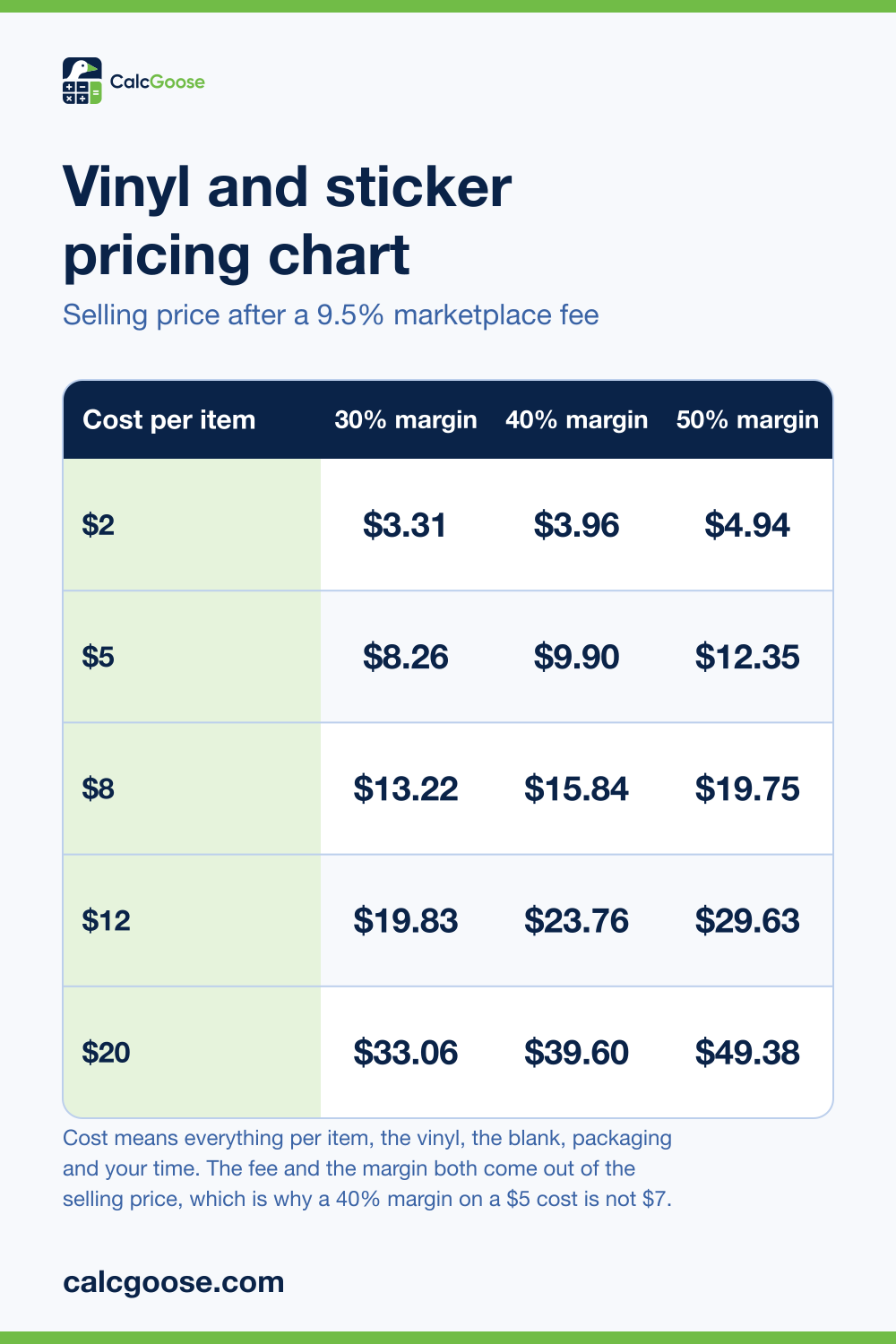
Vinyl and sticker pricing chart
The selling price that covers an item's full cost and still leaves your margin after a 9.5% marketplace fee, about what Etsy takes. Every figure comes from the same formula as the calculator above.
| Cost per item | 30% margin | 40% margin | 50% margin |
|---|---|---|---|
| $2 | $3.31 | $3.96 | $4.94 |
| $5 | $8.26 | $9.90 | $12.35 |
| $8 | $13.22 | $15.84 | $19.75 |
| $12 | $19.83 | $23.76 | $29.63 |
| $20 | $33.06 | $39.60 | $49.38 |
Cost means everything per item, the vinyl, the blank, packaging and your time. The fee and the margin both come out of the selling price, which is why a 40% margin on a $5 cost is not $7.
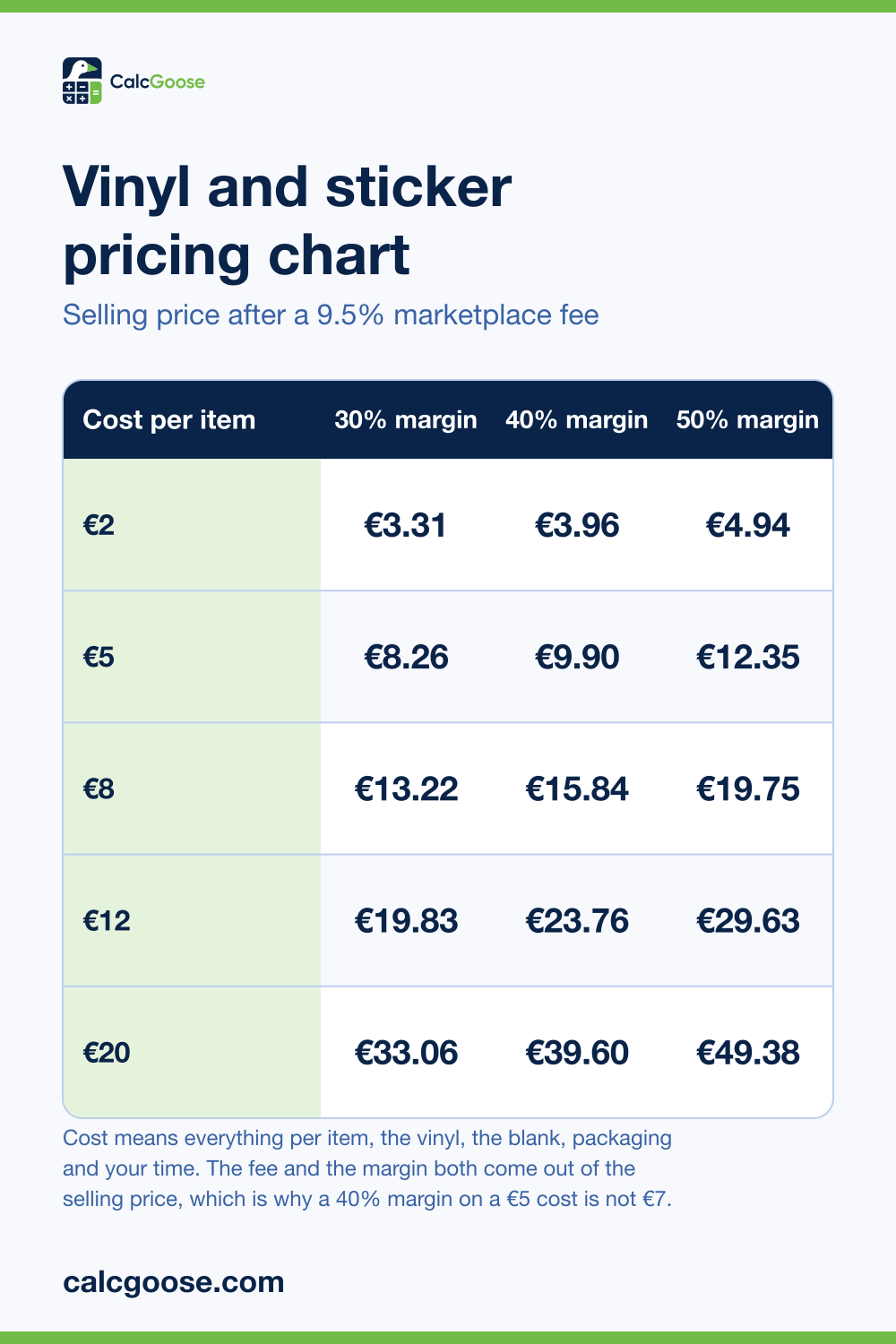
The selling price that covers an item's full cost and still leaves your margin after a 9.5% marketplace fee, about what Etsy takes. Every figure comes from the same formula as the calculator above.
| Cost per item | 30% margin | 40% margin | 50% margin |
|---|---|---|---|
| €2 | €3.31 | €3.96 | €4.94 |
| €5 | €8.26 | €9.90 | €12.35 |
| €8 | €13.22 | €15.84 | €19.75 |
| €12 | €19.83 | €23.76 | €29.63 |
| €20 | €33.06 | €39.60 | €49.38 |
Cost means everything per item, the vinyl, the blank, packaging and your time. The fee and the margin both come out of the selling price, which is why a 40% margin on a €5 cost is not €7.
Assumptions and limits
Everything this calculator quietly assumes on your behalf. If one of these does not match your situation, the answer will be off.
- Margin is expressed as a share of the selling price, which is standard retail practice. It is not a markup on cost, a 40% margin is a 67% markup.
- The marketplace fee is subtracted from the price in the same step as the margin, because both are taken from the same figure. Applying them sequentially produces a price that misses your target margin.
- Design time is amortised across the run size you enter. If you sell fewer than that, each item carries more design cost than shown and your real margin is lower.
- Shipping is not included anywhere. Charge it separately, or add it to the price after this calculation. It is a pass-through cost, not a margin item.
- Failed cuts, mis-weeds and misprints are not modelled. If you scrap more than about one item in twenty, raise the sheets-per-item figure to cover it.
- Machine depreciation and electricity are not included. Both are small for vinyl work, a cutter draws under 50 watts, but a heat press running all day is not negligible.
- The Etsy default of 9.5% covers the 6.5% transaction fee plus roughly 3% payment processing on a typical US order. Your actual rate varies with offsite ads, currency conversion and country.
- Sales tax and VAT are ignored. In most marketplaces these are collected on top of your price and remitted for you, so they do not affect the margin.
Frequently asked questions
What should I charge for a vinyl decal?
For a small decal costing about 1.50 in vinyl, tape and packaging plus ten minutes of your time, a 40% margin after Etsy fees works out around 9 to 11. Most hobby sellers price at 3 to 5 because they only count the vinyl, and then cannot understand why volume does not turn into money.
How much should I charge for a custom shirt?
Take the blank cost, add HTV and packaging, add your press and weeding time, then divide by one minus your margin and the marketplace fee. A 4 blank with 12 minutes of work at 20 an hour lands near 19 at a 40% margin on Etsy. Bulk orders drop that because design time and setup spread further.
How many decals do I get from one sheet of vinyl?
It depends on how tightly you nest them, and it is the input people guess wrong most often. A 12 × 12 inch sheet holds roughly nine 3-inch decals or four 5-inch ones once you allow cutting margins, so enter about 0.11 or 0.25 sheets per item above. Weeding waste and failed cuts come out of the same sheet, so if you scrap more than one item in twenty, round that figure up rather than adding a separate allowance.
How do Etsy fees actually work?
Etsy charges a 20 cent listing fee, a 6.5% transaction fee on the total including shipping, and roughly 3% plus 25 cents in payment processing. That totals around 9.5 to 10% of a typical order. Offsite Ads adds 12–15% on attributed sales, which is worth checking if you are near the mandatory threshold.
Should I charge for design time?
Yes, but spread it across the run rather than charging it to every item. Thirty minutes of design across twenty items is trivial per unit; across one item it is half an hour of unpaid work. This is the entire argument for having a minimum order quantity or a separate setup fee on custom work.
What is the difference between margin and markup?
Margin is profit as a share of the selling price; markup is profit as a share of the cost. A 40% margin means keeping 40 cents of every dollar taken, which requires a 67% markup on cost. Confusing the two is the most common pricing error in handmade selling, and it always errs towards underpricing.
How do I price wholesale versus retail?
Wholesale is usually half your retail price, which only works if your retail margin is high enough to absorb it. That means a retail margin of 60% or more before you can wholesale profitably at 50% off. Run this calculator with the fee at zero and the margin at 25–30% to see whether your wholesale price still clears your costs.
Is my hourly rate too low?
If it is below what you would accept for the same hours doing anything else, yes. Twenty an hour is a common starting point for craft production work, but it is a floor rather than a target, skilled weeding and press work is worth more, and pricing your time at zero simply hides the loss rather than removing it.
Related calculators
- Epoxy Resin Calculator Maker & Craft Work out how much resin a mould, river table or tumbler actually takes, split by part A and B.
- Candle Making Calculator Maker & Craft How much wax and fragrance oil a batch of candles needs, plus a wick size for your jar.
- Soap Lye Calculator Maker & Craft Work out exactly how much lye and water your oils need, with superfat and a full safety brief.
- 3D Print Cost Calculator Maker & Craft The real cost of a print (filament, power, wear and failures) and what to charge for it.
- Yarn Calculator Maker & Craft How much yarn a blanket, scarf or hat takes, by craft, stitch density and yarn weight.
- Fabric Calculator Maker & Craft How much fabric a project needs, with hems, seams and pattern repeat already added.
Share this calculator
Found the number you needed? Send it to whoever asked you for it.