Coffee Ratio Calculator
Pick your brew method and how much you are making, and get the grams of coffee and water, plus a rough tablespoon figure if you have no scale.
Last updated
Where are you?
AWG, NEC, 120/240 V, miles and gallons mm², IEC/BS 7671, 230/400 V, km and litres . We remember this on every calculator.
Your result
Coffee for 480 ml
30 g
- Water
- 480 g
- Ratio
- 1:16
- Rough tablespoons
- 5.45 tbsp
- Method
- V60 / pour-over
- Per cup
- 15 g
- Grind
- Medium-fine
🪿 The goose says: Weigh out 30 g of coffee for 480 g of water. That is a 1:16 ratio, or roughly 5.45 tablespoons if you have no scale.
- Grind: Medium-fine, like table salt.
- Water at 195–205 °F (90–96 °C), just off the boil. Boiling water scorches the grounds and makes the cup bitter, while water below about 185 °F under-extracts and tastes sour and thin.
- The tablespoon figure is genuinely rough. A level tablespoon holds roughly 5 to 6 grams depending on grind size and how the beans settle, so it can be out by 15% either way. Use it to get close, not to dial anything in.
How this coffee ratio calculator works
Coffee brewing is a ratio, and the ratio is expressed as one part coffee to n parts water by weight. A 1:16 ratio means 16 grams of water for every gram of coffee, so 500 grams of water needs 31 grams of coffee.
It works by weight rather than volume because a gram of water is a millilitre, which makes the arithmetic trivial, and because a scoop of coffee can vary by 20% depending on the grind and how it settles. Weighing both sides is the single change that makes coffee consistent.
Espresso inverts it. Rather than starting from the water, you start from the dose in the basket and control the yield in the cup, an 18 gram dose at 1:2 pulls 36 grams of espresso. The ratio is the same idea, measured in the opposite direction.
-
Step 1 Total water
water_g = cups × cup_size_ml1 ml of water weighs 1 g, so millilitres and grams are interchangeable here. -
Step 2 Coffee
coffee_g = water_g ÷ ratioV60 and drip 1:16, French press and AeroPress 1:15, Chemex 1:16.5, moka 1:10, cold brew concentrate 1:5. -
Step 3 Strength adjustment
effective_ratio = base_ratio − strengthLowering the ratio means less water per gram of coffee, which is a stronger cup. -
Step 4 Espresso, in reverse
yield_g = dose_g × ratioAn 18 g dose at 1:2 gives 36 g in the cup, ideally in 25–30 seconds. -
Step 5 Tablespoon approximation
tbsp ≈ coffee_g ÷ 5.5Deliberately rough, a tablespoon of coffee is 5 to 6 grams depending on grind.
For example, two 240 ml mugs of pour-over is 480 g of water. At the V60 default of 1:16 that is 30 grams of coffee, or about 5.5 level tablespoons.
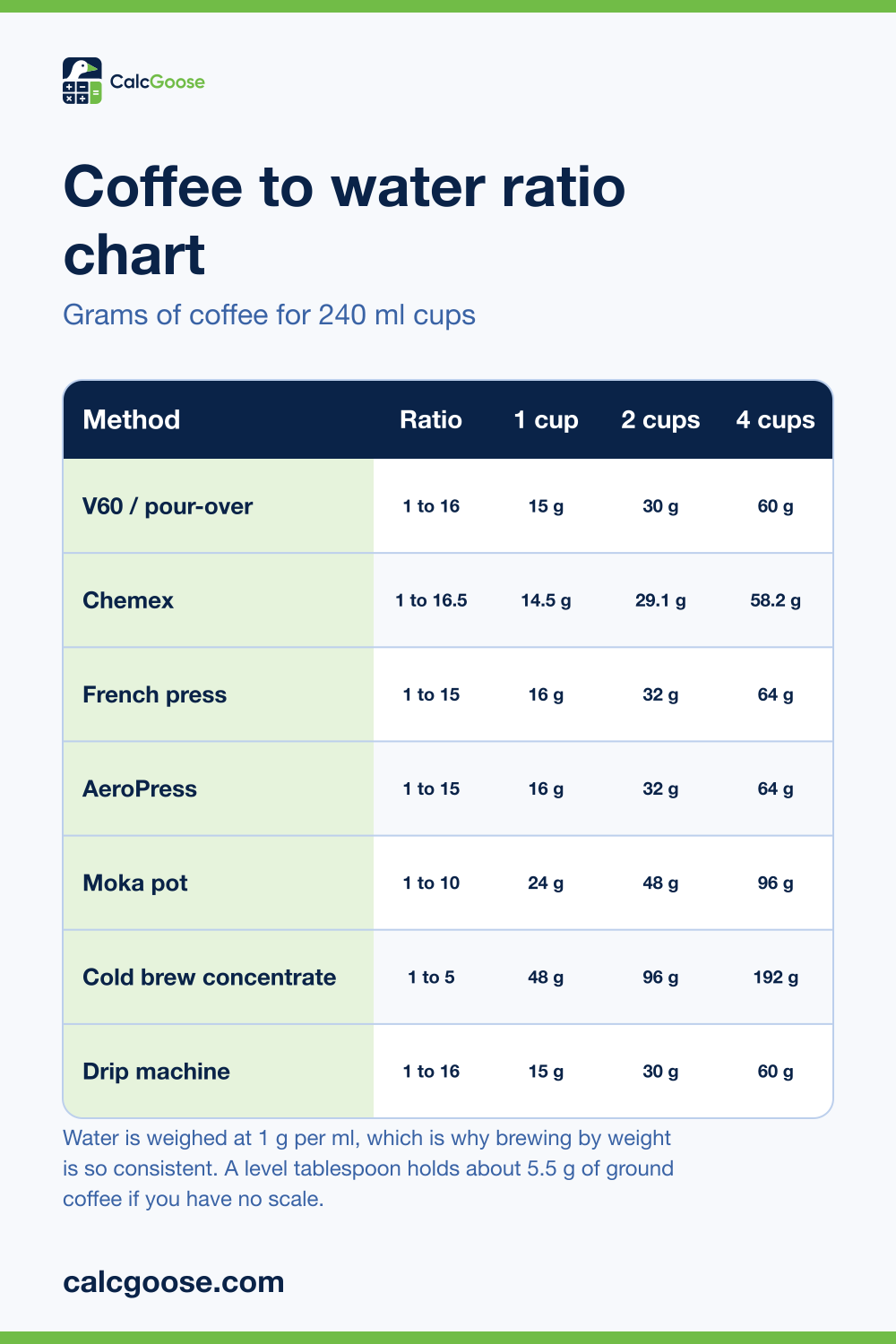
Coffee to water ratio chart
Grams of ground coffee for each brew method at its standard ratio, for one, two and four 240 ml cups. Every figure comes from the same formula as the calculator above.
| Method | Ratio | 1 cup | 2 cups | 4 cups |
|---|---|---|---|---|
| V60 / pour-over | 1 to 16 | 15 g | 30 g | 60 g |
| Chemex | 1 to 16.5 | 14.5 g | 29.1 g | 58.2 g |
| French press | 1 to 15 | 16 g | 32 g | 64 g |
| AeroPress | 1 to 15 | 16 g | 32 g | 64 g |
| Moka pot | 1 to 10 | 24 g | 48 g | 96 g |
| Cold brew concentrate | 1 to 5 | 48 g | 96 g | 192 g |
| Drip machine | 1 to 16 | 15 g | 30 g | 60 g |
Water is weighed at 1 g per ml, which is why brewing by weight is so consistent. A level tablespoon holds about 5.5 g of ground coffee if you have no scale.
Assumptions and limits
Everything this calculator quietly assumes on your behalf. If one of these does not match your situation, the answer will be off.
- The default ratios are widely-used starting points rather than rules. V60 and drip 1:16, Chemex 1:16.5, French press and AeroPress 1:15, moka pot 1:10, cold brew concentrate 1:5, espresso 1:2. Taste is the real arbiter and everyone lands somewhere slightly different.
- Water is treated as 1 gram per millilitre, which is accurate enough for brewing at any temperature you would use.
- The tablespoon conversion of 5.5 grams is approximate and can be 15% out either way depending on grind size, bean density and how the spoon is filled. It is offered for people without a scale, not as a substitute for one.
- Brew water absorbed by the grounds is not deducted. Coffee retains roughly twice its own weight in water, so a 30 gram dose keeps about 60 grams, meaning a 500 gram brew yields around 440 grams in the cup.
- Grind size guidance is generic. The correct grind depends on your specific grinder, the bean, its roast level and how fresh it is, and dialling it in is a matter of tasting and adjusting.
- Cold brew ratios produce a concentrate meant to be diluted. Ready-to-drink cold brew is typically brewed at 1:12 to 1:15 instead.
- Espresso yield assumes a normale shot at 1:2. Ristretto runs around 1:1.5 and lungo 1:3, both of which taste substantially different from the same dose.
- Water quality is ignored and matters more than most people expect. Very soft or heavily softened water extracts poorly, and very hard water scales equipment and mutes acidity.
Frequently asked questions
How much coffee per cup?
About 15 grams of coffee for a 240 ml mug at the standard 1:16 ratio, which is roughly two and a half level tablespoons. Two mugs need 30 grams for 480 ml of water. If your cups are the 150 ml "cups" a drip machine counts, it is closer to 9 grams each.
What is the golden ratio for coffee?
One part coffee to 15 to 18 parts water by weight, most often quoted as 1:16. That range is what the Specialty Coffee Association derives its brewing standards from, and almost every filter method sits inside it. Espresso is the exception at around 1:2, because it is a concentrate rather than a brewed cup.
How much coffee for a French press?
About 67 grams for a full one litre press at the 1:15 ratio, or 33 for the half litre size. Grind coarse, steep four minutes, then press slowly and decant straight away, because coffee left sitting on the grounds carries on extracting and turns bitter. French press tastes a little stronger than pour-over at the same ratio, since the metal filter lets oils and fines through instead of trapping them in paper.
How do I measure coffee without a scale?
A level tablespoon holds roughly 5 to 6 grams of ground coffee, so a 240 ml cup at 1:16 needs about two and a half. It is genuinely imprecise, grind size alone can shift it by 15%, so use it to get in range and buy a scale if you care about consistency. A cheap 0.1 gram scale costs less than a bag of good beans.
What ratio should I use for cold brew?
One to five by weight for a concentrate, so 200 grams of coarsely ground coffee to 1,000 grams of water, steeped 12 to 18 hours. Dilute that one to two or one to three when serving. If you want ready-to-drink straight from the fridge, brew at 1:12 to 1:15 instead.
Does grind size matter more than the ratio?
They matter differently. The ratio sets how strong the cup is; the grind sets how much flavour is extracted from the coffee. Too coarse and the cup is sour and thin even at a strong ratio; too fine and it is bitter and harsh even at a weak one. Fix the grind first, then adjust the ratio to taste.
What water temperature should I use?
Between 195 and 205 °F, which is 90 to 96 °C, just off a rolling boil. In practice, boil the kettle and wait 30 seconds. Water at boiling point scorches the grounds and tastes bitter; below about 185 °F it under-extracts and tastes sour and hollow.
Why does my coffee taste bitter?
Usually over-extraction. The grind is too fine, the brew ran too long, or the water was too hot. Try a coarser grind first, since it is the biggest lever. If it tastes sour and thin instead, that is under-extraction and you want the opposite, finer grind or longer contact time.
Related calculators
- Pool Chemical Calculator Everyday Life How much chlorine and acid your pool needs, worked out from its actual volume.
- Sourdough Calculator Everyday Life Scale any sourdough recipe by baker's percentages, with true hydration worked out properly.
- BBQ Calculator Everyday Life How much meat to buy for a cookout, adjusted for kids, appetite and sides.
- Party Drink Calculator Everyday Life Beer, wine, spirits, mixers and ice for any guest count and party length.
- Tip & Bill Split Calculator Everyday Life Split a bill evenly or by what each person ordered, with tax and tip shared fairly.
- Freelance Rate Calculator Everyday Life Work backwards from the money you want to keep to the hourly rate you have to charge.
- Pizza Dough Calculator Everyday Life Dough ball weight from the pizza size, then flour, water, salt and yeast by baker's percentage.
Share this calculator
Found the number you needed? Send it to whoever asked you for it.