Whole House Generator Cost Calculator
The price on the box is usually less than half of what a standby generator costs installed. Set the size, fuel and connection method to see the whole invoice, broken down.
Last updated
Where are you?
AWG, NEC, 120/240 V, miles and gallons mm², IEC/BS 7671, 230/400 V, km and litres . We remember this on every calculator.
Your result
Installed cost
$11,968
- Likely range
- $10,173 – $13,763
- Equipment
- $7,028
- Installation
- $4,940
- Cost per kW
- $544
- Running cost
- $382/year
- Ten-year total
- $15,784
🪿 The goose says: A 22 kW air-cooled standby lands around $11,968 installed, $7,028 of equipment and $4,940 of work. Expect quotes between $10,173 and $13,763, and budget $382 a year to keep it ready.
- Equipment is 59% of this total. The other 41% is labour, pipework, concrete and paperwork, which is why the price you see advertised for the generator itself is such a poor guide to what you will pay.
Estimate for planning only. Have any electrical work verified by a qualified electrician and installed to code. See the full disclaimer at the bottom of this page.
Where the money goes
- Generator
- $5,828 Air-cooled standby, 22 kW
- Automatic transfer switch
- $1,200 equipment
- Electrical labour
- $3,140 30 ft run + switch fitting
- Gas line
- $900 25 ft plus connection
- Concrete pad
- $550
- Permit and inspection
- $350
- Total installed
- $11,968 $10,173 – $13,763
Labour priced at 1.00× the national average. The range is ±15%, which is about the spread you should expect between three quotes for the same job.
What the same job costs at other sizes
Air-cooled standby on natural gas, same connection and same site work.
- 7.50 kW
- $8,430 $1,124 per kW
- 14 kW
- $10,016 $715 per kW
- 22 kW
- $11,968 $544 per kW
- 26 kW
- $12,944 $498 per kW
- 38 kW
- $15,872 $418 per kW
Cost per kilowatt falls steeply with size, because the pad, the switch, the gas line and the labour barely change. Going one size up is almost always cheaper than going one size up later.
What it costs to own
- Installed cost
- $11,968
- Servicing
- $320/year annual service contract
- Fuel
- $62/year 20 h of outage
- Ten-year total
- $15,784
- Cost per year over ten
- $1,578
Servicing is the item people forget. A standby set exercises itself weekly and needs an annual oil, filter and battery service whether or not the power ever goes out; the battery itself is a consumable every three to five years.
How this generator cost calculator works
A standby generator installation is two purchases wearing one price tag. The first is the machine, which is the one you can look up. The second is everything needed to make it useful, a pad to stand on, a gas line to feed it, conductors back to the house, a transfer switch so it cannot backfeed the utility, and a permit and inspection to prove all of that was done properly.
For a typical air-cooled standby job the second half is roughly the size of the first. That ratio is why quoted generator prices and actual invoices differ so much, and why a homeowner who has budgeted from a product listing is usually shocked by the first quote.
Equipment pricing follows a straight line with size, with a fixed component for the enclosure, controller and alternator that does not shrink no matter how small the engine is. That fixed component is why cost per kilowatt falls sharply as you go up, the pad, the switch, the gas line and most of the labour cost the same for a 14 kW set as for a 22 kW one.
Everything here is a planning estimate. Real quotes vary by region, by how far the generator sits from the panel and the meter, by whether your service needs upgrading, and by how busy the installer is in the month after a storm.
-
Step 1 Equipment
equipment = base + rate × kWPortable $100 + $145/kW; air-cooled standby $460 + $244/kW; liquid-cooled $700 + $391/kW, fitted to current retail listings. -
Step 2 Electrical work
electrical = (call-out + $18/ft × run + switch fitting) × local_rateThe transfer switch adds both hardware and fitting time, $450 for an interlock, $1,400 for a whole-house automatic switch. -
Step 3 Gas line
gas = ($350 connection + $22/ft) × local_rateOnly for natural gas and propane. Long runs need larger pipe, which costs more per foot than this allows. -
Step 4 Site work and paperwork
pad + permit, scaled by local_rate -
Step 5 Installed total
total = equipment + transfer_switch + electrical + gas + pad + permit -
Step 6 Quote range
low = total × 0.85; high = total × 1.15About the spread you should expect between three quotes for identical work. -
Step 7 Cost of ownership
ten_year = installed + (servicing + fuel) × 10Servicing is annual whether or not the power ever fails, and the starting battery is a consumable.
For example, a 22 kW air-cooled standby on natural gas with a whole-house automatic transfer switch, 30 feet from the panel, 25 feet of new gas line, on a concrete pad with a permit, at average labour rates. Equipment is $5,828 plus $1,200 for the switch; installation is $3,140 of electrical, $900 of gas line, $550 of concrete and $350 of permit. That is $11,968 installed, with quotes likely between $10,173 and $13,763, and the generator itself is under half of it.
A standby generator installation is two purchases wearing one price tag. The first is the machine, which is the one you can look up. The second is everything needed to make it useful, a base to stand on, a fuel supply, cable back to the consumer unit, a changeover switch so it cannot energise the incoming supply, and the certification to prove it was done properly.
For a typical standby job the second half is roughly the size of the first. That ratio is why quoted generator prices and actual invoices differ so much, and why anyone budgeting from a product listing is usually surprised by the first quote.
Equipment pricing follows a straight line with size, with a fixed component for the enclosure, controller and alternator that does not shrink no matter how small the engine is. That fixed component is why cost per kilowatt falls sharply as you go up, the base, the changeover switch and most of the labour cost the same for a 10 kW set as for a 16 kW one.
Domestic standby generation is much rarer in Europe than in North America, grids are more reliable, homes are smaller, and heating is usually not electric. Most European installations at this scale are diesel, on farms, in rural properties and anywhere a business cannot afford to stop.
-
Step 1 Equipment
equipment = base + rate × kWPortable €100 + €145/kW; air-cooled standby €460 + €244/kW; liquid-cooled €700 + €391/kW, then a further 25% because European sets at this size are diesel rather than air-cooled gas. -
Step 2 Electrical work
electrical = (call-out + €59/m × run + switch fitting) × local_rateThe changeover switch adds both hardware and fitting time, €450 for an interlocked kit, €1,400 for an automatic changeover. -
Step 3 Gas line
gas = (€350 connection + €72/m) × local_rateOnly for natural gas and LPG. Long runs need larger-bore pipe, which costs more per metre than this allows. -
Step 4 Site work and certification
base + certification, scaled by local_rate -
Step 5 Installed total
total = equipment + changeover + electrical + gas + base + certification -
Step 6 Quote range
low = total × 0.85; high = total × 1.15About the spread you should expect between three quotes for identical work. -
Step 7 Cost of ownership
ten_year = installed + (servicing + fuel) × 10Servicing is annual whether or not the power ever fails, and the starting battery is a consumable.
For example, a 10 kW diesel standby with an automatic changeover, 9 metres from the consumer unit, on a concrete base with certification, at average labour rates. Equipment is €3,625 plus €1,200 for the changeover; installation is €3,131 of electrical work, €550 of concrete and €350 of certification. That is €8,856 installed, with quotes likely between €7,528 and €10,185.
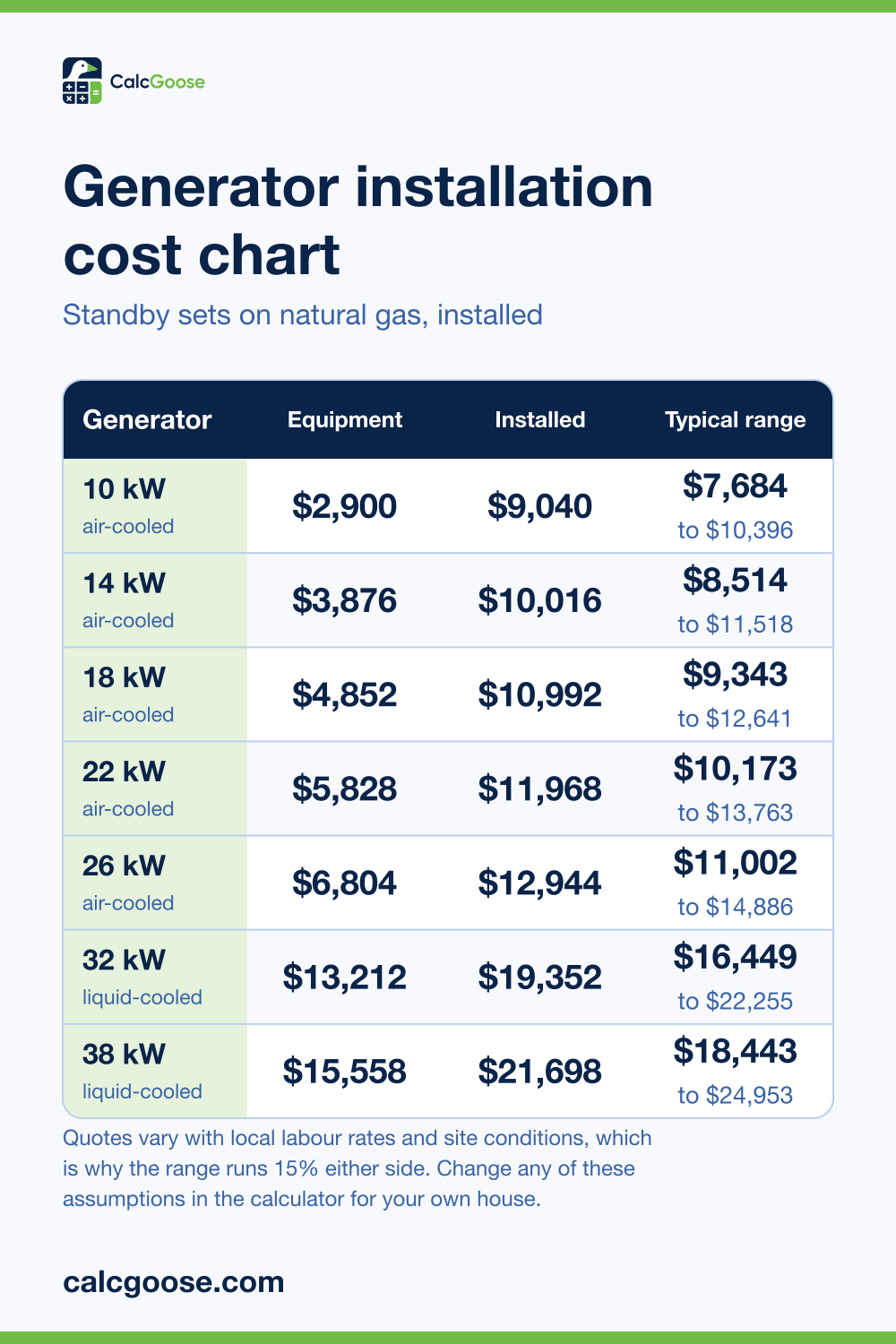
Generator installation cost chart
Typical installed prices for standby generators on natural gas, with an automatic transfer switch, a concrete pad, a 30 foot cable run, a 25 foot gas line and a permit, at national average labour rates. Every figure comes from the same cost model as the calculator above.
| Generator | Equipment | Installed | Typical range |
|---|---|---|---|
| 10 kWair-cooled | $2,900 | $9,040 | $7,684to $10,396 |
| 14 kWair-cooled | $3,876 | $10,016 | $8,514to $11,518 |
| 18 kWair-cooled | $4,852 | $10,992 | $9,343to $12,641 |
| 22 kWair-cooled | $5,828 | $11,968 | $10,173to $13,763 |
| 26 kWair-cooled | $6,804 | $12,944 | $11,002to $14,886 |
| 32 kWliquid-cooled | $13,212 | $19,352 | $16,449to $22,255 |
| 38 kWliquid-cooled | $15,558 | $21,698 | $18,443to $24,953 |
Quotes vary with local labour rates and site conditions, which is why the range runs 15% either side. Change any of these assumptions in the calculator for your own house.
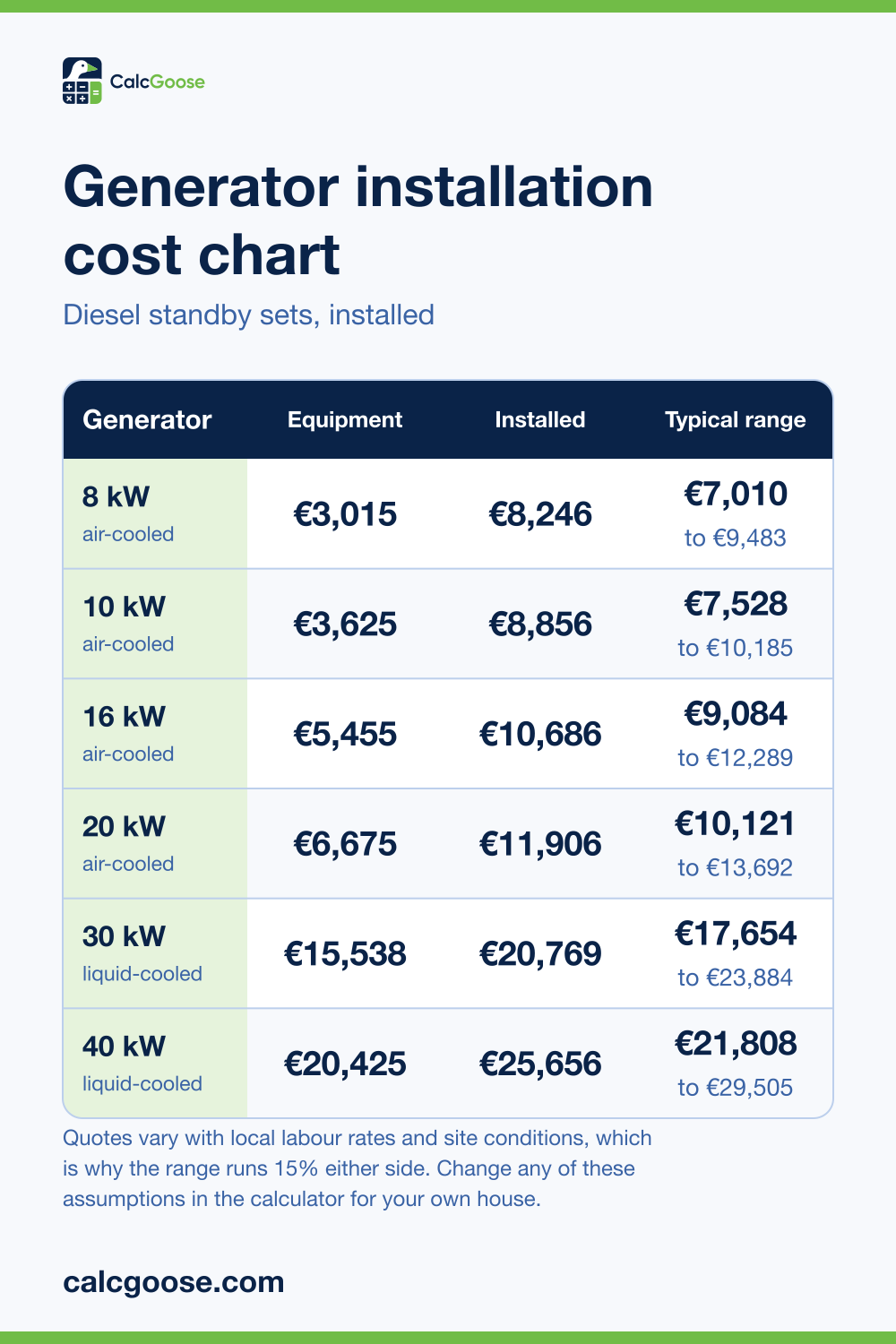
Typical installed prices for diesel standby generators, with an automatic changeover, a concrete pad, a 9 metre cable run and a permit, at average labour rates. Every figure comes from the same cost model as the calculator above.
| Generator | Equipment | Installed | Typical range |
|---|---|---|---|
| 8 kWair-cooled | €3,015 | €8,246 | €7,010to €9,483 |
| 10 kWair-cooled | €3,625 | €8,856 | €7,528to €10,185 |
| 16 kWair-cooled | €5,455 | €10,686 | €9,084to €12,289 |
| 20 kWair-cooled | €6,675 | €11,906 | €10,121to €13,692 |
| 30 kWliquid-cooled | €15,538 | €20,769 | €17,654to €23,884 |
| 40 kWliquid-cooled | €20,425 | €25,656 | €21,808to €29,505 |
Quotes vary with local labour rates and site conditions, which is why the range runs 15% either side. Change any of these assumptions in the calculator for your own house.
Assumptions and limits
Everything this calculator quietly assumes on your behalf. If one of these does not match your situation, the answer will be off.
- Prices are planning estimates built from current retail listings and typical contractor rates, not quotes. Regional variation is large, and the month after a major storm is the worst possible time to buy. Both the equipment and the labour go up.
- Equipment pricing is modelled as a fixed component plus a rate per kilowatt. Real product ladders have steps and promotions that this smooths over.
- No service upgrade is included. If your panel is 100 A, full or old, upgrading it can add $2,000 to $4,000 and is often the largest single surprise in a standby quote.
- The gas line estimate assumes the existing meter and supply can feed the generator. A 22 kW set demands roughly 300 cubic feet an hour, and many residential meters cannot supply that alongside a furnace and a water heater without being upsized by the utility.
- No propane tank purchase or rental is included. A 500-gallon tank is $1,500 to $3,000 to buy, or free on a supply contract.
- Permit costs vary from nothing to over $1,000 depending on jurisdiction, and some areas require separate electrical, gas and mechanical permits for the same job.
- The annual fuel figure charges roughly $0.14 per rated kilowatt per hour of outage, which is about what a set running at 50–60% load costs on natural gas. The generator fuel calculator does that properly from the load and fuel you actually use.
- Running cost assumes fuel is burned only during outages, plus routine servicing. It excludes the weekly exercise cycle, which is small but not zero, and the starting battery, which needs replacing every three to five years.
- Prices are planning estimates built from typical retail listings and contractor rates, not quotes. Variation across Europe is very large, labour in Scandinavia and Ireland can be double the same job in Portugal or Poland.
- Equipment pricing is modelled as a fixed component plus a rate per kilowatt. Real product ladders have steps and promotions that this smooths over.
- No supply upgrade is included. Where the generator has to feed the whole installation rather than selected circuits, the changeover and its protective devices have to be rated for the incoming supply, which can add substantially.
- Installation rules are national, not harmonised. Siting distances, noise limits, exhaust routing, fuel storage and who is permitted to certify the changeover all differ by country, and some require a building notice.
- No LPG tank purchase or rental is included, and bulk tanks have their own siting rules covering distance to buildings, boundaries and drains.
- Fuel cost assumes diesel at typical European pump prices. Off-road or heating oil, where its use in a generator is permitted, is substantially cheaper and changes the running figure considerably.
- The annual fuel figure charges roughly €0.41 per rated kilowatt per hour of outage, which is about what a diesel set running at 50–60% load costs at current pump prices. The generator fuel calculator does that properly from the load and fuel you actually use.
- Running cost assumes fuel is burned only during outages, plus routine servicing. It excludes the weekly exercise cycle and the starting battery, which needs replacing every three to five years.
Frequently asked questions
How much does a whole house generator cost installed?
A 22 kW air-cooled standby with an automatic transfer switch typically lands between $11,000 and $15,000 installed, of which roughly $7,000 is equipment. Smaller 14 kW installations run $9,000 to $12,000, and liquid-cooled sets from 30 kW up start around $18,000. The variables that move it most are the distance to your panel, whether the gas meter needs upsizing, and local labour rates.
How much is a Generac generator?
The unit alone is roughly $2,900 for a 10 kW air-cooled set, $4,850 for 18 kW and $5,800 for 22 kW, with the automatic transfer switch another $500 to $1,200 on top. Those are list-type figures, and dealer markup in 2026 pushes a 22 kW unit anywhere up to about $7,500. Installation typically adds as much again. Treat any advertised price that does not mention the transfer switch, gas line and permit as about half the real number.
How much does it cost to install a generator?
Installation alone usually runs $3,000 to $6,000 for a standby set, electrical work back to the panel, fitting the transfer switch, running a gas line, pouring a pad and pulling permits. A portable with just an interlock kit is far cheaper at $700 to $1,200. The single biggest variable is distance. Every extra foot of cable and gas pipe is billed.
Is a whole house generator worth it?
It depends almost entirely on how often your power fails and what an outage actually costs you. If you lose power for days at a time, have a well, a sump pump, medical equipment or a freezer full of food, the arithmetic works quickly. If you lose it twice a year for an hour, a $500 battery station and a portable will serve you better for a tenth of the money.
How much does a generator cost for a 2,000 sq ft house?
For a gas-heated 2,000 sq ft home, a 14 to 18 kW standby covers everything and runs $9,000 to $13,000 installed. All-electric homes of the same size need 22 to 26 kW and $12,000 to $16,000, because electric heat, an electric water heater and a well pump together are more load than the floor area suggests. Square footage is a weak guide, what matters is whether heating and hot water are electric.
How much does a whole house generator cost to run each year?
Servicing is the fixed cost and you pay it whether the power ever fails or not, roughly $320 a year for the annual oil, filter and plug service an air-cooled standby set needs. Fuel is the small half unless your outages are long, because a 22 kW set covering 20 hours of outage burns only about $60 of natural gas. Budget around $400 a year all in, plus a starting battery every three to five years. Across ten years that adds close to $4,000 on top of whatever the installation cost.
Do I need a transfer switch?
Yes, for anything connected to your house wiring, and it is a legal requirement under NEC 702 rather than a recommendation. Without one, a generator can backfeed the utility line and electrocute the crew repairing it. An interlock kit at $250 plus fitting is the cheapest compliant option; a full automatic transfer switch is $1,200 plus fitting.
What is the cheapest way to power my house in an outage?
A 7,500 W portable plus a panel interlock kit (roughly $2,000 to $3,000 all in, most of it the electrician rather than the generator) covers the essentials of most homes including hardwired circuits. You lose the automatic start and have to refuel it every eight hours or so, but it does about 80% of what a standby set does for around 15% of the money. Start there unless your outages are frequent enough to make the convenience worth paying for.
How much does a standby generator cost installed?
A 10 kW diesel standby with an automatic changeover typically lands between €7,500 and €10,500 installed, of which roughly €4,800 is equipment. A 16 kW set runs €10,000 to €14,000. Labour rates and national certification requirements move the total more than anything else.
How much does it cost to install a generator?
Installation alone usually runs €2,500 to €5,000 for a standby set, cable back to the consumer unit, fitting and certifying the changeover switch, a base, and any fuel pipework. A portable with an interlocked changeover kit is far cheaper at €600 to €1,200. Distance from the set to the consumer unit is the single biggest variable.
Is a standby generator worth it in Europe?
For most urban homes, no, European grids average well under an hour of interruption a year in most countries, and a battery station covers that. It changes completely for rural properties on long overhead lines, anywhere with a borehole pump or septic system, and any business that cannot stop. Those are where almost every domestic European installation ends up.
Do I need a changeover switch?
Yes, for anything connected to your fixed wiring, and it is a legal requirement rather than a recommendation. Without one a generator can energise the incoming supply and electrocute the crew repairing the network. The installation has to be certified by a qualified electrician against your national wiring rules, which in the UK means BS 7671.
Diesel or gas standby generator?
Diesel, for almost every European domestic and small commercial installation. The engines are more efficient, the fuel is denser and stores well, and the equipment is far more widely available and serviceable here. Piped natural gas sets are common in North America and rare in Europe outside larger commercial installations.
What is the cheapest way to keep the lights on in a power cut?
A 3 to 6 kW petrol or diesel portable plus an interlocked changeover kit (roughly €1,500 to €3,000 all in, most of it the electrician rather than the generator) covers the fridge-freezer, boiler, lights and internet, which in a gas-heated European home is genuinely most of what matters. A large battery station does the same silently for a shorter time and needs no fuel, ventilation or exhaust. Start with one of those two unless your outages run into days.
How much does a generator cost to run each year?
Servicing is the fixed cost and it is unavoidable, roughly €300 a year for an annual oil, filter and battery check on a standby set, plus a battery replacement every three to five years. Fuel is small by comparison unless outages are frequent, since a 10 kW set running 20 hours a year uses around €80 of diesel. The machine costs money whether or not it is ever needed.
Guides on this
The reasoning behind the number, and the decisions it does not make for you.
- Portable, standby, and the option in between A portable wired to an inlet and an interlock covers most of what a standby does, for a fraction of the install, and almost nobody advertises it.
- The generator is about half of what a standby install costs Transfer switch, electrical run, pad, gas connection and permits routinely match the price of the machine. Here is what each line item is doing.
Related calculators
- Generator Size Calculator Generators Size it from your appliances, or from your floor area and panel, with the surge load included.
- Watts Calculator Generators Convert between watts, amps, volts and kilowatt-hours, on DC, single-phase or three-phase.
- Home Wattage Calculator Generators How many watts your house actually uses, from average draw to everything-at-once peak and the monthly bill.
- kVA Calculator Generators Convert kVA to kW, amps and horsepower, single or three-phase, with power factor handled properly.
- Generator Fuel Calculator Generators How much fuel a generator burns, how long a tank lasts, and what an outage costs per day.
- Off-Grid Solar & Battery Calculator Power & Off-Grid How many solar panels and batteries you need, from what you actually run in a day.
Share this calculator
Found the number you needed? Send it to whoever asked you for it.
Safety disclaimer
These are planning estimates, not quotes. Generator installation is regulated work, connecting a generator to house circuits requires a transfer switch or interlock installed by a licensed electrician under NEC 702, gas pipework must be sized and pressure-tested by a qualified fitter, and most jurisdictions require permits and an inspection. Backfeeding a generator through an outlet is illegal and can kill utility crews.
These are planning estimates, not quotes. Generator installation is regulated work, connecting a generator to fixed wiring requires a changeover switch installed and certified by a qualified electrician to IEC 60364 and your national rules, and gas pipework must be installed and tested by a registered gas fitter. Siting, noise and exhaust rules are national and some installations require a building notice.