Concrete Calculator
Work out the concrete for a slab, a footing, a set of post holes or a column, then how many bags of your size that is, or when a ready-mix truck is the better buy.
Last updated
Where are you?
AWG, NEC, 120/240 V, miles and gallons mm², IEC/BS 7671, 230/400 V, km and litres . We remember this on every calculator.
Your result
80 lb bags to buy
62 bags
- Concrete needed
- 1.36 cu yd
- In cubic metres
- 1.04 m³
- In cubic feet
- 36.7 cu ft
- Before waste
- 1.23 cu yd
- Each bag yields
- 0.6 cu ft
- Better bought as
- Bags
🪿 The goose says: You need 1.36 cu yd of concrete, which is 62 bags of 80 lb mix with 10% waste included.
- Wet concrete is strongly alkaline and burns skin on long contact, through clothing and boots as well as on hands. Wear gloves and eye protection, keep it out of your boots, and rinse any splashes off straight away.
- 62 bags is a realistic hand-mix job, though a mixer hired for the day turns it from an ordeal into an afternoon. Mix to a consistent wetness, because varying the water between batches varies the strength.
How this concrete calculator works
Concrete is volume, and the only awkward part is that the three numbers you measure are rarely in the same unit. A slab is feet by feet by inches, a footing is feet by inches by inches, and a post hole is a circle in inches sunk a depth in inches.
Everything here is converted to feet first, multiplied, and then divided into whichever unit you are buying in. Cubic yards for a truck, cubic metres in Europe, and bags for anything you can carry.
Bag counts come from one published figure rather than a table. An 80 lb bag of ready-mixed concrete yields 0.6 cubic feet, which is 0.0075 cubic feet for every pound of dry mix, and every other bag size follows from that.
-
Step 1 Slab volume
cubic_feet = length_ft × width_ft × (thickness_in ÷ 12) -
Step 2 Footing volume
cubic_feet = length_ft × (width_in ÷ 12) × (depth_in ÷ 12) -
Step 3 Post holes, less the post
per_hole = (hole_area − post_area) × depth_ftA 4 × 4 post really measures 3.5 in, and it displaces about 15% of a 10 in hole. -
Step 4 Add waste
ordered = volume × (1 + waste%)Uneven subgrade, spillage and what stays in the barrow. -
Step 5 Into the units you buy in
cubic_yards = cubic_feet ÷ 27 cubic_metres = cubic_feet × 0.0283 -
Step 6 Bags
bags = ceil(cubic_feet ÷ (bag_lb × 0.0075))So 0.6 cu ft for an 80 lb bag, 0.45 for a 60, 0.3 for a 40.
For example, a 10 × 10 ft slab at 4 inches is 33.3 cubic feet, or 1.23 cubic yards. With 10% waste that is 1.36 cubic yards, and at 0.6 cubic feet a bag it takes 62 bags of 80 lb mix. That is also the point where a ready-mix truck starts to make more sense than a pallet of bags.
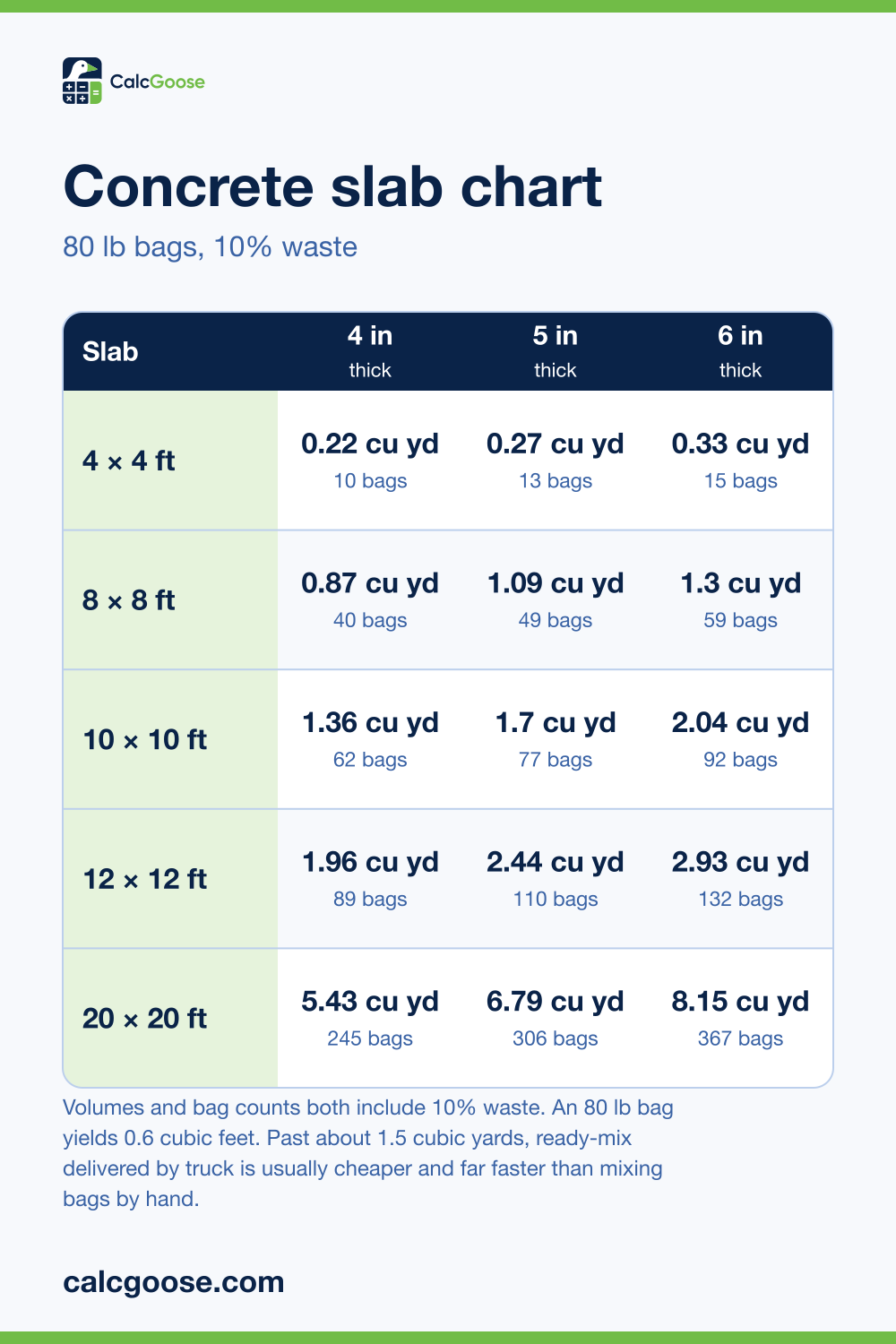
Concrete slab chart
How much concrete a slab takes at common thicknesses, with 10% waste, and how many 80 lb bags that is. Every figure comes from the same formula as the calculator above.
| Slab | 4 in thick | 5 in thick | 6 in thick |
|---|---|---|---|
| 4 × 4 ft | 0.22 cu yd10 bags | 0.27 cu yd13 bags | 0.33 cu yd15 bags |
| 8 × 8 ft | 0.87 cu yd40 bags | 1.09 cu yd49 bags | 1.3 cu yd59 bags |
| 10 × 10 ft | 1.36 cu yd62 bags | 1.7 cu yd77 bags | 2.04 cu yd92 bags |
| 12 × 12 ft | 1.96 cu yd89 bags | 2.44 cu yd110 bags | 2.93 cu yd132 bags |
| 20 × 20 ft | 5.43 cu yd245 bags | 6.79 cu yd306 bags | 8.15 cu yd367 bags |
Volumes and bag counts both include 10% waste. An 80 lb bag yields 0.6 cubic feet. Past about 1.5 cubic yards, ready-mix delivered by truck is usually cheaper and far faster than mixing bags by hand.
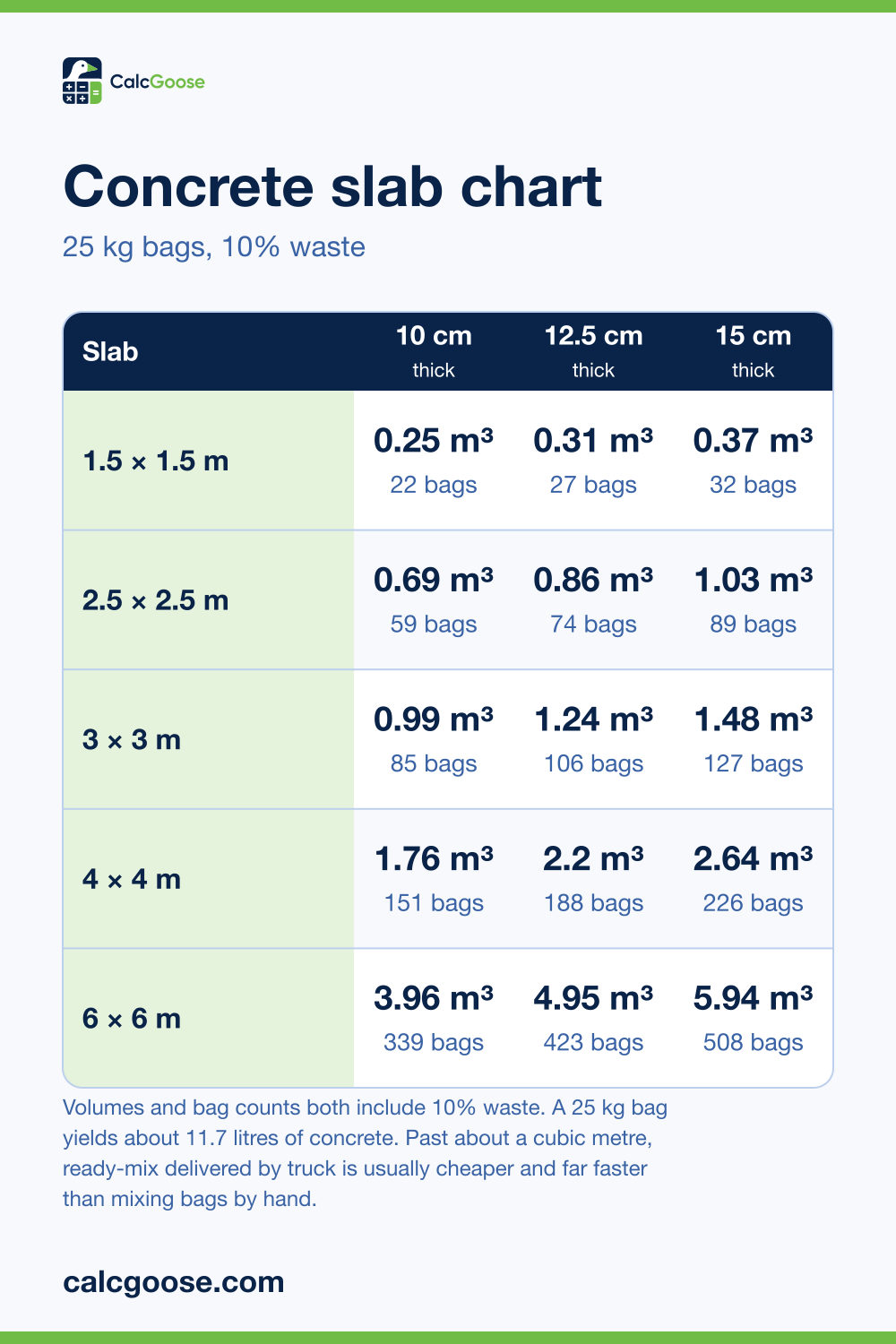
How much concrete a slab takes at common thicknesses, with 10% waste, and how many 25 kg bags that is. Every figure comes from the same formula as the calculator above.
| Slab | 10 cm thick | 12.5 cm thick | 15 cm thick |
|---|---|---|---|
| 1.5 × 1.5 m | 0.25 m³22 bags | 0.31 m³27 bags | 0.37 m³32 bags |
| 2.5 × 2.5 m | 0.69 m³59 bags | 0.86 m³74 bags | 1.03 m³89 bags |
| 3 × 3 m | 0.99 m³85 bags | 1.24 m³106 bags | 1.48 m³127 bags |
| 4 × 4 m | 1.76 m³151 bags | 2.2 m³188 bags | 2.64 m³226 bags |
| 6 × 6 m | 3.96 m³339 bags | 4.95 m³423 bags | 5.94 m³508 bags |
Volumes and bag counts both include 10% waste. A 25 kg bag yields about 11.7 litres of concrete. Past about a cubic metre, ready-mix delivered by truck is usually cheaper and far faster than mixing bags by hand.
Assumptions and limits
Everything this calculator quietly assumes on your behalf. If one of these does not match your situation, the answer will be off.
- Bag yield follows the published 0.6 cubic feet for an 80 lb bag, scaled by weight for every other size. Brands vary by a few percent, and the yield printed on your own bag is the one to trust.
- Waste defaults to 10%, which covers spillage, an uneven subgrade and the concrete left in the barrow. A trench dug by hand swallows more than a formed slab does.
- Volumes are the finished pour. Concrete does not compact or settle the way gravel does, so what you place is what you get.
- Post holes subtract the post. Nominal lumber is smaller than its name, so a 4 × 4 is taken as 3.5 inches and a 6 × 6 as 5.5.
- No reinforcement is allowed for. Rebar and mesh displace a negligible amount of concrete, but they change what the slab can carry, and that is a design question rather than a volume one.
- Slab thickness is uniform. A thickened edge, a haunch around the perimeter or a fall for drainage all add concrete that is not counted here.
- The ready-mix suggestion is a rule of thumb at about one and a half cubic yards. The real break-even depends on delivery charges, minimum loads and how far the truck has to come, and some suppliers charge a short-load fee well above that.
- Nothing here covers mix strength. The bagged product you buy is a set strength, usually around 3,000 to 4,000 psi, and structural work has its own specification.
Frequently asked questions
How many bags of concrete do I need for a 10 × 10 slab?
About 62 bags of 80 lb mix at 4 inches thick, including 10% waste. That is 1.36 cubic yards. At that size a ready-mix truck is usually cheaper and much quicker than mixing 62 bags by hand.
How much does an 80 lb bag of concrete cover?
It yields 0.6 cubic feet, which covers about 1.8 square feet at 4 inches thick, or 3.6 square feet at 2 inches. A 60 lb bag yields 0.45 cubic feet and a 40 lb bag 0.3, so it takes 45 of the 80 lb bags to make a cubic yard.
How many bags of concrete per fence post?
About two 80 lb bags for a 4 × 4 post in a 10 inch hole 30 inches deep, once the post itself is subtracted. Wider holes and deeper frost lines push it to three. The fence calculator uses the same two-bag figure when it works out a whole run.
When should I use ready-mix instead of bags?
Past about one and a half cubic yards, which is roughly 60 bags of 80 lb mix. Beyond that the bags cost more per yard than the truck, and the real problem is time, because a large pour has to be placed and finished before the first of it sets.
How thick should a concrete slab be?
Four inches for a patio, a shed base or a footpath. Five to six inches for a driveway or anything a vehicle parks on, and more where the ground is poor. Under four inches a slab cracks under any load heavier than foot traffic.
How do I calculate concrete for post holes?
Work out the hole as a cylinder, subtract the post, and multiply by the number of holes. A 10 inch hole 30 inches deep is 1.36 cubic feet, and a 3.5 inch square post takes 0.21 of that back, leaving 1.15 cubic feet a hole.
How much concrete is in a cubic yard?
Twenty seven cubic feet, which is 45 bags of 80 lb mix, 60 bags of 60 lb or 90 bags of 40 lb. A cubic yard covers 81 square feet at 4 inches thick, and weighs roughly two tons once mixed.
Does concrete need to be ordered with extra?
Yes. Ten percent is the usual allowance for a bagged job and covers spillage and an uneven base. On a truck delivery, order slightly over rather than under, because a pour that runs short while the first half is setting leaves a cold joint you cannot undo.
Related calculators
- Mulch Calculator Home & Yard Cubic yards, bags or tons of mulch, soil or gravel for any number of beds.
- Paver Calculator Home & Yard Paver count, gravel base, bedding sand and edging for a patio or path.
- Wallpaper Calculator Home & Yard How many rolls a room needs, counted by strips rather than square footage.
- Paint Calculator Home & Yard Gallons of paint for a room, with coats, doors, windows and ceiling accounted for.
- Deck Board Calculator Home & Yard Board count, linear feet, screws and joists for a deck of any size.
- Fence Calculator Home & Yard Posts, panels, pickets, rails and concrete for a fence run of any length.
- Grass Seed Calculator Home & Yard Pounds of seed or pallets of sod for a lawn, by grass type and whether you are seeding or overseeding.
Share this calculator
Found the number you needed? Send it to whoever asked you for it.