Grass Seed Calculator
Enter your lawn size and grass type to get the pounds of seed, the sod pallets, and the starter fertilizer that goes down with them.
Last updated
Where are you?
AWG, NEC, 120/240 V, miles and gallons mm², IEC/BS 7671, 230/400 V, km and litres . We remember this on every calculator.
Your result
Seed for a new lawn
16.8 lb
- Lawn area
- 2,400 sq ft
- Rate applied
- 7 lb / 1,000 sq ft
- In kilograms
- 7.62 kg
- Starter fertilizer
- 12 lb
- Grass type
- Tall fescue
- In acres
- 0.06
🪿 The goose says: Buy 16.8 lb of tall fescue seed at 7 lb per 1,000 sq ft.
- Resist the urge to over-apply. Seed sown too thickly competes with itself, produces thin weak seedlings and is more prone to damping-off disease than a correctly-rated sowing.
- Tall fescue: Deep-rooted and drought-tolerant. The most forgiving choice for a home lawn.
- New seed needs the top half-inch of soil kept damp, usually light watering two or three times a day for two to three weeks. Letting it dry out once after germination kills the seedlings outright.
- Put down about 12 lb of starter fertilizer at the same time. It is high in phosphorus for root development, which regular lawn feed is not.
How this grass seed calculator works
Grass seed is rated per thousand square feet, and every species has a different rate, not because some grasses are hungrier, but because the seeds are different sizes. Kentucky bluegrass seed is tiny, so two and a half pounds contains an enormous number of seeds. Tall fescue seed is much bigger, so the same coverage takes seven pounds.
That is why "how much grass seed do I need" has no single answer, and why the bag rate matters more than the bag size.
Overseeding halves it. You are not establishing a lawn from nothing. You are filling gaps in one that already exists, so half the new-seeding rate is the standard application and more simply wastes seed.
-
Step 1 Lawn area
area = length × width, or your known square footageA quarter acre is 10,890 sq ft. -
Step 2 Seed for a new lawn
pounds = area ÷ 1000 × species_rateBluegrass 2.5, fine fescue 5, tall fescue 7, ryegrass 7.5 lb per 1,000 sq ft. -
Step 3 Seed for overseeding
pounds = area ÷ 1000 × species_rate ÷ 2 -
Step 4 Or in metric
grams = area_m² × rate_g_per_m²One pound per 1,000 sq ft is 4.9 g/m², so tall fescue at 7 lb comes out at about 34 g/m², which is the familiar 35 g/m² new-lawn rate. -
Step 5 Sod
pallets = ceil(area ÷ pallet_coverage)A pallet is typically 450 sq ft, or about 45 rolls of 10 sq ft each. -
Step 6 Starter fertilizer
pounds = area ÷ 1000 × 5Starter feed is high in phosphorus for root growth, unlike regular lawn fertilizer.
For example, a 60 × 40 ft lawn is 2,400 square feet. Seeding it new with tall fescue at 7 lb per 1,000 needs 16.8 pounds of seed. Overseeding the same lawn needs 8.4. Sodding it takes 6 pallets.
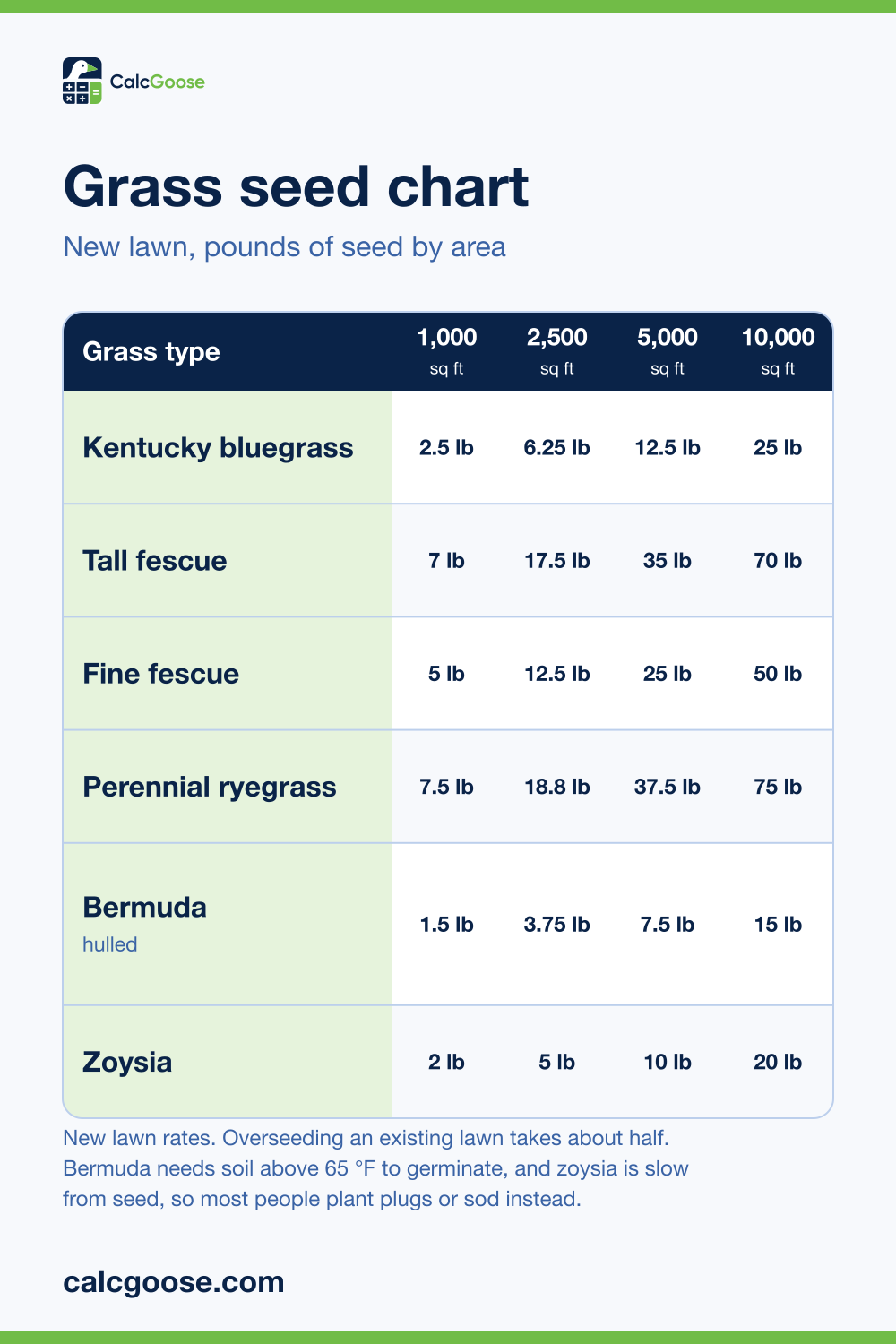
Grass seed chart
How much seed a new lawn takes for each grass type the calculator covers, at its recommended sowing rate. Every figure comes from the same formula as the calculator above.
| Grass type | 1,000 sq ft | 2,500 sq ft | 5,000 sq ft | 10,000 sq ft |
|---|---|---|---|---|
| Kentucky bluegrass | 2.5 lb | 6.25 lb | 12.5 lb | 25 lb |
| Tall fescue | 7 lb | 17.5 lb | 35 lb | 70 lb |
| Fine fescue | 5 lb | 12.5 lb | 25 lb | 50 lb |
| Perennial ryegrass | 7.5 lb | 18.8 lb | 37.5 lb | 75 lb |
| Bermudahulled | 1.5 lb | 3.75 lb | 7.5 lb | 15 lb |
| Zoysia | 2 lb | 5 lb | 10 lb | 20 lb |
New lawn rates. Overseeding an existing lawn takes about half. Bermuda needs soil above 65 °F to germinate, and zoysia is slow from seed, so most people plant plugs or sod instead.
How much seed a new lawn takes for each grass type the calculator covers, at its recommended sowing rate. Every figure comes from the same formula as the calculator above.
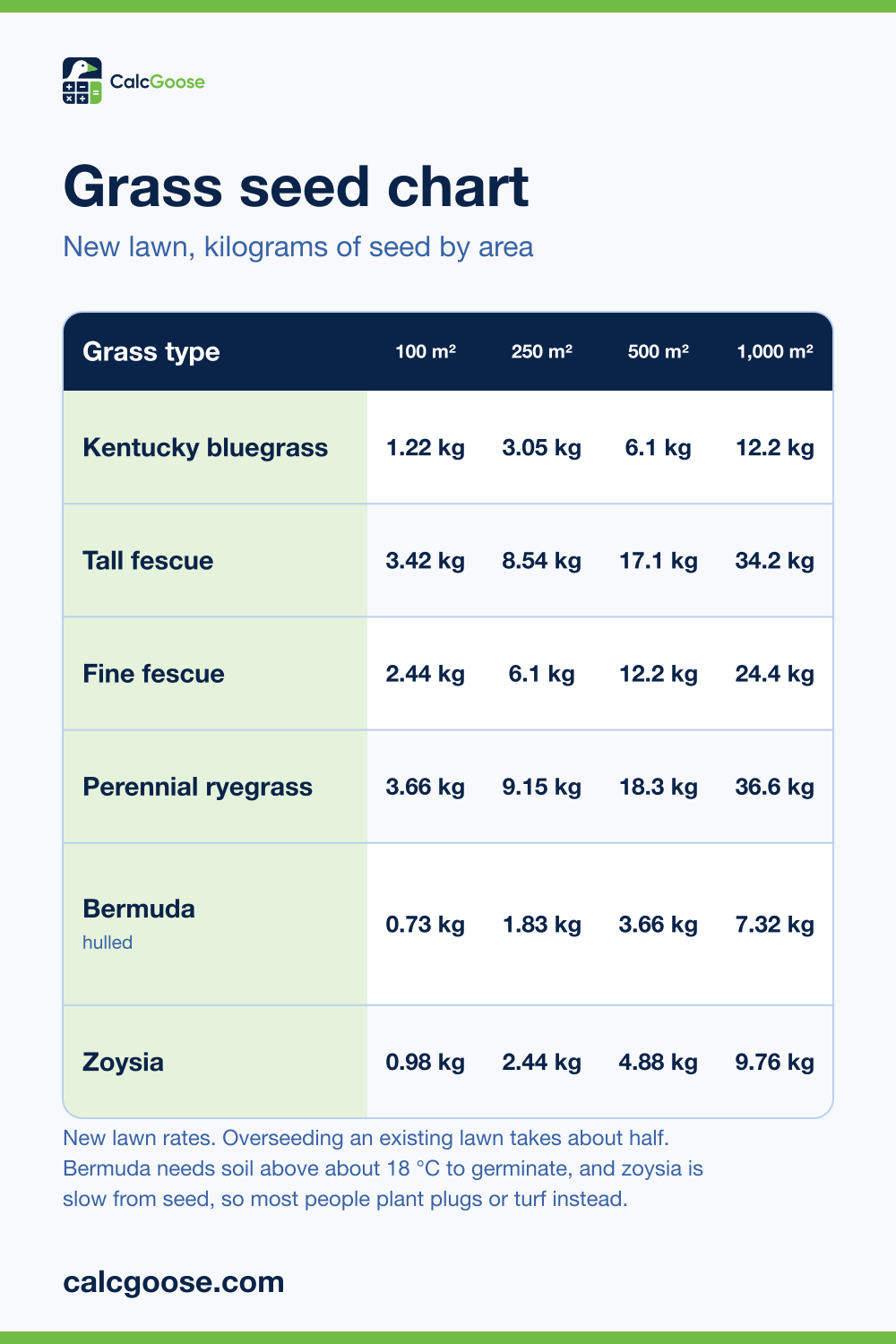
| Grass type | 100 m² | 250 m² | 500 m² | 1,000 m² |
|---|---|---|---|---|
| Kentucky bluegrass | 1.22 kg | 3.05 kg | 6.1 kg | 12.2 kg |
| Tall fescue | 3.42 kg | 8.54 kg | 17.1 kg | 34.2 kg |
| Fine fescue | 2.44 kg | 6.1 kg | 12.2 kg | 24.4 kg |
| Perennial ryegrass | 3.66 kg | 9.15 kg | 18.3 kg | 36.6 kg |
| Bermudahulled | 0.73 kg | 1.83 kg | 3.66 kg | 7.32 kg |
| Zoysia | 0.98 kg | 2.44 kg | 4.88 kg | 9.76 kg |
New lawn rates. Overseeding an existing lawn takes about half. Bermuda needs soil above about 18 °C to germinate, and zoysia is slow from seed, so most people plant plugs or turf instead.
Assumptions and limits
Everything this calculator quietly assumes on your behalf. If one of these does not match your situation, the answer will be off.
- Seeding rates are standard published figures per 1,000 square feet for pure seed of each species. Kentucky bluegrass 2.5, tall fescue 7, fine fescue 5, perennial ryegrass 7.5, hulled bermuda 1.5, zoysia 2. Seed blends and mixes fall between these. Use the rate printed on the bag when there is one.
- Overseeding is applied at half the new-seeding rate, which is standard practice. Very thin lawns can take two-thirds; a lawn that is more than half bare should be treated as a new seeding.
- Sod pallet coverage defaults to 450 square feet, but pallets genuinely range from about 400 to 700 depending on region and roll size. Confirm with your supplier before ordering.
- Starter fertilizer is estimated at 5 pounds of product per 1,000 square feet, which suits typical starter formulations. Read the bag, application rates vary with analysis.
- No allowance is made for beds, paths, trees or the driveway. Measure the grass, not the property.
- Germination timing depends entirely on soil temperature, not air temperature. Cool-season grasses need soil above 50 °F and are best sown in late summer or early autumn; warm-season grasses need soil above 65 °F and are sown in late spring.
- Seed quality varies. Cheap bags often contain a high percentage of inert matter and annual ryegrass filler, so the useful seed is well below the bag weight. Check the seed label for purity and germination percentages.
- Slopes wash. On anything steeper than a gentle grade, use an erosion blanket or hydroseed rather than broadcasting.
Frequently asked questions
How much grass seed do I need for a quarter acre?
About 76 pounds of tall fescue for a new lawn on a quarter acre, which is 10,890 square feet at 7 pounds per 1,000. Kentucky bluegrass would need only 27 pounds for the same area because the seed is much smaller. Overseeding halves either figure.
How much seed do I need for overseeding?
Half the new-seeding rate, about 3.5 pounds per 1,000 square feet for tall fescue or ryegrass. Overseeding fills gaps in an existing lawn rather than establishing one, so the full rate simply wastes seed and creates competition. Mow short and rake or aerate first so the seed reaches soil.
How much grass seed per square metre?
About 35 grams per square metre for a new lawn and half that for overseeding, which is where the standard UK and Irish rates come from. That figure matches tall fescue and ryegrass, since one pound per 1,000 square feet works out to 4.9 grams per square metre. Fine-seeded bluegrass covers the same ground on about 12 grams per square metre, because what matters is the number of seeds rather than their weight.
Is seed or sod cheaper?
Seed is roughly a tenth of the cost, around 0.10 to 0.20 per square foot against 0.80 to 1.50 for sod delivered. Sod buys you an instant lawn and works on slopes where seed washes away. Seed gives you a wider choice of grass variety and a deeper root system, at the cost of six weeks of careful watering.
When is the best time to plant grass seed?
Late summer to early autumn for cool-season grasses like fescue, ryegrass and bluegrass, warm soil, cooler air, and less weed competition. Late spring into early summer for warm-season grasses like bermuda and zoysia, which need soil above 65 °F. Spring seeding of cool-season grass works but competes with crabgrass.
How often should I water new grass seed?
Lightly two or three times a day for the first two to three weeks, keeping the top half inch of soil constantly damp but never soaked. Once seedlings are up, shift gradually to less frequent but deeper watering to drive roots down. A single dry day after germination can kill the whole sowing.
How many square feet does a pallet of sod cover?
Typically 450 square feet, made up of about 45 rolls of 10 square feet each, though pallets range from 400 to 700 depending on the supplier and region. Confirm the coverage before ordering, and arrange delivery for the day you can lay it, stacked sod starts dying within 24 hours in warm weather.
Can I put too much grass seed down?
Yes, and it is a common mistake. Overcrowded seedlings compete for water, light and nutrients, producing thin weak grass that is far more prone to damping-off disease. More seed does not make a thicker lawn, correct spacing and consistent watering do.
Guides on this
The reasoning behind the number, and the decisions it does not make for you.
- Why a heavier seeding rate gives you a thinner lawn Seed rates differ by species because seed size differs enormously. Sowing tall fescue at a bluegrass rate, or double any rate, costs you the lawn.
- Soil temperature decides when to seed, not the calendar Late August to mid September suits most cool season lawns, but the reason is soil temperature. A thermometer beats a date in any unusual year.
Related calculators
- Mulch Calculator Home & Yard Cubic yards, bags or tons of mulch, soil or gravel for any number of beds.
- Paver Calculator Home & Yard Paver count, gravel base, bedding sand and edging for a patio or path.
- Wallpaper Calculator Home & Yard How many rolls a room needs, counted by strips rather than square footage.
- Paint Calculator Home & Yard Gallons of paint for a room, with coats, doors, windows and ceiling accounted for.
- Deck Board Calculator Home & Yard Board count, linear feet, screws and joists for a deck of any size.
- Fence Calculator Home & Yard Posts, panels, pickets, rails and concrete for a fence run of any length.
- Concrete Calculator Home & Yard Concrete for slabs, footings, post holes and columns, in yards or metres and in bags.
Share this calculator
Found the number you needed? Send it to whoever asked you for it.