Sourdough Calculator
Build a recipe from baker's percentages or scale to a target dough weight, with the starter's flour and water counted into the real hydration.
Last updated
Where are you?
AWG, NEC, 120/240 V, miles and gallons mm², IEC/BS 7671, 230/400 V, km and litres . We remember this on every calculator.
Your result
Flour
500 g
- Water
- 375 g
- Starter
- 100 g
- Salt
- 10 g
- Total dough
- 985 g
- Per loaf
- 985 g
- True hydration
- 77.3%
🪿 The goose says: Mix 500 g flour, 375 g water, 100 g starter and 10 g salt. That is 985 g of dough.
- Your recipe hydration is 75%, but the true hydration (counting the flour and water already in the starter) is 77.3%. That second number is what the dough actually feels like, and it is why two recipes at "75%" can handle completely differently.
- Dough temperature drives fermentation more than the clock does. A dough at 78 °F ferments roughly twice as fast as the same dough at 68 °F, so use the look and feel of the dough rather than fixed timings.
The full recipe
Baker's percentages against 500 g of added flour.
- Flour
- 500 g 100%
- Water
- 375 g 75%
- Starter (100% hydration)
- 100 g 20%
- Salt
- 10 g 2%
- Total dough
- 985 g
Counting the starter, the dough contains 550 g of flour and 425 g of water in total, a true hydration of 77.3%.
How this sourdough calculator works
Baker's percentages express every ingredient against the flour, which is always 100%. Water at 75% means 750 g of water for every 1,000 g of flour. It looks odd at first, the percentages add up to well over 100, but it makes a recipe scale to any batch size without breaking, which cup measurements never do.
The part almost every calculator gets wrong is the starter. A starter at 100% hydration is half flour and half water, so a recipe using 200 g of starter is quietly adding 100 g more flour and 100 g more water than the headline numbers suggest.
That is why this calculator shows two hydration figures. Recipe hydration is the number you typed. True hydration counts the starter's contribution, and it is the one that describes how the dough will actually feel in your hands.
-
Step 1 Everything is a percentage of flour
water = flour × hydration% starter = flour × starter% salt = flour × salt% -
Step 2 Total dough weight
dough = flour + water + starter + salt -
Step 3 Working backwards from a target
flour = target_dough ÷ (1 + hydration% + salt% + starter%)This is how you scale to fit your tins or bannetons. -
Step 4 True hydration
total_flour = flour + starter ÷ 2
total_water = water + starter ÷ 2
true_hydration = total_water ÷ total_flour
Assumes a 100% hydration starter, equal flour and water. -
Step 5 Split across loaves
per_loaf = total_dough ÷ number_of_loaves
For example, 500 g flour at 75% hydration, 2% salt and 20% starter gives 375 g water, 10 g salt and 100 g starter, 985 g of dough. True hydration is 425 ÷ 550 = 77.3%, slightly wetter than the 75% on the label.
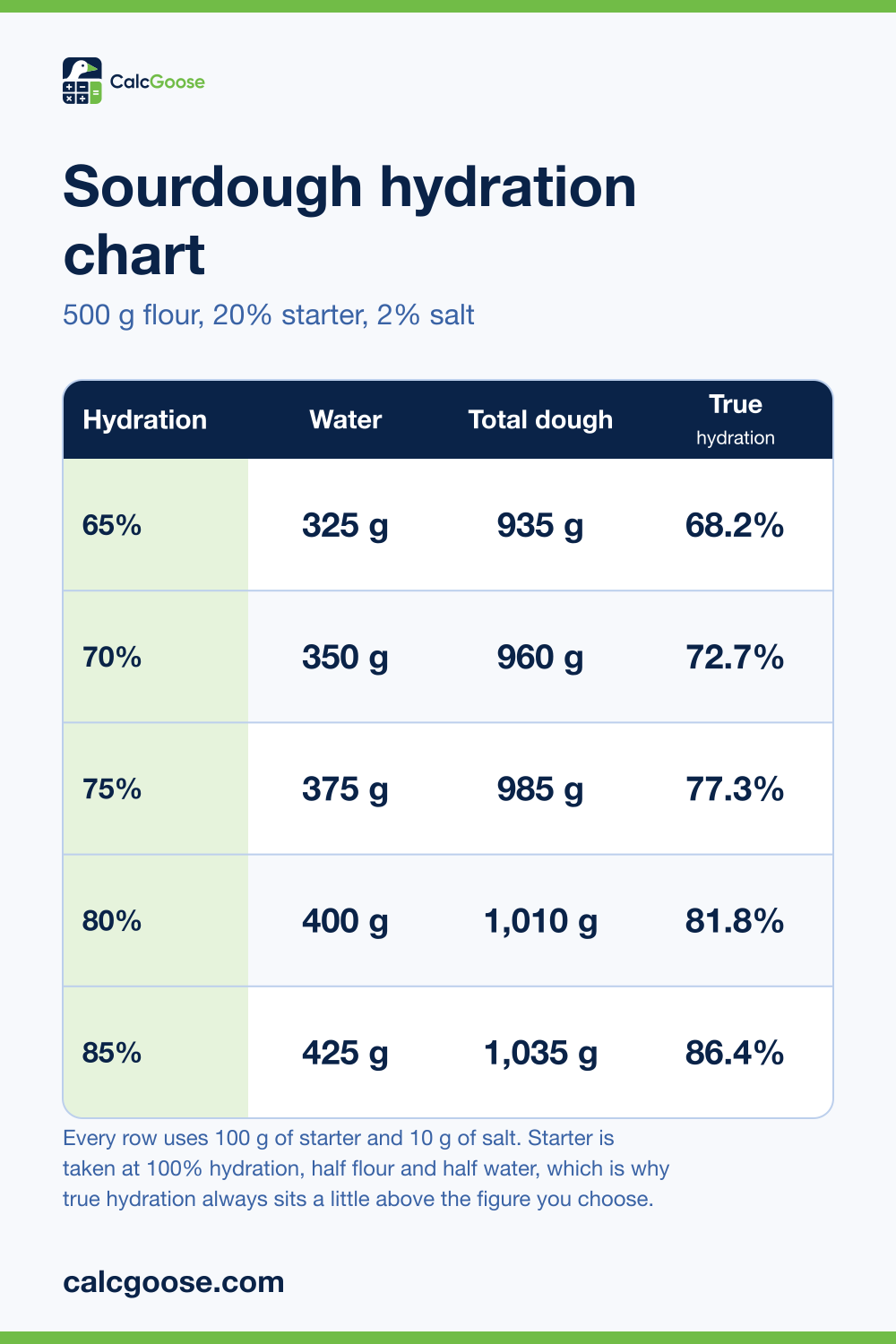
Sourdough hydration chart
The water and finished dough for 500 g of flour at common hydrations, with 20% starter and 2% salt, and the true hydration once the starter's own flour and water are counted. Every figure comes from the same baker's percentages as the calculator above.
| Hydration | Water | Total dough | True hydration |
|---|---|---|---|
| 65% | 325 g | 935 g | 68.2% |
| 70% | 350 g | 960 g | 72.7% |
| 75% | 375 g | 985 g | 77.3% |
| 80% | 400 g | 1,010 g | 81.8% |
| 85% | 425 g | 1,035 g | 86.4% |
Every row uses 100 g of starter and 10 g of salt. Starter is taken at 100% hydration, half flour and half water, which is why true hydration always sits a little above the figure you choose.
Assumptions and limits
Everything this calculator quietly assumes on your behalf. If one of these does not match your situation, the answer will be off.
- The starter is assumed to be at 100% hydration, equal weights of flour and water, which is the most common maintenance ratio. A stiff starter at 50% or a liquid levain at 125% changes the true hydration figure significantly.
- True hydration includes the starter's flour and water. Some recipes and calculators quote hydration excluding the starter, so the same dough can be described as 75% or 77% depending on convention. Both are shown here.
- Salt is calculated on added flour rather than total flour including the starter. The difference is small, under 0.2% on a typical recipe, but it is the more common convention.
- No allowance is made for evaporation during baking. A finished loaf weighs roughly 10 to 15 percent less than the dough that went in.
- Fermentation timing is not modelled at all, because it depends on dough temperature, starter activity and ambient conditions far more than on the ratios. A dough at 78 °F ferments about twice as fast as the same dough at 68 °F.
- Add-ins such as seeds, nuts, oil, honey and inclusions are not included. Seeds in particular absorb water and will effectively lower your hydration unless soaked first.
- Whole grain and rye flours absorb considerably more water than white bread flour. A 75% hydration dough made with 30% whole wheat behaves more like a 70% white dough.
Frequently asked questions
What does hydration mean in sourdough?
It is the weight of water as a percentage of the weight of flour. A 75% hydration dough has 750 grams of water per 1,000 grams of flour. Higher hydration gives a more open, holey crumb but a slacker dough that is harder to shape, 65 to 70% is a comfortable place to learn.
How do I scale a sourdough recipe for two loaves?
Multiply every ingredient by two, or work backwards from your target dough weight, divide it by one plus the hydration, salt and starter percentages to get the flour, then rebuild from there. Because everything is expressed against flour, baker's percentages scale perfectly. This is the entire reason bakers use them.
What is true hydration?
The hydration once the flour and water inside your starter are counted. A recipe at 75% hydration using 20% starter is really about 77% true hydration, because the starter brings its own equal parts flour and water. It matters because true hydration is what the dough actually feels like when you handle it.
How much starter should I use?
Ten to thirty percent of the flour weight is the usual range, and it changes speed rather than quality. Twenty percent suits an overnight bulk at room temperature; ten percent stretches it out for more flavour development; thirty or more speeds things up when you are short of time. Using more starter does not make better bread.
How much dough do I need for one loaf?
Between 800 and 1,000 grams for a standard round boule, and about 900 for a 2 lb tin. Work backwards by dividing the target dough weight by one plus the hydration, salt and starter percentages, so a 900 gram loaf at 75% hydration with 2% salt and 20% starter needs 457 grams of flour. The baked loaf then comes out 10 to 15 percent lighter than the dough that went in, because water leaves during the bake.
Why do bakers use grams instead of cups?
Because a cup of flour can weigh anywhere from 120 to 155 grams depending on how it was scooped, which is a 30% swing in the single most important ingredient. Weight is reproducible, it makes percentages possible, and it is why two bakers following the same gram recipe get the same dough.
How much salt should I put in sourdough?
Two percent of the flour weight, so 10 grams per 500 grams of flour. Note that is flour rather than finished loaf, since 500 g of flour makes nearly a kilo of dough. Salt does far more than season. It tightens the gluten network and slows fermentation. Below 1.5% the dough ferments too quickly and tastes flat; above about 2.5% the rise noticeably drags.
How do I handle high hydration dough?
Wet hands rather than floured ones, a bench scraper instead of fingers, and coil folds instead of kneading. Build strength with three or four sets of folds spaced half an hour apart during bulk, and shape with confidence rather than fussing. If it fights you at 85%, drop to 72% for a few bakes, the crumb difference is smaller than people claim.
Guides on this
The reasoning behind the number, and the decisions it does not make for you.
- Dough temperature decides the timing, not the recipe Bulk times in recipes assume a kitchen you do not have. Temperature and how much starter you used move the clock by hours in either direction.
- The flour hiding in your starter A recipe at 70% hydration is usually not at 70%. The starter brings its own flour and water, and counting them moves the real figure by several points.
Related calculators
- Pool Chemical Calculator Everyday Life How much chlorine and acid your pool needs, worked out from its actual volume.
- Coffee Ratio Calculator Everyday Life How many grams of coffee for any brew method, cup count and strength.
- BBQ Calculator Everyday Life How much meat to buy for a cookout, adjusted for kids, appetite and sides.
- Party Drink Calculator Everyday Life Beer, wine, spirits, mixers and ice for any guest count and party length.
- Tip & Bill Split Calculator Everyday Life Split a bill evenly or by what each person ordered, with tax and tip shared fairly.
- Freelance Rate Calculator Everyday Life Work backwards from the money you want to keep to the hourly rate you have to charge.
- Pizza Dough Calculator Everyday Life Dough ball weight from the pizza size, then flour, water, salt and yeast by baker's percentage.
Share this calculator
Found the number you needed? Send it to whoever asked you for it.