kVA Calculator
Enter kVA, kW, amps or motor horsepower and get the other three, for single-phase or three-phase at any voltage, plus the generator size that actually covers the load.
Last updated
Where are you?
AWG, NEC, 120/240 V, miles and gallons mm², IEC/BS 7671, 230/400 V, km and litres . We remember this on every calculator.
Your result
Apparent power
10 kVA
- Real power
- 8 kW
- Current per line
- 12 A
- Motor equivalent
- 9.44 HP
- Reactive power
- 6 kVAR
- Supply
- 480 V 3-phase
- Generator size
- 12.5 kVA
🪿 The goose says: 10 kVA at power factor 0.80 is 8 kW, drawing 12 A per line from a 480 V three-phase supply. A generator for it wants to be 12.5 kVA.
- At a power factor of 0.80, 10 kVA delivers 8 kW. The missing 6 kVAR is reactive power. It flows back and forth without doing work, but your cable and your alternator still have to carry it.
- Three-phase, kVA = √3 × 480 V × 12 A ÷ 1000. Each line carries 12 A. Using 480 V with the single-phase formula would understate the load by 73%.
- A generator for this load wants 12.5 kVA, 25% above the calculated demand, so the set is not running flat out. North American sets are usually advertised in kW instead, which for this size is about 10 kW.
kVA to kW at other power factors
What 10 kVA actually delivers as the load changes character. This is the conversion people get wrong most often.
- Power factor 0.60
- 6 kW lightly loaded motors
- Power factor 0.70
- 7 kW lightly loaded motors
- Power factor 0.80
- 8 kW nameplate convention
- Power factor 0.85
- 8.50 kW mixed load
- Power factor 0.90
- 9 kW mixed load
- Power factor 1.00
- 10 kW pure heating
kW = kVA × power factor. There is no fixed conversion, quoting one without the other is meaningless.
The same load at other voltages
Apparent power stays the same; the current does not. This is what decides your cable size.
- 120 V single-phase
- 83.3 A
- 240 V single-phase
- 41.7 A
- 208 V three-phase
- 27.8 A
- 480 V three-phase
- 12 A your supply
- 600 V three-phase
- 9.62 A
Single-phase. A = kVA × 1000 ÷ V. Three-phase. A = kVA × 1000 ÷ (√3 × V).
How this generator kVA calculator works
kVA and kW measure the same load twice. kVA is apparent power, volts multiplied by amps, everything the supply has to carry. kW is real power, the part that actually turns a shaft or makes heat. The ratio between them is the power factor.
The difference exists because current in a coil lags behind voltage. That lagging portion still flows through your cable, your breaker and your alternator, heating all three, but it does no work and your meter does not bill you for it. Which is why a generator is rated in kVA and sold on kW, and why the two numbers on the same nameplate differ by exactly the 0.8 the industry assumes.
Horsepower brings in a second, unrelated loss. A motor nameplate quotes shaft output. Getting that output requires more electrical input, because no motor is perfectly efficient. So converting HP to kVA needs both corrections, divide by efficiency to get electrical kW, then divide by power factor to get kVA.
Three-phase is the third complication. All three lines carry current and the phases are 120 degrees apart, so with voltage measured line-to-line the power works out to √3, about 1.732, times line volts times line amps.
-
Step 1 Apparent power, single-phase
kVA = volts × amps ÷ 1000 -
Step 2 Apparent power, three-phase
kVA = √3 × line_volts × line_amps ÷ 1000Line volts means 208, 240 or 480, the voltage between two phases. -
Step 3 kVA to kW
kW = kVA × power_factor -
Step 4 kW to kVA
kVA = kW ÷ power_factor -
Step 5 Horsepower to kVA
kVA = HP × 0.7457 ÷ efficiency ÷ power_factorTwo divisions, two different losses. Efficiency is the motor; power factor is the supply. -
Step 6 Reactive power
kVAR = √(kVA² − kW²)The three form a right triangle. Correcting power factor shrinks the kVAR side and pulls kVA down towards kW. -
Step 7 Generator sizing
generator_kVA = load_kVA × 1.25, rounded up to a size you can buySized on kVA, not kW, because the alternator carries the reactive current too.
For example, a 10 HP motor at 88% efficiency and 0.85 power factor. Shaft output is 7.46 kW, electrical input is 8.47 kW, and apparent power is 9.97 kVA. On a 480 V three-phase supply that is 12.0 A per line. A generator to start and run it wants to be about 12.5 kVA before you allow for starting current, which for a direct-on-line motor can be six times higher again.
kVA and kW measure the same load twice. kVA is apparent power, volts multiplied by amps, everything the supply has to carry. kW is real power, the part that actually turns a shaft or makes heat. The ratio between them is the power factor.
The difference exists because current in a coil lags behind voltage. That lagging portion still flows through your cable, your MCB and your alternator, heating all three, but it does no work and your meter does not bill you for it. This is exactly why generators across Europe are advertised in kVA, a 5 kVA set sounds larger than the 4 kW it actually delivers.
Horsepower brings in a second, unrelated loss. A motor nameplate quotes shaft output, and getting that output requires more electrical input because no motor is perfectly efficient. So converting HP to kVA needs both corrections, divide by efficiency to get electrical kW, then divide by power factor to get kVA. European motors are usually rated in kW rather than HP, but imported machinery is not.
Three-phase is the third complication. A 400 V supply is 400 V between any two lines, all three carry current, and the phases sit 120 degrees apart, so the power works out to √3, about 1.732, times line volts times line amps.
-
Step 1 Apparent power, single-phase
kVA = volts × amps ÷ 1000 -
Step 2 Apparent power, three-phase
kVA = √3 × line_volts × line_amps ÷ 1000Line volts means 400 V, not the 230 V measured from a phase to neutral. -
Step 3 kVA to kW
kW = kVA × power_factor -
Step 4 kW to kVA
kVA = kW ÷ power_factor -
Step 5 Horsepower to kVA
kVA = HP × 0.7457 ÷ efficiency ÷ power_factorTwo divisions, two different losses. Efficiency is the motor; power factor is the supply. -
Step 6 Reactive power
kVAR = √(kVA² − kW²)The three form a right triangle. Power-factor correction capacitors shrink the kVAR side and pull kVA down towards kW. -
Step 7 Generator sizing
generator_kVA = load_kVA × 1.25, rounded up to a size you can buySized on kVA, not kW, because the alternator carries the reactive current too.
For example, a 7.5 kW motor nameplate quotes shaft output, not what the motor pulls from the supply. At 90% efficiency the electrical input is 7.5 ÷ 0.9 = 8.33 kW, and at 0.85 power factor that is 9.8 kVA of apparent power, or 14.2 A per line on a 400 V three-phase supply. Type 8.33 rather than 7.5 into the kW box, because the calculator reads the kW you give it as electrical power that has already been through the motor efficiency. A generator to start and run it wants to be about 12.5 kVA before allowing for starting current, which for a direct-on-line motor can be six times higher again.
kVA to kW and amps chart
Real power and line current for common generator and transformer ratings, at the 0.8 power factor that nameplates assume. Every figure comes from the same formula as the calculator above.
| Rating | Real power at 0.8 PF | 240 V single-phase | 208 V three-phase | 480 V three-phase |
|---|---|---|---|---|
| 5 kVA | 4 kW | 20.8 A | 13.9 A | 6.01 A |
| 10 kVA | 8 kW | 41.7 A | 27.8 A | 12 A |
| 15 kVA | 12 kW | 62.5 A | 41.6 A | 18 A |
| 20 kVA | 16 kW | 83.3 A | 55.5 A | 24.1 A |
| 30 kVA | 24 kW | 125 A | 83.3 A | 36.1 A |
| 50 kVA | 40 kW | 208 A | 139 A | 60.1 A |
| 100 kVA | 80 kW | 417 A | 278 A | 120 A |
Three-phase current is per line. A different power factor changes the kW figure but not the current, because current follows kVA.
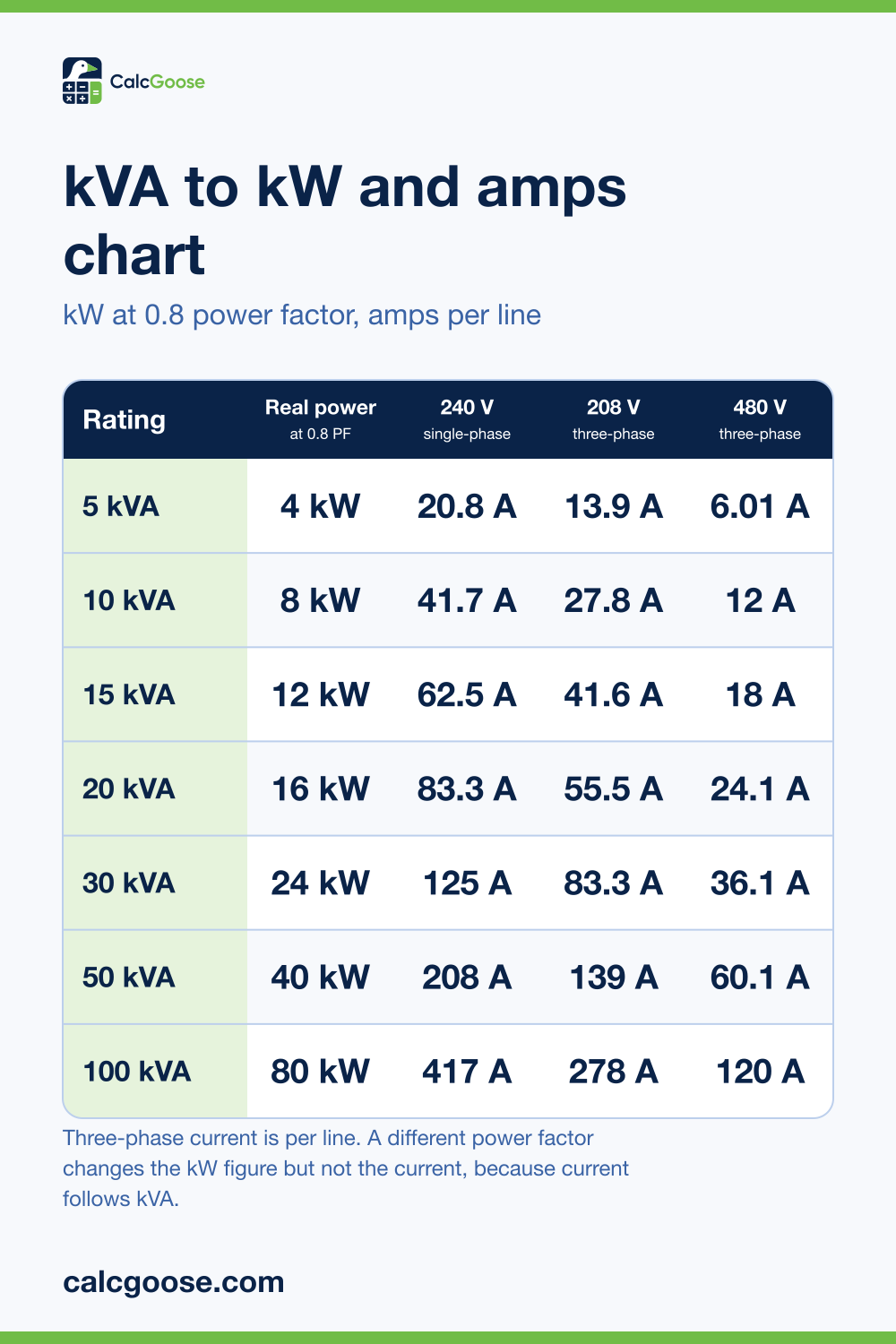
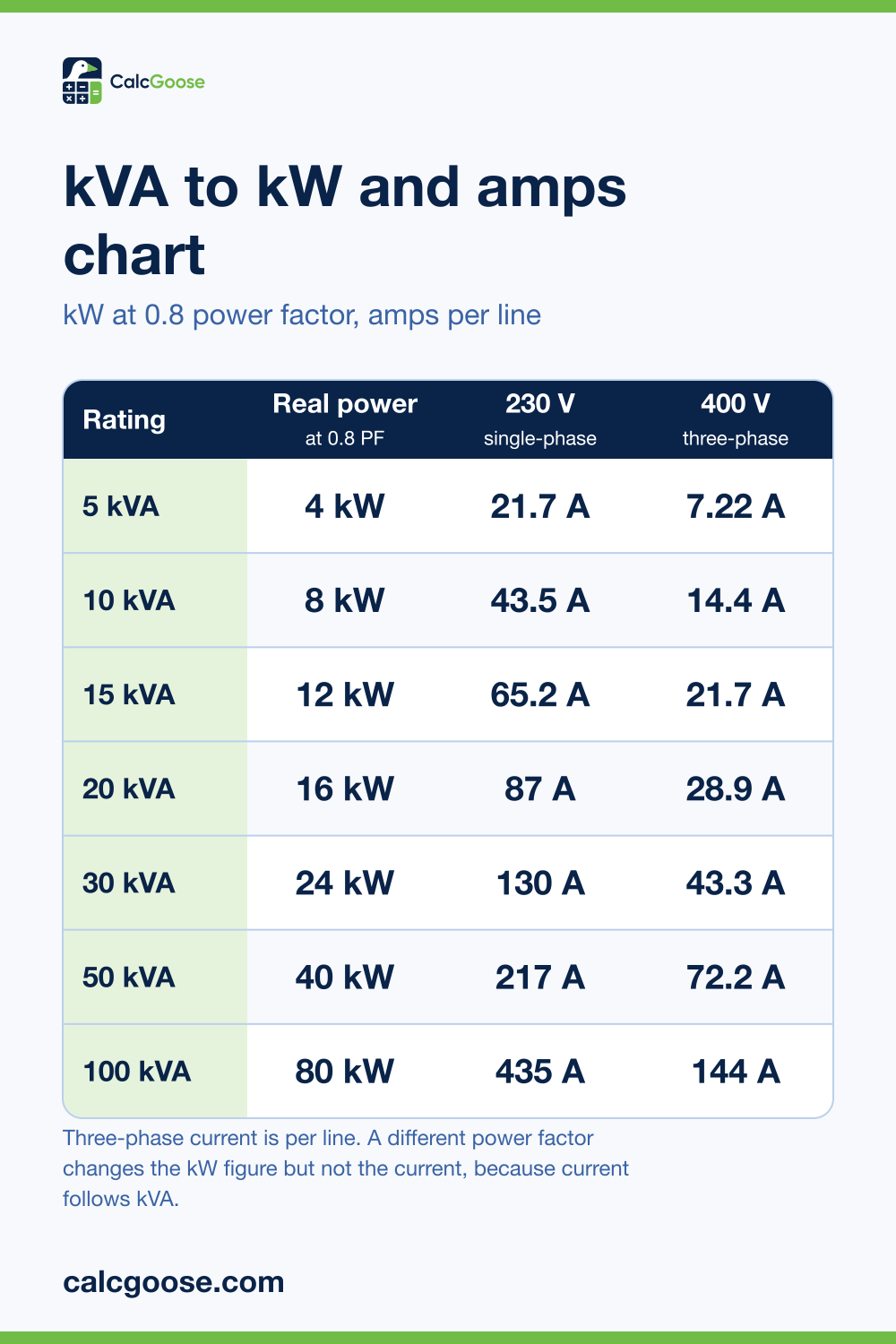
Real power and line current for common generator and transformer ratings, at the 0.8 power factor that nameplates assume. Every figure comes from the same formula as the calculator above.
| Rating | Real power at 0.8 PF | 230 V single-phase | 400 V three-phase |
|---|---|---|---|
| 5 kVA | 4 kW | 21.7 A | 7.22 A |
| 10 kVA | 8 kW | 43.5 A | 14.4 A |
| 15 kVA | 12 kW | 65.2 A | 21.7 A |
| 20 kVA | 16 kW | 87 A | 28.9 A |
| 30 kVA | 24 kW | 130 A | 43.3 A |
| 50 kVA | 40 kW | 217 A | 72.2 A |
| 100 kVA | 80 kW | 435 A | 144 A |
Three-phase current is per line. A different power factor changes the kW figure but not the current, because current follows kVA.
Assumptions and limits
Everything this calculator quietly assumes on your behalf. If one of these does not match your situation, the answer will be off.
- The load is assumed balanced across all three phases when three-phase is selected. An unbalanced load has to be worked out phase by phase, and the worst phase decides the cable.
- Voltage entered for three-phase is line-to-line. Entering the line-to-neutral figure understates the load by a factor of 1.73.
- Power factor is treated as a single constant. In reality it moves with load, an induction motor at a quarter load can fall to 0.5, which is a good reason not to oversize motors.
- Motor efficiency applies only to the horsepower conversion. It is a nameplate figure at full load, and drops off sharply below about 40% load.
- Starting current is not included. A direct-on-line induction motor draws six to eight times its running current for a few seconds, which is usually what sizes the generator rather than the running kVA.
- Generator sizing here applies a flat 25% margin on apparent power. A real specification would also account for step-load acceptance, harmonic content from variable-speed drives, and altitude and temperature derating.
- Horsepower means mechanical horsepower at 745.7 W. Some equipment quotes electrical or metric horsepower, both slightly different.
- The load is assumed balanced across all three phases when three-phase is selected. An unbalanced load has to be worked out phase by phase, and the worst phase decides the cable.
- Voltage entered for three-phase is line-to-line, so 400 V rather than the 230 V measured to neutral. Entering 230 V understates the load by a factor of 1.73.
- Nominal voltage is treated as exact. The harmonised supply tolerance is 230 V +10%/−6%, so real current can sit several percent either side of the calculation.
- Power factor is treated as a single constant. In reality it moves with load, an induction motor at a quarter load can fall to 0.5, which is a good reason not to oversize motors.
- Motor efficiency applies only to the horsepower conversion. IE-class efficiencies are quoted at full load and fall away sharply below about 40% load.
- Starting current is not included. A direct-on-line induction motor draws six to eight times its running current for a few seconds, which is usually what sizes the generator rather than the running kVA. Star-delta and soft starters cut it substantially.
- Generator sizing applies a flat 25% margin on apparent power. A real specification would also account for step-load acceptance, harmonic content from variable-speed drives, and altitude and temperature derating.
Frequently asked questions
How do I convert kVA to kW?
Multiply kVA by the power factor, kW = kVA × pf. At the standard 0.8 assumed on generator nameplates, a 10 kVA set delivers 8 kW. There is no fixed conversion factor, a purely resistive load at power factor 1.0 gets the full 10 kW from the same machine.
How many kW is a 10 kVA generator?
Eight kilowatts, at the 0.8 power factor generator manufacturers assume. That is the number to compare against a load calculation, not the 10 on the label. If a set is advertised at 10 kVA and 8 kW, those are the same machine described twice, not two ratings.
How do I convert HP to kVA?
Multiply horsepower by 0.7457 to get mechanical kilowatts, divide by the motor efficiency to get electrical kilowatts, then divide by the power factor to get kVA. A 10 HP motor at 88% efficiency and 0.85 power factor comes to about 10 kVA. Both divisions matter, skipping the efficiency step undersizes the supply by 10 to 20%.
What is the difference between kVA and kW?
kVA is apparent power, everything the supply carries; kW is real power, the part that does work. The gap is reactive current that flows back and forth through your cable without producing anything useful. Cables, breakers and generators are sized on kVA; your electricity meter bills you on kW.
How do I calculate three-phase kW?
Multiply √3 (1.732) by the line-to-line voltage, by the current in one line, by the power factor, then divide by 1,000. A 480 V supply at 40 A and 0.85 power factor gives 1.732 × 480 × 40 × 0.85 ÷ 1000 = 28.3 kW. The commonest mistake is entering the line-to-neutral voltage instead of line-to-line.
How do I convert kVA to amps?
Multiply kVA by 1,000, then divide by the voltage on single-phase or by the voltage times 1.732 on three-phase. A 100 kVA transformer on a 480 V three-phase supply carries 120 A per line, and the same 100 kVA at 208 V carries 278 A. Power factor plays no part in this one, because current follows apparent power rather than real power.
What size generator do I need for a 10 HP motor?
About 12.5 kVA to run it, but starting is what really decides the size. A direct-on-line induction motor draws six to eight times its running current for a few seconds, so a set sized only on running load will stall or trip. Soft starters and variable-frequency drives cut the inrush enough to bring the generator down a size or two.
Why is power factor 0.8 on generator nameplates?
It is a long-standing industry convention that reflects a typical mixed commercial load of motors, lighting and electronics. It also lets manufacturers print the larger kVA number on the front. If your load is genuinely resistive (heaters, ovens, filament lighting), you can draw the full kVA in kilowatts, but very few real installations are.
How do I convert kVA to kW?
Multiply kVA by the power factor, kW = kVA × pf. At the standard 0.8 assumed on generator nameplates, a 10 kVA set delivers 8 kW. There is no fixed conversion factor, a purely resistive load at power factor 1.0 gets the full 10 kW from the same machine.
How many kW is a 5 kVA generator?
Four kilowatts, at the 0.8 power factor generator manufacturers assume across Europe. That is the number to compare against a load calculation, not the 5 on the label. It is the single most common reason people buy a generator that turns out to be too small.
How do I convert HP to kVA?
Multiply horsepower by 0.7457 to get mechanical kilowatts, divide by the motor efficiency to get electrical kilowatts, then divide by the power factor to get kVA. A 10 HP motor at 88% efficiency and 0.85 power factor comes to about 10 kVA. European motors are usually rated in kW already, in which case you skip the first step but still need both divisions.
What is the difference between kVA and kW?
kVA is apparent power, everything the supply carries; kW is real power, the part that does work. The gap is reactive current that flows back and forth through your cable without producing anything useful. Cables, MCBs and generators are sized on kVA; your meter bills you on kW.
How do I calculate three-phase kW at 400V?
Multiply √3 (1.732) by 400, by the current in one line, by the power factor, then divide by 1,000. At 40 A and 0.85 power factor that is 1.732 × 400 × 40 × 0.85 ÷ 1000 = 23.6 kW. The commonest mistake is using 230 V, the line-to-neutral figure, which understates the answer by 42%.
How many amps is a 100 kVA supply?
On 400 V three-phase it is 144 A per line, from 100,000 divided by 400 times 1.732. The same 100 kVA on 230 V single-phase would be 435 A, which is why nothing that size is ever single-phase. Power factor plays no part in this one, because current follows apparent power rather than real power.
What size generator do I need for a 7.5kW motor?
About 12.5 kVA to run it, but starting is what really decides the size. A direct-on-line induction motor draws six to eight times its running current for a few seconds, so a set sized only on running load will stall or trip. Star-delta starting, soft starters and variable-frequency drives all cut the inrush enough to bring the generator down a size or two.
Why are generators sold in kVA in Europe and kW in America?
It is convention rather than physics, the same machine, described by the larger of its two ratings in one market and the smaller in the other. European and Asian manufacturers quote apparent power at 0.8 power factor; North American ones quote real power. When comparing across the two, always convert to the same unit first or the comparison is 25% out.
Guides on this
The reasoning behind the number, and the decisions it does not make for you.
- Why a 10 kVA generator gives you 8 kW Apparent power is what the windings carry, real power is what does the work, and the gap between them is power factor. The convention hides a fifth.
- Turning a kVA rating into amps you can plan with A kVA figure means nothing until you know the voltage and the phases. The three phase formula carries a square root, and missing it is a large error.
- Amps to watts, and the voltage people assume Watts equals amps times volts, which is easy until you guess the voltage. Half the errors in load planning come from assuming a circuit is 120 V.
Related calculators
- Generator Size Calculator Generators Size it from your appliances, or from your floor area and panel, with the surge load included.
- Watts Calculator Generators Convert between watts, amps, volts and kilowatt-hours, on DC, single-phase or three-phase.
- Home Wattage Calculator Generators How many watts your house actually uses, from average draw to everything-at-once peak and the monthly bill.
- Whole House Generator Cost Calculator Generators The full installed cost of a generator (unit, transfer switch, gas line, pad, labour and permit).
- Generator Fuel Calculator Generators How much fuel a generator burns, how long a tank lasts, and what an outage costs per day.
- Wire Gauge Calculator Power & Off-Grid Cable size from amps, distance and voltage, in AWG or mm², with voltage drop, resistance and parallel runs.
- UPS Runtime Calculator Power & Off-Grid How many minutes your UPS really holds your gear up, by battery rather than by guesswork.
Share this calculator
Found the number you needed? Send it to whoever asked you for it.