Pizza Dough Calculator
Work out the dough ball your pizza actually needs from its size and style, then the flour, water, salt, oil and yeast to make that many of them.
Last updated
Where are you?
AWG, NEC, 120/240 V, miles and gallons mm², IEC/BS 7671, 230/400 V, km and litres . We remember this on every calculator.
Your result
Flour
778 g
- Water
- 482 g
- Salt
- 19.5 g
- Instant dry yeast
- 2.33 g
- Dough per ball
- 321 g
- Total dough
- 1,283 g
- Hydration
- 62%
🪿 The goose says: Mix 778 g flour, 482 g water, 19.5 g salt and 2.33 g instant dry yeast. That makes 4 balls of 321 g, 1,283 g of dough in total.
- A 12 in pizza in this style takes 321 g of dough. Dough follows the area, so going up one size adds far more than it looks. A 16 inch pizza needs nearly twice the dough of a 12 inch one, not a third more.
- That is 2.33 g of instant dry yeast, 2.92 g of active dry or 7 g of fresh. Swap freely as long as you convert, they are the same organism at different moisture levels.
- Time and temperature matter more than the yeast percentage. A dough left at room temperature ferments roughly twice as fast for every 17 °F it warms, so judge it by how puffed it looks rather than by the clock.
The full recipe
Baker's percentages against 778 g of flour.
- Flour
- 778 g 100%
- Water
- 482 g 62%
- Salt
- 19.5 g 2.5%
- Instant dry yeast
- 2.33 g 0.3%
- Total dough
- 1,283 g 4 × 321 g
Weigh the salt and yeast on a scale that reads to a tenth of a gram, or measure the yeast by the quarter teaspoon, which is about 0.8 g of instant.
How this pizza dough calculator works
Two calculations sit behind a pizza recipe. The first works out how much dough one pizza needs, and the second turns that into flour, water, salt and yeast.
Pizzerias size the ball with a thickness factor, the ounces of dough per square inch of finished pizza. It exists because dough follows the area of the pizza, not its width. Going from a 12 inch pizza to a 16 inch one is a third more across but nearly twice the surface, and a recipe scaled by diameter comes out thin and short.
From there it is baker's percentages, the same system as bread. Flour is always 100% and every other ingredient is a share of it, which is what lets one recipe scale from two pizzas to twenty without changing how it behaves.
-
Step 1 Dough for one pizza
ball_oz = π × (diameter ÷ 2)² × thickness_factorThin 0.07, Neapolitan 0.085, New York 0.10, pan 0.14 ounces per square inch. -
Step 2 Total dough
total = pizzas × ball_weight -
Step 3 Flour, working backwards
flour = total ÷ (1 + hydration% + salt% + yeast% + oil% + sugar%) -
Step 4 Every other ingredient
water = flour × hydration% salt = flour × salt% yeast = flour × yeast% -
Step 5 Swapping yeast
active_dry = instant × 1.25
fresh = instant × 3
The same organism at different moisture levels, so convert rather than substitute one for one. -
Step 6 Sourdough instead
true_hydration = (water + starter ÷ 2) ÷ (flour + starter ÷ 2)A 100% hydration starter is half flour and half water, so it shifts the real hydration.
For example, four 12 inch New York pizzas. Each ball is π × 36 × 0.1 = 11.3 ounces, or 321 g, so the batch is 1,283 g of dough. At 62% hydration, 2.5% salt and 0.3% instant yeast that divides into 778 g of flour, 482 g of water, 19.5 g of salt and 2.3 g of yeast.
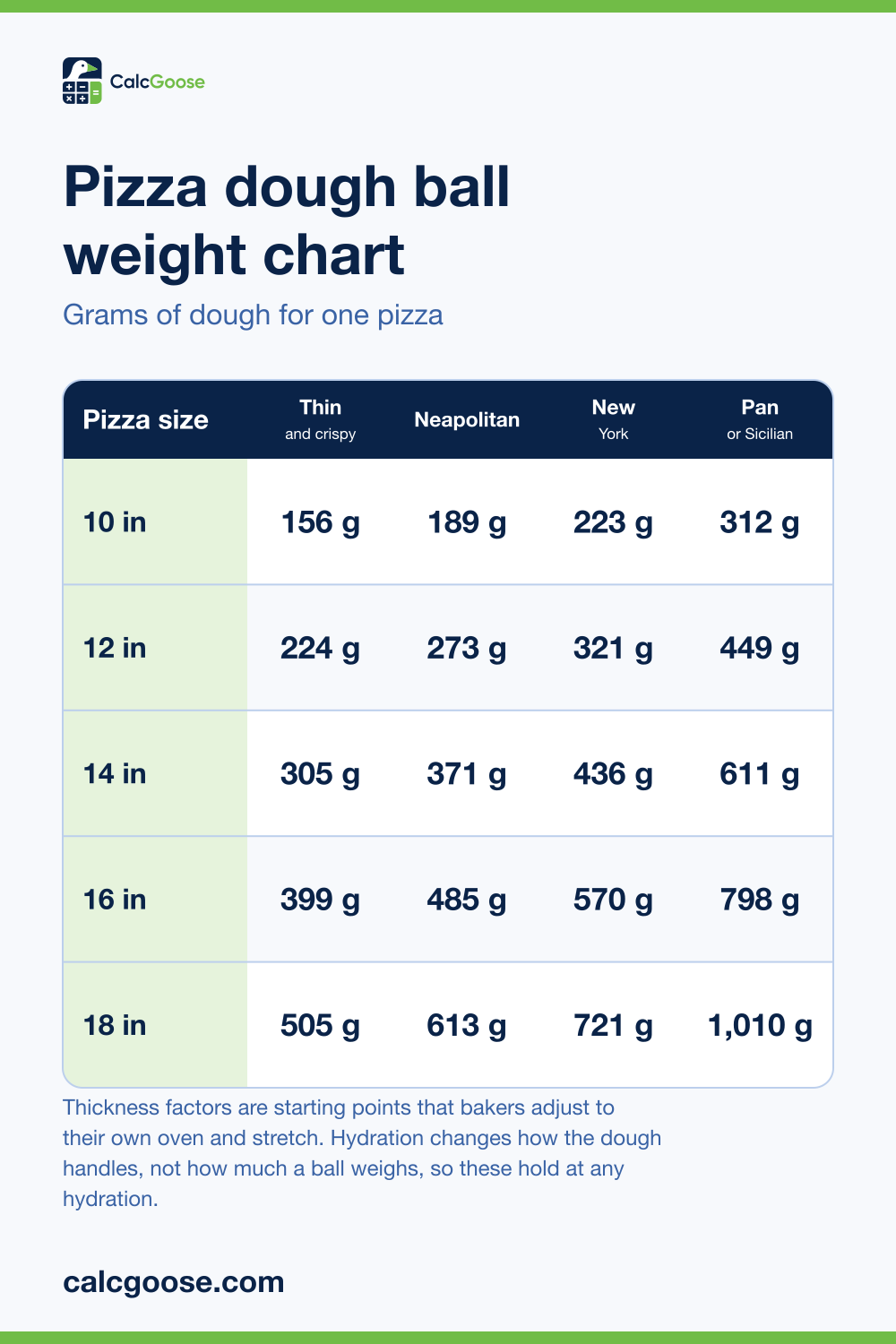
Pizza dough ball weight chart
How much dough one pizza takes, by size and style. Dough scales with the area of the pizza rather than its width, which is why a 16 inch pizza needs nearly twice the dough of a 12 inch one. Every figure comes from the same formula as the calculator above.
| Pizza size | Thin and crispy | Neapolitan | New York | Pan or Sicilian |
|---|---|---|---|---|
| 10 in | 156 g | 189 g | 223 g | 312 g |
| 12 in | 224 g | 273 g | 321 g | 449 g |
| 14 in | 305 g | 371 g | 436 g | 611 g |
| 16 in | 399 g | 485 g | 570 g | 798 g |
| 18 in | 505 g | 613 g | 721 g | 1,010 g |
Thickness factors are starting points that bakers adjust to their own oven and stretch. Hydration changes how the dough handles, not how much a ball weighs, so these hold at any hydration.
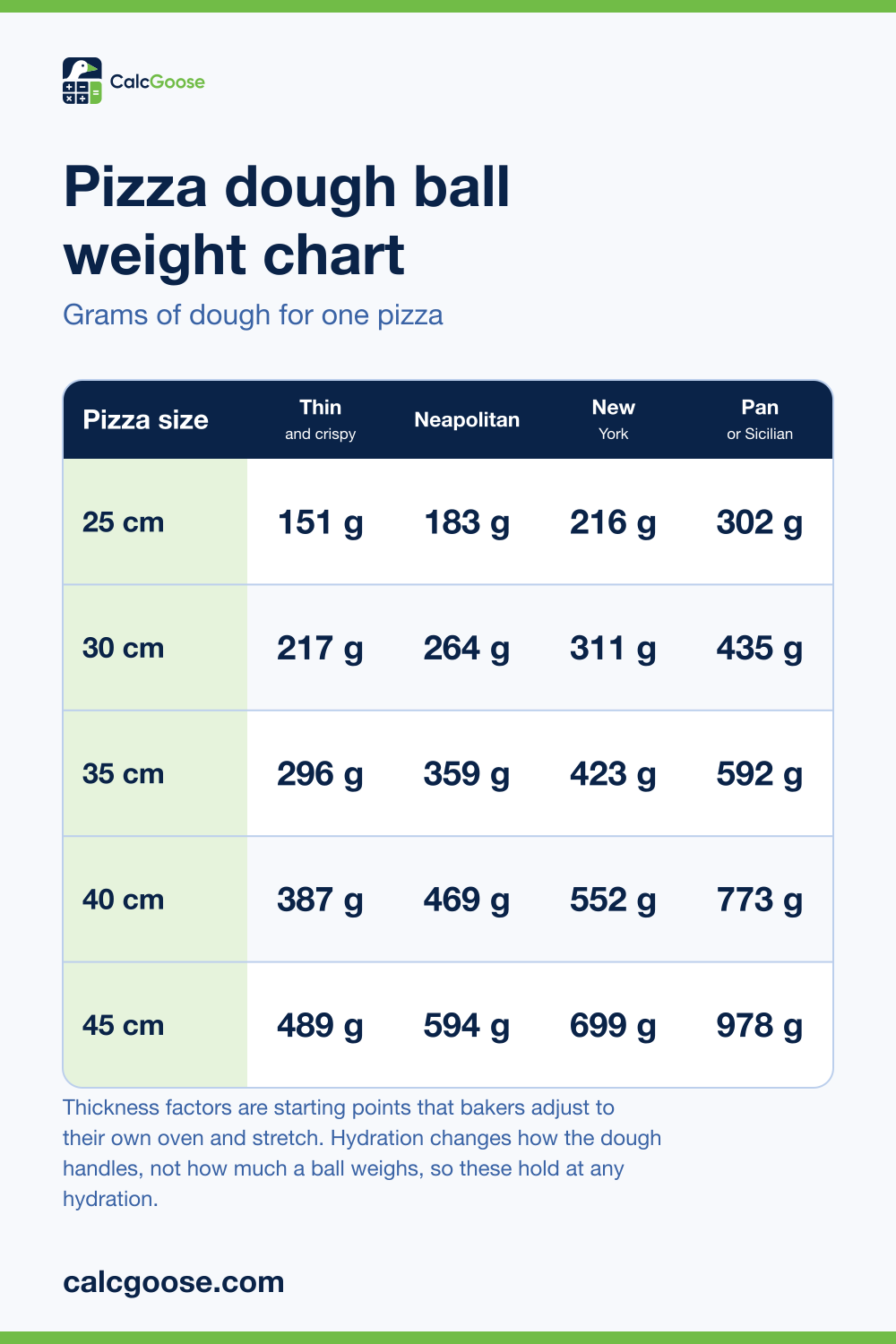
How much dough one pizza takes, by size and style. Dough scales with the area of the pizza rather than its width, which is why a 40 cm pizza needs nearly twice the dough of a 30 cm one. Every figure comes from the same formula as the calculator above.
| Pizza size | Thin and crispy | Neapolitan | New York | Pan or Sicilian |
|---|---|---|---|---|
| 25 cm | 151 g | 183 g | 216 g | 302 g |
| 30 cm | 217 g | 264 g | 311 g | 435 g |
| 35 cm | 296 g | 359 g | 423 g | 592 g |
| 40 cm | 387 g | 469 g | 552 g | 773 g |
| 45 cm | 489 g | 594 g | 699 g | 978 g |
Thickness factors are starting points that bakers adjust to their own oven and stretch. Hydration changes how the dough handles, not how much a ball weighs, so these hold at any hydration.
Assumptions and limits
Everything this calculator quietly assumes on your behalf. If one of these does not match your situation, the answer will be off.
- Thickness factors are starting points rather than rules. Pizzerias tune them to their own oven, flour and stretch, and a factor that suits a 900 °F wood oven gives a different result in a home oven at 500 °F.
- Hydration changes how the dough handles, not how much a ball weighs. A 12 inch pizza takes the same 321 g of dough at 58% as at 70%, it just stretches differently.
- The yeast percentage assumes a rise of a few hours at room temperature. A long cold ferment in the fridge, which is where most of the flavour comes from, uses a fraction of it, often 0.05 to 0.1% instant over 24 to 72 hours.
- Yeast conversions are the standard ones, about 1.25 times instant for active dry and three times for fresh. Brands differ slightly, and old yeast is weaker than any conversion allows for.
- Salt is calculated on the flour weight, not on the finished dough. The two differ by more than half, so a recipe quoting salt on total weight is a different number entirely.
- Sourdough starter is assumed to be at 100% hydration, equal flour and water. A stiff starter changes both the true hydration and the timing.
- Flour strength is not modelled. A high protein bread flour absorbs more water than a supermarket plain flour, so the same hydration can feel quite different between two bags.
- Nothing is allowed for the flour you use on the bench and the peel. It is small, but it is not zero, and it stiffens the outside of the dough.
Frequently asked questions
How much dough do I need for a 12 inch pizza?
About 321 grams for a New York style, 273 g for Neapolitan and 225 g for thin and crispy. The figure comes from the area of the pizza multiplied by a thickness factor, which is how pizzerias size a ball rather than guessing at a round number.
What is a thickness factor in pizza dough?
The ounces of dough per square inch of finished pizza. Thin and crispy sits around 0.07, Neapolitan 0.085, New York 0.10 and a pan pizza 0.14. It is the cleanest way to scale a recipe between pizza sizes, because it works on area rather than on width.
How much yeast do I need for pizza dough?
About 0.3% of the flour weight in instant dry yeast for a rise of a few hours at room temperature, so roughly 2.3 grams for 780 g of flour. A long cold ferment in the fridge needs far less, often a quarter of that, because 24 to 72 hours gives the yeast plenty of time.
What hydration should Neapolitan pizza dough be?
Between 58 and 65%, with 62% a good place to start. Higher hydration gives a softer, airier rim but a slacker dough that is harder to stretch by hand, and it needs a genuinely hot oven to set before it dries out.
Can I use sourdough starter instead of yeast in pizza dough?
Yes, at 10 to 20% of the flour weight for an overnight rise. Remember the starter brings its own flour and water, so a recipe at 62% hydration with 15% starter actually behaves like about 63% hydration, and the timing depends on how lively your starter is.
How many pizzas does a kilo of flour make?
About five 12 inch New York pizzas, or six Neapolitan. A kilo of flour at 62% hydration with salt and yeast makes roughly 1,650 grams of dough, which divides into balls of 321 g or 273 g depending on the style.
Should I weigh pizza dough ingredients or use cups?
Weigh them. A cup of flour varies by 30% depending on how it was scooped, and that single variable swamps everything else in the recipe. Percentages only mean anything against a weight, which is why every pizzeria works in grams.
How do I scale a pizza dough recipe up?
Multiply the flour by whatever factor you need and rebuild every other ingredient from its percentage, or set the number of pizzas here and let the calculator work backwards from the total dough weight. Scaling by diameter rather than by area is the classic mistake.
Related calculators
- Pool Chemical Calculator Everyday Life How much chlorine and acid your pool needs, worked out from its actual volume.
- Sourdough Calculator Everyday Life Scale any sourdough recipe by baker's percentages, with true hydration worked out properly.
- Coffee Ratio Calculator Everyday Life How many grams of coffee for any brew method, cup count and strength.
- BBQ Calculator Everyday Life How much meat to buy for a cookout, adjusted for kids, appetite and sides.
- Party Drink Calculator Everyday Life Beer, wine, spirits, mixers and ice for any guest count and party length.
- Tip & Bill Split Calculator Everyday Life Split a bill evenly or by what each person ordered, with tax and tip shared fairly.
- Freelance Rate Calculator Everyday Life Work backwards from the money you want to keep to the hourly rate you have to charge.
Share this calculator
Found the number you needed? Send it to whoever asked you for it.