Wire Gauge Calculator
Enter amps, distance and voltage to get the cable size you need, checked against both voltage drop and ampacity, with resistance, the metric equivalent and parallel-run options worked out for you.
Last updated
Where are you?
AWG, NEC, 120/240 V, miles and gallons mm², IEC/BS 7671, 230/400 V, km and litres . We remember this on every calculator.
Your result
Cable size you need (copper)
2 AWG
- Voltage drop
- 0.29 V
- Drop percentage
- 2.43%
- Limited by
- Voltage drop
- Same size in mm²
- 33.6 mm²
- Circuit resistance
- 0.01 Ω
- Rating at 60°C
- 95 A
🪿 The goose says: Run 2 AWG copper, step up to 1 AWG if you want to stay under 2% drop.
- Voltage drop is the binding constraint here. 10 AWG would carry 30 A safely, but you would lose too much voltage over 25 ft.
Estimate for planning only. Have any electrical work verified by a qualified electrician and installed to code. See the full disclaimer at the bottom of this page.
Running conductors in parallel
Splitting the run across more conductors divides both the current and the cross-section each one has to provide. Here is what 30 A over 25 ft needs at each option.
- Single run
- 2 AWG 2.43% drop
- 2 in parallel
- 2 × 4 AWG equivalent to 1 AWG · 1.93% drop
- 3 in parallel
- 3 × 6 AWG equivalent to 1.3 AWG · 2.05% drop
- 4 in parallel
- 4 × 8 AWG equivalent to 2 AWG · 2.44% drop
NEC 310.10(H) only permits paralleled conductors at 1/0 AWG and larger, and they must be identical in material, size, length and termination. Below 1/0 this is a low-voltage DC technique, common in vans, boats and solar, and not code-compliant on an AC branch circuit.
How this wire gauge calculator works
Wire size is decided by two separate questions, and the answer is whichever one demands the thicker wire.
The first question is heat. Every conductor has an ampacity, the current it can carry continuously without its insulation cooking. That comes straight from the NEC table, and it does not care how long your run is.
The second is voltage drop. Copper has resistance, so some of your voltage is lost as heat on the way out and on the way back. Over 10 feet nobody notices. Over 80 feet at 12 volts, a fridge browns out. This is why long runs need thick wire even when the current is modest.
-
Step 1 How many volts can you afford to lose?
allowed_drop_V = system_voltage × drop_target%At 12V and 3%, that is only 0.36 V. At 240V and 3%, it is 7.2 V, which is why low-voltage runs need fat cable. -
Step 2 Convert that into circular mils of copper
required_cmil = (2 × K × amps × one_way_feet) ÷ allowed_drop_VK is 12.9 for copper and 21.2 for aluminum. The 2 is there because current travels out and back. -
Step 3 Round up to a real wire size
The next size in the AWG table whose circular mils meet or exceed the requirement -
Step 4 Now check heat
The wire must also meet the NEC 60°C ampacity for your currentA 100 ft, 5-amp run might be drop-limited at 10 AWG; a 3 ft, 60-amp run is ampacity-limited at 4 AWG. -
Step 5 Take the thicker of the two
final_size = max(drop_result, ampacity_result) -
Step 6 Split it across parallel conductors if you want to
per_conductor_cmil = required_cmil ÷ runs
per_conductor_amps = amps ÷ runs
Two equal conductors have twice the cross-section and half the resistance, which is exactly three AWG sizes, two 12 AWG behave like one 9 AWG.
For example, 30 A at 12V over 20 ft one-way, 3% drop. Allowed drop is 0.36 V, so required circular mils = (2 × 12.9 × 30 × 20) ÷ 0.36 = 43,000. That is 3 AWG. Ampacity only needs 10 AWG. Voltage drop wins, so you run 3 AWG. Split across two conductors, each needs 21,500 circular mils, which is 6 AWG, and two 6 AWG really is equivalent to one 3 AWG.
Cable size is decided by two separate questions, and the answer is whichever one demands the larger cross-section.
The first question is heat. Every conductor has a current-carrying capacity, the current it can carry continuously without cooking its insulation. That comes from the IEC 60364-5-52 tables (Table 4D2A in BS 7671), and it does not care how long your run is.
The second is voltage drop. Copper has resistance, so some of your voltage is lost as heat on the way out and on the way back. Over 5 metres nobody notices. Over 25 metres at 12 volts, a fridge browns out. This is why long runs need thicker cable even when the current is modest.
-
Step 1 How many volts can you afford to lose?
allowed_drop_V = system_voltage × drop_target%At 12 V and 3% that is only 0.36 V. At 230 V and 3% it is 6.9 V, which is why low-voltage runs need much larger cable. -
Step 2 Convert that into a cross-section
required_mm² = (k × ρ × amps × length_m) ÷ allowed_drop_Vρ is 0.0214 Ω·mm²/m for copper and 0.0352 for aluminium. k is 2 for DC and single-phase, because current goes out and comes back, or √3 for a balanced three-phase circuit. -
Step 3 Round up to a cable you can buy
The next standard size, 1.0, 1.5, 2.5, 4, 6, 10, 16, 25, 35, 50, 70, 95, 120 mm² … -
Step 4 Now check heat
The cable must also meet its tabulated capacity for your currentA 40 m, 16 A run is drop-limited at 4 mm²; a 2 m, 45 A run is capacity-limited at 10 mm². -
Step 5 Take the larger of the two
final_size = max(drop_result, capacity_result) -
Step 6 Split it across parallel conductors if you want to
per_conductor_mm² = required_mm² ÷ runs
per_conductor_amps = amps ÷ runs
Two equal conductors have twice the cross-section and half the resistance, so two 4 mm² behave like one 8 mm², rounded up, a 10 mm² cable.
For example, 16 A at 230 V over 40 m one-way, 3% drop. Allowed drop is 6.9 V, so required cross-section = (2 × 0.0214 × 16 × 40) ÷ 6.9 = 3.98 mm². That rounds up to 4 mm². Capacity alone would only need 1.5 mm². Voltage drop wins, so you run 4 mm².
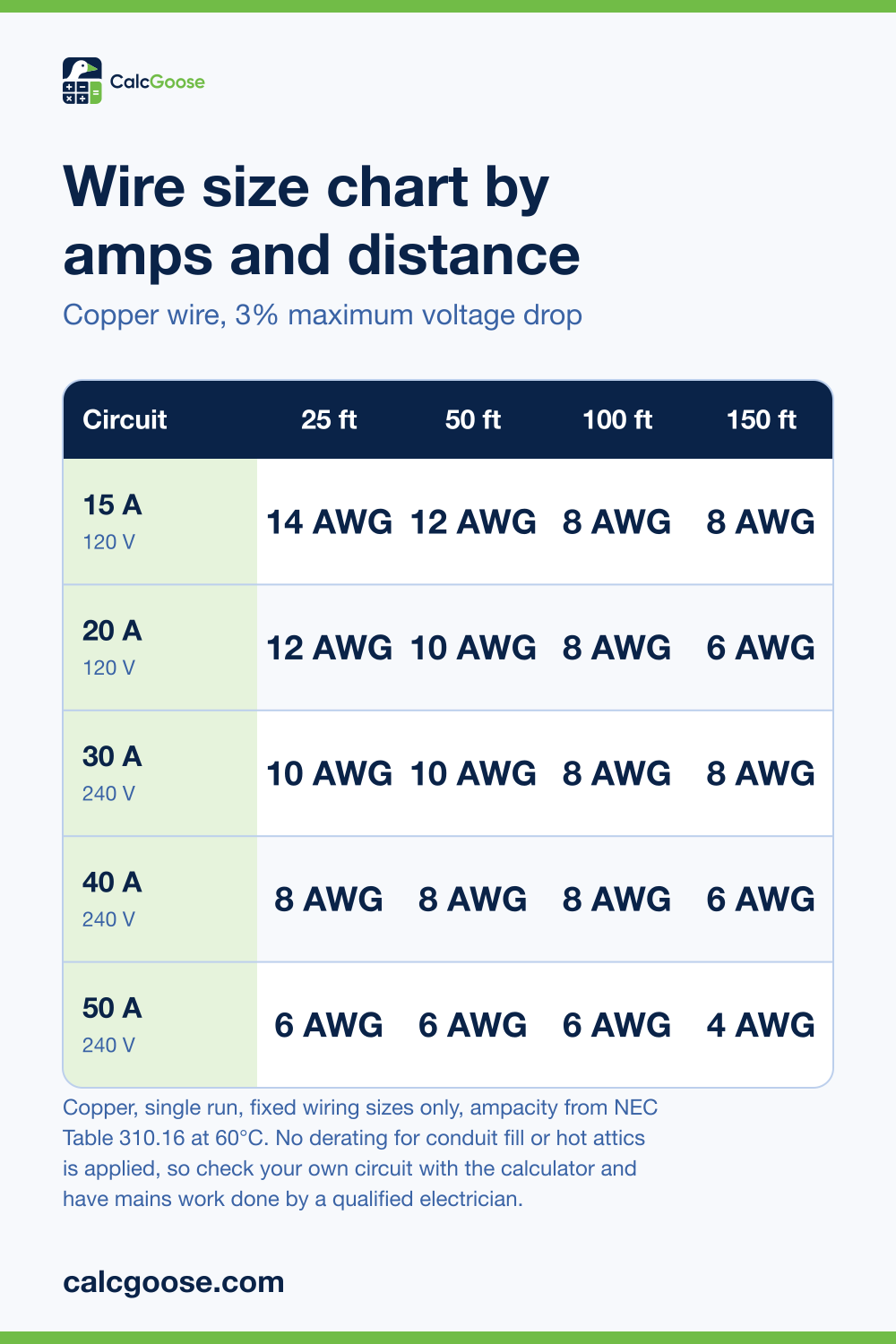
Wire size chart by amps and distance
The smallest copper wire that keeps voltage drop to 3% on common household circuits, by one-way distance. Each size is the larger of what voltage drop and ampacity require, worked out with the same formula as the calculator above.
| Circuit | 25 ft | 50 ft | 100 ft | 150 ft |
|---|---|---|---|---|
| 15 A120 V | 14 AWG | 12 AWG | 8 AWG | 8 AWG |
| 20 A120 V | 12 AWG | 10 AWG | 8 AWG | 6 AWG |
| 30 A240 V | 10 AWG | 10 AWG | 8 AWG | 8 AWG |
| 40 A240 V | 8 AWG | 8 AWG | 8 AWG | 6 AWG |
| 50 A240 V | 6 AWG | 6 AWG | 6 AWG | 4 AWG |
Copper, single run, fixed wiring sizes only, ampacity from NEC Table 310.16 at 60°C. No derating for conduit fill or hot attics is applied, so check your own circuit with the calculator and have mains work done by a qualified electrician.
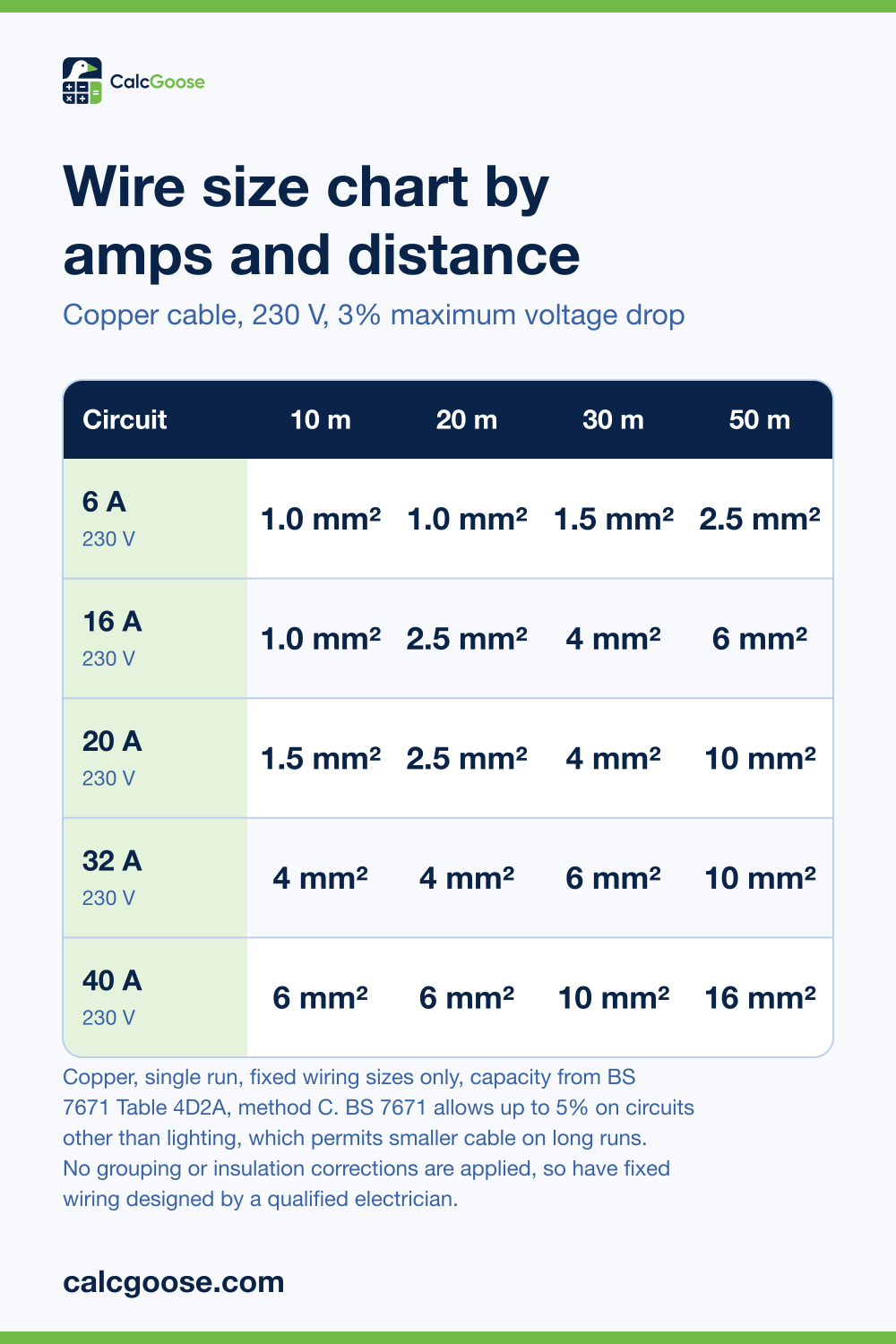
The smallest copper cable that keeps voltage drop to 3% on common 230 V single-phase circuits, by one-way run. Each size is the larger of what voltage drop and current-carrying capacity require, worked out with the same formula as the calculator above.
| Circuit | 10 m | 20 m | 30 m | 50 m |
|---|---|---|---|---|
| 6 A230 V | 1.0 mm² | 1.0 mm² | 1.5 mm² | 2.5 mm² |
| 16 A230 V | 1.0 mm² | 2.5 mm² | 4 mm² | 6 mm² |
| 20 A230 V | 1.5 mm² | 2.5 mm² | 4 mm² | 10 mm² |
| 32 A230 V | 4 mm² | 4 mm² | 6 mm² | 10 mm² |
| 40 A230 V | 6 mm² | 6 mm² | 10 mm² | 16 mm² |
Copper, single run, fixed wiring sizes only, capacity from BS 7671 Table 4D2A, method C. BS 7671 allows up to 5% on circuits other than lighting, which permits smaller cable on long runs. No grouping or insulation corrections are applied, so have fixed wiring designed by a qualified electrician.
Assumptions and limits
Everything this calculator quietly assumes on your behalf. If one of these does not match your situation, the answer will be off.
- Ampacity figures come from NEC Table 310.16, 60°C column. That is the conservative column and matches the terminal rating on most residential breakers and devices. Equipment rated for 75°C terminals may allow a smaller conductor, an electrician can confirm.
- No ambient-temperature or conduit-fill derating is applied. More than three current-carrying conductors in one conduit, or an attic above 86°F, both reduce ampacity, sometimes by 30% or more.
- The formula uses DC resistance. On AC circuits above roughly 1/0 AWG, inductive reactance adds a little more drop than shown, and the effect grows with conductor size.
- Resistivity constants of 12.9 (copper) and 21.2 (aluminum) ohm-cmil/ft assume a conductor at about 75°C. Cold wire has slightly less resistance and less drop.
- Distance is one-way. The calculator doubles it for the return path. Three-phase circuits use a different multiplier and are covered in the Europe & UK mode, not here.
- NEC 240.4(D) caps overcurrent protection at 15 A for 14 AWG, 20 A for 12 AWG and 30 A for 10 AWG copper regardless of what any other table says.
- Continuous loads (anything running more than three hours, like an EV charger), must be sized at 125% of the load current under NEC 210.19(A)(1). Enter the already-adjusted figure if that applies to you.
- 18 and 16 AWG appear here for low-power DC accessory wiring only; they are not NEC branch-circuit sizes.
- Parallel conductors are assumed identical in material, size, length and termination, which is what makes the current divide evenly. NEC 310.10(G) only permits paralleling at 1/0 AWG and larger on AC circuits; below that it is a low-voltage DC technique used in vans, boats and battery banks.
- Resistance figures use the same 12.9 and 21.2 ohm-circular-mil-per-foot constants as the voltage-drop calculation, which correspond to a conductor at roughly 75°C. At room temperature copper is about 8% lower.
- The mm² equivalent shown is a direct area conversion, not a recommendation. The two systems use different ampacity tables, so a metric size that matches on cross-section may not be compliant for the same current.
- A 10% drop target reflects ABYC and SAE practice for non-critical automotive and marine loads only. It is not acceptable for building wiring under any code.
- Current-carrying capacities follow IEC 60364-5-52 and BS 7671 Table 4D2A, installation method C, cable clipped direct to a surface, 30 °C ambient, PVC insulation, two loaded conductors. This is the common domestic case.
- No correction factors are applied. Grouping several circuits together (Cg), ambient temperatures above 30 °C (Ca), thermal insulation and buried runs all reduce capacity, sometimes by 50% or more. Your electrician applies these; this calculator does not.
- Resistivity is 0.0214 Ω·mm²/m for copper and 0.0352 for aluminium, which correspond to the conventional 0.0225 and 0.036 figures quoted at 70 °C conductor temperature to within about 5%.
- Three-phase sizing assumes a balanced load and uses the √3 line-to-line factor. An unbalanced three-phase circuit needs the neutral considered separately.
- The formula uses DC resistance. On AC circuits above roughly 95 mm², inductive reactance adds a little more drop than shown.
- BS 7671 recommends a maximum drop of 3% for lighting and 5% for other uses, measured from the origin of the installation, so if part of the budget is already spent on a submain, tighten the target here.
- Circuit protection is not sized here. Cable capacity must exceed the protective device rating, and RCD/RCBO requirements for socket and outdoor circuits are separate obligations.
- 0.5 and 0.75 mm² are flexible-cable sizes for appliance flexes and low-power DC accessories, not fixed wiring. Aluminium is not used below 16 mm².
- Parallel conductors are assumed identical in material, cross-section, length and arrangement. IEC 60364 and BS 7671 permit paralleling but attach conditions on protection and arrangement that need designing rather than improvising.
- Resistance figures use 0.0214 and 0.0352 ohm-mm² per metre, the same constants as the voltage-drop calculation, corresponding to a conductor at roughly 70°C. At 20°C copper is about 8% lower.
- The AWG equivalent shown is a direct area conversion, not a recommendation. The two systems use different current-carrying tables, so an AWG size that matches on cross-section may not be compliant for the same current.
- A 10% drop target reflects ABYC and SAE practice for non-critical automotive and marine loads only. It is not acceptable for fixed building wiring under BS 7671 or IEC 60364.
Frequently asked questions
What gauge wire do I need for 30 amps?
For a 30-amp circuit, 10 AWG copper is the NEC minimum on the 60°C column. How far that carries depends on the voltage, because the volts you can afford to lose scale with it. At 120V, 10 AWG stays inside a 3% drop for about 50 feet; at 240V the same wire is good for roughly 95 feet, and past those points you want 8 AWG. On a 12V system, 30 amps needs 3 or 4 AWG at anything over about 15 feet.
What gauge wire do I need for 50 amps?
A 50-amp circuit needs 6 AWG copper as a minimum on the 60°C column, or 8 AWG if all terminations are rated 75°C and an electrician signs off on it. Enter it at 240V and 6 AWG holds a 3% drop out past 140 feet, which is why the calculator keeps handing it back. An RV pedestal is the case where that answer misleads, because everything inside the RV runs off a 120V leg, and on that basis 6 AWG runs out at about 70 feet. Size a long pedestal feed at 120V and expect 4 AWG.
What size wire do I need for a 100 amp subpanel?
On the 60°C column this calculator uses, 100 amps needs 1 AWG copper, and that is the size it will hand back. Most 100-amp panels and breakers carry 75°C-rated terminations, and on that column an electrician will normally specify 3 AWG copper or 1 AWG aluminum. Houses get a shortcut on top of that. NEC 310.12 lets a service or feeder carrying the entire load of one dwelling be sized at 83% of the breaker rating, which brings a 100-amp service down to 4 AWG copper or 2 AWG aluminum.
What wire size do I need for a 100 foot run?
It depends entirely on current and voltage, because a 100-foot run is where voltage drop, not heat, decides the answer. At 120V and 20 amps, 100 feet needs 8 AWG instead of the usual 12 AWG. At 12V, a 100-foot run of any real current needs cable so thick it is usually cheaper to move the battery.
What wire size do I need for 12V solar?
Panel-to-controller runs are usually 10 AWG for a few hundred watts, because panel voltage is higher and current is low. Controller-to-battery and battery-to-inverter runs are the thick ones, 4 AWG for 100 amps over a few feet, 2/0 for a 3,000 W inverter. Keep the battery and inverter as close together as you physically can.
Should I use copper or aluminum wire?
Copper for almost everything, because it carries more current per size, terminates reliably, and is what most household devices are rated for. Aluminum earns its place on long heavy feeders such as a 200-amp service or a run out to a detached garage, where the material saving is real money. Aluminum needs about two sizes larger, AL-rated connectors and anti-oxidant paste.
What happens if the wire gauge is too small?
Two things, and the second one is the dangerous one. Voltage sags, so motors run hot, lights dim and chargers take longer. And the wire itself heats up, which over time degrades the insulation and can start a fire inside a wall, which is why ampacity is a code requirement, not a suggestion.
What is two 12 AWG wires in parallel equal to?
About 9 AWG, doubling any conductor gains exactly three gauge sizes, because two equal wires have twice the cross-section and half the resistance. Two 6 AWG make 3 AWG, two 1/0 make 3/0, and three in parallel gains about five sizes. NEC 310.10(G) only permits this at 1/0 and larger on AC circuits, though it is common practice on low-voltage DC.
Can I run two wires in parallel instead of one thick one?
Electrically yes, and it is the standard fix when a single conductor would be impractically stiff, a 4/0 battery cable is hard to route, two 1/0 are not. All the conductors must be the same material, size, length and termination, or the current will not divide evenly. On AC branch circuits NEC 310.10(G) restricts this to 1/0 and larger; on 12 V DC in a van or boat it is routine.
What is the resistance of 12 AWG wire?
About 1.98 ohms per 1,000 feet of copper at operating temperature, or 0.0065 ohms per foot. Each gauge size up roughly multiplies resistance by 1.26, so 14 AWG is about 3.1 ohms per 1,000 ft and 10 AWG about 1.24. Resistance is what produces voltage drop, which is why long runs need thicker wire even at modest current.
How do I convert AWG to mm²?
Divide the circular-mil area by 1,973.5, or use the rough equivalents, 14 AWG is 2.1 mm², 12 AWG 3.3, 10 AWG 5.3, 8 AWG 8.4, 6 AWG 13.3, 4 AWG 21.2 and 1/0 is 53.5 mm². There is no clean one-to-one match, so always round up to the next standard metric size, and remember the two systems carry different ampacity ratings.
Can I use this for speaker wire?
No, speaker wire is sized by a different rule. Rather than a percentage of supply voltage, the target is keeping total wire resistance below about 5% of the speaker impedance, so an 8 ohm speaker wants under 0.4 ohms of cable. That usually means 16 AWG for short runs and 12 AWG past about 50 feet. The resistance figure here will help, but the drop percentage will not.
Does a longer wire run need thicker wire?
Yes. Resistance is proportional to length, so doubling the distance doubles the voltage lost. Ampacity does not change with length, but voltage drop does, and on long runs it is almost always the constraint that sets your wire size.
What size cable do I need for a 32 A circuit?
By the bare table, 4 mm² copper carries 37 A on method C and covers a 32 A circuit. In practice installers usually fit 6 mm², because correction factors for grouping, insulation and ambient temperature eat into that margin and 32 A loads tend to be continuous. A 32 A ring final circuit is the exception. It uses 2.5 mm², because the load is shared between two legs.
What cable do I need for a 7.4 kW EV charger?
A 7.4 kW wallbox draws 32 A at 230 V, so 6 mm² twin and earth is the usual answer for runs up to about 30 metres clipped direct. Longer runs, buried sections or cable grouped with others in insulation all push you to 10 mm². EV chargers are continuous loads and need their own RCD, so this is not DIY territory.
What is the difference between 2.5 mm² and 1.5 mm² cable?
1.5 mm² carries 20 A on method C and is the standard choice for lighting circuits; 2.5 mm² carries 27 A and is used for socket circuits and ring finals. The larger cable also drops about 40% less voltage over the same distance, which matters on long runs.
What cable size do I need for a 30 metre run?
It depends on current and voltage, because at 30 metres voltage drop rather than heat usually decides. At 230 V and 16 A, 30 metres wants 4 mm² to stay inside a 3% drop, even though 1.5 mm² would carry that current without complaint. Fitting 2.5 mm² over that distance lands you around 3.6%, which still passes the 5% limit for a socket circuit but fails the 3% one for lighting. At 12 V, a 30 metre run of any meaningful current needs cable so large it is normally cheaper to move the battery.
How do I convert AWG to mm²?
There is no clean one-to-one match, so always round up to the next standard metric size. Roughly, 14 AWG ≈ 2.1 mm², 12 AWG ≈ 3.3 mm², 10 AWG ≈ 5.3 mm², 8 AWG ≈ 8.4 mm², 6 AWG ≈ 13.3 mm², 4 AWG ≈ 21.2 mm². American cable also carries different ratings, so never assume a US calculator result is compliant here.
Why does three-phase need less cable than single-phase?
A balanced three-phase circuit shares the current across three conductors and uses the √3 factor rather than the out-and-back factor of 2, so the same power moves with roughly 40% less voltage drop. That is why large ovens, hobs, workshops and heat pumps in Germany and Scandinavia are wired three-phase.
What is two 4 mm² cables in parallel equal to?
Eight square millimetres of copper, which behaves like a single 10 mm² cable once you round up to a standard size. Doubling any conductor halves its resistance and halves the voltage drop. Every parallel conductor must be the same material, cross-section and length, and the installation needs designing rather than improvising.
Can I run cables in parallel instead of one large one?
Electrically yes, and it is standard on large supply cables where a single conductor would be unmanageable. IEC 60364 and BS 7671 both permit it, but with conditions on identical length, arrangement and protection, and the design is a job for a qualified electrician. On low-voltage DC, campervans, boats, battery banks, paralleling smaller cable is routine.
What is the resistance of 2.5 mm² cable?
About 8.6 ohms per kilometre of copper at operating temperature, or 0.0086 ohms per metre. Halving the cross-section roughly doubles the resistance, so 1.5 mm² is around 14.3 ohms per km and 6 mm² about 3.6. Resistance is what produces voltage drop, which is why long runs need larger cable even at modest current.
How do I convert mm² to AWG?
Multiply the cross-section by 1,973.5 to get circular mils, then look it up, or use the rough equivalents, 1.5 mm² is about 16 AWG, 2.5 mm² 14 AWG, 4 mm² 12 AWG, 6 mm² 10 AWG, 10 mm² 8 AWG and 16 mm² 6 AWG. The match is never exact, and the two systems use different current-carrying tables, so never assume a US figure is compliant here.
Can I use this for speaker cable?
No, speaker cable is sized by a different rule. Instead of a percentage of supply voltage, the target is keeping total cable resistance below about 5% of the speaker impedance, so an 8 ohm speaker wants under 0.4 ohms of cable. That is typically 1.5 mm² for short runs and 2.5 mm² beyond about 15 metres. The resistance figure here helps; the drop percentage does not.
What happens if the cable is too small?
Two things, and the second one is dangerous. Voltage sags, so motors run hot, lights dim and chargers take longer. And the cable itself heats up, degrading its insulation over time and creating a fire risk inside a wall or ceiling, which is why current-carrying capacity is a regulatory requirement, not a suggestion.
Guides on this
The reasoning behind the number, and the decisions it does not make for you.
- Why 90 C wire is almost never a 90 C circuit The highest column in the ampacity table is usually off limits, because the terminations decide the rating. Then heat and bundling take more off the top.
- Where the ampacity chart stops answering the question Ampacity tells you what the wire can carry without overheating. On a long run the limit is voltage drop instead, and it lands two sizes larger.
- Turning a kVA rating into amps you can plan with A kVA figure means nothing until you know the voltage and the phases. The three phase formula carries a square root, and missing it is a large error.
Related calculators
- Off-Grid Solar & Battery Calculator Power & Off-Grid How many solar panels and batteries you need, from what you actually run in a day.
- UPS Runtime Calculator Power & Off-Grid How many minutes your UPS really holds your gear up, by battery rather than by guesswork.
- EV Charging Calculator Power & Off-Grid How long a charge takes, what it costs at home, and how much you save against filling a fuel tank.
- Watts Calculator Generators Convert between watts, amps, volts and kilowatt-hours, on DC, single-phase or three-phase.
- kVA Calculator Generators Convert kVA to kW, amps and horsepower, single or three-phase, with power factor handled properly.
Share this calculator
Found the number you needed? Send it to whoever asked you for it.
Safety disclaimer
This is an estimate for planning. Electrical work should be verified by a licensed electrician and installed per NEC and your local code. Derating for ambient temperature, conduit fill and continuous loads can all change the required size, and this calculator does not apply them.
This is an estimate for planning. Electrical work must be designed, installed and certified by a qualified electrician to IEC 60364 and your national rules, BS 7671 in the UK, NF C 15-100 in France, DIN VDE 0100 in Germany. Correction factors for grouping, ambient temperature, insulation and buried runs can all change the required size, and this calculator does not apply them.