Off-Grid Solar & Battery Calculator
Tell the goose what you run in a day and get how many solar panels and batteries to buy, plus the inverter, the charge controller and how many days without sun the bank will carry.
Last updated
Where are you?
AWG, NEC, 120/240 V, miles and gallons mm², IEC/BS 7671, 230/400 V, km and litres . We remember this on every calculator.
Your result
Solar panels needed
2 × 200 W
- Total array
- 400 W
- Batteries
- 3 × 100 Ah
- Battery bank
- 300 Ah @ 12V
- Inverter
- 150 W
- Charge controller
- 50 A MPPT
- Daily energy use
- 1,057 Wh
🪿 The goose says: You use about 1.06 kWh a day. Fit 2 × 200 W panels and 3 × 100 Ah LiFePO4 batteries at 12V, with a 150 W inverter.
- Peak sun hours drop by roughly half in midwinter. If this system has to work in December, rerun it with your winter figure or plan on a generator or alternator charging.
Your shopping list
What to actually buy, and what it gives you once you round up to whole panels and whole batteries.
- Solar panels (200 W each)
- 2 400 W total
- Batteries (100 Ah each)
- 3 300 Ah at 12V
- Days without sun it will carry
- 2.72 you asked for 2
- Generation on an average day
- 1,350 Wh 293 Wh spare
- Refilling an empty bank
- 2.13 days of sun with nothing running
- Charge controller
- 50 A MPPT
Battery count assumes batteries at your system voltage. Building 24V or 48V from 12V batteries means wiring them in series in matched pairs or quads, and the count goes up accordingly.
How this off-grid solar and battery calculator works
Every off-grid system is sized from one number, watt-hours per day. Multiply each device by the hours it actually runs, add them up, and the rest of the design falls out of that figure.
Panels are sized from your daily energy and your peak sun hours, the number of hours of full-strength sun your location effectively delivers. A 100 W panel in a place with 4.5 peak sun hours makes about 450 Wh on paper, but never that much in practice, so a 0.75 efficiency factor covers charge controller losses, wiring resistance, heat, dust and panel tolerance.
Batteries are sized from how many cloudy days you want to ride out, divided by how much of the battery you can actually use. Lithium gives you 80%; lead-acid and AGM give you 50% before you start killing the battery.
-
Step 1 Daily energy
daily_Wh = sum of (watts × hours per day) for every device -
Step 2 Panel wattage
panel_W = daily_Wh ÷ peak_sun_hours ÷ 0.75The 0.75 is combined real-world system losses. -
Step 3 Battery energy
battery_Wh = daily_Wh × days_of_autonomy ÷ usable_depth_of_dischargeUsable DoD is 0.8 for LiFePO4, 0.5 for AGM and flooded lead-acid. -
Step 4 Battery amp-hours
battery_Ah = battery_Wh ÷ system_voltage -
Step 5 Inverter size
inverter_W = sum of AC device watts × 1.25 -
Step 6 Charge controller
controller_A = panel_W ÷ system_voltage × 1.25
For example, 1,057 Wh a day at 4.5 peak sun hours needs 1,057 ÷ 4.5 ÷ 0.75 = 313 W of panels, two 200 W panels, or 400 W installed. For two days of autonomy on LiFePO4 that is 1,057 × 2 ÷ 0.8 = 2,643 Wh, which at 12V is 220 Ah, so three 100 Ah batteries. That 300 Ah actually carries 2.7 days rather than the two you asked for.
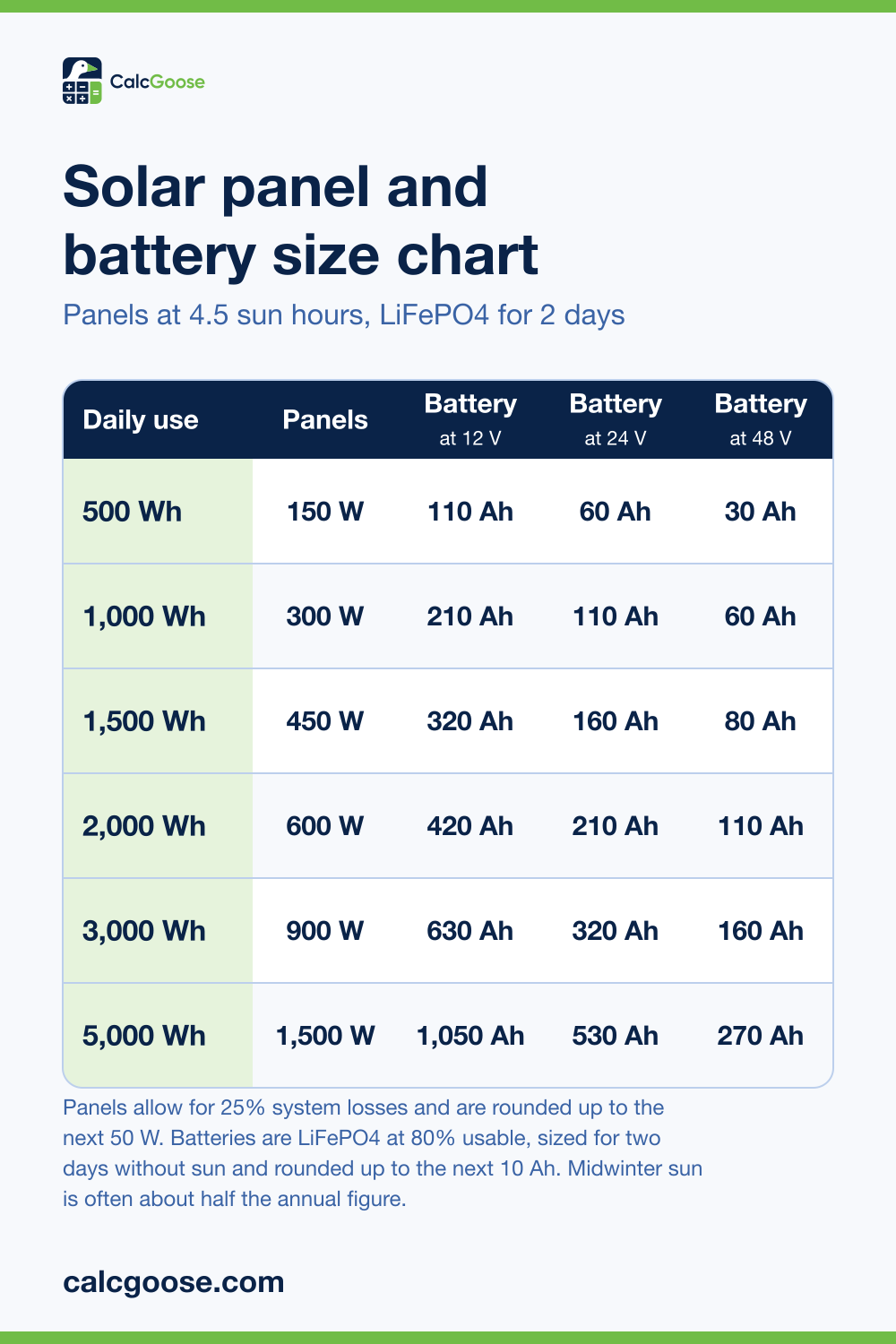
Solar panel and battery size chart
The solar array and battery bank an off-grid system needs for a given daily energy use, at 4.5 peak sun hours, about the US average. Every figure comes from the same formula as the calculator above.
| Daily use | Panels | Battery at 12 V | Battery at 24 V | Battery at 48 V |
|---|---|---|---|---|
| 500 Wh | 150 W | 110 Ah | 60 Ah | 30 Ah |
| 1,000 Wh | 300 W | 210 Ah | 110 Ah | 60 Ah |
| 1,500 Wh | 450 W | 320 Ah | 160 Ah | 80 Ah |
| 2,000 Wh | 600 W | 420 Ah | 210 Ah | 110 Ah |
| 3,000 Wh | 900 W | 630 Ah | 320 Ah | 160 Ah |
| 5,000 Wh | 1,500 W | 1,050 Ah | 530 Ah | 270 Ah |
Panels allow for 25% system losses and are rounded up to the next 50 W. Batteries are LiFePO4 at 80% usable, sized for two days without sun and rounded up to the next 10 Ah. Midwinter sun is often about half the annual figure.
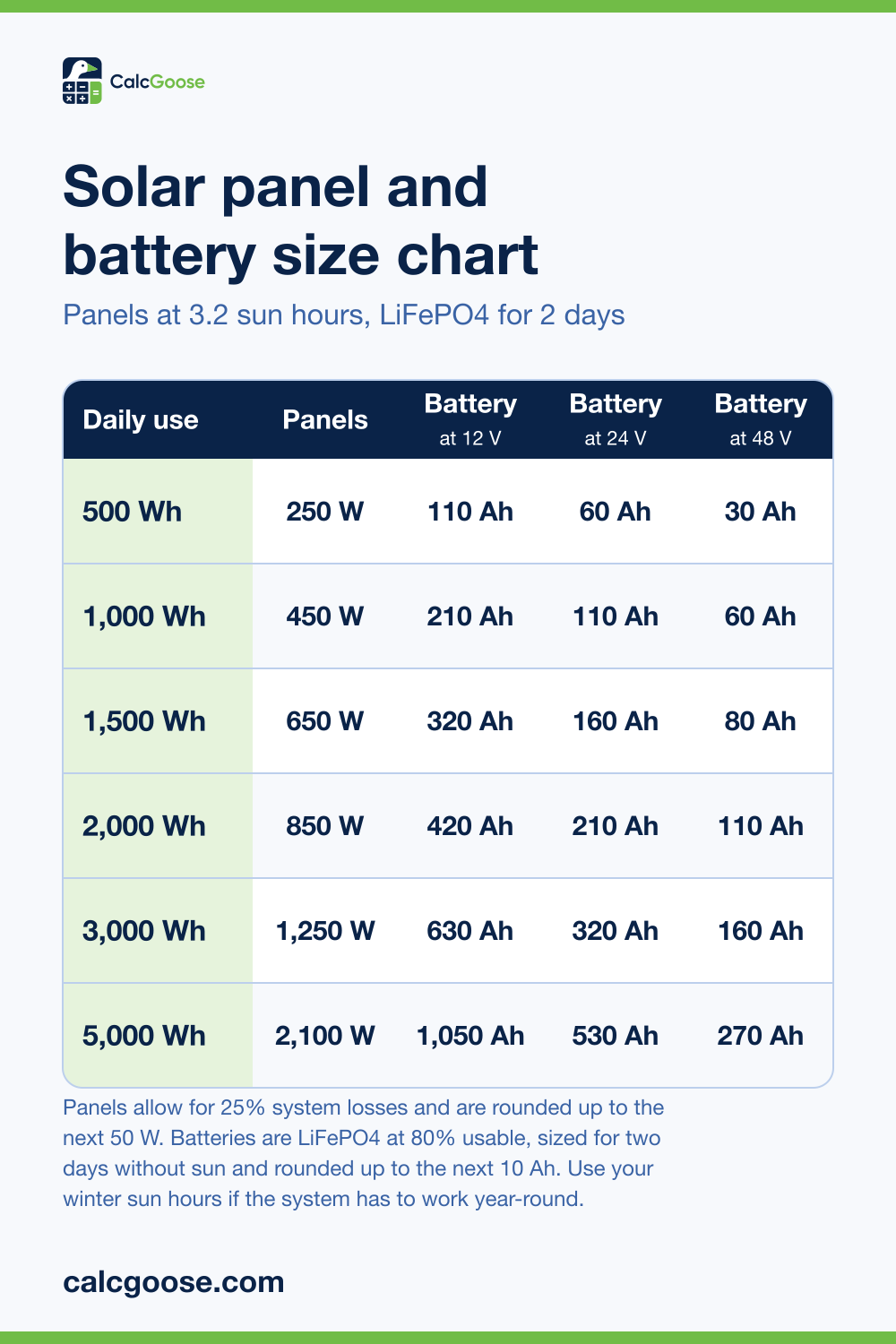
The solar array and battery bank an off-grid system needs for a given daily energy use, at 3.2 peak sun hours, typical of Germany, Poland and the Netherlands. Every figure comes from the same formula as the calculator above.
| Daily use | Panels | Battery at 12 V | Battery at 24 V | Battery at 48 V |
|---|---|---|---|---|
| 500 Wh | 250 W | 110 Ah | 60 Ah | 30 Ah |
| 1,000 Wh | 450 W | 210 Ah | 110 Ah | 60 Ah |
| 1,500 Wh | 650 W | 320 Ah | 160 Ah | 80 Ah |
| 2,000 Wh | 850 W | 420 Ah | 210 Ah | 110 Ah |
| 3,000 Wh | 1,250 W | 630 Ah | 320 Ah | 160 Ah |
| 5,000 Wh | 2,100 W | 1,050 Ah | 530 Ah | 270 Ah |
Panels allow for 25% system losses and are rounded up to the next 50 W. Batteries are LiFePO4 at 80% usable, sized for two days without sun and rounded up to the next 10 Ah. Use your winter sun hours if the system has to work year-round.
Assumptions and limits
Everything this calculator quietly assumes on your behalf. If one of these does not match your situation, the answer will be off.
- System losses are lumped into a single 0.75 factor covering MPPT conversion, wiring drop, panel heat derate, dirt and manufacturing tolerance. A clean, cool, well-wired system does better; a hot roof with shading does worse.
- Peak sun hours are an annual average unless you enter a winter figure. Midwinter output in the northern US and northern Europe is roughly half the annual average, and short winter days are exactly when you use the most power.
- Usable depth of discharge is 80% for LiFePO4 and 50% for AGM/lead-acid. Lithium can technically go deeper, but leaving 20% in reserve is what makes a bank last a decade.
- The inverter is sized on the sum of your AC devices, which is conservative. You probably will not run the microwave and the induction hob at once. If you know you will not, size on the largest one or two instead.
- Motor and compressor devices draw a surge on startup. Pure sine inverters usually handle 2× their rating for a second, which covers most of it, but a well pump on a small inverter may not start.
- Charge controller amps are sized on the array you actually install after rounding up to whole panels, with a 1.25 safety factor matching NEC practice for continuous solar current. Sizing on the theoretical figure would leave the controller undersized.
- Panel and battery counts round up to whole units, which usually delivers more capacity and more autonomy than the minimum. The extra is real headroom, not waste.
- Battery counts assume batteries at your system voltage, a 12V battery for a 12V system, a 48V rack unit for a 48V system. Making 24V or 48V from 12V batteries means matched series strings, and the count rises to the next whole string.
- Recharge time assumes an empty bank, an average day of sun and nothing running. Real recharge is slower because your loads draw at the same time, and much slower in winter.
- No allowance is made for cold. LiFePO4 must not be charged below freezing without an internal heater, and lead-acid loses 20–30% of capacity in the cold.
- Round-trip efficiency sits outside the 0.75 factor. That figure covers the path from panel to battery, and a further loss happens inside the battery itself. LiFePO4 returns about 95% of the energy you put into it while AGM returns about 80%, so an AGM bank quietly needs more panel than the wattage above suggests.
- Fridge and heater rows use an effective run time rather than clock hours, because those devices cycle on and off.
Frequently asked questions
How many solar panels do I need to run a refrigerator?
A 12V compressor fridge uses roughly 400–500 Wh a day, which needs about 150 W of panel at 4.5 peak sun hours. A full-size household AC fridge uses 1,000–1,500 Wh a day and needs 300–450 W of panel plus an inverter. In both cases the battery matters more than the panel, because the fridge runs all night.
How much solar do I need for van life?
A typical van with a 12V fridge, lights, fans, laptops and phone charging uses 800–1,200 Wh a day, which works out to 300–400 W of panel and a 200–300 Ah 12V lithium bank. Add Starlink and you are closer to 600 W and 400 Ah. Induction cooking or air conditioning pushes you past what a van roof can hold.
How many solar panels do I need?
Divide the panel wattage your loads require by the wattage of one panel and round up. A van using about 1 kWh a day at 4.5 peak sun hours needs roughly 310 W, which is two 200 W panels or one 400 W. A house running 25 kWh a day needs closer to 7.5 kW, or about eighteen 420 W panels, which is why roof area, not budget, is usually the limit.
How many batteries do I need for my solar system?
Divide the amp-hours your autonomy requires by the capacity of one battery and round up. A 220 Ah requirement at 12V takes three 100 Ah batteries, or one 280 Ah cell bank. Rounding up almost always buys you more days of backup than you asked for, three 100 Ah batteries carry 2.7 days rather than the two the calculation demanded.
How long does it take to charge a battery from solar?
Divide the usable energy in the bank by what the array makes on an average day. A 300 Ah 12V LiFePO4 bank holds about 2,880 usable watt-hours, and 400 W of panel at 4.5 peak sun hours makes about 1,350 Wh a day, so just over two days of sun to refill it from empty. That assumes nothing is running; with your normal loads on it takes considerably longer.
What size battery bank do I need for off-grid?
Take your daily watt-hours, multiply by the number of cloudy days you want to survive, and divide by 0.8 for lithium or 0.5 for lead-acid. For 1,000 Wh a day and two days of autonomy, that is 2,500 Wh of lithium, about 200 Ah at 12V. Most people underestimate this and end up adding a second battery within a year.
Is LiFePO4 or AGM better for off-grid solar?
LiFePO4 wins on everything except purchase price. You get 80% of the capacity rather than 50%, roughly a third of the weight, and 3,000 to 5,000 cycles instead of 400 to 800. It also returns about 95% of the energy you put in against roughly 80% for AGM, so an AGM bank needs more panel as well as more battery. AGM still earns its place in a small backup bank, on a very tight budget, or in a system that sits below freezing without heating.
What are peak sun hours?
Peak sun hours is the number of hours per day your location would get if all the sunlight arrived at a standard 1,000 W/m² intensity. A place with 12 hours of daylight might only have 4.5 peak sun hours, because early and late sun is weak and oblique. It is the single figure that turns panel watts into watt-hours.
Can I mix different size solar panels?
Yes, if you wire them in parallel and each panel has a similar voltage, mismatched currents are fine in parallel. Do not put different panels in series, because the whole string drops to the current of the weakest panel. The cleanest option for mixed panels is a separate charge controller per array.
Do I need a charge controller?
Yes, for anything above a trickle-charging maintenance panel. Without one, panel voltage will overcharge and destroy your battery. Use MPPT rather than PWM above about 200 W. It harvests 15–30% more energy and lets you wire panels in series with thinner cable.
Guides on this
The reasoning behind the number, and the decisions it does not make for you.
- How many days of autonomy to build for Two to three days covers most off-grid homes. Each extra day costs the same as the first and gets used a handful of times a year, which is the real trade.
- Why a 100 Ah battery is not 100 Ah Depth of discharge decides what you can actually take out of a bank. It is why lead acid needs roughly twice the nameplate of lithium for the same job.
Related calculators
- Wire Gauge Calculator Power & Off-Grid Cable size from amps, distance and voltage, in AWG or mm², with voltage drop, resistance and parallel runs.
- UPS Runtime Calculator Power & Off-Grid How many minutes your UPS really holds your gear up, by battery rather than by guesswork.
- EV Charging Calculator Power & Off-Grid How long a charge takes, what it costs at home, and how much you save against filling a fuel tank.
- Generator Size Calculator Generators Size it from your appliances, or from your floor area and panel, with the surge load included.
- Home Wattage Calculator Generators How many watts your house actually uses, from average draw to everything-at-once peak and the monthly bill.
Share this calculator
Found the number you needed? Send it to whoever asked you for it.