Raw Dog Food Calculator
Get your dog's daily raw portion by the percentage-of-body-weight method or by calories, plus meals per day and what a month costs.
Last updated
Where are you?
AWG, NEC, 120/240 V, miles and gallons mm², IEC/BS 7671, 230/400 V, km and litres . We remember this on every calculator.
Your result
Food per day
624 g
- In pounds
- 1.38 lb
- Per meal
- 312 g
- Meals a day
- 2
- Daily calories
- 1,250 kcal
- Per month
- 19 kg
- Monthly cost
- $209.27
🪿 The goose says: Feed about 624 g a day, split into 2 meals. That is 2.50% of body weight. Adjust by body condition, not by the scale alone.
- A complete raw diet is not just meat. The usual model is roughly 80% muscle meat, 10% bone and 10% organ (half of that liver), and even that often needs supplementing for vitamin E, iodine and manganese. Get a vet or a qualified canine nutritionist to check your recipe.
- Split this across 2 meals a day. Two meals is standard for adults; deep-chested breeds should not be fed one large meal, because of bloat risk.
- Adjust by what you see, not by the number. Ribs should be easy to feel but not visible, with a waist behind the ribs from above. Reassess every couple of weeks.
Estimate for planning only. Have any electrical work verified by a qualified electrician and installed to code. See the full disclaimer at the bottom of this page.
What the two methods give you
Both are standard. They disagree most at the extremes of size, where the percentage rule over-feeds small dogs and under-feeds large ones.
- Percentage method (2.50% of body weight)
- 624 g/day
- Calorie method (RER × activity factor)
- 833 g/day
- Resting energy requirement
- 781 kcal
- Daily energy requirement
- 1,250 kcal
Resting energy requirement is 70 × weight in kg to the power 0.75, the standard veterinary equation. It is not linear, which is why a 40 kg dog does not eat twice what a 20 kg dog does.
How this raw dog food calculator works
There are two accepted ways to portion raw food, and they answer slightly different questions.
The percentage-of-body-weight method is the one most raw feeders use, because it needs nothing but a scale. An adult dog eats 2 to 3 percent of its body weight a day depending on activity; puppies eat far more, starting around 10 percent at two months and falling to 4 percent by their first birthday.
The calorie method is what vets use, and it is more accurate at the extremes. It starts from resting energy requirement, 70 times body weight in kilograms raised to the power 0.75, then multiplies by a factor for life stage and activity. That exponent matters, metabolism does not scale linearly with size, which is why a 40 kg dog needs roughly 1.7 times the food of a 20 kg one rather than twice as much.
-
Step 1 Percentage method
grams_per_day = body_weight_kg × 1000 × percentAdults 2–3%; puppies 10% at 2–3 months, 8% at 4–5, 6% at 6–8, 4% at 9–12. -
Step 2 Resting energy requirement
RER = 70 × weight_kg^0.75The standard veterinary equation. The 0.75 exponent is metabolic body weight. -
Step 3 Daily energy requirement
DER = RER × factorNeutered adult 1.6, low activity 1.4, working dog 2.0, puppy 2.0–3.0 by age. -
Step 4 Convert calories to grams
grams = DER ÷ food_kcal_per_kg × 1000Complete raw mixes are typically 1,300–1,800 kcal/kg. -
Step 5 Monthly planning
monthly_kg = grams_per_day × 30.44 ÷ 1000
For example, a 25 kg adult dog at normal activity. The percentage method gives 25 × 1000 × 2.5% = 625 g a day. The calorie method gives RER of 783 kcal, times 1.6 for a normal adult, which is 1,253 kcal, about 835 g of a 1,500 kcal/kg raw mix.
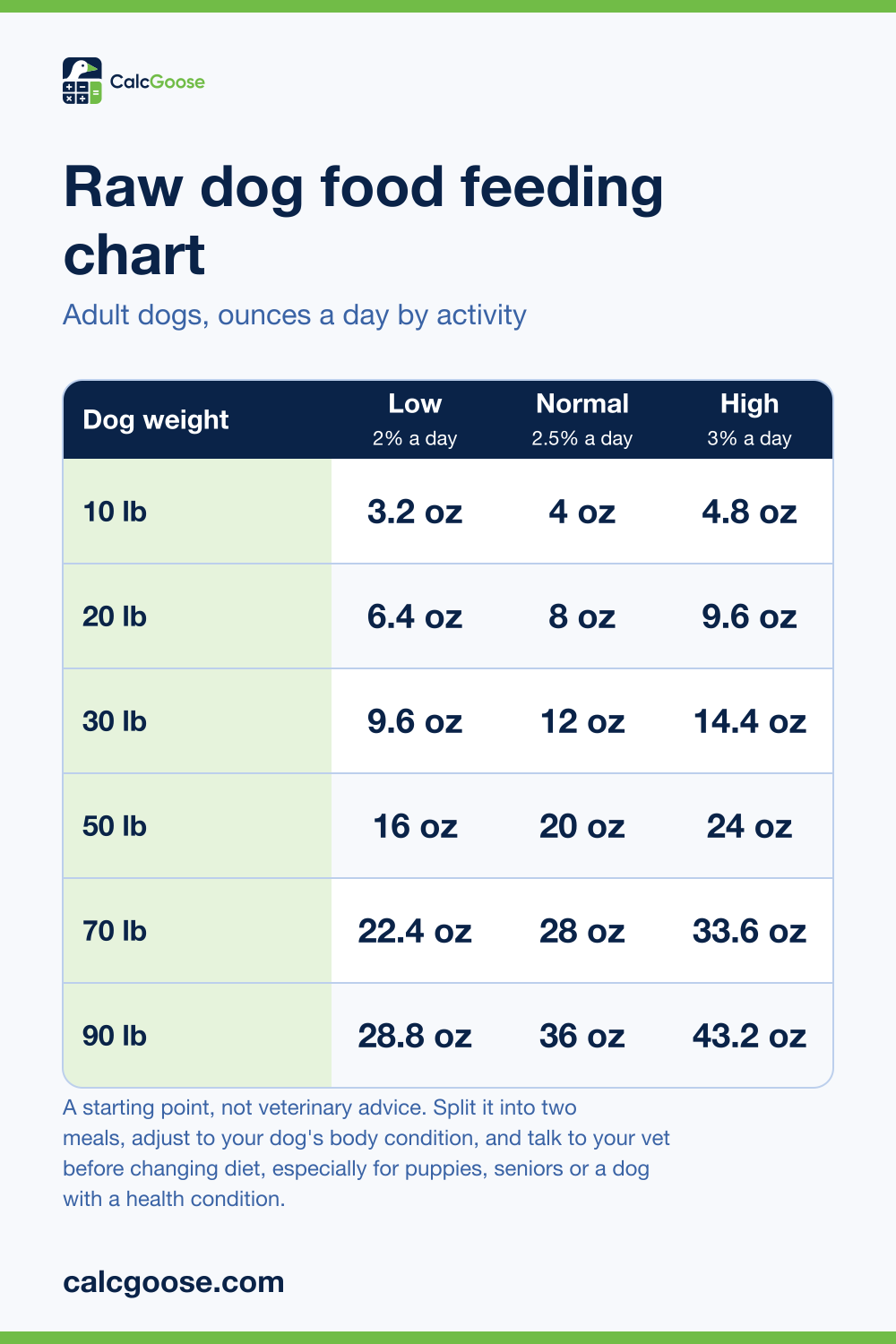
Raw dog food feeding chart
A daily raw food portion for a healthy adult dog by weight and activity, using the percentage of body weight method. Every figure comes from the same formula as the calculator above.
| Dog weight | Low 2% a day | Normal 2.5% a day | High 3% a day |
|---|---|---|---|
| 10 lb | 3.2 oz | 4 oz | 4.8 oz |
| 20 lb | 6.4 oz | 8 oz | 9.6 oz |
| 30 lb | 9.6 oz | 12 oz | 14.4 oz |
| 50 lb | 16 oz | 20 oz | 24 oz |
| 70 lb | 22.4 oz | 28 oz | 33.6 oz |
| 90 lb | 28.8 oz | 36 oz | 43.2 oz |
A starting point, not veterinary advice. Split it into two meals, adjust to your dog's body condition, and talk to your vet before changing diet, especially for puppies, seniors or a dog with a health condition.
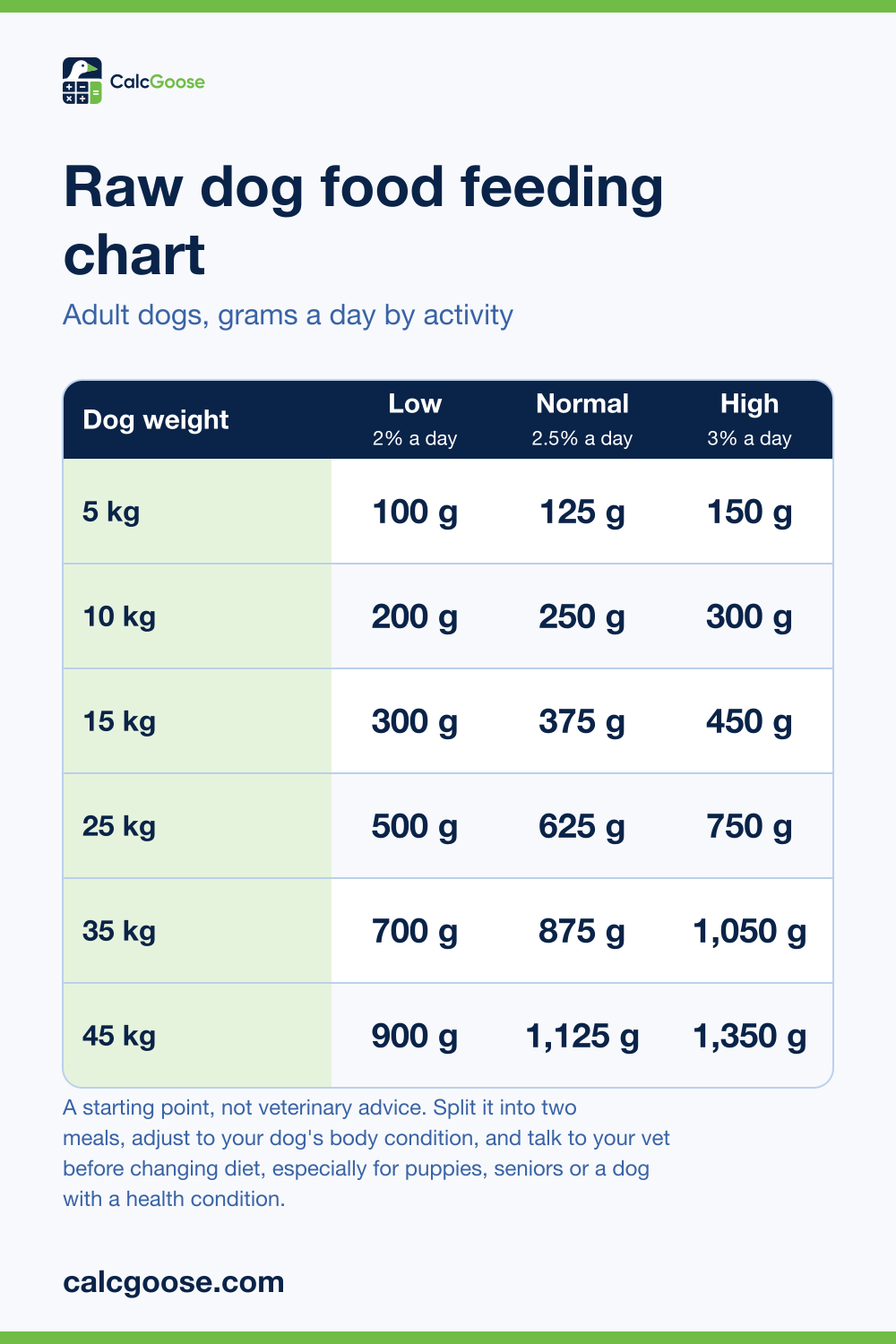
A daily raw food portion for a healthy adult dog by weight and activity, using the percentage of body weight method. Every figure comes from the same formula as the calculator above.
| Dog weight | Low 2% a day | Normal 2.5% a day | High 3% a day |
|---|---|---|---|
| 5 kg | 100 g | 125 g | 150 g |
| 10 kg | 200 g | 250 g | 300 g |
| 15 kg | 300 g | 375 g | 450 g |
| 25 kg | 500 g | 625 g | 750 g |
| 35 kg | 700 g | 875 g | 1,050 g |
| 45 kg | 900 g | 1,125 g | 1,350 g |
A starting point, not veterinary advice. Split it into two meals, adjust to your dog's body condition, and talk to your vet before changing diet, especially for puppies, seniors or a dog with a health condition.
Assumptions and limits
Everything this calculator quietly assumes on your behalf. If one of these does not match your situation, the answer will be off.
- The percentage-of-body-weight figures are the standard raw-feeding ranges, 2% for low activity, 2.5% normal, 3% high. They are a starting point that assumes an adult dog at a healthy weight.
- Puppy percentages use published age bands and fall sharply with age. Because puppies grow week to week, any figure here is out of date within a fortnight, reweigh regularly.
- The calorie method uses RER = 70 × kg^0.75 with a multiplier of 1.6 for a normal neutered adult, which is the widely-used veterinary starting point. Individual dogs vary by 20% either way around it.
- Food energy density defaults to 1,500 kcal/kg, typical of a complete commercial raw mix. Home-prepared raw varies enormously with fat content, lean chicken is nearer 1,100, high-fat lamb can exceed 2,200.
- The two methods deliberately disagree. The percentage rule is linear and metabolism is not, so against the calorie figure it comes out low on small dogs and closes the gap as the dog gets bigger. A 3 kg dog on 2.5% lands at under half the calorie method, a 25 kg dog at about three-quarters of it, and by 60 kg the two are within a tenth. Where they differ substantially, the calorie method is the better guide.
- Nothing here addresses nutritional completeness. A portion size being right does not mean the diet is balanced. That depends on the ratio of muscle meat, bone and organ, and on supplementation.
- Pregnancy, lactation, illness, recovery from surgery and senior dogs with reduced kidney function all change requirements substantially and are outside what this calculator models.
- Cost is calculated at a flat 30.44 days per month using the price you enter.
Frequently asked questions
How much raw food should I feed my dog?
About 2 to 3 percent of body weight per day for an adult, so a 25 kg dog eats roughly 500 to 750 grams. Low-activity dogs sit at the bottom of that range and working dogs at the top. Split it across two meals and adjust based on body condition after a couple of weeks.
How much raw food does a puppy need?
Far more proportionally than an adult, around 10 percent of body weight at two to three months, 8 percent at four to five, 6 percent at six to eight, and 4 percent by nine to twelve months. Because puppies gain weight weekly, reweigh and recalculate every fortnight rather than setting a portion and forgetting it.
Is the percentage or calorie method more accurate?
The calorie method, and the gap is widest on small dogs. Metabolism scales with body weight to the power of 0.75 rather than linearly, so a flat percentage runs low on toy breeds and only catches up at the giant end. A 3 kg dog on 2.5% gets under half what the calorie method suggests, while at 60 kg the two land within a tenth of each other. For a mid-sized dog either is a reasonable starting point, though the percentage figure still sits low.
Is raw feeding cheaper than kibble?
Usually not, unless you buy in bulk and portion yourself. Commercial complete raw typically runs two to four times the cost of mid-range kibble per day, though sourcing meat directly and freezing in bulk narrows the gap considerably. Factor in freezer space and the electricity to run it.
How do I switch my dog to raw food?
Most people transition over 7 to 10 days, replacing a quarter of the old food with raw and increasing every couple of days, though some vets recommend a clean switch after a fasting period. Start with a single protein source so any reaction is easy to identify. Loose stools in the first week are common; persistent problems are not, and need a vet.
Do raw diets need supplements?
Home-prepared raw usually does. The common 80/10/10 model of muscle meat, bone and organ is frequently short on vitamin E, vitamin D, iodine, manganese and sometimes zinc. Commercial complete raw is formulated to meet published standards; a recipe you assemble yourself is not, unless someone qualified has checked it.
How many times a day should I feed a dog raw?
Twice a day for adults, three times for puppies, and four for the youngest under three months. Deep-chested breeds like Great Danes, Weimaraners and Setters should never get one large daily meal because of gastric torsion risk. Splitting the portion also keeps energy steadier through the day.
Guides on this
The reasoning behind the number, and the decisions it does not make for you.
- What the bone and organ shares in 80/10/10 are doing Bone is there for calcium, liver for vitamin A and copper. Get the shares wrong in either direction and the stool tells you before anything else does.
- Feed the percentage of the dog you want, not the one you have Two to three percent of body weight is the standard rule, and it quietly maintains an overweight dog. The weight you use is the one that matters.
Related calculators
- Chicken Coop Calculator Pets & Animals Coop size, run size, nest boxes, feed and eggs for a backyard flock, in either direction.
- Aquarium Calculator Pets & Animals Tank volume, heater wattage, filter turnover and an honest stocking check.
- Cat Calorie Calculator Pets & Animals Daily calories for a cat, converted into cups of dry or cans of wet food.
Share this calculator
Found the number you needed? Send it to whoever asked you for it.
Safety disclaimer
This is a planning estimate, not veterinary advice. Discuss any change of diet with your vet before making it, particularly for puppies, seniors, pregnant or nursing dogs, and any dog with a health condition. A correct portion size does not make a diet nutritionally complete, home-prepared raw diets need the right balance of muscle meat, bone and organ, and frequently need supplementation. Raw meat also carries salmonella and listeria risk for both the dog and the people in the household, handle it as you would raw meat for yourself, and take extra care if anyone in the home is immunocompromised.