Candle Making Calculator
Enter your container size and batch count to get the wax weight, fragrance oil weight and a starting wick size, in grams and ounces.
Last updated
Where are you?
AWG, NEC, 120/240 V, miles and gallons mm², IEC/BS 7671, 230/400 V, km and litres . We remember this on every calculator.
Your result
Wax needed
177 g
- Wax in ounces
- 6.22 oz
- Fragrance oil
- 15.3 g
- Fragrance in ounces
- 0.54 oz
- Per candle (wax)
- 176 g
- Per candle (fragrance)
- 15.3 g
- Total pour weight
- 192 g
🪿 The goose says: You need 177 g of soy (container blend) and 15.3 g of fragrance oil. Buy about 10% extra to cover what sticks to the pot.
- Wick starting point for a 2.80 in container: CD 12–14 / ECO 8–10, one wick. Wick size is the one variable you cannot calculate, burn-test before you sell.
- Buy about 10% more wax than this figure. Wax clings to the melting pot and pouring jug, and soy usually needs a small top-up pour after the first cool.
How this candle making calculator works
Candle jars are sold by volume and wax is sold by weight, and that mismatch is the whole problem. An 8 oz jar does not hold 8 ounces of wax. It holds 8 fluid ounces of space, which is about 6.8 ounces of soy once you account for density and headspace.
So the calculation runs, work out the space you are filling, decide how full to pour, convert volume to weight using the density of your wax, then split that weight between wax and fragrance oil.
The last step catches people out. Fragrance load is a percentage of the total pour, not something added on top. An 8% load in a 200 g pour means 184 g of wax and 16 g of oil, not 200 g of wax plus 16 g of oil.
-
Step 1 Volume of the container
from the jar size, or π × (diameter/2)² × fill_height1 US fluid ounce is 29.57 ml. -
Step 2 How much of it you actually fill
usable_ml = volume × fill%90% is the normal pour, leaving headspace below the rim. -
Step 3 Convert volume to weight
pour_weight = usable_ml × wax_densitySoy and paraffin are about 0.9 g/ml, beeswax 0.96. -
Step 4 Split the pour between wax and oil
fragrance = pour_weight × load% wax = pour_weight − fragrance -
Step 5 Multiply by the batch
total = per_candle × number_of_candles
For example, an 8 fl oz jar is 236.6 ml. Filled to 90% that is 213 ml, which in soy at 0.9 g/ml is a 192 g pour. At 8% fragrance that splits into 176 g of wax and 15 g of oil per candle.
Candle wax chart
How much soy wax and fragrance oil common jar sizes take, filled to 90% with an 8% fragrance load. Jars are sold by fluid ounces of volume, which is why an 8 oz jar holds well under 8 oz of wax. Every figure comes from the same formula as the calculator above.
| Jar size | Soy wax | Fragrance at 8% | Total pour |
|---|---|---|---|
| 4 fl oz | 3.11 oz | 0.27 oz | 3.38 oz |
| 6 fl oz | 4.66 oz | 0.41 oz | 5.07 oz |
| 8 fl oz | 6.22 oz | 0.54 oz | 6.76 oz |
| 10 fl oz | 7.77 oz | 0.68 oz | 8.45 oz |
| 12 fl oz | 9.33 oz | 0.81 oz | 10.1 oz |
| 16 fl oz | 12.4 oz | 1.08 oz | 13.5 oz |
Weights are in ounces by weight. Soy wax is taken at 0.9 g per ml, and beeswax is denser, so the same jar holds a little more of it. Choose your own wax and fill in the calculator.
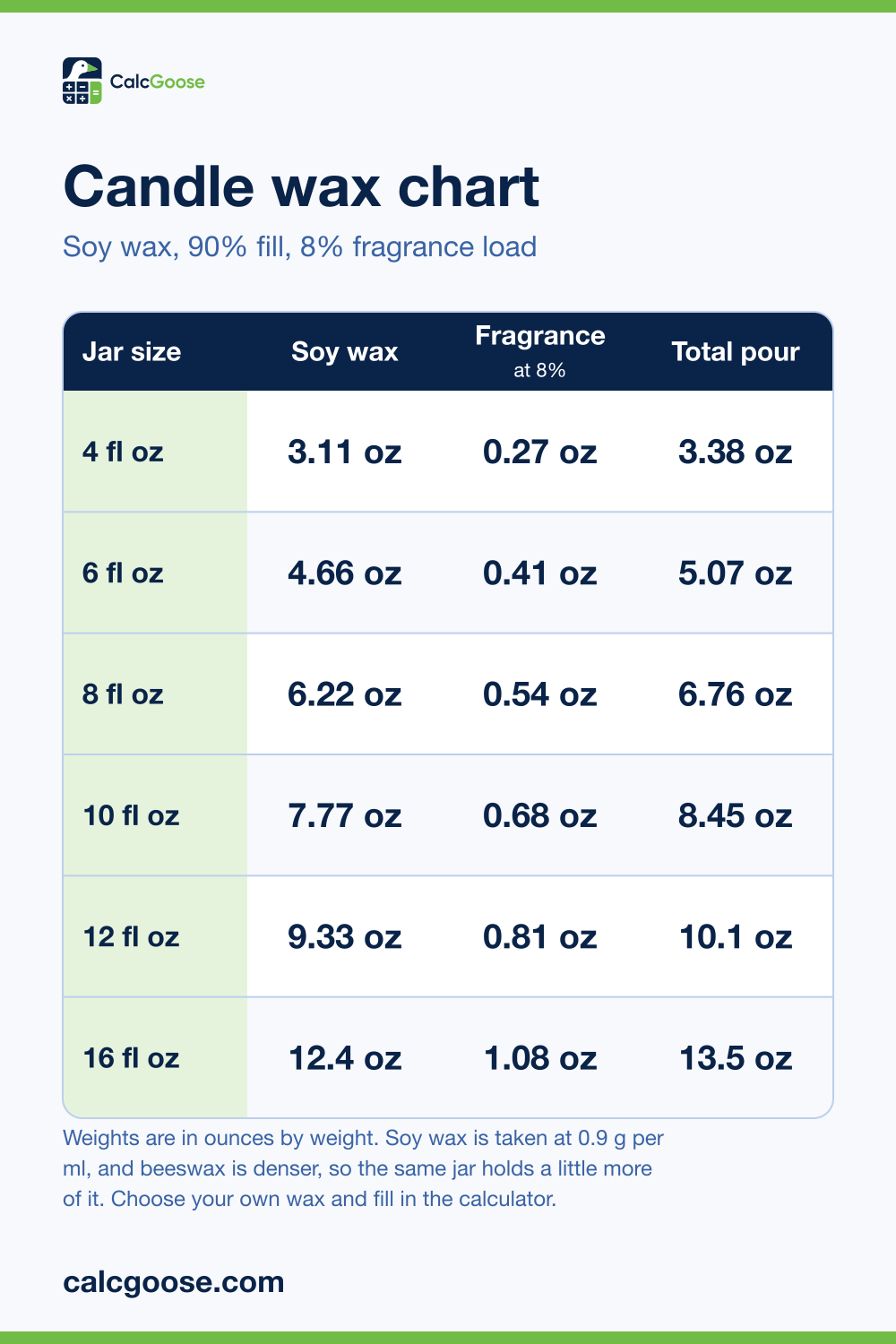
How much soy wax and fragrance oil common jar sizes take, filled to 90% with an 8% fragrance load. Every figure comes from the same formula as the calculator above.
| Jar size | Soy wax | Fragrance at 8% | Total pour |
|---|---|---|---|
| 100 ml | 75 g | 6 g | 81 g |
| 150 ml | 112 g | 10 g | 122 g |
| 200 ml | 149 g | 13 g | 162 g |
| 250 ml | 186 g | 16 g | 203 g |
| 300 ml | 224 g | 19 g | 243 g |
| 500 ml | 373 g | 32 g | 405 g |
Soy wax is taken at 0.9 g per ml, and beeswax is denser, so the same jar holds a little more of it. Choose your own wax and fill in the calculator.
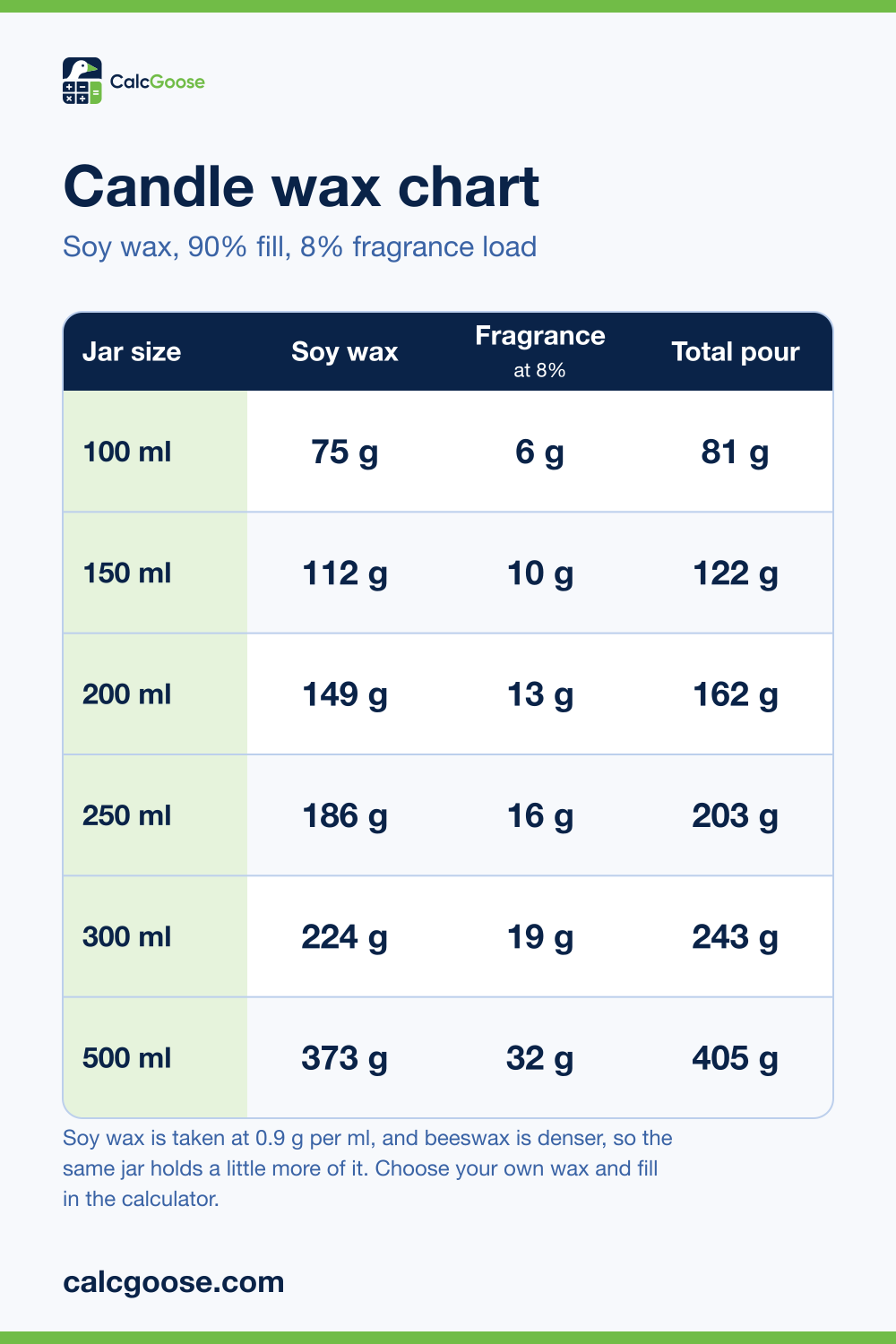
Assumptions and limits
Everything this calculator quietly assumes on your behalf. If one of these does not match your situation, the answer will be off.
- Wax densities are 0.90 g/ml for soy and paraffin, 0.96 for beeswax and 0.92 for coconut-soy blends, measured solid at room temperature. Blends vary by a few percent between suppliers.
- Fragrance oil is treated as part of the total pour weight, which is how fragrance load is defined in the industry. Some suppliers quote load as a percentage of wax weight instead, a 10% difference at the top end.
- The default 90% fill level leaves normal headspace. If you pour to the brim, set it to 100, but expect wax to overflow as it expands when hot.
- Wick recommendations are starting points for a medium-melt-point container wax, based on container diameter. Wick size also depends on your wax, fragrance load and dye, and the only reliable test is burning a sample for four hours and checking the melt pool.
- No allowance is made for wax left in the melting pot, the pouring jug or a top-up pour. Soy in particular usually needs a second small pour after the first cools and sinks. Buy about 10% over.
- Container diameter is assumed constant. Tapered jars hold less than the widest measurement implies, so measure at the average width for those.
- The calculator does not model dye, which is used in fractions of a percent and makes no meaningful difference to the wax weight.
Frequently asked questions
How much wax do I need for an 8 oz jar?
About 175–180 grams, or roughly 6.2 ounces, of soy wax for a standard 8 fl oz jar filled to 90% at an 8% fragrance load. The jar size refers to fluid ounces of volume, not the weight of wax, which is why the wax figure is lower than the number on the jar.
How much fragrance oil per pound of wax?
At an 8% load you use about 1.3 oz of fragrance oil per pound of finished candle, or about 1.4 oz per pound of wax, because the load is a share of the whole pour rather than of the wax alone. Most container soy waxes hold 6–10% comfortably; above that the oil tends to seep out as a film on the surface.
How many candles will 10 lb of wax make?
About 25 candles in 8 oz jars, working back from roughly 176 g of wax each at a 90% fill and an 8% fragrance load. Ten pounds is 4,536 g, and stepping up to 16 oz jars roughly halves the count to about 13. Buy around 10% over whatever the number says, because soy usually wants a top-up pour and some wax always stays behind in the pouring jug.
What wick size do I need?
Start from the container diameter, about CD 8–10 for a 2.5-inch jar, CD 12–14 for a 3-inch jar, and multiple wicks above 3.5 inches. This is a starting point only, the melt pool should reach the edge of the jar within about four hours without the flame mushrooming, and only a burn test tells you that.
Should I use soy or paraffin wax?
Paraffin throws scent more strongly and gives a smooth, glossy finish, while soy is renewable, burns longer and cooler, and is what most small makers use. Soy is also more temperamental, since it frosts, it sinks, and it usually needs a top-up pour. If you want the easiest good result, start with a wax sold specifically as a container soy blend rather than a pillar or flake wax.
Why do my candles tunnel?
Almost always an undersized wick, occasionally a first burn that was cut short. The first burn sets the memory ring, so it needs to run until the melt pool reaches the jar wall, usually three to four hours. If a correctly-sized wick still tunnels, the fragrance load or dye is choking the flame.
How long should candles cure before burning?
One to two weeks for soy, three to five days for paraffin. Curing lets the fragrance oil bind fully into the wax, and a soy candle burned the day after pouring will smell noticeably weaker than the same candle two weeks later. It costs nothing but patience.
How do I stop soy wax frosting?
Pour cooler, around 120–135 °F, warm the jars first, and cool the finished candles slowly at room temperature rather than in a draught. Frosting is soy recrystallising and is cosmetic only. It does not affect burn or scent, and no soy wax avoids it entirely.
Related calculators
- Epoxy Resin Calculator Maker & Craft Work out how much resin a mould, river table or tumbler actually takes, split by part A and B.
- Soap Lye Calculator Maker & Craft Work out exactly how much lye and water your oils need, with superfat and a full safety brief.
- 3D Print Cost Calculator Maker & Craft The real cost of a print (filament, power, wear and failures) and what to charge for it.
- Yarn Calculator Maker & Craft How much yarn a blanket, scarf or hat takes, by craft, stitch density and yarn weight.
- Fabric Calculator Maker & Craft How much fabric a project needs, with hems, seams and pattern repeat already added.
- Vinyl & Sticker Pricing Calculator Maker & Craft What to charge for decals, shirts and signs once materials, labour and marketplace fees are in.
Share this calculator
Found the number you needed? Send it to whoever asked you for it.