Yarn Calculator
Pick your project, craft and yarn weight to get the yardage and number of skeins, with the extra that crochet needs already included.
Last updated
Where are you?
AWG, NEC, 120/240 V, miles and gallons mm², IEC/BS 7671, 230/400 V, km and litres . We remember this on every calculator.
Your result
Skeins at 364 yd each
7 skeins
- Total yardage
- 2,292 yd
- In metres
- 2,096 m
- Finished area
- 20.8 sq ft
- Yards per sq ft
- 100
- Before 10% margin
- 2,084 yd
- Craft
- Knit
🪿 The goose says: Buy 7 skeins, about 2,292 yards (2,096 m) including a 10% margin. Get them all in the same dye lot.
- Buy all your skeins in one order and check they share a dye lot. Two lots of the same colour are visibly different in daylight, and a blanket is exactly where that shows.
- This is a planning estimate from a yards-per-square-foot table, not a gauge swatch. If you are tight or loose, your real usage can differ by 20% either way. Make a swatch if the yarn is expensive.
How this yarn calculator works
Yarn requirement is an area problem with a fudge factor, and it is honest to say so up front. There is no exact formula, because how much yarn a square foot of fabric takes depends on your hook or needle size, your tension, and the stitch you choose.
What does work is a lookup table. For each yarn weight class there is a typical yardage per square foot of medium-density knitted fabric, assembled from what published patterns actually call for. Worsted sits around 100 yards per square foot; super bulky around 42; fingering around 240.
From there it is two multipliers. Crochet consumes roughly 30% more than knitting for the same area, because crochet stitches are taller and each one wraps more yarn. And your stitch density shifts it again, open lace uses about 20% less, tight garter or single crochet about 25% more.
-
Step 1 Finished area
area_sqft = width_in × length_in ÷ 144 -
Step 2 Base yardage for the yarn weight
from the table, #1 = 240, #2 = 175, #3 = 135, #4 = 100, #5 = 65, #6 = 42 yd per sq ft -
Step 3 Adjust for stitch and craft
yd_per_sqft = base × density_factor × craft_factorDensity, open 0.8, medium 1.0, dense 1.25. Crochet multiplies by 1.3. -
Step 4 Total, with a margin
total_yards = area × yd_per_sqft × 1.110% covers the swatch, the join-in tails and the edging you decide to add later. -
Step 5 Convert to skeins
skeins = ceil(total_yards ÷ yards_per_skein)
For example, a 50 × 60 in throw is 20.8 sq ft. In #4 worsted at medium density that is 100 yd per sq ft, so 2,083 yards knitted, 2,292 with the margin, which is 7 skeins of 364 yd. The same throw in crochet needs 2,979 yards, or 9 skeins.
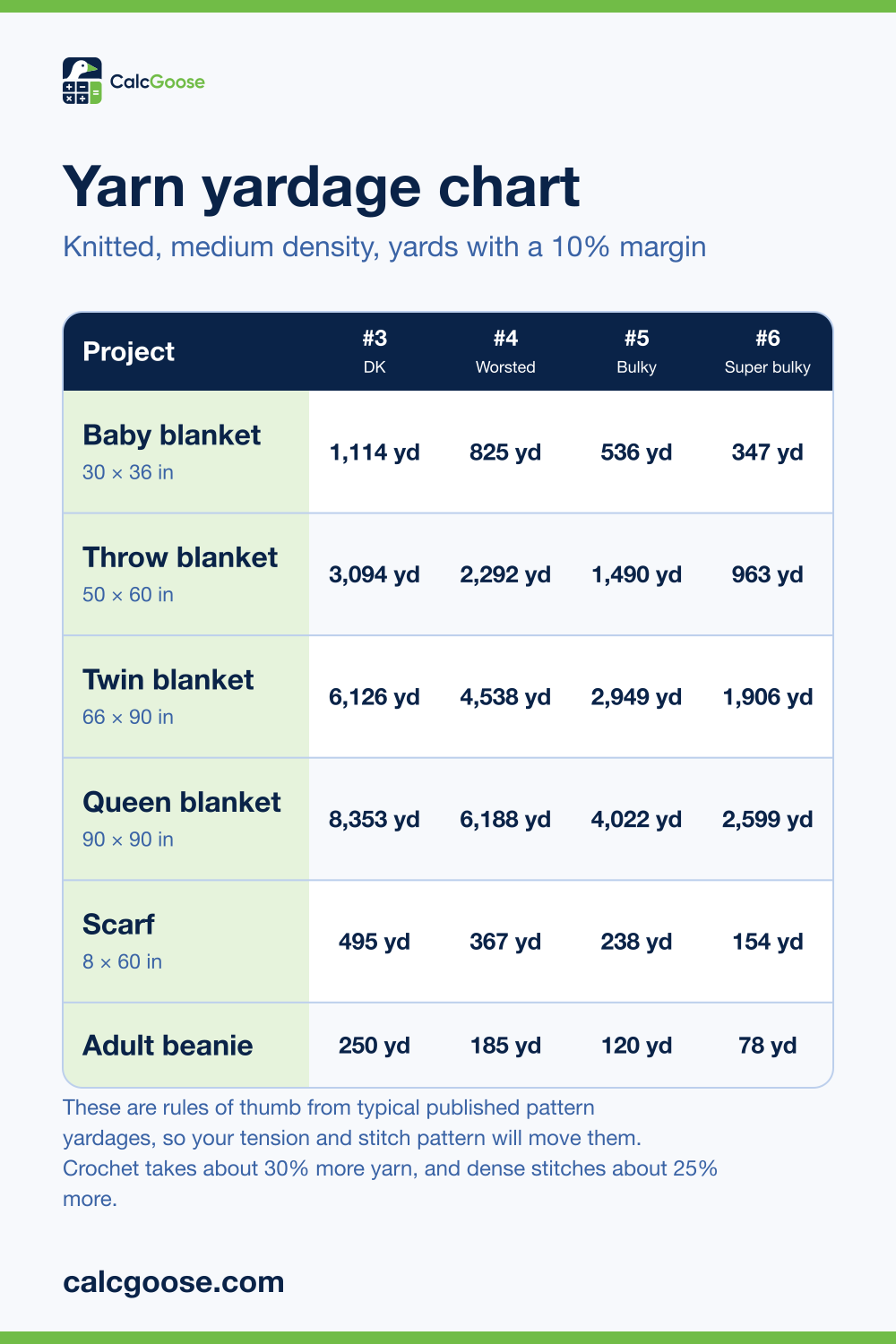
Yarn yardage chart
Roughly how much yarn common knitted projects take at a medium stitch density, by yarn weight, with the calculator's 10% margin included. Every figure comes from the same formula as the calculator above.
| Project | #3 DK | #4 Worsted | #5 Bulky | #6 Super bulky |
|---|---|---|---|---|
| Baby blanket30 × 36 in | 1,114 yd | 825 yd | 536 yd | 347 yd |
| Throw blanket50 × 60 in | 3,094 yd | 2,292 yd | 1,490 yd | 963 yd |
| Twin blanket66 × 90 in | 6,126 yd | 4,538 yd | 2,949 yd | 1,906 yd |
| Queen blanket90 × 90 in | 8,353 yd | 6,188 yd | 4,022 yd | 2,599 yd |
| Scarf8 × 60 in | 495 yd | 367 yd | 238 yd | 154 yd |
| Adult beanie | 250 yd | 185 yd | 120 yd | 78 yd |
These are rules of thumb from typical published pattern yardages, so your tension and stitch pattern will move them. Crochet takes about 30% more yarn, and dense stitches about 25% more.
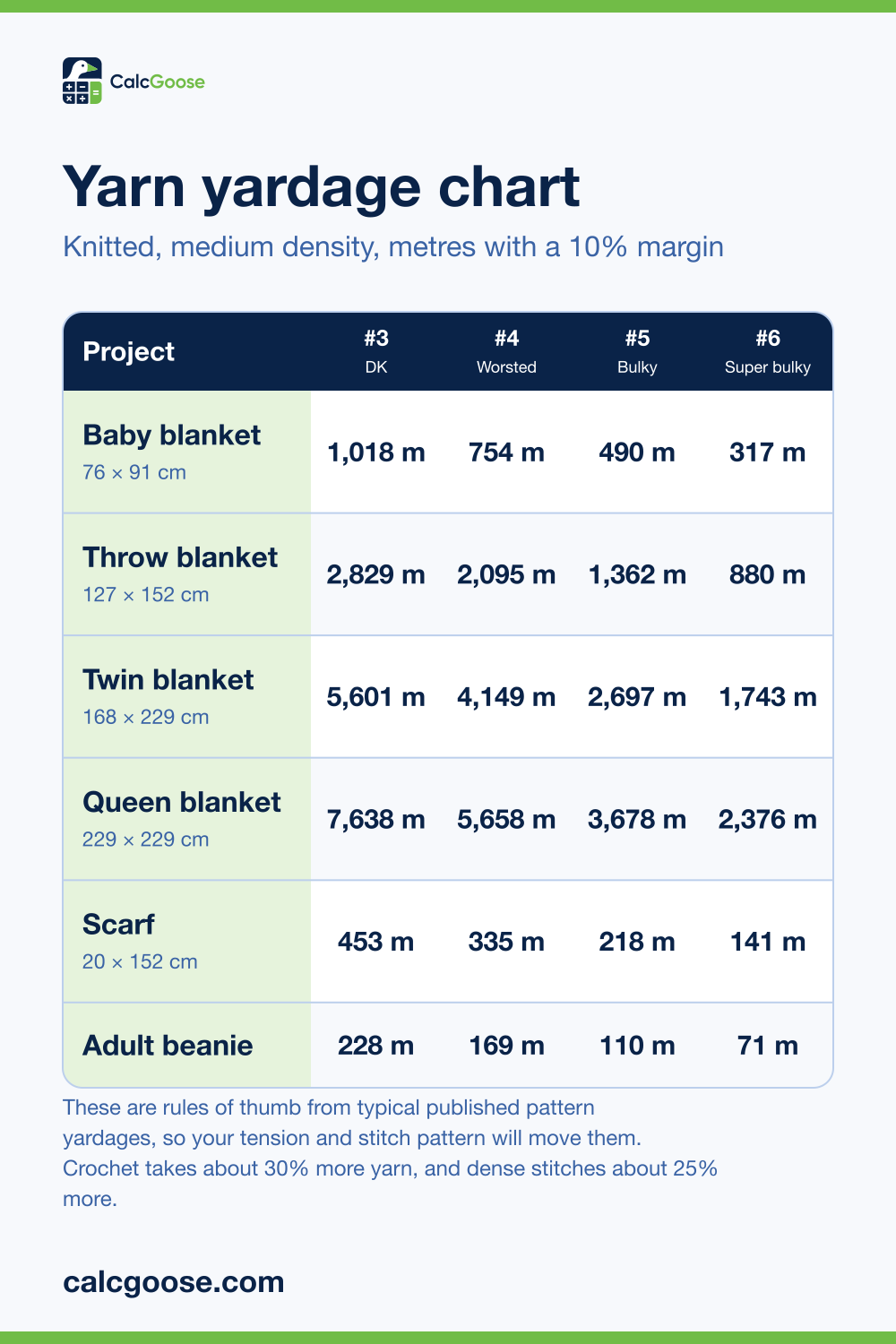
Roughly how much yarn common knitted projects take at a medium stitch density, by yarn weight, with the calculator's 10% margin included. Every figure comes from the same formula as the calculator above.
| Project | #3 DK | #4 Worsted | #5 Bulky | #6 Super bulky |
|---|---|---|---|---|
| Baby blanket76 × 91 cm | 1,018 m | 754 m | 490 m | 317 m |
| Throw blanket127 × 152 cm | 2,829 m | 2,095 m | 1,362 m | 880 m |
| Twin blanket168 × 229 cm | 5,601 m | 4,149 m | 2,697 m | 1,743 m |
| Queen blanket229 × 229 cm | 7,638 m | 5,658 m | 3,678 m | 2,376 m |
| Scarf20 × 152 cm | 453 m | 335 m | 218 m | 141 m |
| Adult beanie | 228 m | 169 m | 110 m | 71 m |
These are rules of thumb from typical published pattern yardages, so your tension and stitch pattern will move them. Crochet takes about 30% more yarn, and dense stitches about 25% more.
Assumptions and limits
Everything this calculator quietly assumes on your behalf. If one of these does not match your situation, the answer will be off.
- The yards-per-square-foot figures are rules of thumb derived from typical published pattern yardages, not laboratory measurements. Treat them as a shopping guide, not a specification.
- Crochet is modelled as using 30% more yarn than knitting for the same area. The real range is roughly 25–40% depending on stitch, double crochet is at the low end, single crochet at the high end.
- A 10% margin is added for swatching, tails woven in, and the border you decide to add halfway through. It does not cover a change of mind about size.
- Gauge is the single biggest variable and this calculator cannot see yours. Someone who works tightly can use 20% more yarn than someone loose, with the same yarn and pattern.
- Hats are modelled as a flat area of about 1.7 square feet, which matches typical adult beanie yardages. Heavily cabled or double-brimmed hats use considerably more.
- Colourwork is not modelled. Stranded knitting carries a second yarn across the back and can use 1.5 to 2 times the plain figure.
- Skein yardage is taken from your input. Ball bands sometimes state metres rather than yards, 100 m is 109 yd.
Frequently asked questions
How much yarn do I need for a blanket?
A 50 × 60 inch throw in worsted-weight yarn takes about 2,300 yards knitted or 3,000 crocheted once the margin is in, which is 7 to 9 of the big 364-yard skeins. A baby blanket at 30 × 36 inches needs roughly 825 yards knitted. Bulky yarn covers the same area in far less yardage, but each skein holds less, so the skein count barely changes.
How much yarn for a scarf?
A standard 8 × 60 inch scarf in worsted weight takes about 370 yards knitted, which just tips over a 364-yard skein, so buy two rather than one. In crochet, budget closer to 480 yards. Bulky scarves work up faster but need a similar number of skeins, because bulky skeins hold less yardage.
How much yarn do I need for a hat?
An adult beanie works out to about 1.7 square feet of fabric, which is roughly 185 yards of worsted knitted or 240 crocheted. Either figure fits inside a single skein of almost any size, which is why hats are the classic use for one leftover ball. Cables or a folded double brim can push it past 250 yards, so keep the spare to hand.
Does crochet use more yarn than knitting?
Yes, typically 25 to 40 percent more for the same finished area. Crochet stitches are taller and each one loops the yarn more times, so the fabric contains more strand per square inch. Single crochet is the hungriest common stitch; double crochet and mesh patterns are closer to knitting.
What does yarn weight mean?
It is the thickness of the strand, not how heavy the ball is, and it runs from #0 lace to #7 jumbo. The number sits inside a small skein symbol on the ball band. Thicker yarn covers more area per yard, which is why the same blanket takes about 65% of the worsted yardage in #5 bulky and about 40% in #6 super bulky.
What happens if I run out of yarn mid-project?
You buy more and hope the dye lot matches, which it usually does not. Dye lots are batch numbers, and two skeins of the same colour from different lots are noticeably different under daylight, especially across a large flat piece like a blanket. Buy one skein more than you think you need, at the same time, from the same shop.
How many yards are in a skein of yarn?
It varies enormously, from about 197 yards for a standard supermarket worsted skein to 364 for a large economy skein and only 220 for chunky chenille. Boutique and hand-dyed skeins are often 400 yards of fingering weight. Always check the ball band rather than assuming.
Should I make a gauge swatch?
For anything expensive or fitted, yes. A swatch tells you how much fabric your hands actually produce from a given yardage, which is the one number this calculator has to estimate. For a rough blanket in cheap acrylic, buying a spare skein is faster and costs about the same.
Related calculators
- Epoxy Resin Calculator Maker & Craft Work out how much resin a mould, river table or tumbler actually takes, split by part A and B.
- Candle Making Calculator Maker & Craft How much wax and fragrance oil a batch of candles needs, plus a wick size for your jar.
- Soap Lye Calculator Maker & Craft Work out exactly how much lye and water your oils need, with superfat and a full safety brief.
- 3D Print Cost Calculator Maker & Craft The real cost of a print (filament, power, wear and failures) and what to charge for it.
- Fabric Calculator Maker & Craft How much fabric a project needs, with hems, seams and pattern repeat already added.
- Vinyl & Sticker Pricing Calculator Maker & Craft What to charge for decals, shirts and signs once materials, labour and marketplace fees are in.
Share this calculator
Found the number you needed? Send it to whoever asked you for it.