UPS Runtime Calculator
Enter what is plugged in, pick your kind of UPS, and see how many minutes of battery you really get, plus how every common VA size compares and what you would need for longer.
Last updated
Where are you?
AWG, NEC, 120/240 V, miles and gallons mm², IEC/BS 7671, 230/400 V, km and litres . We remember this on every calculator.
Your result
Estimated runtime
38 minutes
- In plain time
- 38 min
- At half the load
- 1 h 27 min
- UPS watt rating
- 900 W
- Battery energy
- 216 Wh
- Battery bank
- 9 Ah @ 24V
- For 30 min you need
- 1,350VA
🪿 The goose says: Your 150 W load will ride out about 38 min, enough for most outages.
- Using the 24V 9Ah cartridge these units ship with, 216 Wh. That is a class figure rather than your exact model, so check the label on your own cartridge if you want it precise.
- For 30 minutes at 150 W you would want roughly a 1,350VA consumer UPS, or a smaller unit with an external battery pack.
How long each UPS size would last
Runtime for your 150 W load across the common consumer UPS ratings, using the same 0.15 Wh per VA estimate.
- 650VA
- 15 min rated for 390 W
- 900VA
- 22 min rated for 540 W
- 1,000VA
- 24 min rated for 600 W
- 1,500VA
- 40 min rated for 900 W
- 2,200VA
- 1 h 3 min rated for 1,320 W
- 3,000VA
- 1 h 31 min rated for 1,800 W
Consumer figures. A line-interactive unit (Smart-UPS, Eaton 5PX) at the same VA rating carries roughly twice the battery and runs roughly twice as long. Pick your type of UPS above to see that.
How this UPS runtime calculator works
A UPS holds up your gear for as long as its battery has energy to give. The arithmetic looks simple, energy divided by load, but a lead-acid battery has an awkward habit. The faster you drain it, the less total energy it gives you. A 9 Ah battery pulled at 1 amp delivers close to 9 amp-hours. Pulled at 40 amps it delivers barely a third of that.
That relationship is described by Peukert's law, and ignoring it is why so many UPS calculators promise an hour and deliver ten minutes. This calculator applies it.
The other half of the problem is knowing how big the battery is. Consumer UPS units do not advertise it, so in simple mode we estimate about 0.15 watt-hours of stored energy per VA of rating, the ratio you get from teardowns of the popular 600VA to 1500VA models. If you know the actual battery, use the advanced mode and the estimate goes away.
-
Step 1 Work out the stored energy
from the battery label, battery_Wh = volts × Ah × count
from your type of UPS, the cartridge that class ships with
from the VA rating alone, battery_Wh ≈ VA × 0.15
A consumer 1500VA holds about 216 Wh, two 12V 9Ah cells in series. A line-interactive 1500VA holds 408 Wh, nearly double, at the same VA rating. -
Step 2 Convert your AC load to battery current
dc_amps = load_watts ÷ (0.85 × battery_voltage)The 0.85 is inverter conversion loss, which you pay for whether you like it or not. -
Step 3 Apply Peukert's law
hours = 20 × (Ah ÷ (dc_amps × 20))^1.2The 20 is the standard rating period for the printed Ah figure; 1.2 is the Peukert exponent for UPS-grade AGM cells. -
Step 4 Allow for a battery that is not brand new
runtime = hours × 0.9 × 60 minutes -
Step 5 Sanity-check the load against the rating
ups_watts = VA × 0.6If your load exceeds this, the UPS overloads and drops out immediately no matter how good the battery is.
For example, a consumer 1500VA UPS holds 24V × 9Ah = 216 Wh. A 150 W load draws 150 ÷ (0.85 × 24) = 7.4 amps. Peukert gives 20 × (9 ÷ 147)^1.2 = 0.70 hours, and after the health factor that is about 38 minutes. The same load on a line-interactive 1500VA with a 17Ah cartridge runs about 81 minutes, the VA rating is identical, the battery is not.
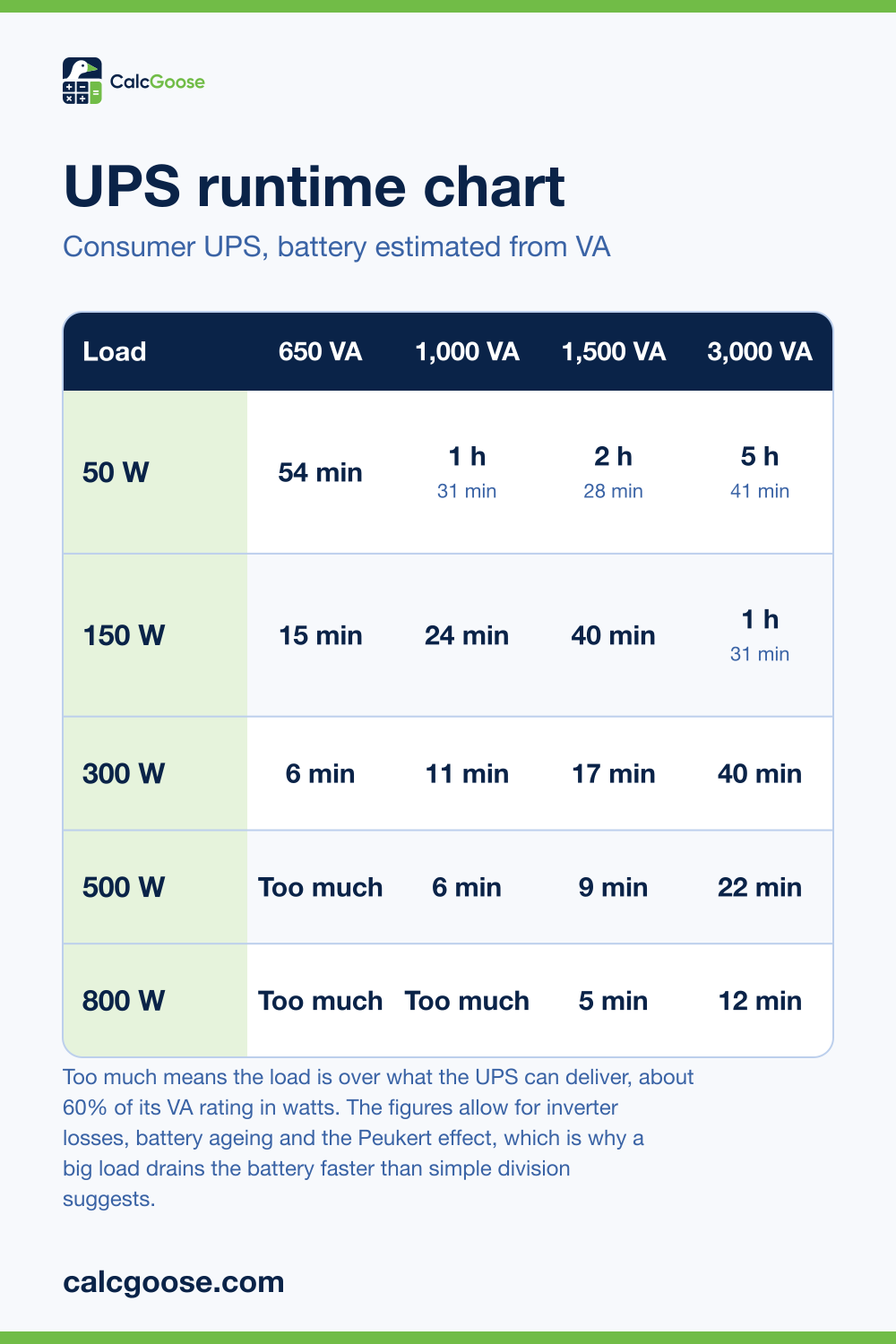
UPS runtime chart
How long a typical consumer UPS keeps common loads running, by its VA rating. The battery is estimated from the rating at 0.15 Wh per VA, exactly as the calculator does when you only know the VA rating.
| Load | 650 VA | 1,000 VA | 1,500 VA | 3,000 VA |
|---|---|---|---|---|
| 50 W | 54 min | 1 h31 min | 2 h28 min | 5 h41 min |
| 150 W | 15 min | 24 min | 40 min | 1 h31 min |
| 300 W | 6 min | 11 min | 17 min | 40 min |
| 500 W | Too much | 6 min | 9 min | 22 min |
| 800 W | Too much | Too much | 5 min | 12 min |
Too much means the load is over what the UPS can deliver, about 60% of its VA rating in watts. The figures allow for inverter losses, battery ageing and the Peukert effect, which is why a big load drains the battery faster than simple division suggests.
Assumptions and limits
Everything this calculator quietly assumes on your behalf. If one of these does not match your situation, the answer will be off.
- Peukert exponent of 1.2 and a 20-hour capacity rating, which suits the sealed lead-acid cells in consumer and small rack UPS units. Lithium UPS units behave much more linearly and will outperform this estimate.
- Inverter efficiency of 85%. Cheap standby units run a little worse; good online double-conversion units a little better.
- A 0.9 factor for battery age and reserve. A brand-new battery beats this estimate; a four-year-old one falls short of it, sometimes badly.
- The VA-only estimate uses 0.15 Wh of battery per VA of rating, which matches typical consumer units from the APC Back-UPS and CyberPower CP series. It is the weakest input in the whole calculation, which is why the class and battery-label options exist.
- The UPS class figures describe the cartridge a class of unit typically ships with, 12V 7Ah for a 600–750VA consumer unit, 24V 9Ah for a consumer 1500VA, 24V 17Ah for a line-interactive 1500VA. They are class typicals rather than per-model spec-sheet data, so the label on your own cartridge is always more reliable.
- Manufacturer runtime tools (the APC, Eaton and CyberPower calculators people look for) use the exact battery in the exact model, which makes them more accurate for that unit. Many also publish figures for a new battery under laboratory conditions, so a four-year-old UPS in a warm cupboard will not match them.
- A power factor of 0.6 converts VA to watts. Newer sine-wave units are often rated at 0.9, which means more usable watts than shown here. Check the label.
- The UPS inverter's own idle consumption (typically 5–20 W) is ignored. At very light loads this makes the estimate optimistic, which is why runtime is capped at 12 hours.
- Runtime is measured from a fully charged battery. A UPS that has just handled an outage may need 4–8 hours to recharge.
- This estimates a single UPS with its internal battery. External battery packs add capacity roughly proportionally.
Frequently asked questions
How long will a 1500VA UPS run a router?
Roughly three to six hours for a 25 W router and modem, depending on the age of the battery. Small loads are where a UPS gives its best value, because Peukert losses are negligible at low current. Adding a laptop to the same UPS drops it to somewhere between an hour and ninety minutes, depending on how hungry the laptop is.
How long will a 1500VA UPS run a PC?
A 1500VA consumer UPS holds a typical 300–400 W desktop for about twelve to sixteen minutes. A gaming PC pulling 450 W under load gets about ten. UPS units of this class are designed to cover a graceful shutdown or a brief flicker, not to let you keep playing.
What is the difference between VA and watts?
VA is volts times amps, the apparent power the UPS can pass. Watts is the real power actually delivered, and it is always lower because current and voltage are not perfectly in step. Consumer UPS units run about 0.6 watts per VA, so a 1500VA unit is really a 900 W unit; newer sine-wave models are often 0.9.
Can a UPS run a refrigerator?
Only if the UPS is big enough to survive the compressor start surge, which lands somewhere between 1,200 and 2,200 W on a household fridge. A 1500VA consumer unit is rated for 900 W and will usually trip on that. A 3000VA pure sine unit rides the surge out and then holds a 150–200 W fridge for roughly an hour of compressor time, which stretches further in practice because the compressor cycles rather than running flat out. For a real outage a power station or a generator is still the better tool, since a UPS is built to bridge seconds rather than hours.
How long will a 1000VA UPS last?
About 24 minutes on a 150 W load for a consumer 1000VA unit, or roughly 5 minutes at its full 600 W rating. A 650VA unit on the same 150 W load manages about 15 minutes and a 1500VA about 40. Runtime rises faster than the VA rating does, because a lighter relative load also loses less to Peukert effects.
Why does the APC runtime calculator give a different answer?
Because it knows the exact battery in the exact model and this calculator does not, unless you tell it. Manufacturer tools also tend to publish figures for a new battery at room temperature, which a three-year-old UPS in a warm cupboard will not match. Selecting your type of UPS above, or entering the cartridge label, closes most of the gap.
What is the formula for UPS runtime?
Runtime in hours is 20 × (Ah ÷ (amps × 20))^1.2, where amps is the load in watts divided by 0.85 times the battery voltage. That exponent is Peukert's law, which accounts for lead-acid batteries delivering less total energy the faster you drain them. The naive version, battery watt-hours divided by load, overstates runtime at high loads by three to four times.
How long do UPS batteries last?
Three to five years for the sealed lead-acid cartridges in consumer units, and less in a warm cupboard. Heat is what kills them. Capacity fades gradually, so a five-year-old UPS may give you a third of its original runtime while still showing a green light. Most units have a self-test that will tell you when it is time.
Do lithium UPS batteries last longer than lead-acid?
Longer in both senses of the word. A LiFePO4 cartridge is barely touched by the Peukert effect, with an exponent near 1.05 against the 1.2 this calculator assumes for sealed lead-acid, so a lithium unit under a heavy load beats the runtime shown here rather than falling short of it. It also survives thousands of cycles instead of a few hundred, which is why manufacturers quote around ten years of battery life for lithium models against three to five for lead-acid. If your UPS is lithium, read the minutes above as a floor.
What size UPS do I need for a gaming PC?
Measure the actual draw first. Most gaming PCs pull 300–500 W under load regardless of the power supply rating. A 1500VA pure sine wave unit covers that with room to spare for a monitor. Pure sine matters here, active-PFC power supplies can refuse to run on the stepped-wave output of cheaper units.
Why is my real runtime shorter than the calculator says?
Usually an old battery, which can lose half its capacity in four years. The other common cause is loading the UPS closer to its rating than you think, power supply labels overstate real draw, but monitors, external drives and a second PC add up fast. Plug a power meter into the UPS input to find out for certain.
Guides on this
The reasoning behind the number, and the decisions it does not make for you.
Related calculators
- Off-Grid Solar & Battery Calculator Power & Off-Grid How many solar panels and batteries you need, from what you actually run in a day.
- Wire Gauge Calculator Power & Off-Grid Cable size from amps, distance and voltage, in AWG or mm², with voltage drop, resistance and parallel runs.
- EV Charging Calculator Power & Off-Grid How long a charge takes, what it costs at home, and how much you save against filling a fuel tank.
- Watts Calculator Generators Convert between watts, amps, volts and kilowatt-hours, on DC, single-phase or three-phase.
- Generator Size Calculator Generators Size it from your appliances, or from your floor area and panel, with the surge load included.
Share this calculator
Found the number you needed? Send it to whoever asked you for it.